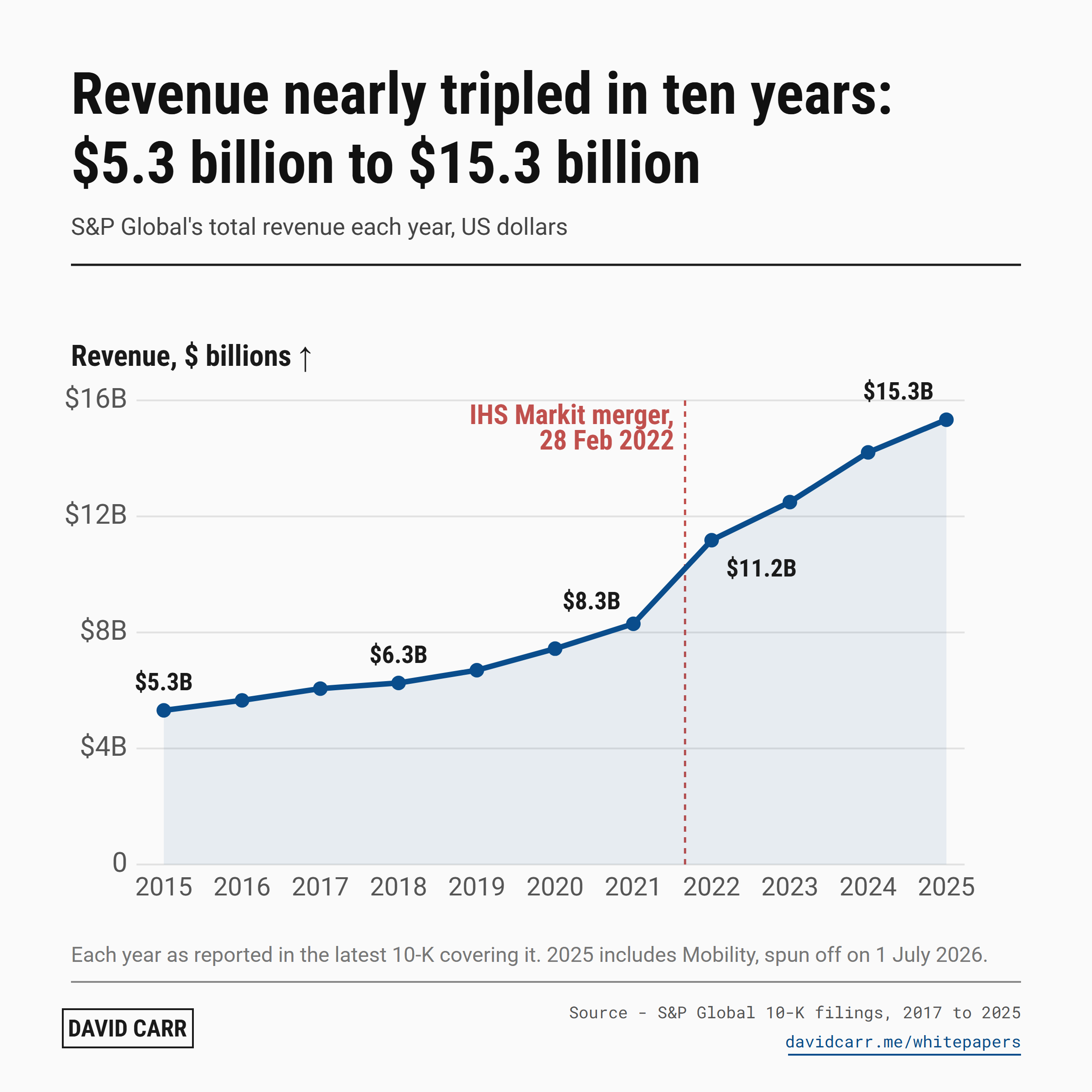
Revenue nearly tripled in ten years: $5.3 billion to $15.3 billion
- 2015: $5.3 billion
- 2021: $8.3 billion
- 2022: $11.2 billion, the first year with IHS Markit
- 2025: $15.3 billion
Growth was steady before the merger. The merger year added about $2.9 billion, and revenue has kept rising since.
Revenue as reported in each year's 10-K, via the SEC's XBRL data. 2025 still includes Mobility, which was spun off on 1 July 2026.
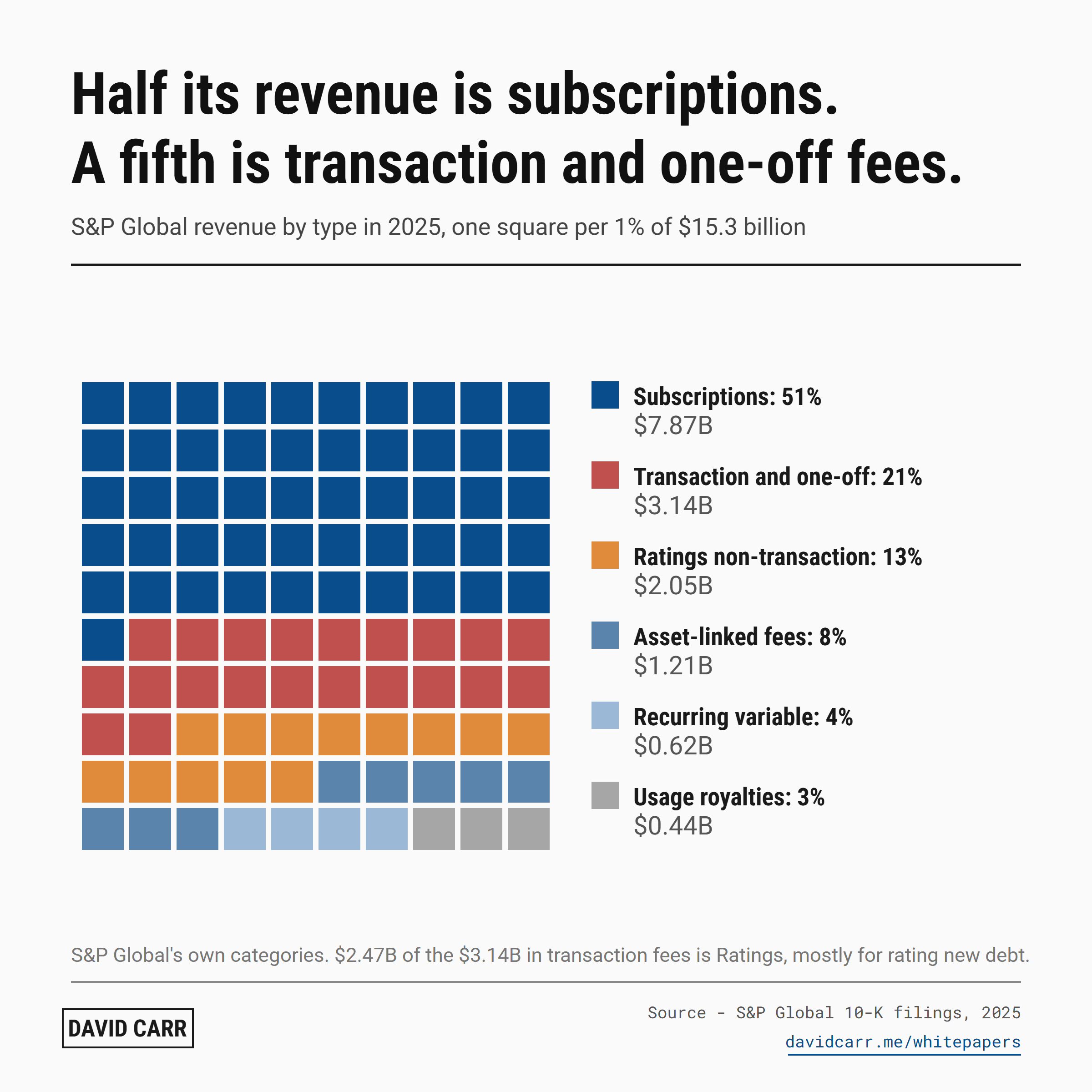
Half its revenue is subscriptions. A fifth is transaction and one-off fees.
- Subscriptions: 51%, $7.87 billion
- Transaction and one-off: 21%, $3.14 billion
- Ratings non-transaction fees: 13%, $2.05 billion
- Asset-linked fees from index funds: 8%, $1.21 billion
S&P Global sells data in several ways at once: by subscription, by the deal, and as a cut of the money tracking its indices.
The six categories are S&P Global's own, from the 2025 10-K.
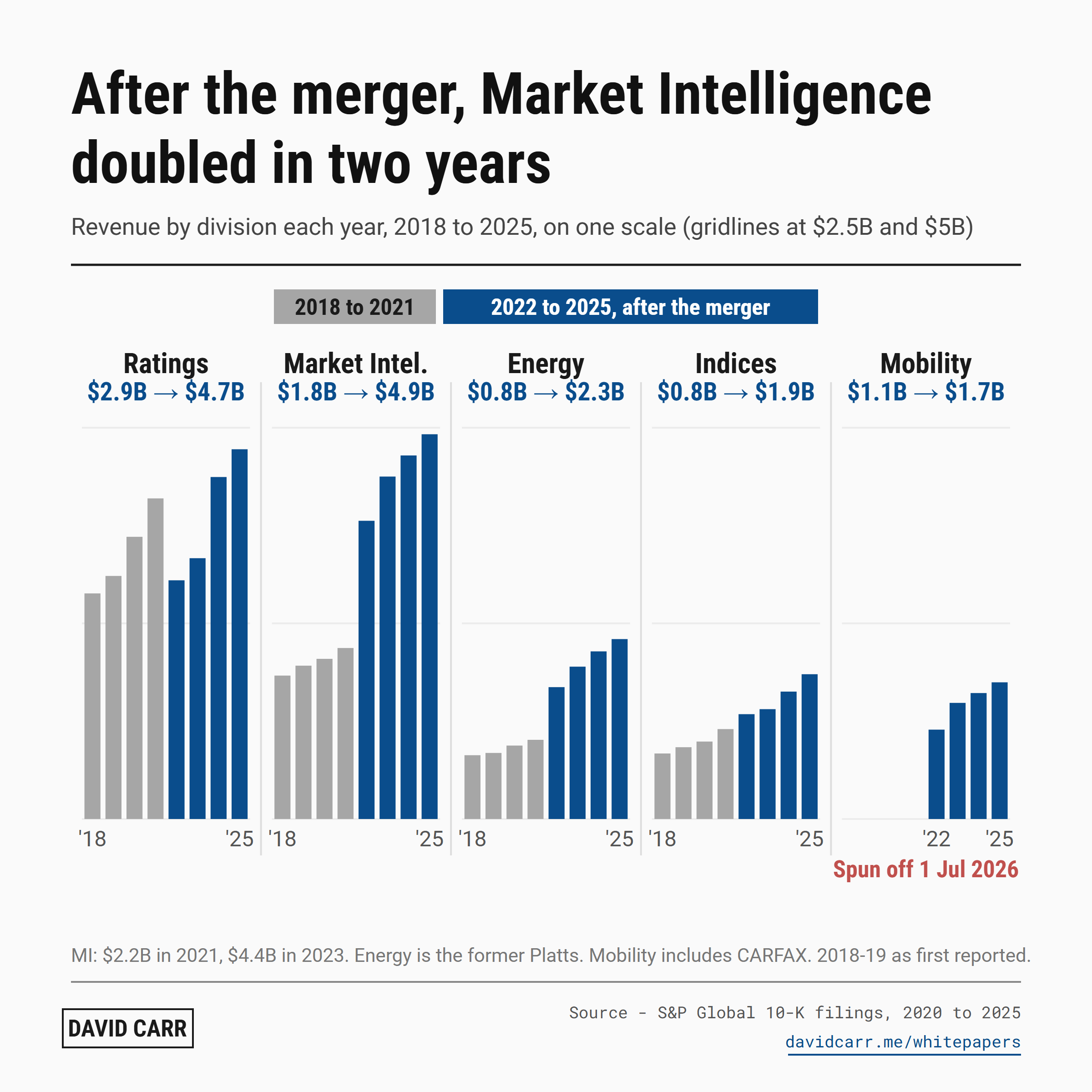
After the merger, Market Intelligence doubled in two years
- Market Intelligence: $2.2 billion (2021) to $4.4 billion (2023)
- Energy, the former Platts: $1.0 billion to $1.9 billion
- Mobility, home of CARFAX: $1.7 billion in 2025
- Ratings: $4.7 billion in 2025
IHS Markit brought data businesses that fitted into Market Intelligence and Commodity Insights, and a new automotive one. Engineering Solutions was sold in May 2023. Mobility left as its own listed company, Mobility Global, in July 2026.
Division revenue from the 2020, 2022, 2023 and 2025 10-Ks. 2018-19 are as first reported, before a small 2022 reshuffle between two divisions. Commodity Insights is now called S&P Global Energy.
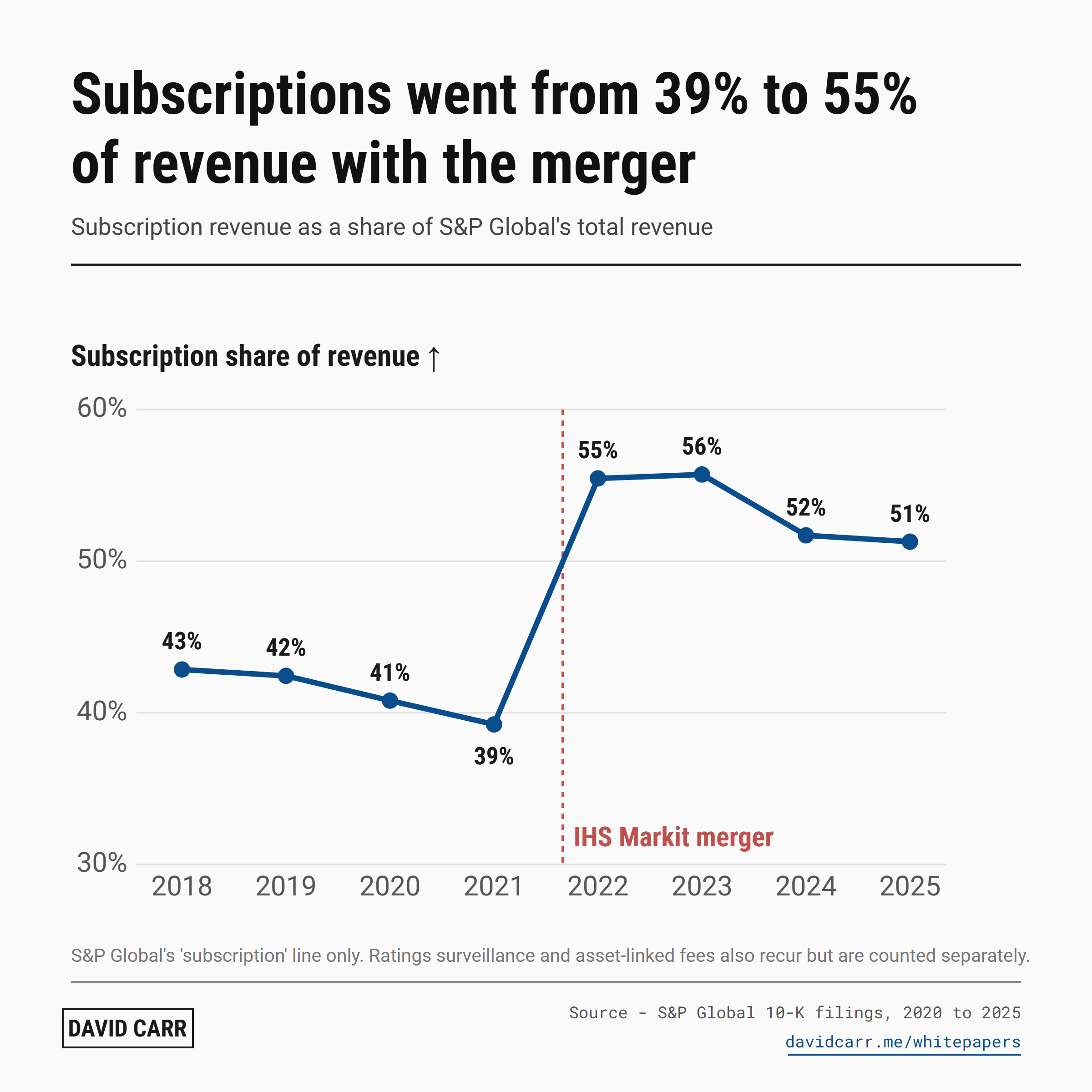
Subscriptions went from 39% to 55% of revenue with the merger
- 2018: 43%
- 2021: 39%
- 2022: 55%
- 2025: 51%
IHS Markit sold mostly subscriptions, so the merger made S&P Global less tied to how much debt gets issued in a year. The share has eased since, as ratings fees came back.
S&P Global's "subscription" line divided by total revenue. From the 2020, 2022 and 2025 10-Ks.
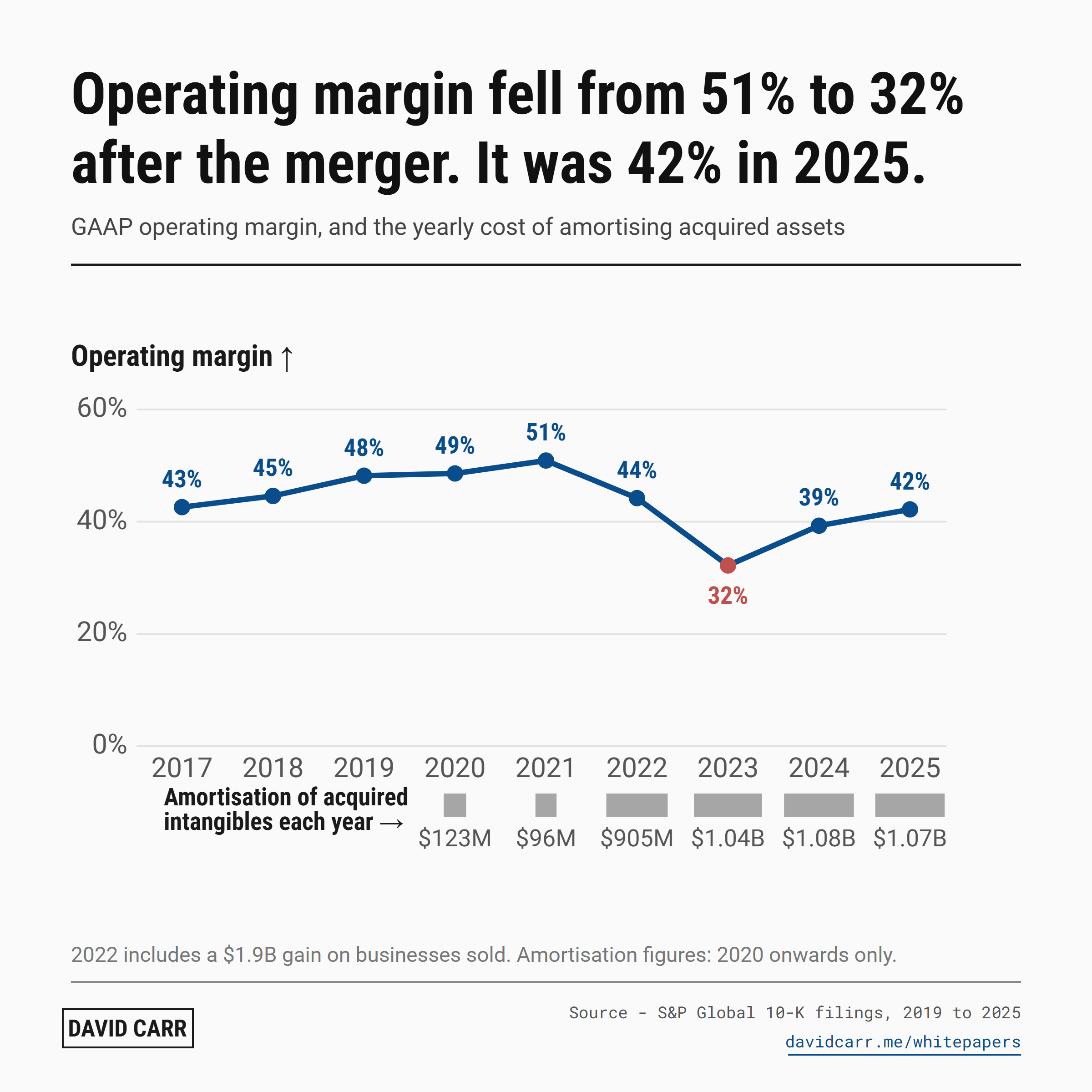
Operating margin fell from 51% to 32% after the merger. It was 42% in 2025.
- 2021: 51%
- 2023: 32%
- 2025: 42%
- Amortisation of acquired intangibles: $96 million in 2021, $1.07 billion in 2025
Much of the drop is accounting. Buying IHS Markit added about $1 billion a year of amortisation, plus merger costs in the first years.
GAAP operating profit over revenue, from the 10-Ks. 2022 includes a $1.9 billion gain on businesses sold (2022 10-K). S&P Global also reports adjusted margins; they aren't used here.
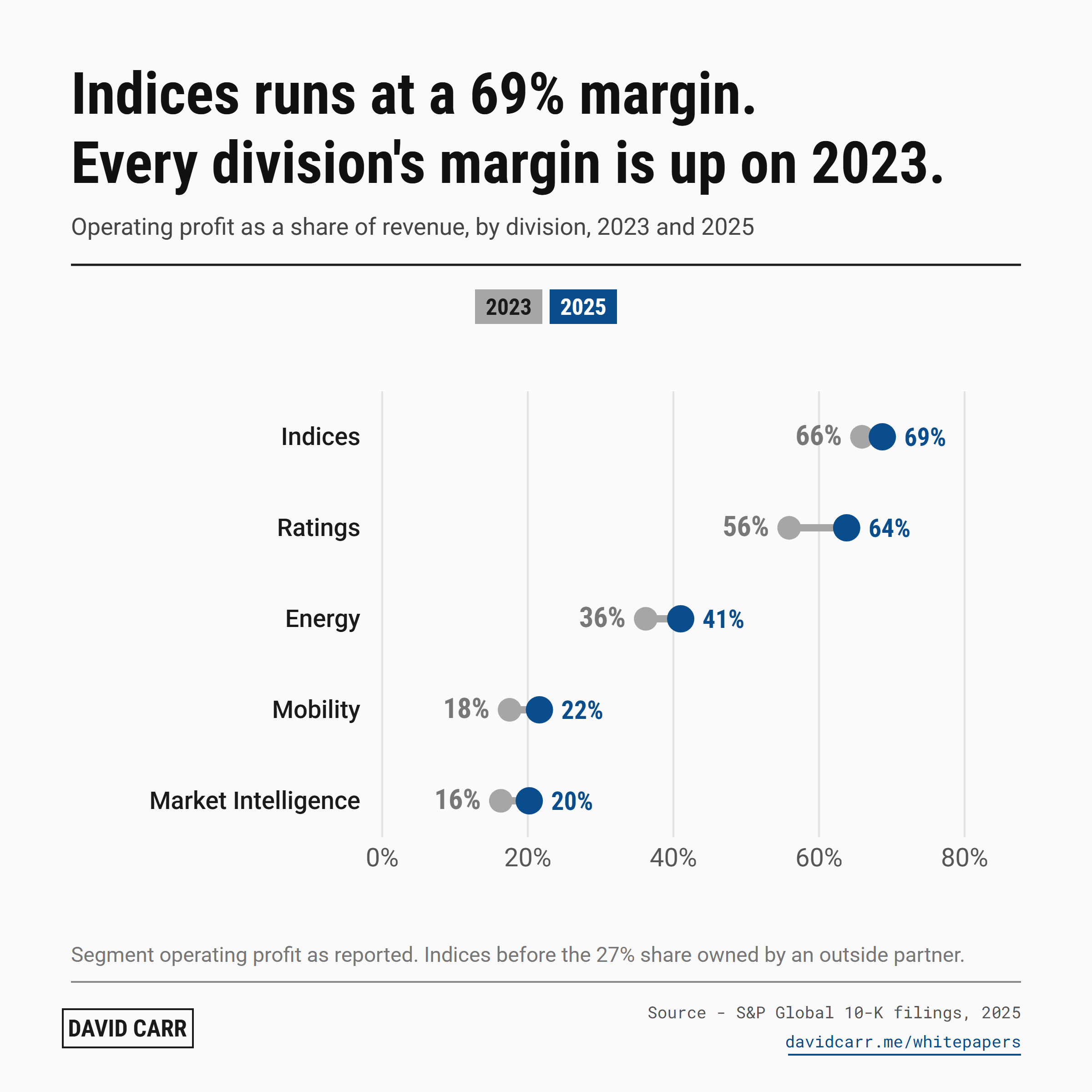
Indices runs at a 69% margin. Every division's margin is up on 2023.
- Indices: 66% to 69%
- Ratings: 56% to 64%
- Energy: 36% to 41%
- Mobility: 18% to 22%
- Market Intelligence: 16% to 20%
Running an index costs little once it exists. Market Intelligence carries much of the merger's amortisation, which pulls its margin down.
Segment operating profit over segment revenue, 2025 10-K. An outside partner owns 27% of S&P Dow Jones Indices; the margin is before its share.
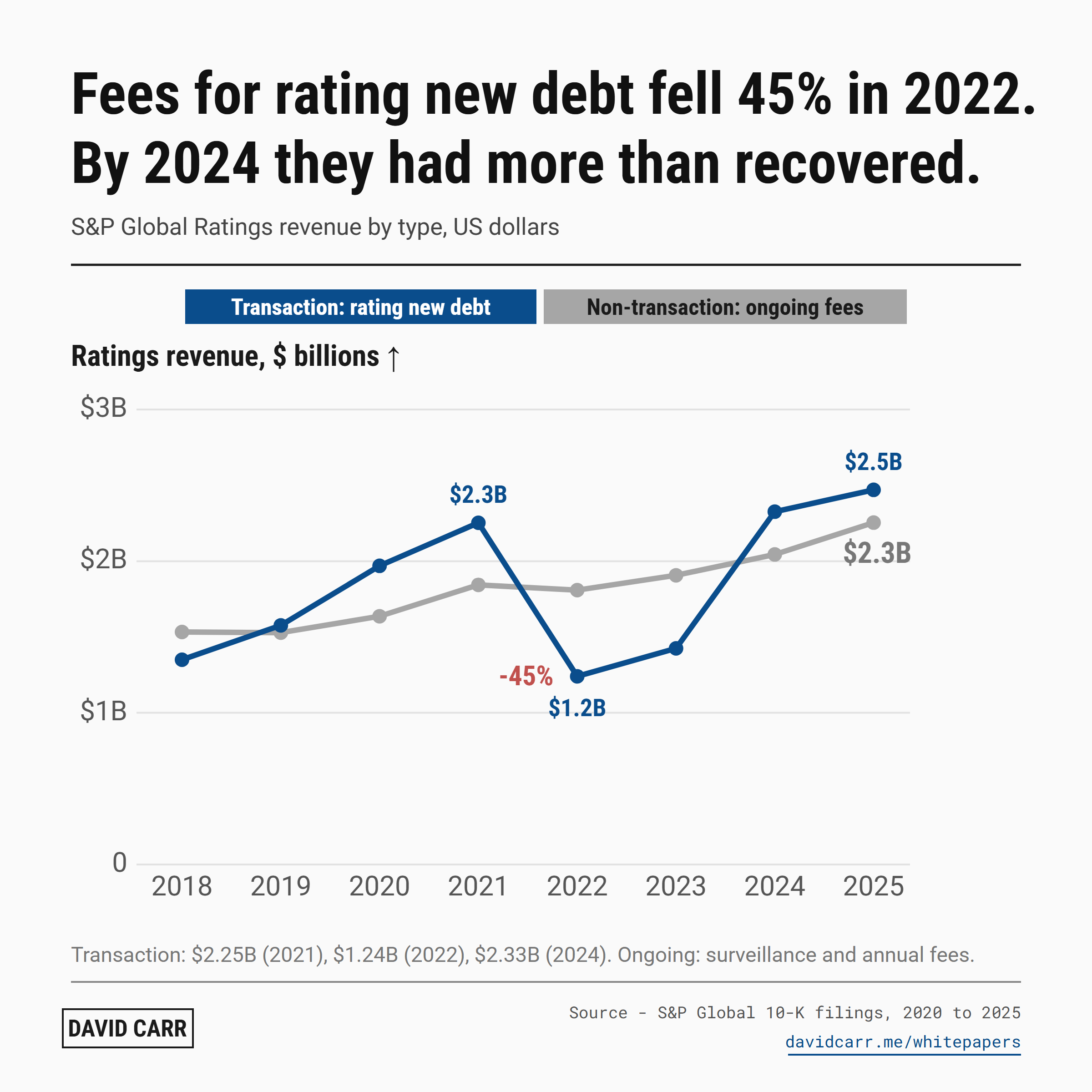
Fees for rating new debt fell 45% in 2022. By 2024 they had more than recovered.
- 2021: $2.25 billion
- 2022: $1.24 billion
- 2024: $2.33 billion
- 2025: $2.47 billion
Ratings transaction fees follow new bond and loan issuance, which fell sharply in 2022. The ongoing fees for monitoring existing ratings held steady through it.
Ratings transaction and non-transaction revenue from the 2020, 2022 and 2025 10-Ks.
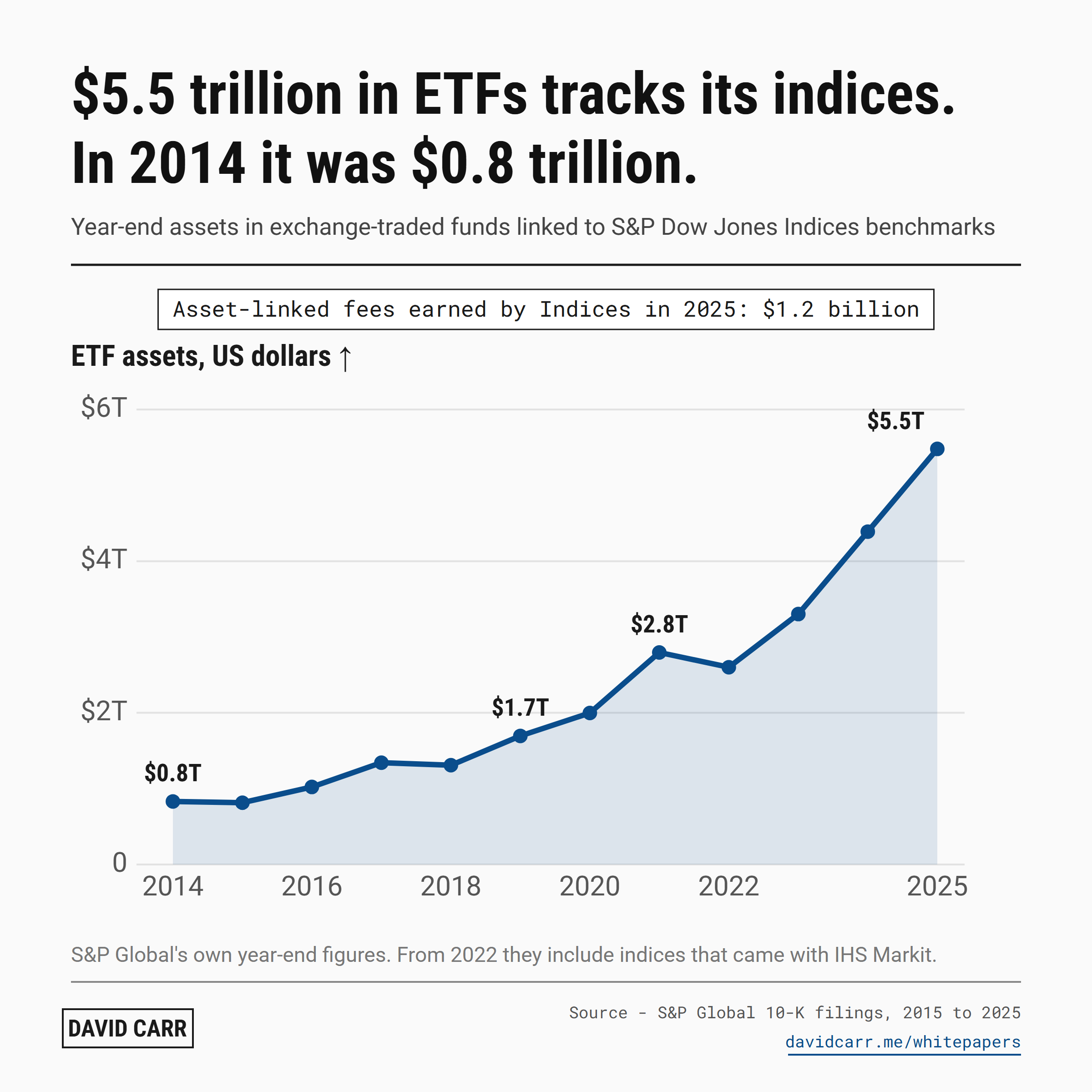
$5.5 trillion in ETFs tracks its indices. In 2014 it was $0.8 trillion.
- 2014: $0.83 trillion
- 2019: $1.70 trillion
- 2021: $2.80 trillion
- 2025: $5.48 trillion
S&P Dow Jones Indices runs the S&P 500 and the Dow. Funds that track its indices pay fees linked to their assets, which brought in $1.2 billion in 2025.
Year-end ETF assets linked to its indices, as stated in each 10-K, for example 2016 and 2025. From 2022 the figure includes indices that came with IHS Markit.
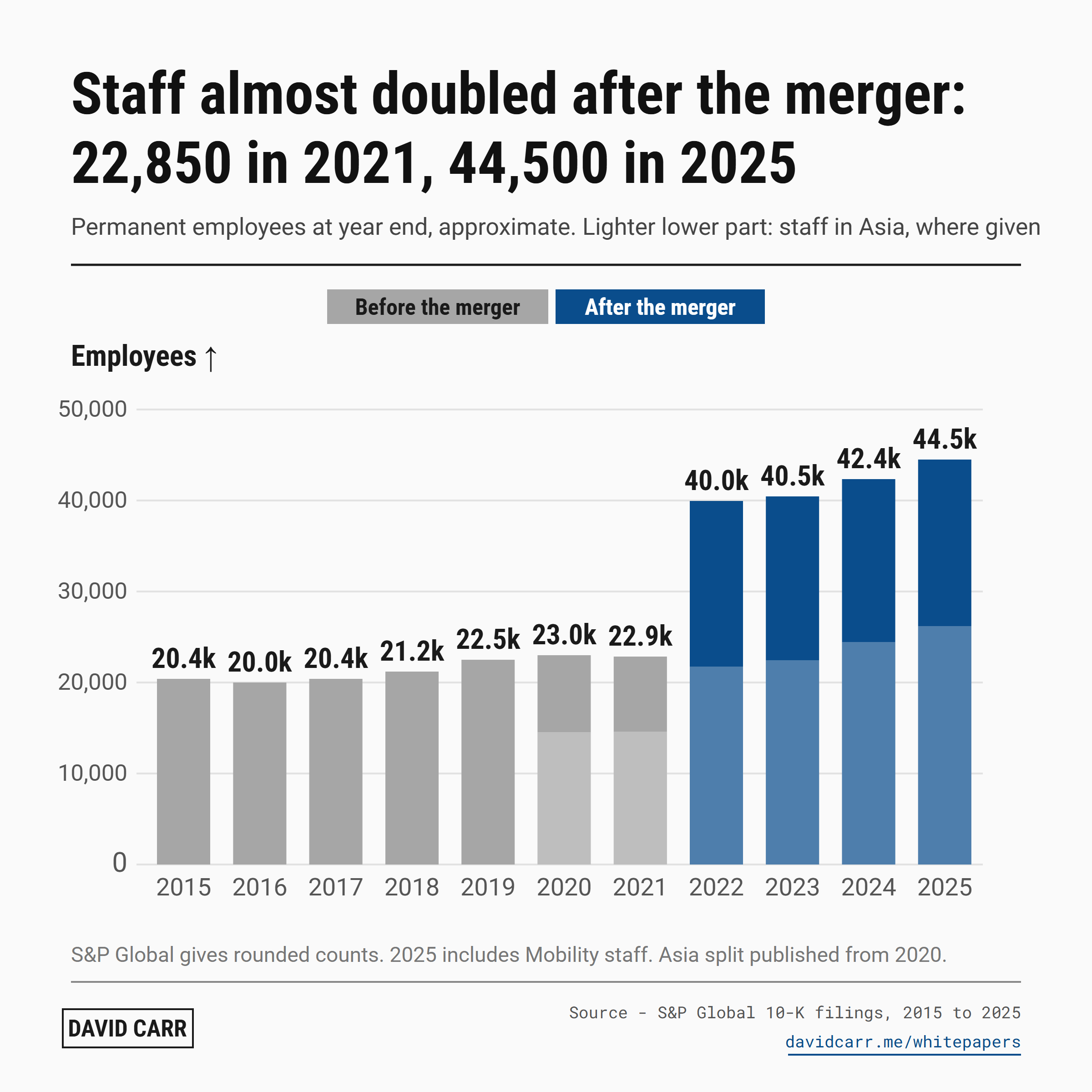
Staff almost doubled after the merger: 22,850 in 2021, 44,500 in 2025
- 2015: 20,400
- 2021: 22,850
- 2022: 39,950
- 2025: 44,500
Headcount barely moved for six years, then jumped with IHS Markit. It has grown by about 4,500 since.
Approximate permanent employees at year end, as each 10-K states it. 2025 includes Mobility staff, who left with the spin-off.
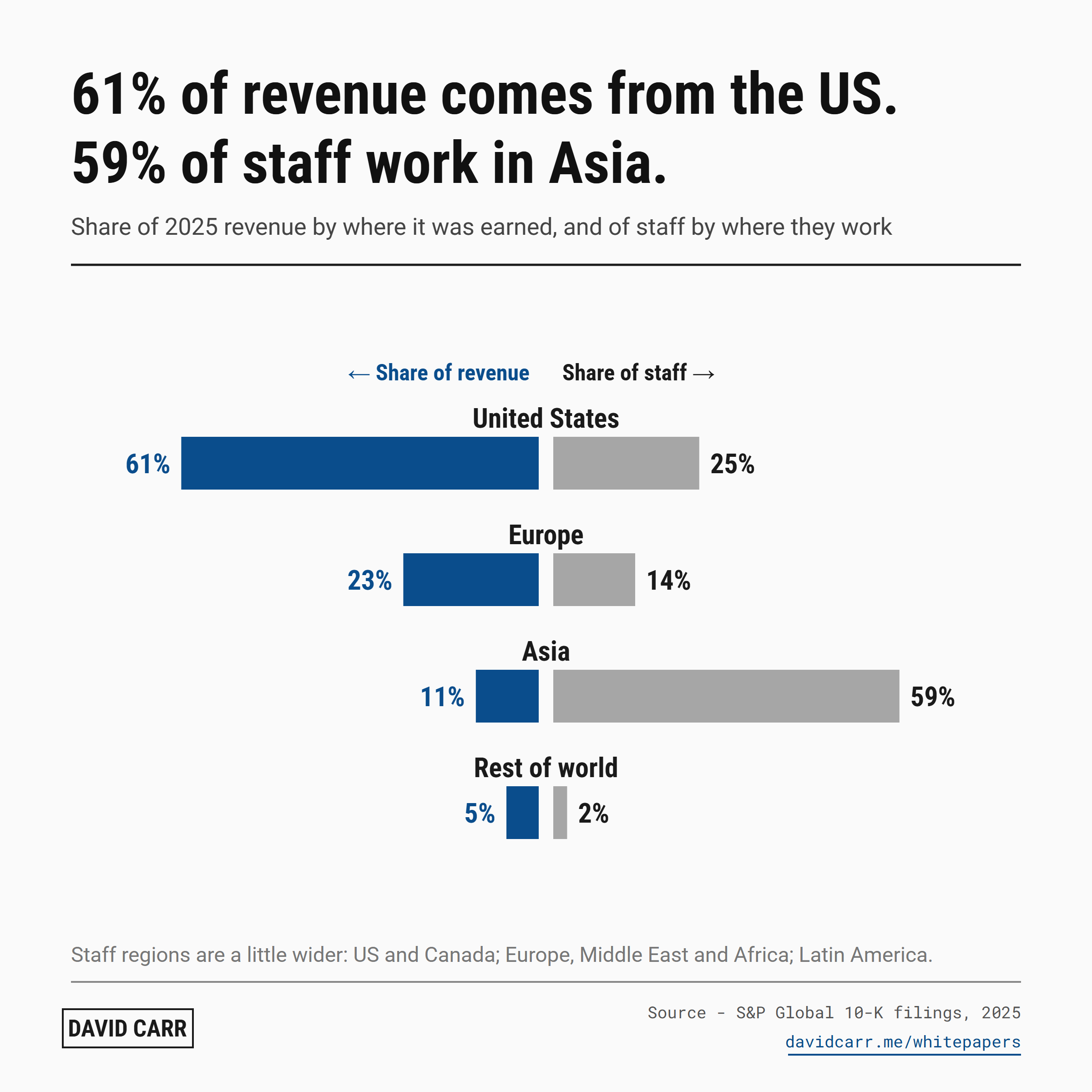
61% of revenue comes from the US. 59% of staff work in Asia.
- Revenue: US 61%, Europe 23%, Asia 11%, rest of world 5%
- Staff: Asia 59%, US and Canada 25%, Europe, Middle East and Africa 14%, Latin America 2%
Most of the revenue comes from customers in the US and Europe. Most of the people work in Asia.
Revenue by region and staff by region from the 2025 10-K. The two use slightly different regions.
Method, caveats and sources
The short answer. S&P Global made $15.3 billion in 2025, nearly three times its 2015 revenue. The 2022 IHS Markit merger doubled its staff and made subscriptions half the business. Its GAAP margin dipped to 32% after the deal and was back to 42% in 2025. Indices and Ratings earn the highest margins. Mobility, home of CARFAX, was spun off on 1 July 2026.
Sources. Everything comes from S&P Global's own SEC filings: 10-Ks for 2015 to 2025, the third-quarter 2026 10-Q, and the 8-K on the Mobility separation. Each year uses the latest 10-K that reports it, so restated figures win. Pulled 25 November 2026.
The merger. S&P Global completed its all-stock merger with IHS Markit on 28 February 2022, for consideration valued at $43.5 billion. As a condition of approval it sold CUSIP Global Services, LCD and its leveraged loan indices, and Base Chemicals. It sold Engineering Solutions to KKR in May 2023.
Mobility. Mobility Global (NYSE: MBGL) became a separate company on 1 July 2026, with one share for each S&P Global share. In 2026 filings it is reported as discontinued operations. For the nine months to September 2026, revenue from continuing operations was $11.07 billion, up 9% (Q3 2026 10-Q). The charts stop at 2025, when Mobility was still in.
Margins. All margins here are GAAP operating profit over revenue. S&P Global also reports adjusted figures that strip out amortisation and one-off costs; those are higher and are not used.
Staff. Rounded year-end counts of permanent employees from each 10-K. The regions changed from 2022: "U.S." became "U.S. and Canada".
Also: Stripe, Mastercard and PitchBook.