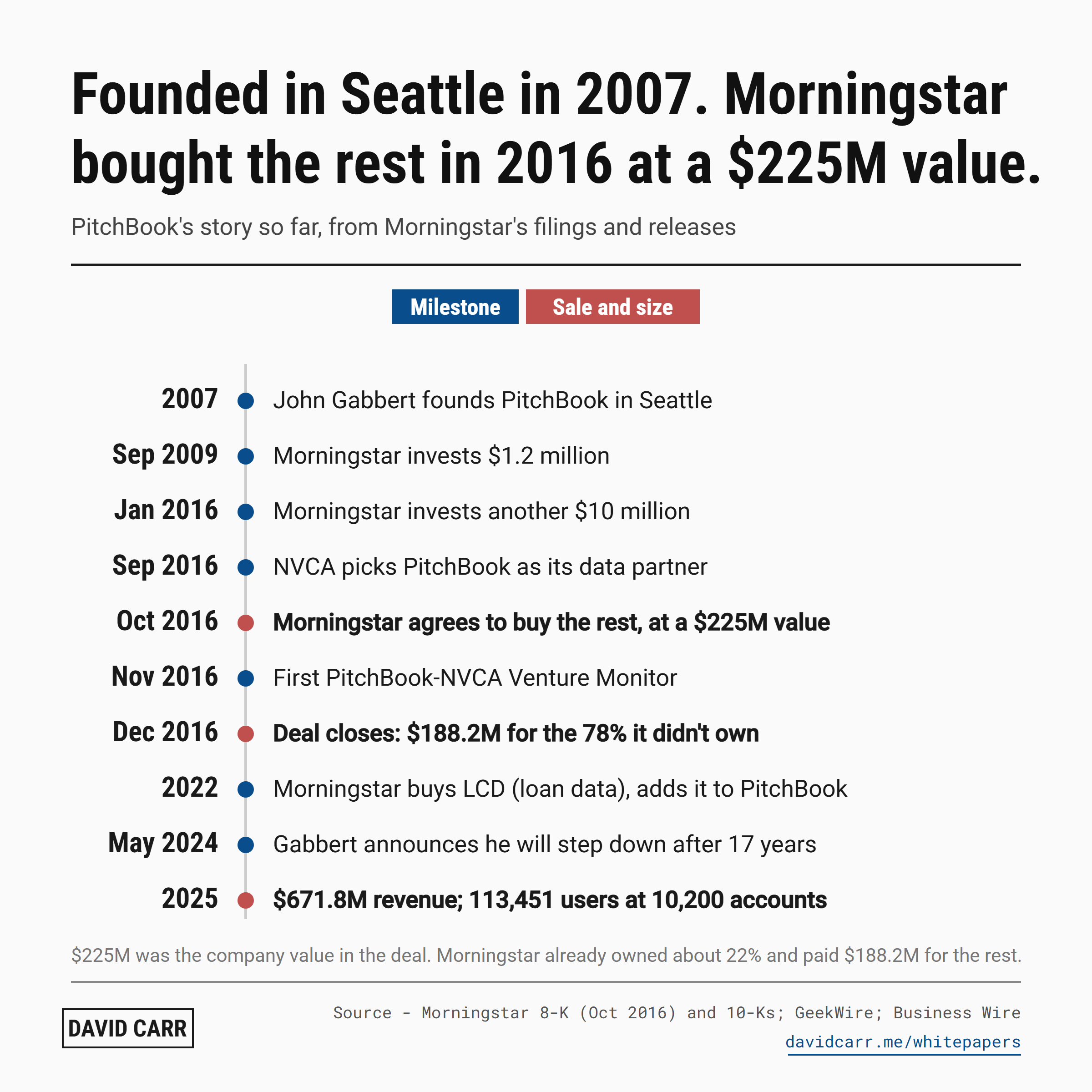
Founded in Seattle in 2007. Morningstar bought the rest in 2016, valuing it at $225 million.
- 2007: John Gabbert founds PitchBook
- 2009 and 2016: Morningstar invests $1.2M, then $10M
- October 2016: Morningstar agrees to buy the rest, valuing it at $225M
- Late 2016: PitchBook becomes the data partner for the US venture industry body, the NVCA
- May 2024: Gabbert says he will step down after 17 years
When the deal was agreed, PitchBook had about 300 staff and $31.1 million a year in revenue. Morningstar now calls it one of its five business segments.
Deal terms from Morningstar's release and its 2018 annual report: $188.2M in cash for the 78% it did not already own.
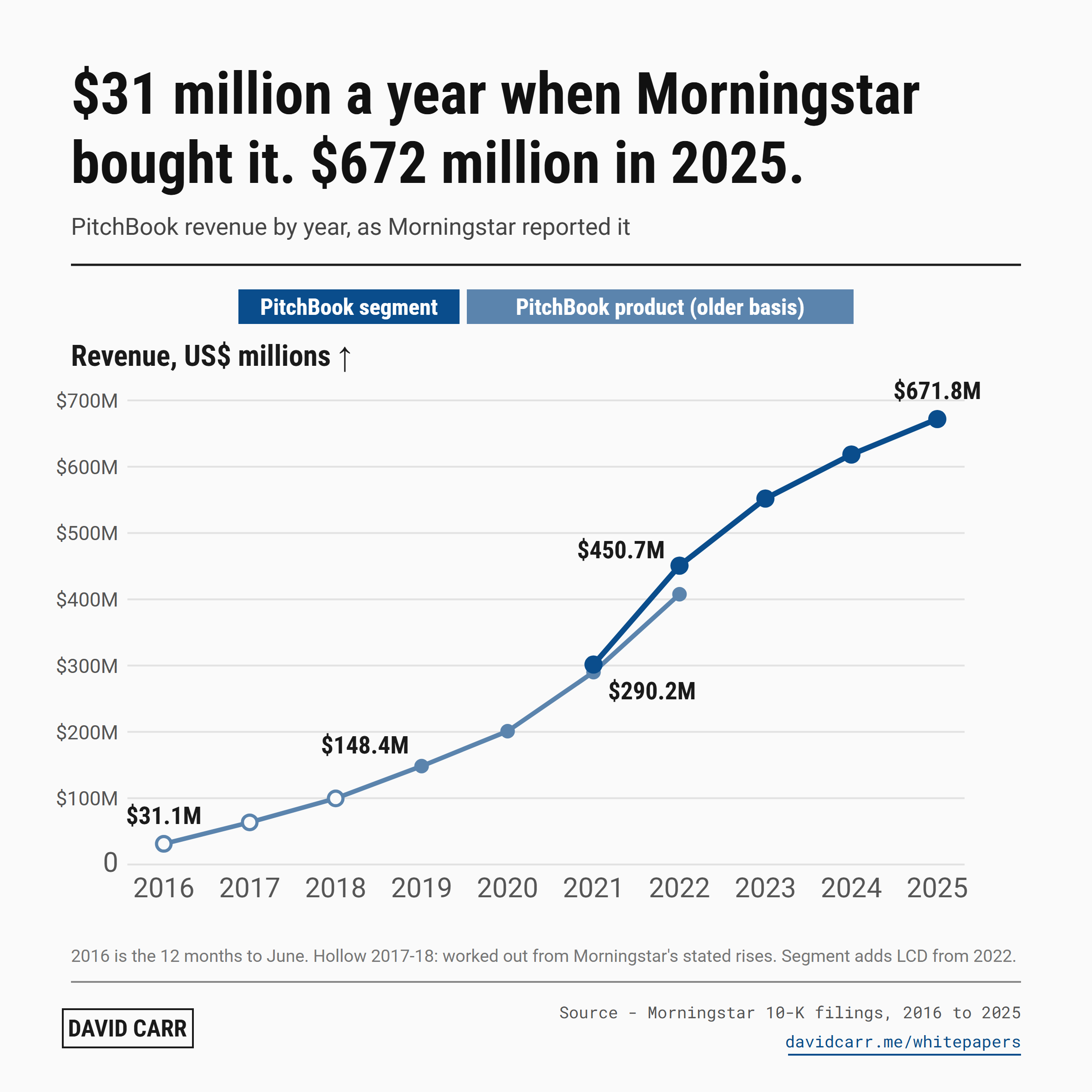
$31 million a year when Morningstar bought it. $672 million in 2025.
- 2016 (12 months to June): $31.1 million
- 2019: $148.4 million
- 2021: $290.2 million
- 2023: $551.9 million
- 2025: $671.8 million
About 22 times bigger in under ten years. Part of that since 2022 is LCD, a loan-data business Morningstar bought and put inside PitchBook.
From Morningstar's annual reports, e.g. 2021, 2023, 2025. 2017 and 2018 are worked out from the rises Morningstar stated.
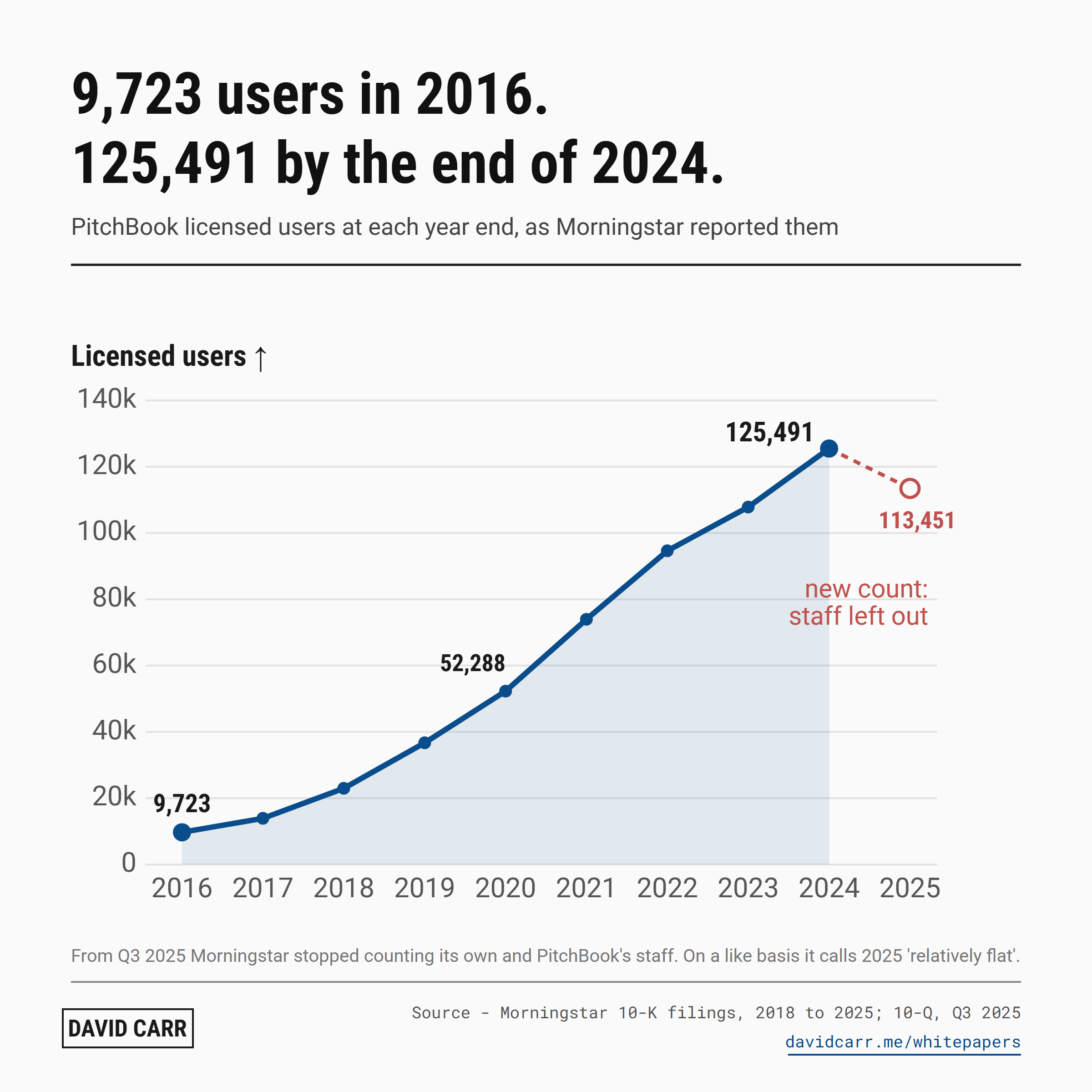
9,723 users in 2016. 125,491 by the end of 2024.
- 2016: 9,723
- 2019: 36,695
- 2021: 73,940
- 2024: 125,491
- 2025: 113,451, on a new count
Users grew by at least 13% every year to 2024. Pricing is mostly per user, so this is the number that drives revenue.
In Q3 2025 Morningstar stopped counting its own and PitchBook's staff. On a like basis it called 2025 "relatively flat".
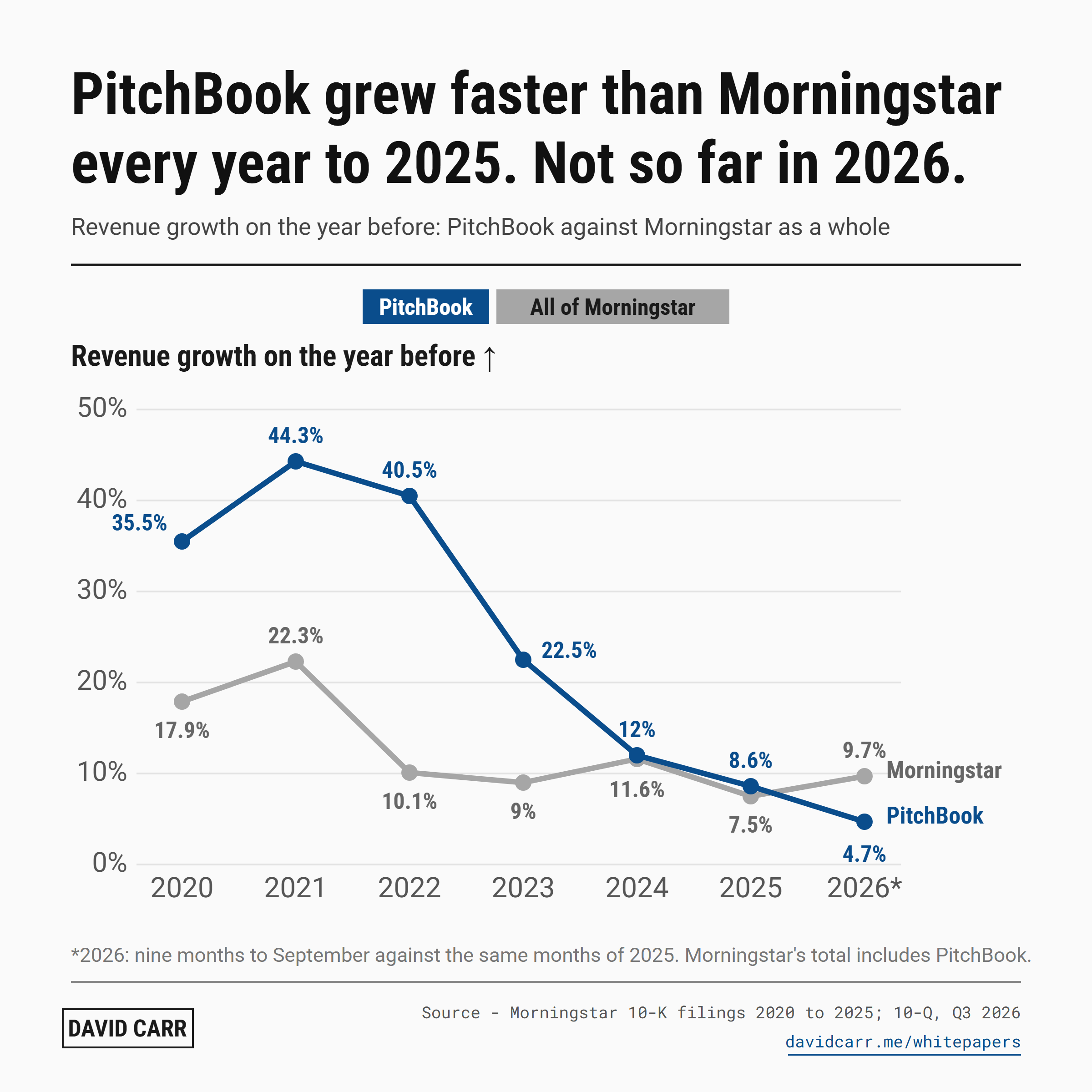
PitchBook grew faster than Morningstar every year to 2025. Not so far in 2026.
- 2021: PitchBook 44.3%, Morningstar 22.3%
- 2023: 22.5% against 9%
- 2025: 8.6% against 7.5%
- 2026 to September: 4.7% against 9.7%
Morningstar says PitchBook's platform growth slowed in 2026, with more customers leaving among corporate and venture capital firms. Its smaller direct-data business is still growing strongly.
Morningstar's total includes PitchBook. Growth worked out from the revenue each annual report gives.
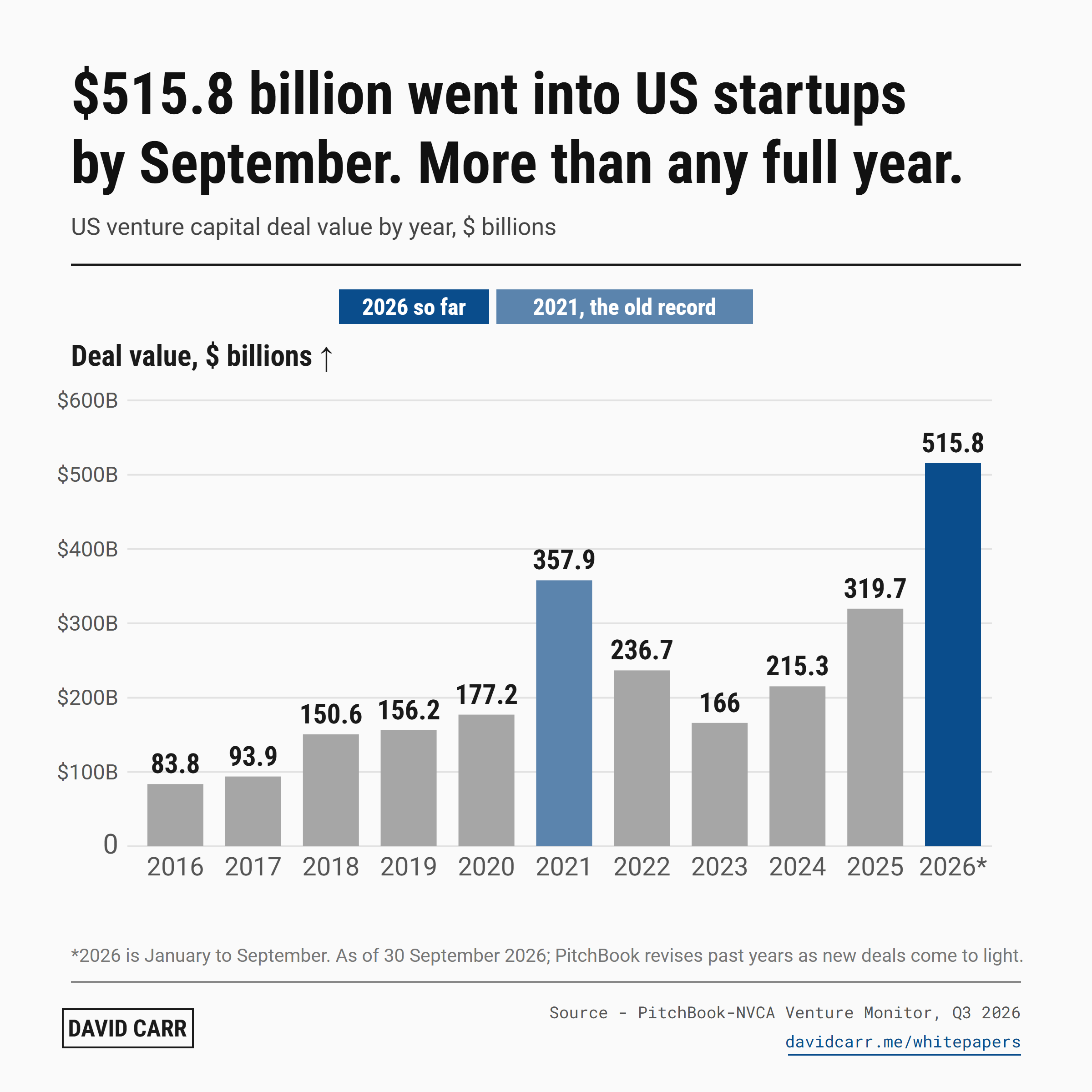
$515.8 billion went into US startups by September. More than any full year.
- 2016: $83.8 billion
- 2021: $357.9 billion, the old record
- 2023: $166 billion
- 2025: $319.7 billion
- 2026 to September: $515.8 billion
Almost all of it came in the first half: two quarters that were each the biggest PitchBook has recorded. The third quarter fell to $98.4 billion.
From the PitchBook-NVCA Venture Monitor, Q3 2026. PitchBook revises past years as deals surface.
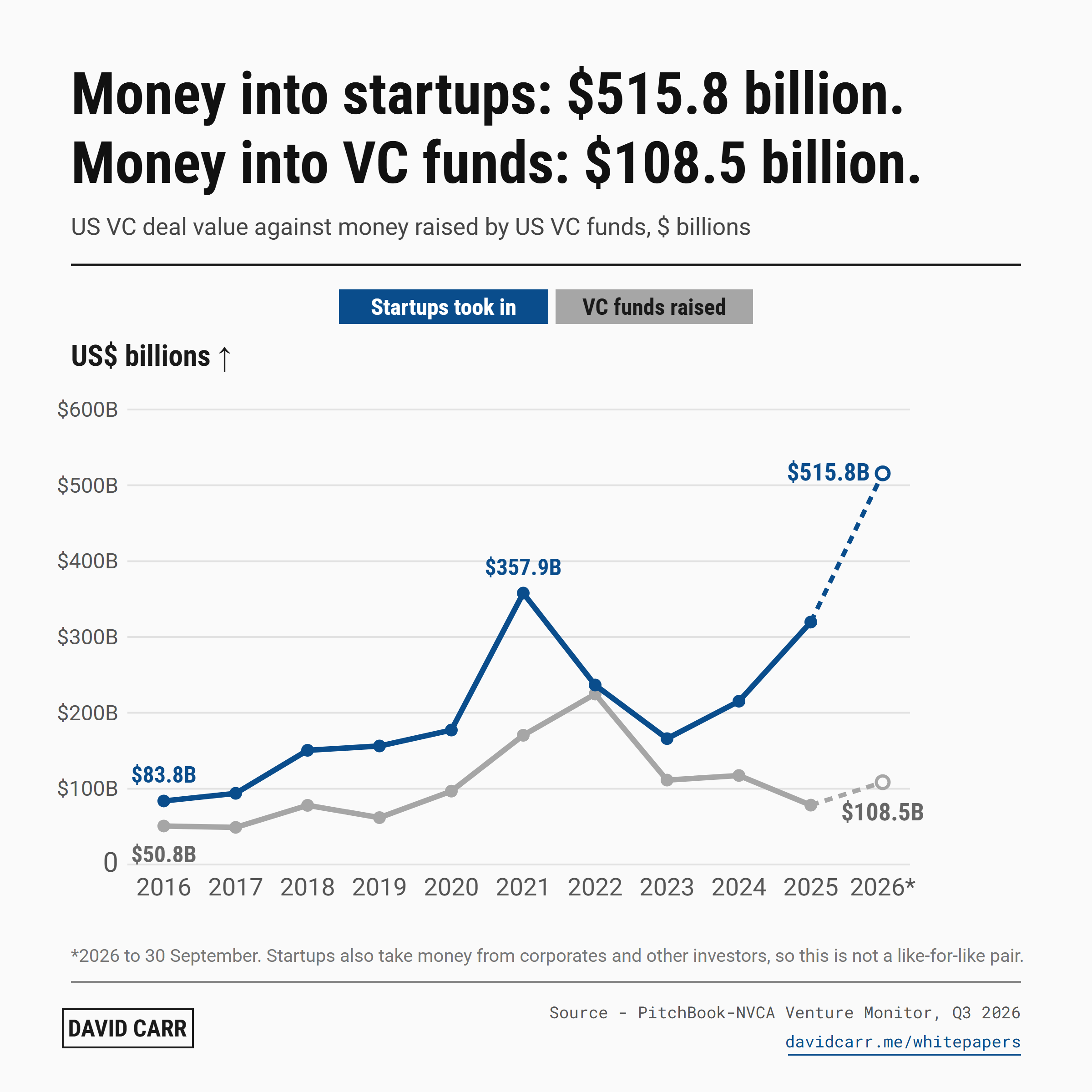
Money into startups: $515.8 billion. Money into VC funds: $108.5 billion.
- 2016: $83.8B into startups, $50.8B into funds
- 2022: funds raised $224.8B, their high
- 2025: $319.7B against $78.3B
- 2026 to September: $515.8B against $108.5B
Big funds take most of what is raised. Funds of $500 million or more took 78.1% of this year's money, but were 6% of the funds that closed.
Startups also take money from corporates and other investors, so the two lines aren't a like-for-like pair.
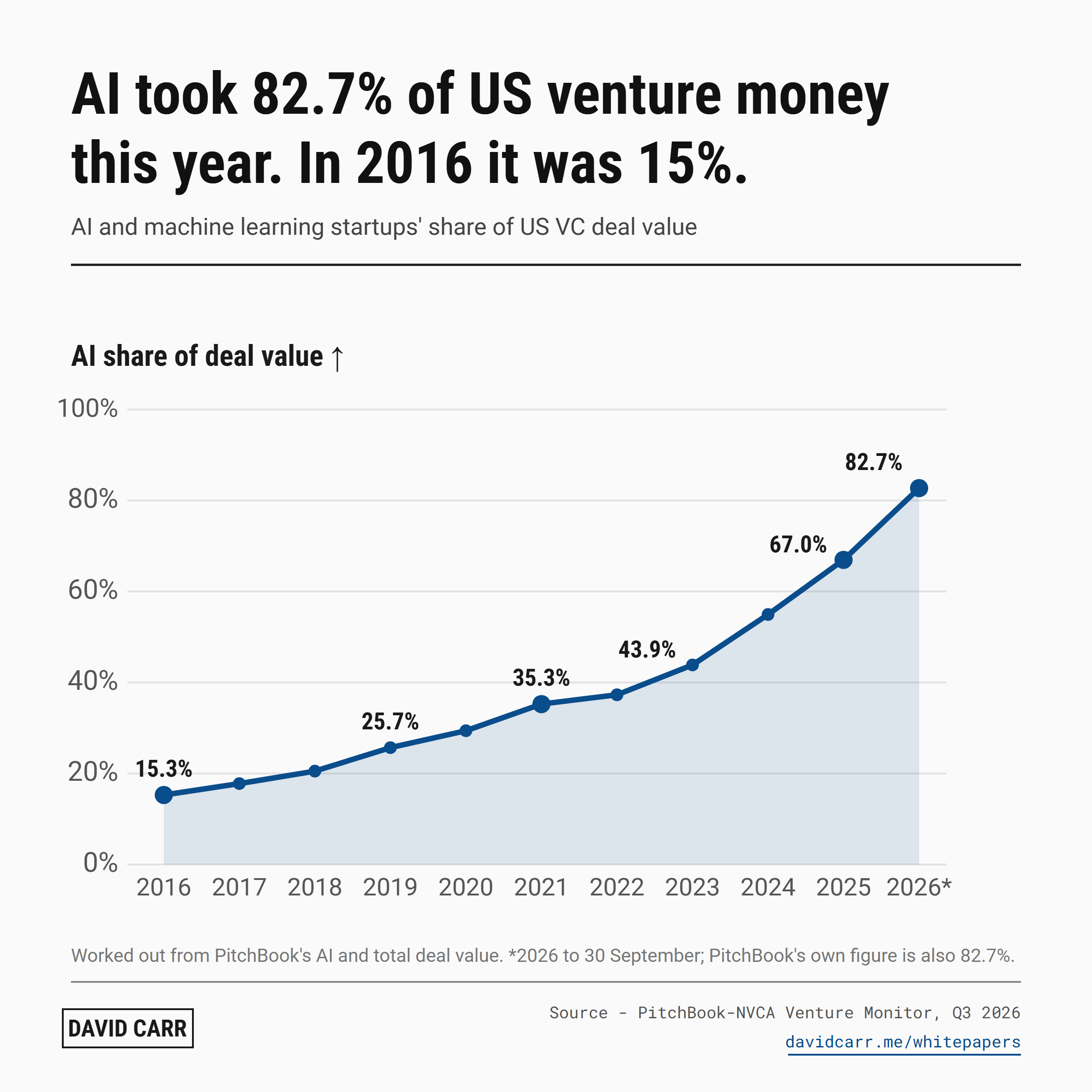
AI took 82.7% of US venture money this year. In 2016 it was 15%.
- 2016: 15.3%
- 2021: 35.3%
- 2023: 43.9%
- 2025: 67.0%
- 2026 to September: 82.7%
By number of deals it is 5,325 of 14,199, about 38%. A few very large rounds carry the value.
My division of PitchBook's AI and total deal value. For 2026 it matches PitchBook's own 82.7%.
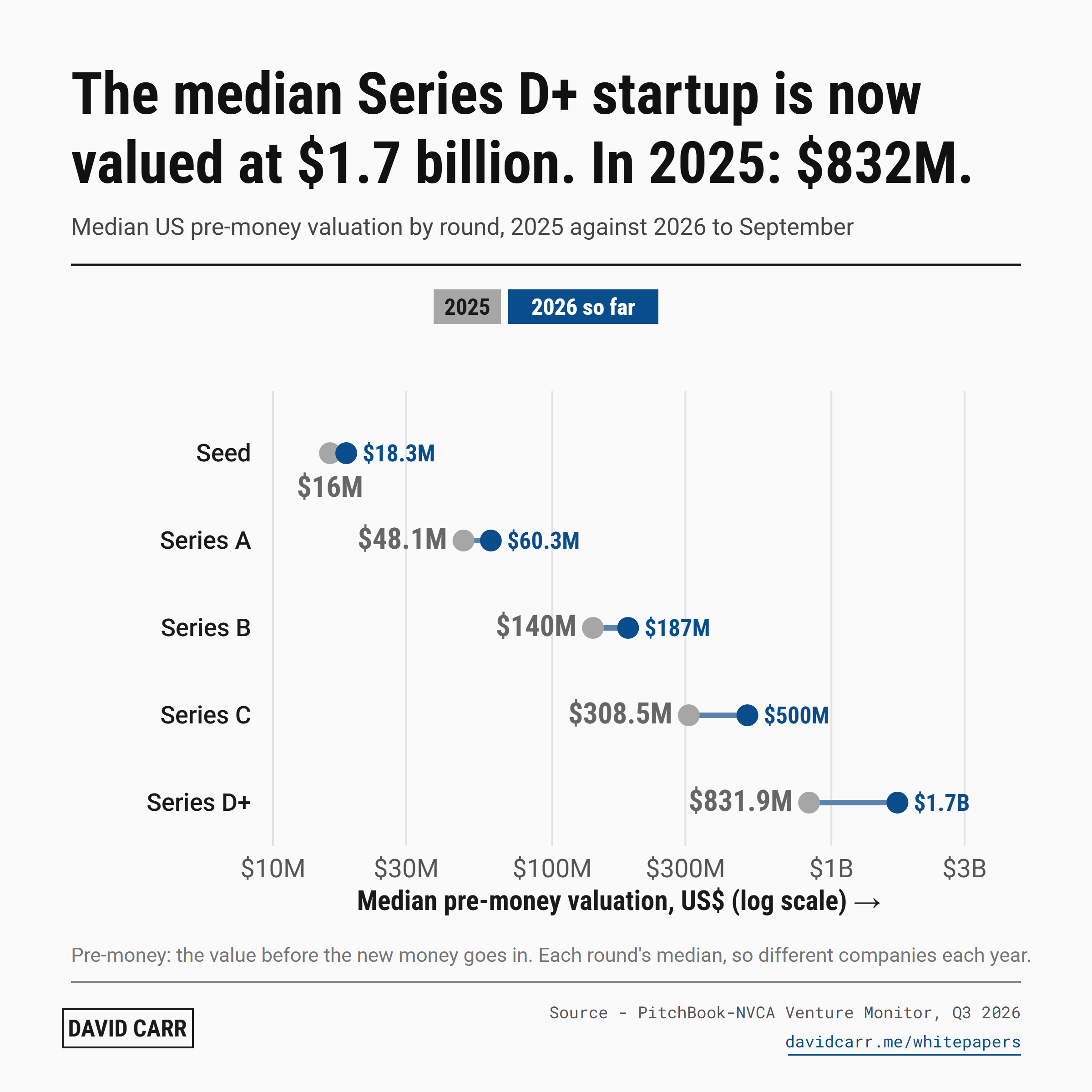
The median Series D+ startup is now valued at $1.7 billion. In 2025: $832M.
- Seed: $16M to $18.3M
- Series A: $48.1M to $60.3M
- Series B: $140M to $187M
- Series C: $308.5M to $500M
- Series D+: $831.9M to $1.72B
Every round is up. The later the round, the bigger the jump: D+ more than doubled.
Median pre-money valuations, 2025 against January to September 2026, from the same Venture Monitor.
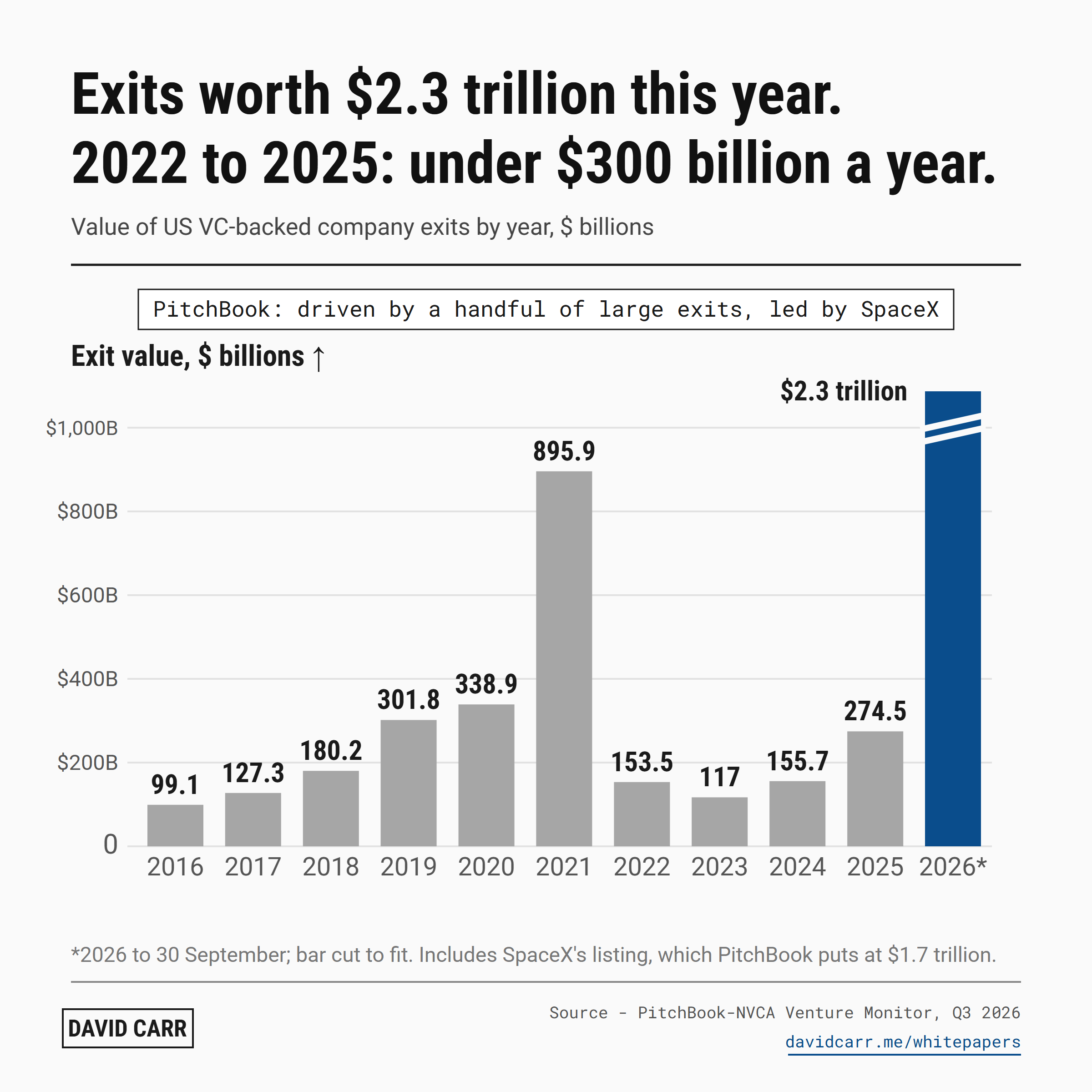
Exits worth $2.3 trillion this year. 2022 to 2025: under $300 billion a year.
- 2021: $895.9 billion
- 2023: $117 billion
- 2025: $274.5 billion
- 2026 to September: $2.29 trillion
PitchBook says a handful of large exits did it, led by SpaceX's listing. Only 18 companies went public in the third quarter.
Exit value is the deal price for a sale, and the company's value at its share price for a listing. It isn't cash paid out to investors.
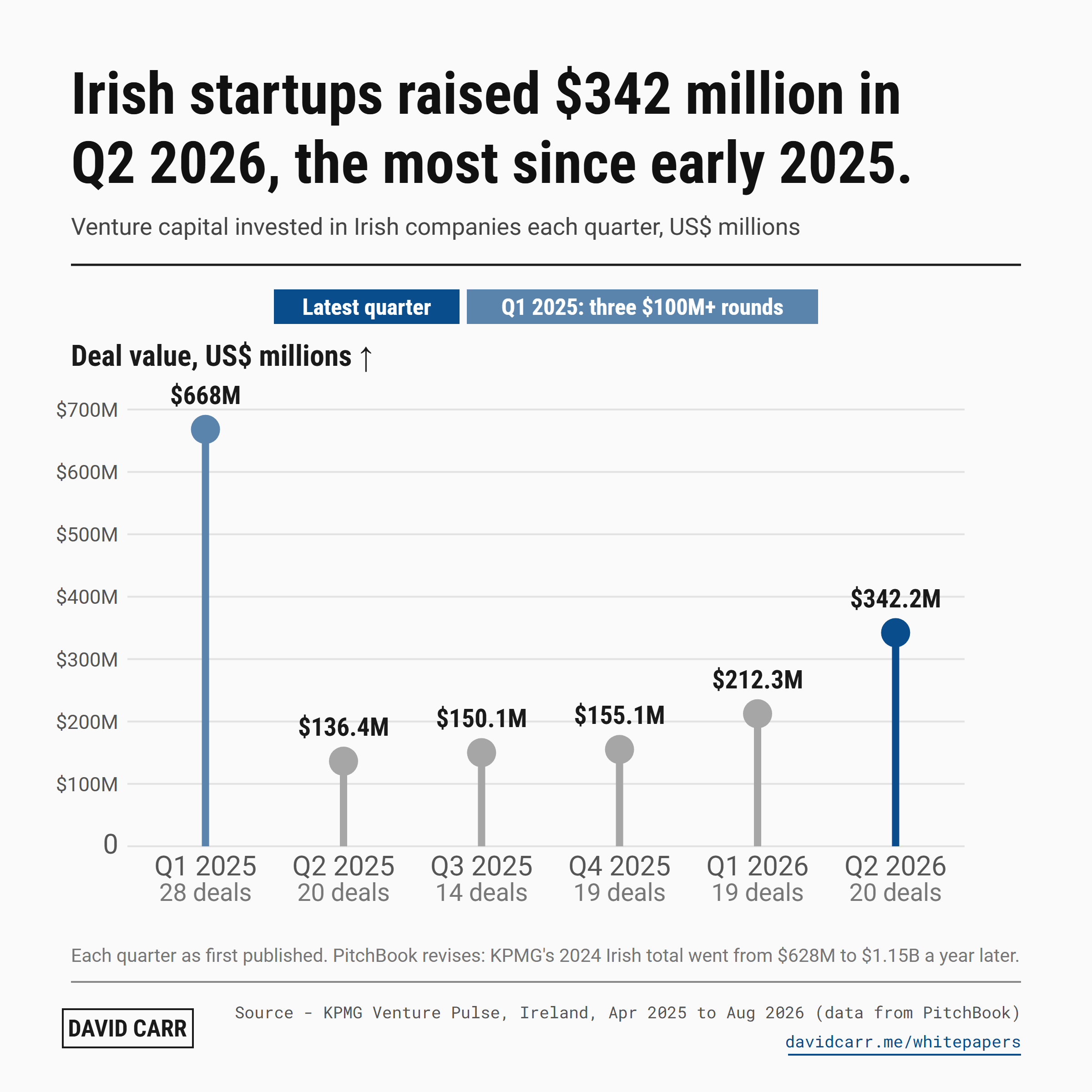
Irish startups raised $342 million in Q2 2026, the most since early 2025.
- Q1 2025: $668M across 28 deals, with three rounds over $100M
- Q2 to Q4 2025: $136M to $155M a quarter
- Q1 2026: $212.3M
- Q2 2026: $342.2M across 20 deals
The Q2 2026 total was led by Fonoa's $110 million round. Deal counts stayed between 14 and 28 a quarter.
KPMG Ireland's Venture Pulse, which uses PitchBook data, in US dollars. Each quarter as first published: KPMG's 2024 Irish total went from $628M to $1.15B a year later.
Method, caveats and sources
The short answer. PitchBook was founded in Seattle in 2007 and bought by Morningstar in 2016 at a $225 million value. Its revenue went from $31 million to $672 million in 2025. Growth has slowed to under 5% this year. Its own research shows a record $515.8 billion into US startups by September, 82.7% of it to AI.
PitchBook the company. PitchBook is part of Morningstar, which is listed in the US, so its revenue and users come from Morningstar's SEC filings. Before 2023 Morningstar reported PitchBook as a product; since then as a segment that also includes LCD, a loan-data business it bought in 2022. Both are shown. 2017 and 2018 revenue are worked out from the yearly rise Morningstar stated. Users were first reported as "platform licenses", and the count changed in Q3 2025 to leave out staff.
The Venture Monitor. US figures come from the PitchBook-NVCA Venture Monitor, Q3 2026, data as of 30 September 2026. PitchBook revises past years as late deals come in: its 2025 deal value was $339.4 billion in the Q4 2025 edition and $319.7 billion nine months later. "AI" is PitchBook's AI and machine learning group.
Ireland. PitchBook doesn't publish an Irish report of its own. The Irish figures are KPMG Ireland's quarterly Venture Pulse, built on PitchBook data, as first published. They don't add up to KPMG's later annual totals, because the data is revised.
Also: Stripe, Carta and Y Combinator.