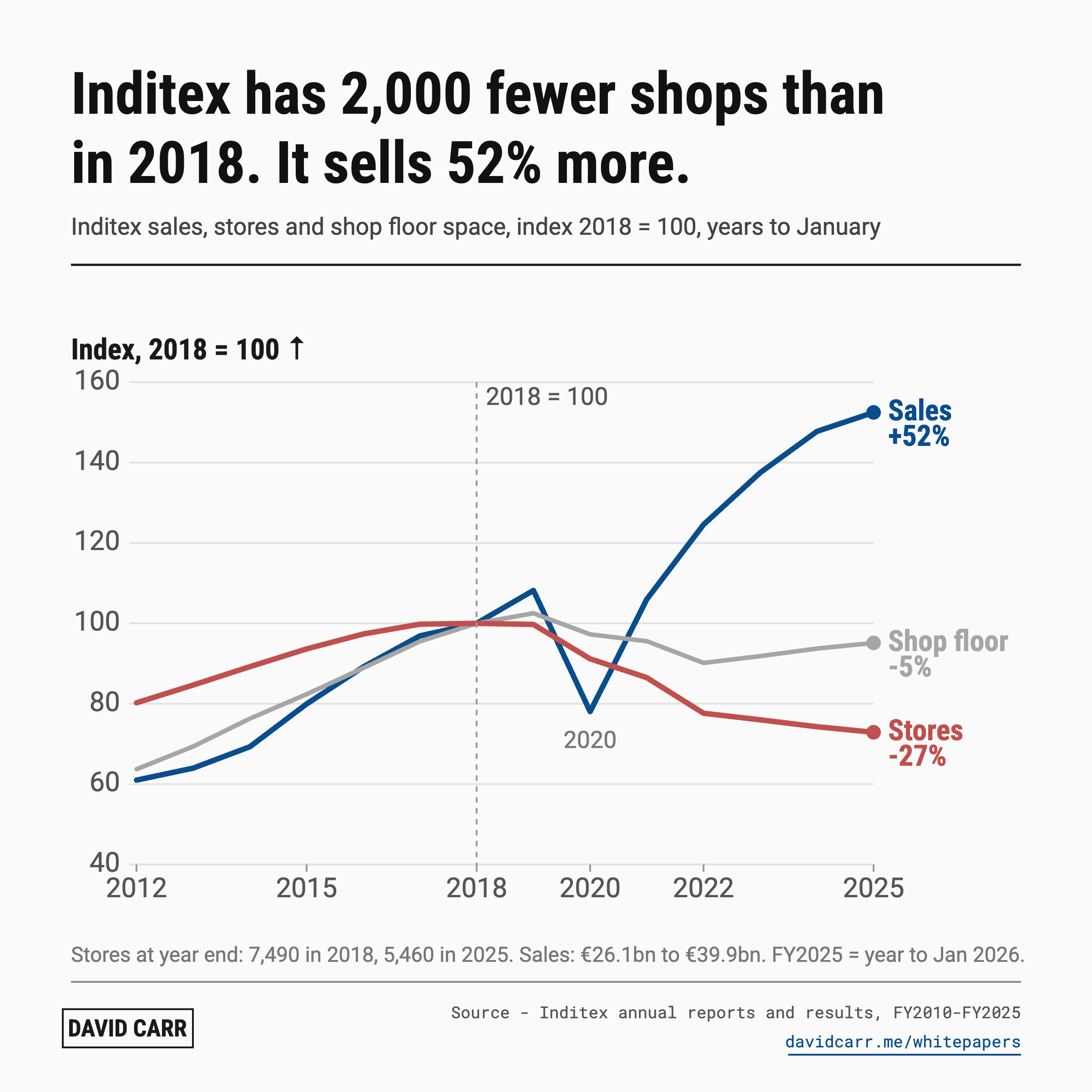
Inditex has 2,000 fewer shops than in 2018. It sells 52% more.
- Stores at year end: 7,490 in FY2018, 5,460 in FY2025, down 27%
- Net sales: €26.1bn to €39.9bn, up 52%
- Shop floor space fell only 5%, so the average shop is bigger
- FY2020, the year of lockdowns, is the one dip in sales
Inditex is selling more through fewer, bigger shops and online. Sales per shop have more than doubled since 2018.
Inditex financial years run February to January, so FY2025 is the year to January 2026. Store counts include franchised shops.
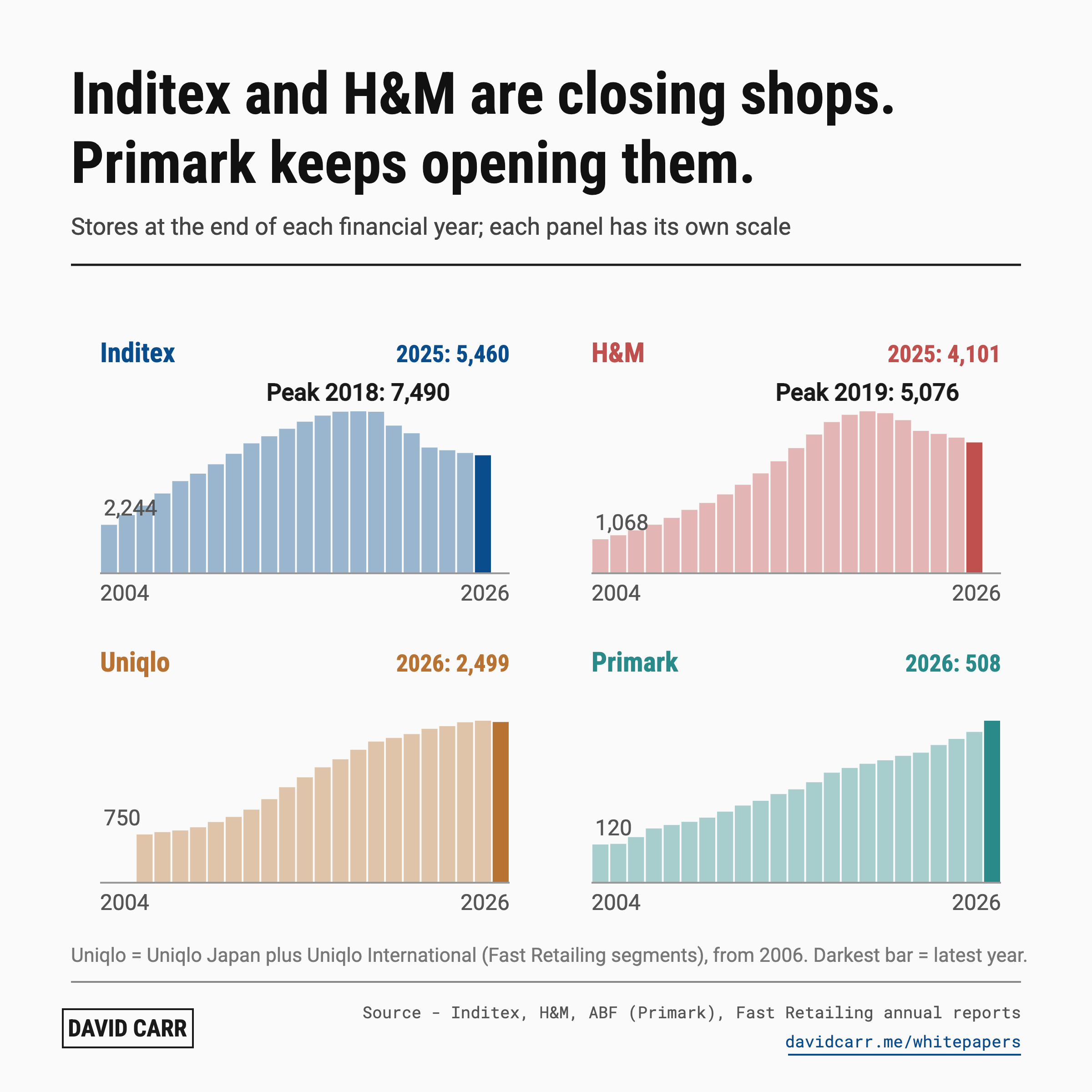
H&M has 975 fewer shops than at its 2019 peak. Primark has 508, and more every year.
- Inditex: 2,244 shops in 2004, a peak of 7,490 in 2018, 5,460 in 2025
- H&M: 1,068 in 2004, a peak of 5,076 in 2019, 4,101 in 2025
- Uniqlo, in Japan and abroad: 750 in 2006, 2,499 in 2026, close to its 2025 peak of 2,519
- Primark: 120 in 2004, 508 in 2026, in 19 countries. It has opened shops every year
The two biggest have been closing shops since 2018 and 2019. Uniqlo has levelled off. Primark, which sells almost entirely in its shops, is still opening them.
Stores at the end of each financial year, as each company reports them. Uniqlo is the sum of Fast Retailing’s Uniqlo Japan and Uniqlo International segments.
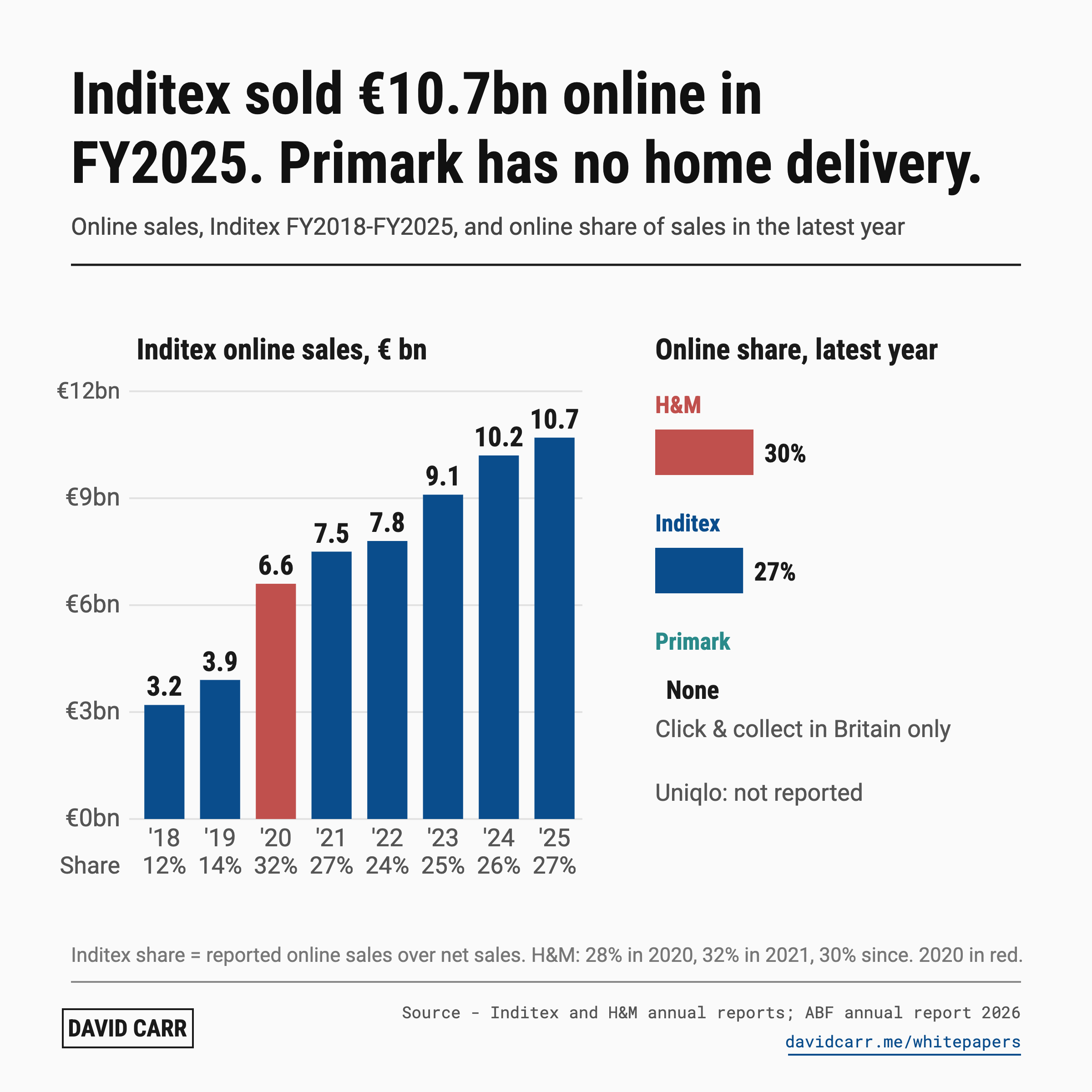
Inditex sold €10.7bn online in FY2025. Primark has no home delivery.
- Inditex online sales: €3.2bn in FY2018, €6.6bn in FY2020, €10.7bn in FY2025
- That is 27% of Inditex sales, up from 12% in FY2018. It hit 32% in FY2020, when many shops were shut
- H&M: 28% online in 2020, 32% in 2021, 30% each year since
- Primark: click and collect in Britain, with home delivery planned “in the future”, says ABF
About a quarter to a third of sales at Inditex and H&M now happen online. The share jumped in 2020 and has held at that level since.
Inditex reports its online sales in euros; the share is my calculation on its net sales. Fast Retailing does not break out online sales in the figures used here.
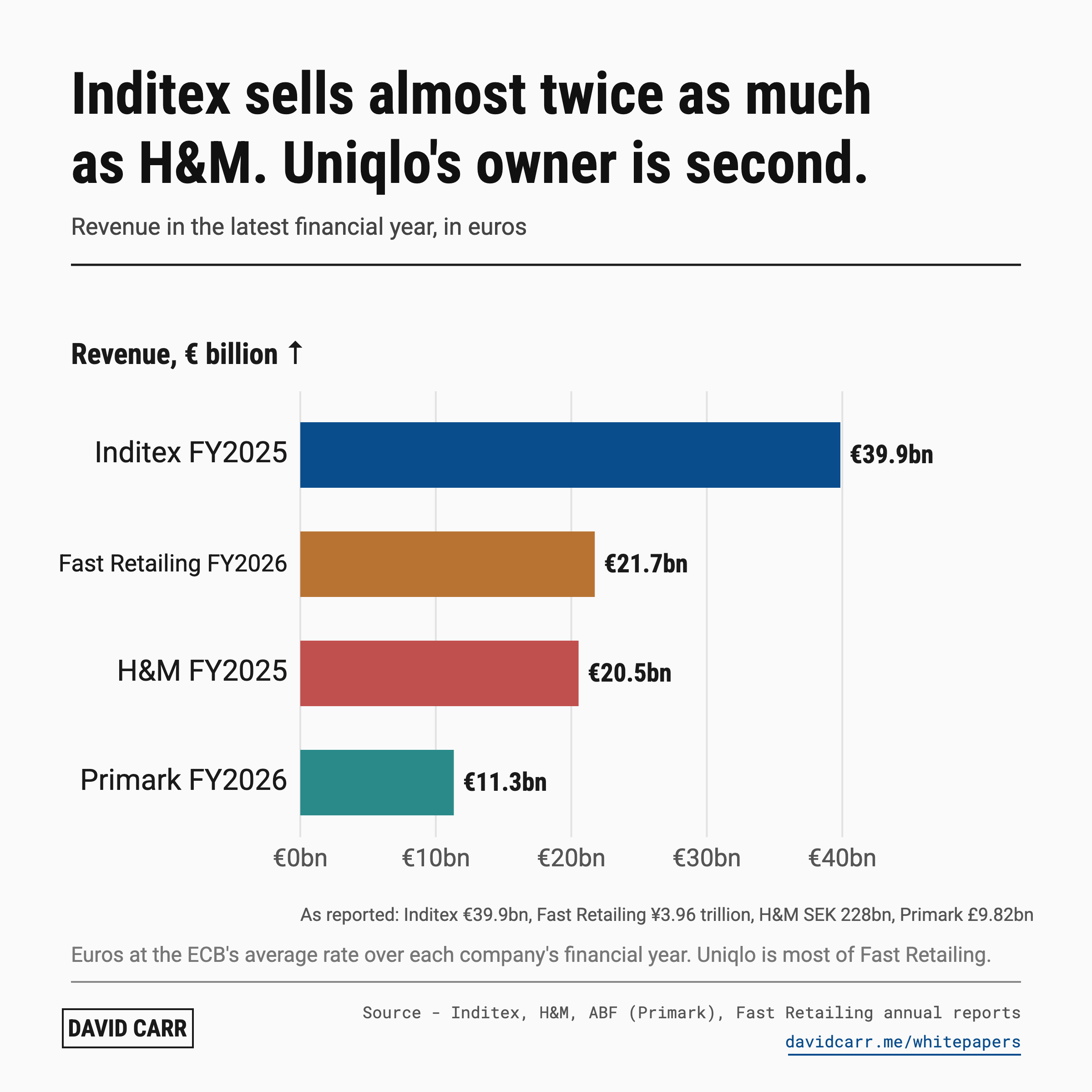
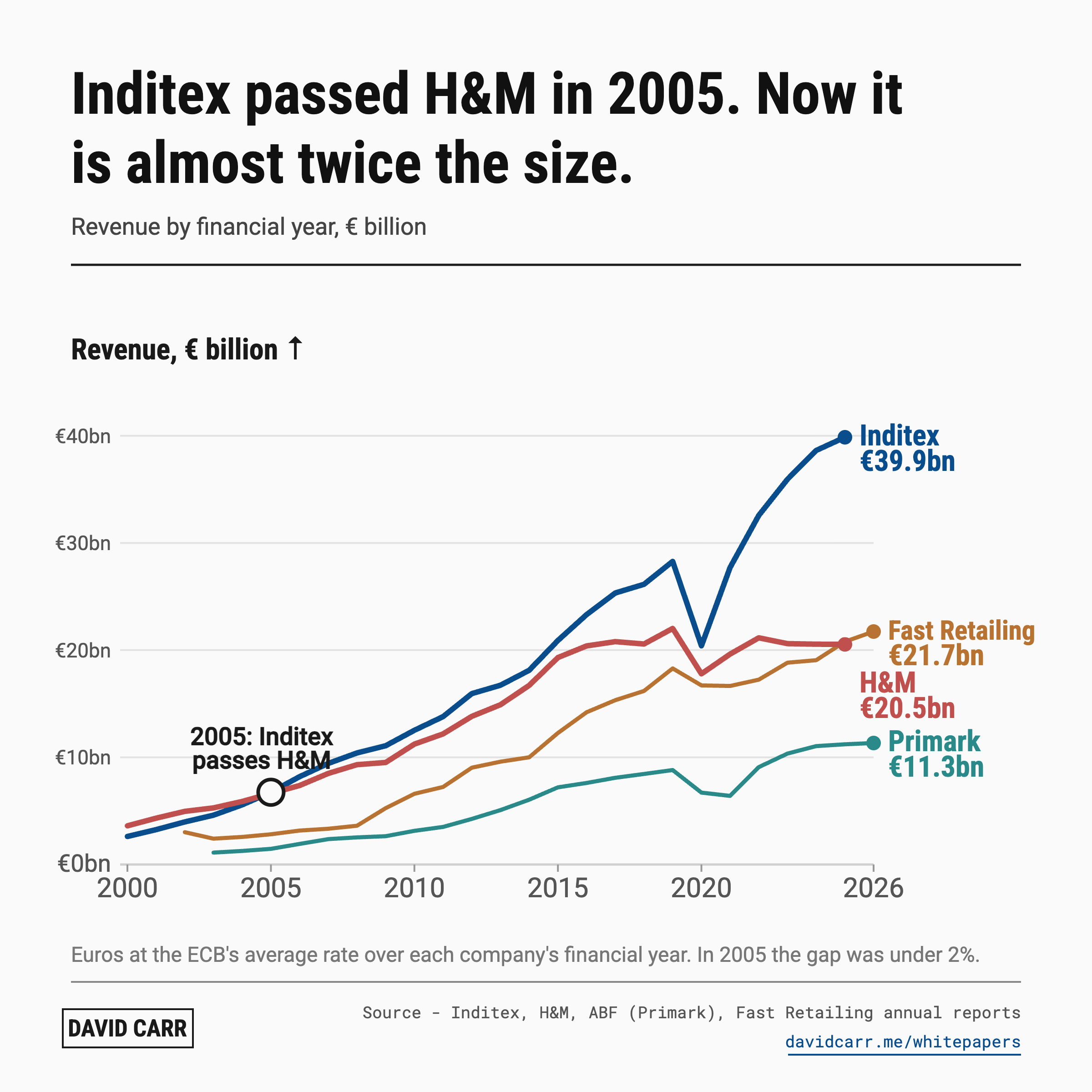
Inditex sells almost twice as much as H&M. Uniqlo’s owner is now second.
- Inditex, FY2025: €39.9bn
- Fast Retailing, FY2026: ¥3.96 trillion, about €21.7bn
- H&M, FY2025: SEK 228bn, about €20.5bn
- Primark, FY2026: £9.82bn, about €11.3bn
Fast Retailing passed H&M in euros in its FY2025, the first year it has done so. The two are close, and the weak yen makes Fast Retailing’s figure smaller in euros than at home.
Each company’s latest full financial year. Euros at the ECB’s average rate over that company’s financial year. The years end at different times: H&M in November, Inditex in January, Fast Retailing in August, Primark in September.
Inditex passed H&M in 2005. Now it is almost twice the size.
- 2005: Inditex €6.7bn, H&M about €6.6bn
- 2019: Inditex €28.3bn, H&M €22.0bn
- 2025: Inditex €39.9bn, H&M €20.5bn
- Primark: €1.1bn in 2003, €11.3bn in 2026
Since 2019, Inditex’s sales are up 41% in euros. H&M’s are down 2% in kronor and 7% in euros.
In 2005 the gap was under 2%, so the exact year depends on the exchange rate used. Inditex has been ahead every year since.
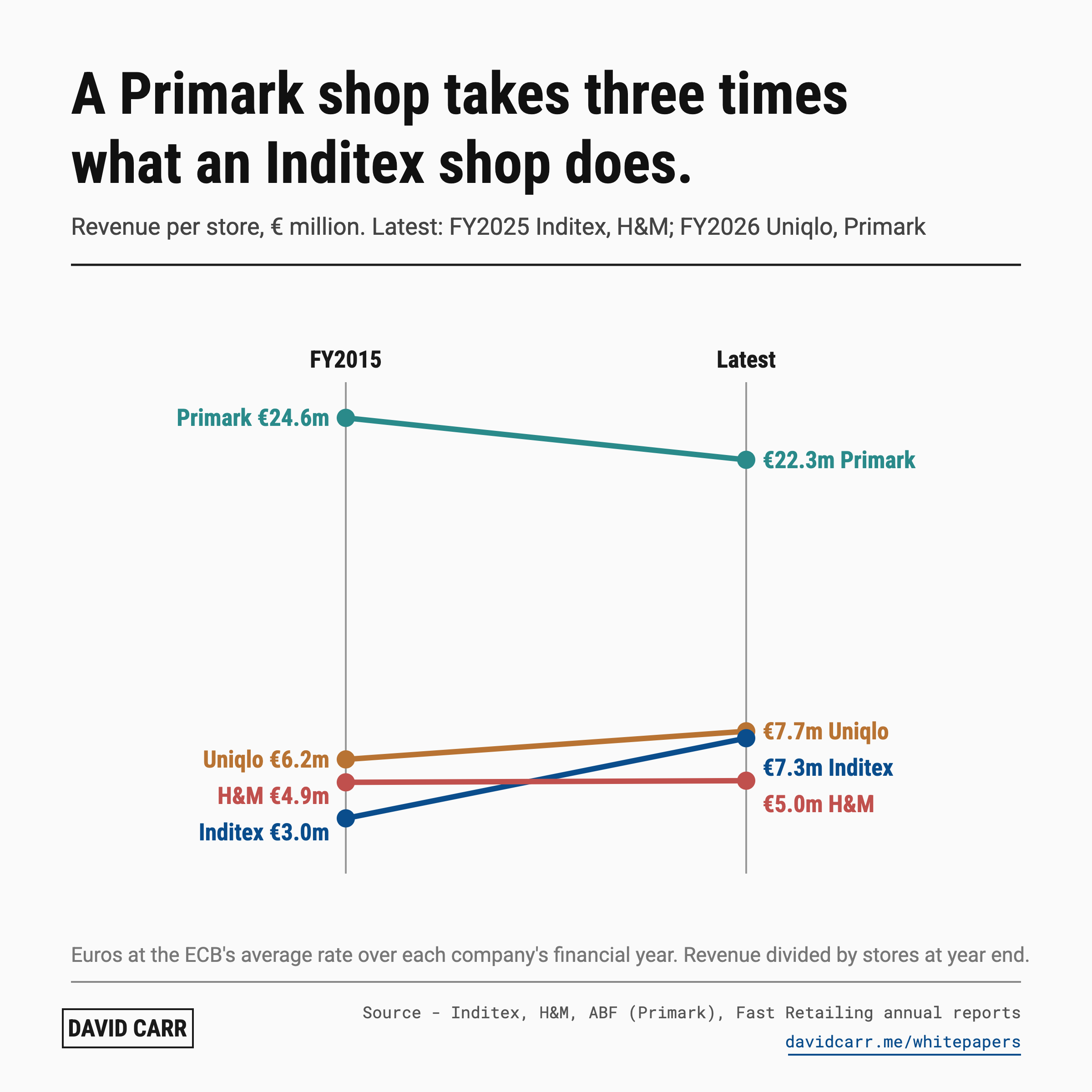
A Primark shop takes three times what an Inditex shop does.
- Primark: €22.3m per shop in FY2026 (£19.3m)
- Uniqlo: €7.7m. Inditex: €7.3m. H&M: €5.0m
- Inditex per shop: €3.0m in FY2015, €7.3m in FY2025
- H&M per shop: €4.9m in FY2015, €5.0m in FY2025
Primark’s shops are big: 20.6 million square feet across 508 of them, about 40,500 each. Inditex has more than doubled what each of its shops takes since 2015, partly because online sales are counted in.
Total revenue, including online, divided by stores at year end. For Inditex and H&M that flatters the shops; Primark has almost no online sales.
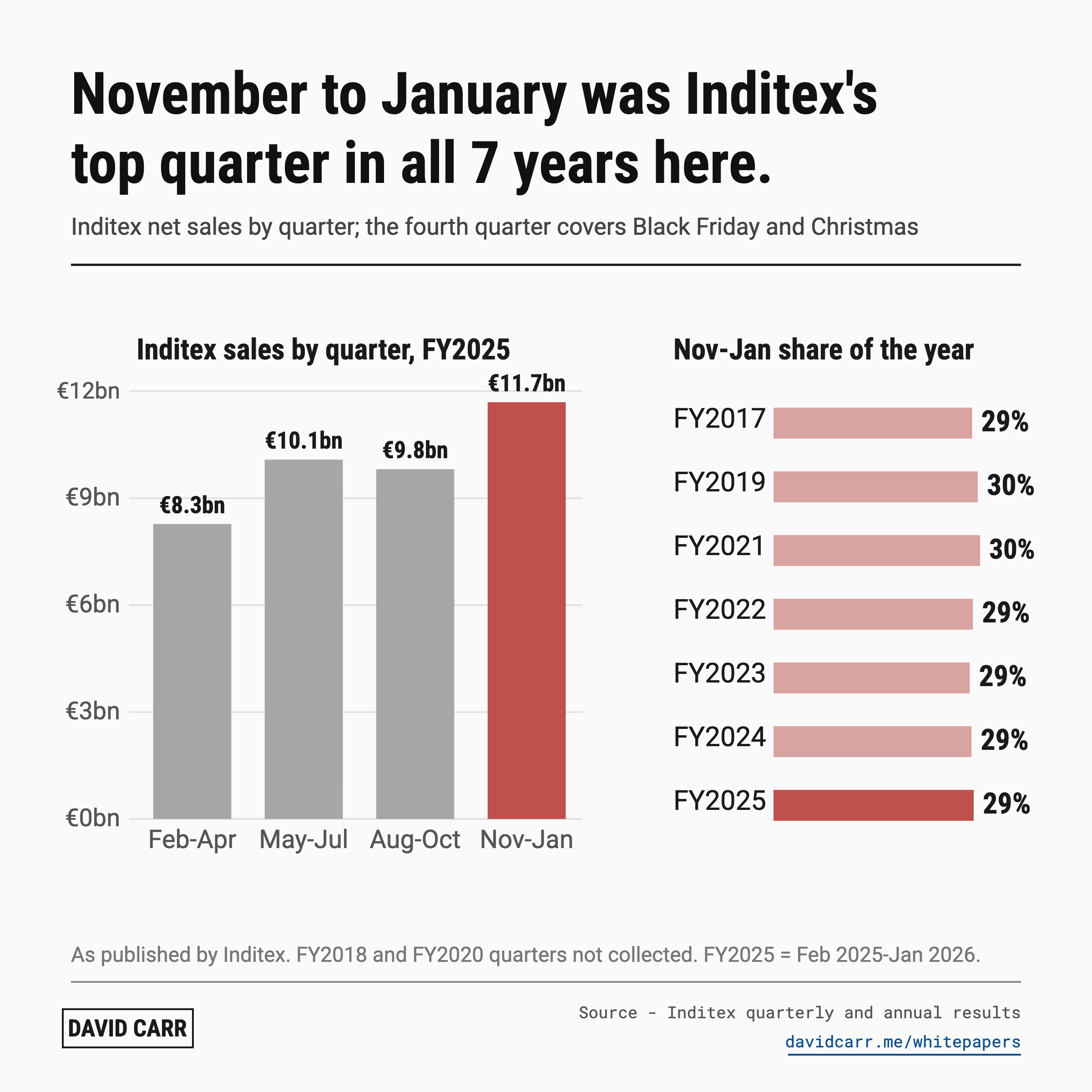
November to January was Inditex’s biggest quarter in all seven years here.
- FY2025: €11.7bn from November to January, against €8.3bn to €10.1bn in the other three quarters
- That is about €127m a day over the 92 days
- Share of the year: between 29% and 30% every year shown, FY2017 to FY2025
- H&M’s September to November quarter, which takes in Black Friday, was SEK 59.2bn in 2025, 26% of its year
Black Friday, Christmas and the January sales all fall in Inditex’s fourth quarter. It brings in close to 30% of the year’s sales.
Quarterly sales as published by Inditex. FY2018 and FY2020 quarters were not collected.
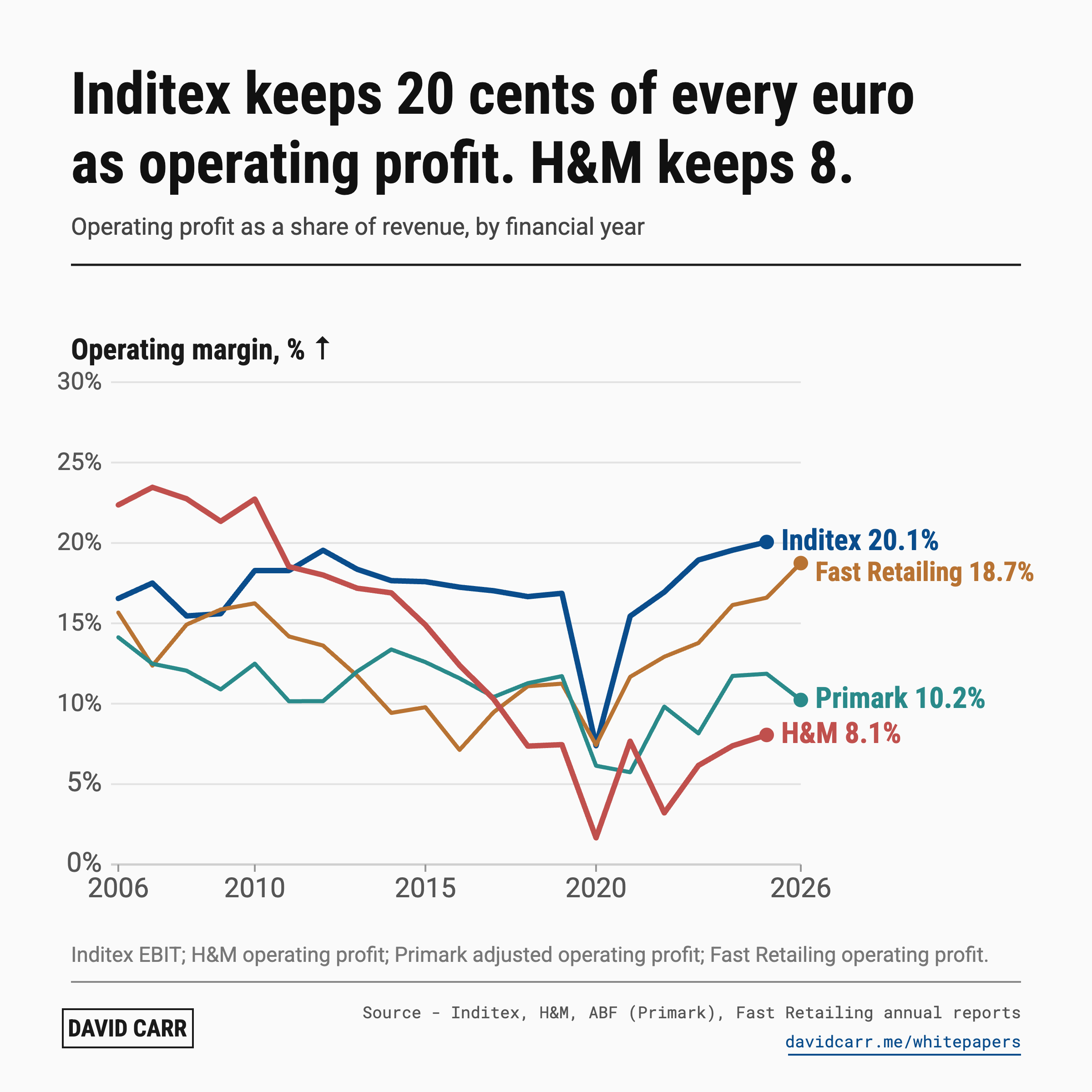
Inditex keeps 20 cents of every euro as operating profit. H&M keeps 8.
- Latest year: Inditex 20.1%, Fast Retailing 18.7%, Primark 10.2%, H&M 8.1%
- H&M was the most profitable of the four from 2006 to 2010, at 21% to 24%
- All four fell in 2020. Inditex and Fast Retailing are now above where they were before it
- Fast Retailing: from 7.1% in FY2016 to 18.7% in FY2026
The two biggest sellers are also the two most profitable now. Inditex’s gross margin, 58.3% in FY2025, is the highest of the three that report one.
Operating profit over revenue. Inditex EBIT; H&M operating profit; Primark adjusted operating profit, as ABF reports it; Fast Retailing operating profit (Japanese accounting rules to FY2013, IFRS since). IFRS 16 changed lease accounting from 2019-20.
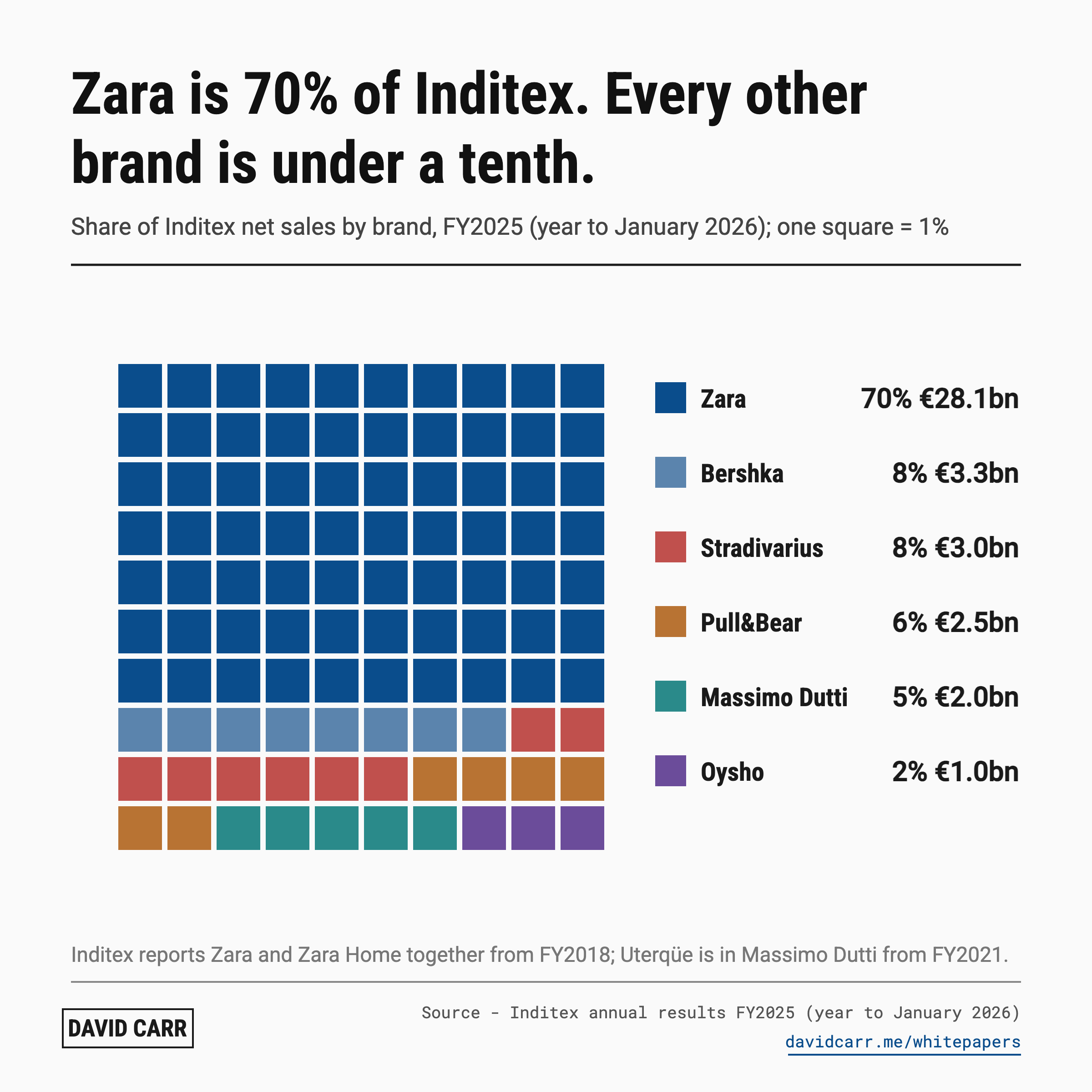
Zara is 70% of Inditex. Every other brand is under a tenth.
- Zara (with Zara Home): €28.1bn of €39.9bn in FY2025
- Bershka €3.3bn, Stradivarius €3.0bn, Pull&Bear €2.5bn
- Massimo Dutti €2.0bn, Oysho €1.0bn
- In FY2012, Zara and Zara Home were 68% of Inditex
Inditex has several brands, but Zara is most of it, and was in every year of brand figures here, back to FY2012.
Inditex has reported Zara and Zara Home together since FY2018. Uterqüe is in Massimo Dutti from FY2021.
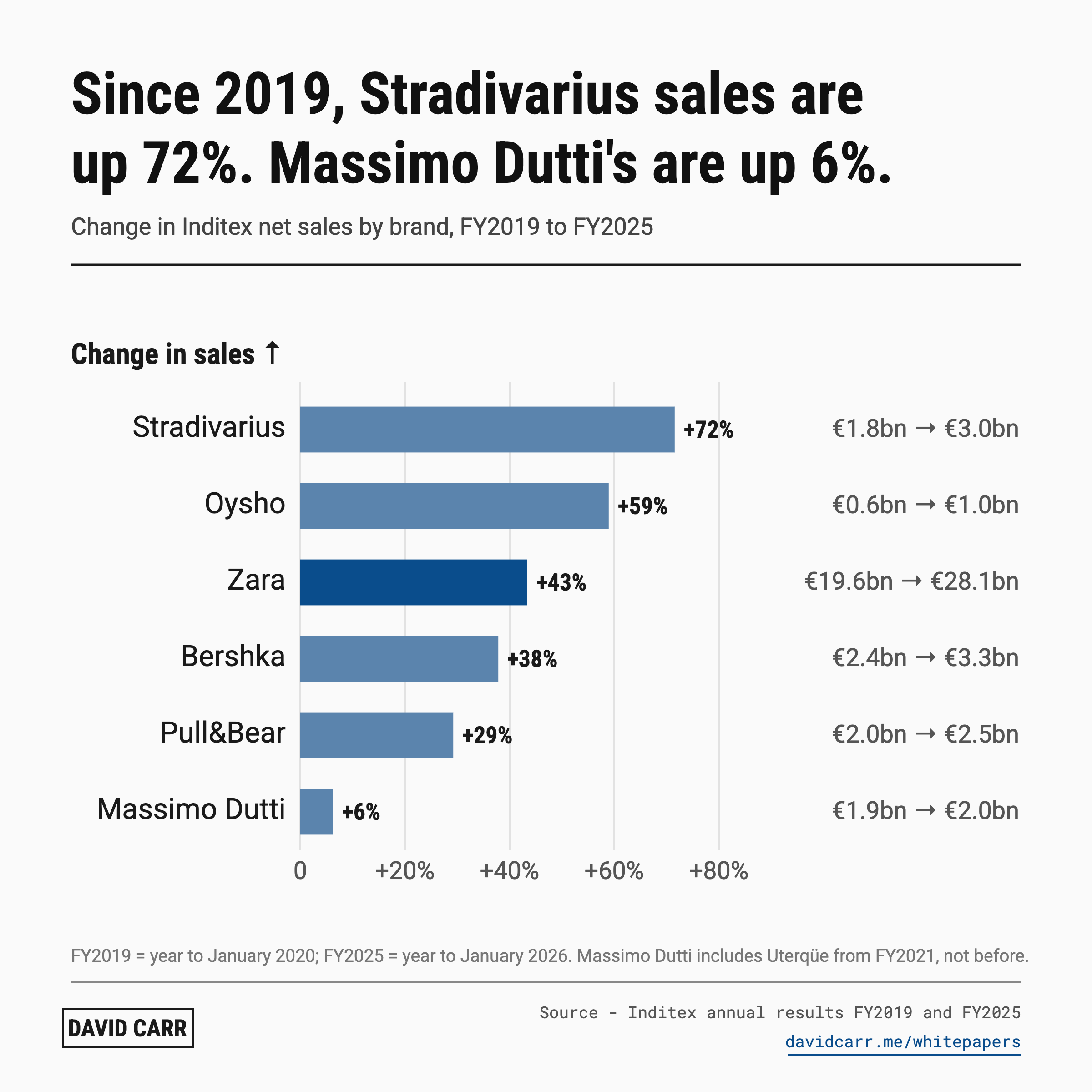
Since 2019, Stradivarius sales are up 72%. Massimo Dutti’s are up 6%.
- Stradivarius +72%, Oysho +59%, Zara +43%
- Bershka +38%, Pull&Bear +29%, Massimo Dutti +6%
- Inditex as a whole: +41%
Every brand sells more than before the pandemic. Stradivarius and Oysho have grown fastest; Massimo Dutti least.
Net sales by brand, FY2019 (year to January 2020) to FY2025 (year to January 2026), in euros. Massimo Dutti’s FY2025 figure includes Uterqüe; its FY2019 figure does not, which flatters its growth slightly.
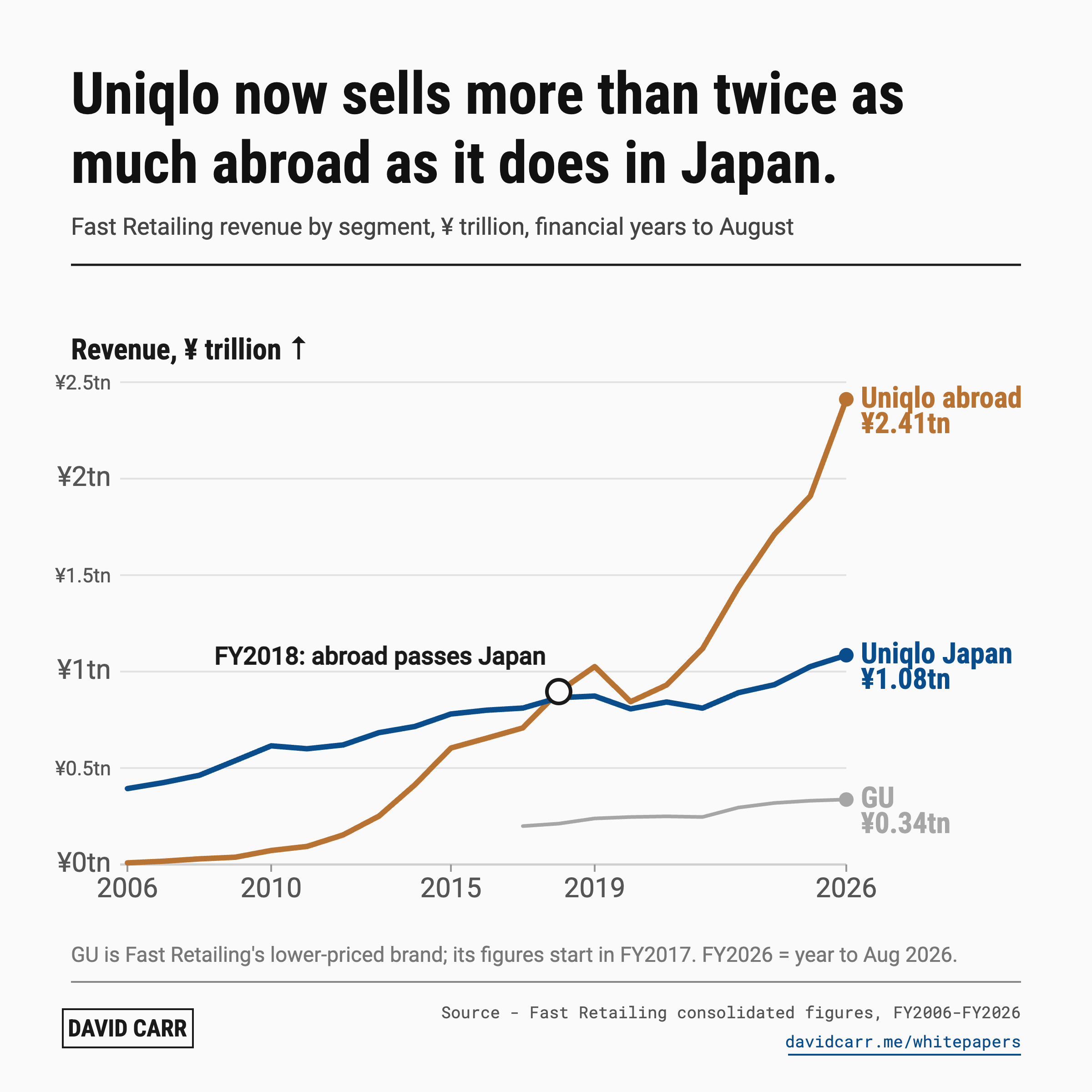
Uniqlo now sells more than twice as much abroad as it does in Japan.
- Uniqlo International: ¥8.7bn in FY2006, ¥2.41 trillion in FY2026
- Uniqlo Japan: ¥0.39 trillion to ¥1.08 trillion
- Abroad first passed Japan in FY2018, and has been ahead every year since
- Uniqlo International operating profit: ¥448bn in FY2026, against ¥197bn in Japan
Twenty years ago Uniqlo was a Japanese chain with a few shops abroad. Now most of its sales and profit come from outside Japan.
Fast Retailing segment revenue in yen, financial years to August. GU, its lower-priced brand, is shown from FY2017, when its own segment figures start in the data used.
Method, caveats and sources
The short answer. Inditex, Zara’s owner, is the biggest by far: €39.9bn of sales in its latest year, almost twice H&M’s €20.5bn. It passed H&M in 2005. Fast Retailing, Uniqlo’s owner, has just edged ahead of H&M in euros, and Uniqlo now sells more than twice as much abroad as in Japan. Inditex and H&M have both been closing shops since 2018-19, while selling more online: about 27% to 30% of their sales. Primark has no home delivery and keeps opening shops, now 508, and each one takes about three times what an Inditex shop does. Inditex keeps 20 cents of each euro as operating profit; H&M keeps 8. The November to January quarter brings Inditex close to 30% of its year.
Sources. Annual reports, annual results and quarterly results from Inditex, H&M Group, Associated British Foods (Primark is its Retail segment) and Fast Retailing, pulled 27 November 2026. Some older Inditex reports and the ABF results were read from Internet Archive copies of the companies’ own documents, because the originals are no longer online or could not be fetched automatically. The latest years are Inditex FY2025 (to January 2026), H&M FY2025 (to November 2025), Fast Retailing FY2026 (to August 2026) and Primark FY2026 (to September 2026).
Currencies. Each company reports in its own currency: euros, Swedish kronor, sterling and yen. Where the four are compared, figures are converted to euros at the ECB’s average reference rate over each company’s own financial year (the monthly averages for those twelve months). A change in exchange rates moves the comparisons: the yen in particular is much weaker against the euro than it was five years ago.
Caveats. The four years end in different months, so “latest year” does not mean the same twelve months for each. Store counts are as each company reports them; Inditex’s include franchised shops. Revenue per shop uses all revenue, online included, so it overstates what the shop alone takes at Inditex and H&M. Profit measures differ a little: Primark’s is ABF’s adjusted operating profit. Accounting for leases changed in 2019-20 (IFRS 16), and earlier years were not restated. Shein and Temu are left out: neither publishes audited accounts that can be compared with these four, and this page uses no estimates.
Also: How long do the biggest companies stay on top?