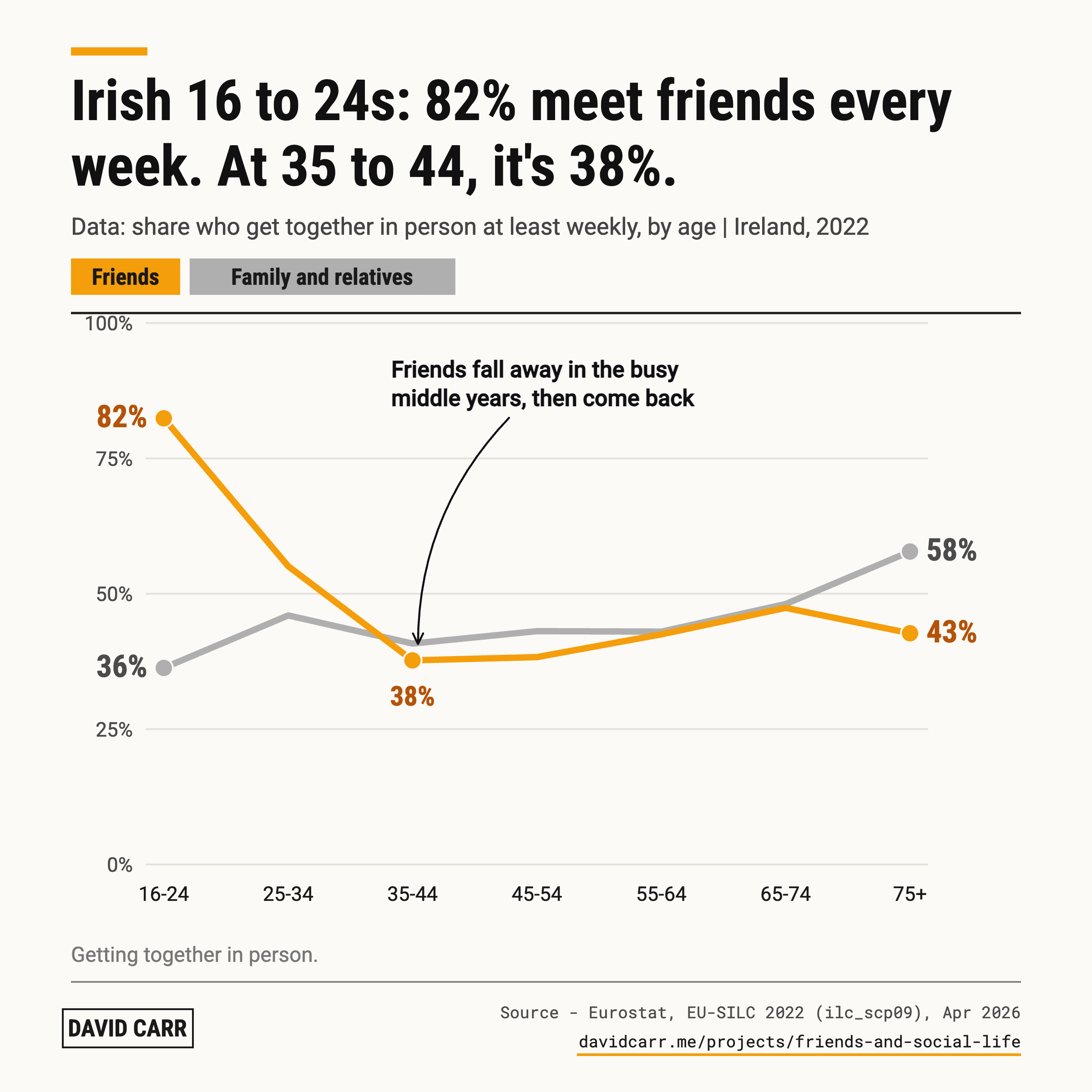
Irish 16 to 24s: 82% meet friends every week. At 35 to 44, it's 38%.
- 16 to 24: 82% meet friends weekly, 36% meet family weekly
- 35 to 44: 38% friends, 41% family
- 65 to 74: 47% friends, 48% family
- 75 and over: 43% friends, 58% family
Friends fill the late teens and early twenties. From the mid-30s, family and friends sit level, and after 75 family takes the lead.
Eurostat, EU-SILC 2022 ad-hoc module, table ilc_scp09: getting together with friends, or with relatives, at least once a week. Pulled 29 November 2026.
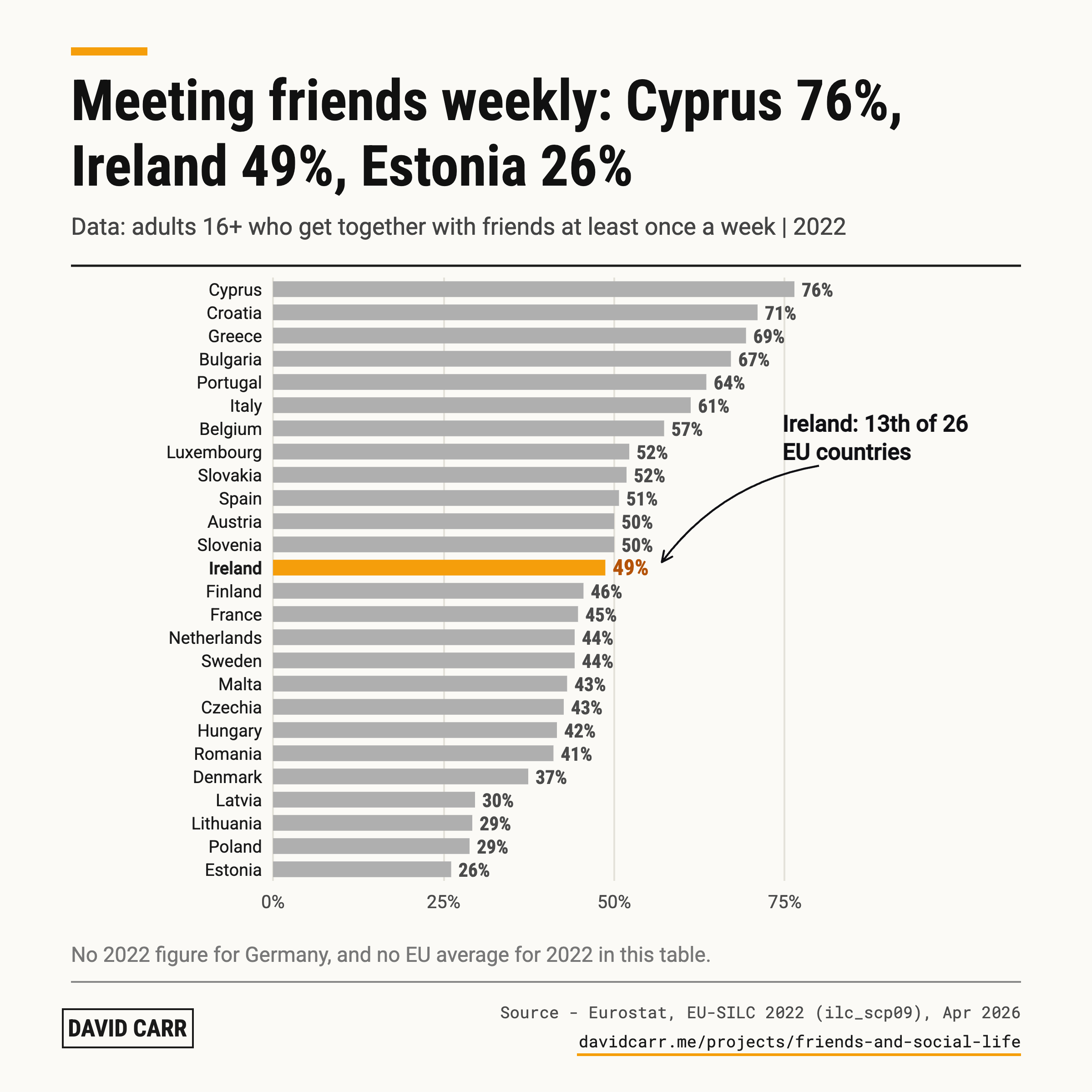
Meeting friends weekly: Cyprus 76%, Ireland 49%, Estonia 26%
- Cyprus 76%, Croatia 71%, Greece 69%
- Ireland 49%: 13th of 26 EU countries
- Latvia 30%, Lithuania 29%, Poland 29%, Estonia 26%
Southern Europe meets friends most often in person. The Baltic countries and Poland meet least. Ireland sits in the middle.
Eurostat ilc_scp09, 2022, adults 16 and over. Germany has no 2022 figure, and the table has no EU average for 2022.
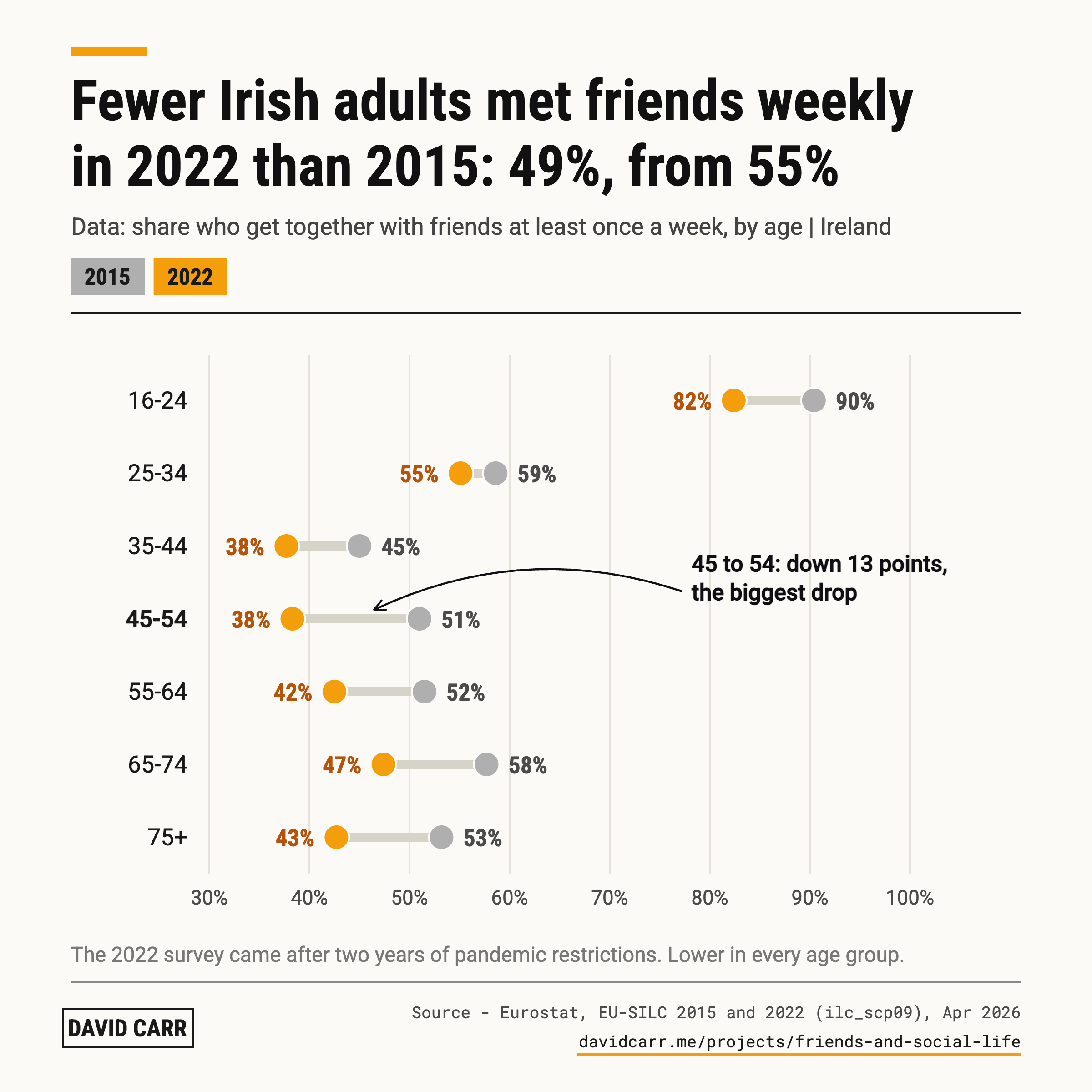
Fewer Irish adults met friends weekly in 2022 than 2015: 49%, from 55%
- All adults: 54.8% in 2015, 48.7% in 2022
- 45 to 54: 51% to 38%, the biggest drop
- 25 to 34: 59% to 55%, the smallest
Weekly meet-ups with family fell further, from 56.7% to 43.9%. The 2022 survey came after two years of pandemic restrictions, so the next round will show whether this sticks.
Eurostat ilc_scp09, 2015 and 2022, Ireland. Family figures from ilc_scp10.
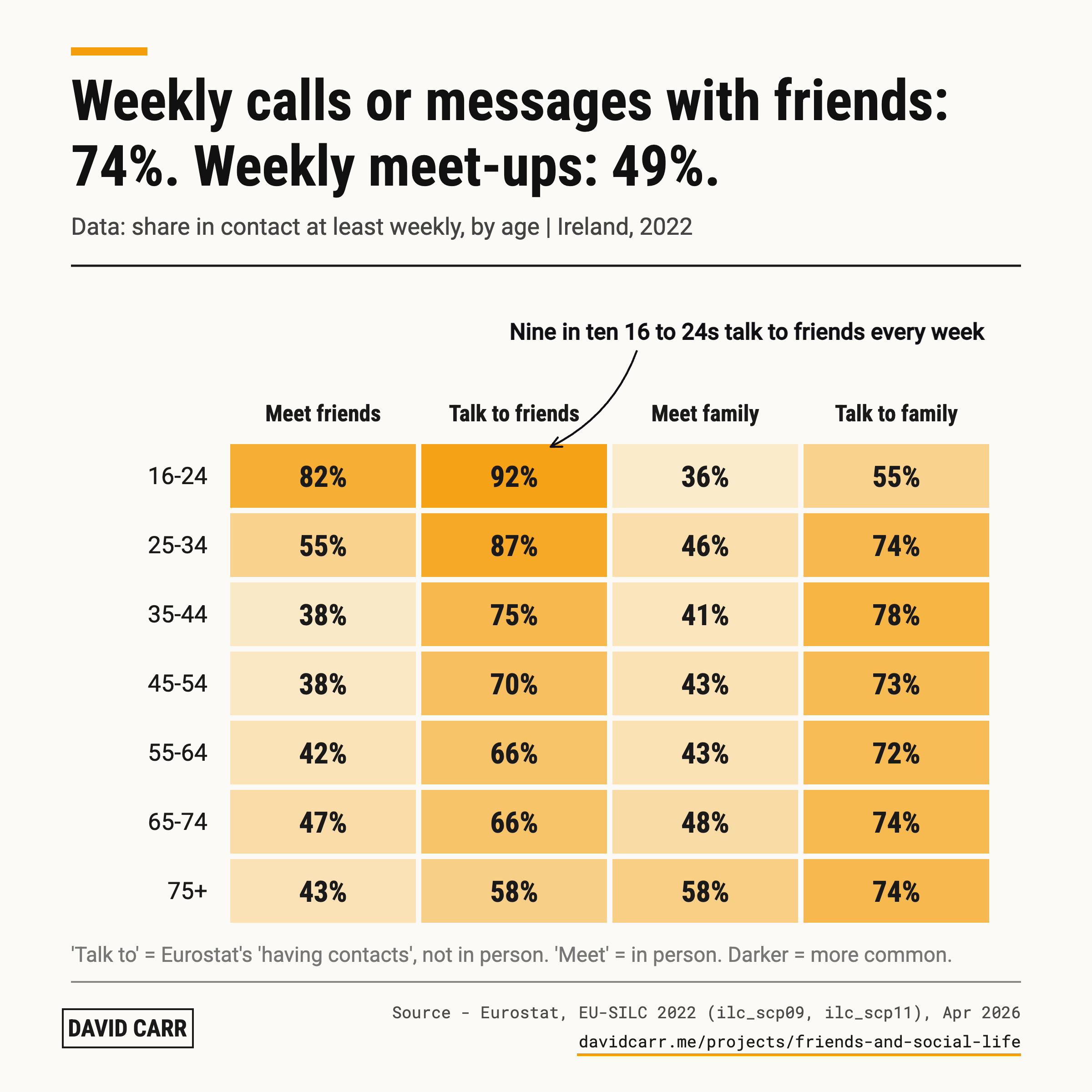
Weekly calls or messages with friends: 74%. Weekly meet-ups: 49%.
- 16 to 24: 92% talk to friends weekly, 82% meet them
- 35 to 44: 75% talk, 38% meet
- 75 and over: 58% talk to friends, 74% talk to family
Keeping in touch holds up much better through the busy years than meeting. Ireland's 74% compares with 67% across the EU. For how much time goes on phones, see Screen time.
Eurostat ilc_scp09 (meeting) and ilc_scp11 (contact without meeting in person), Ireland, 2022.
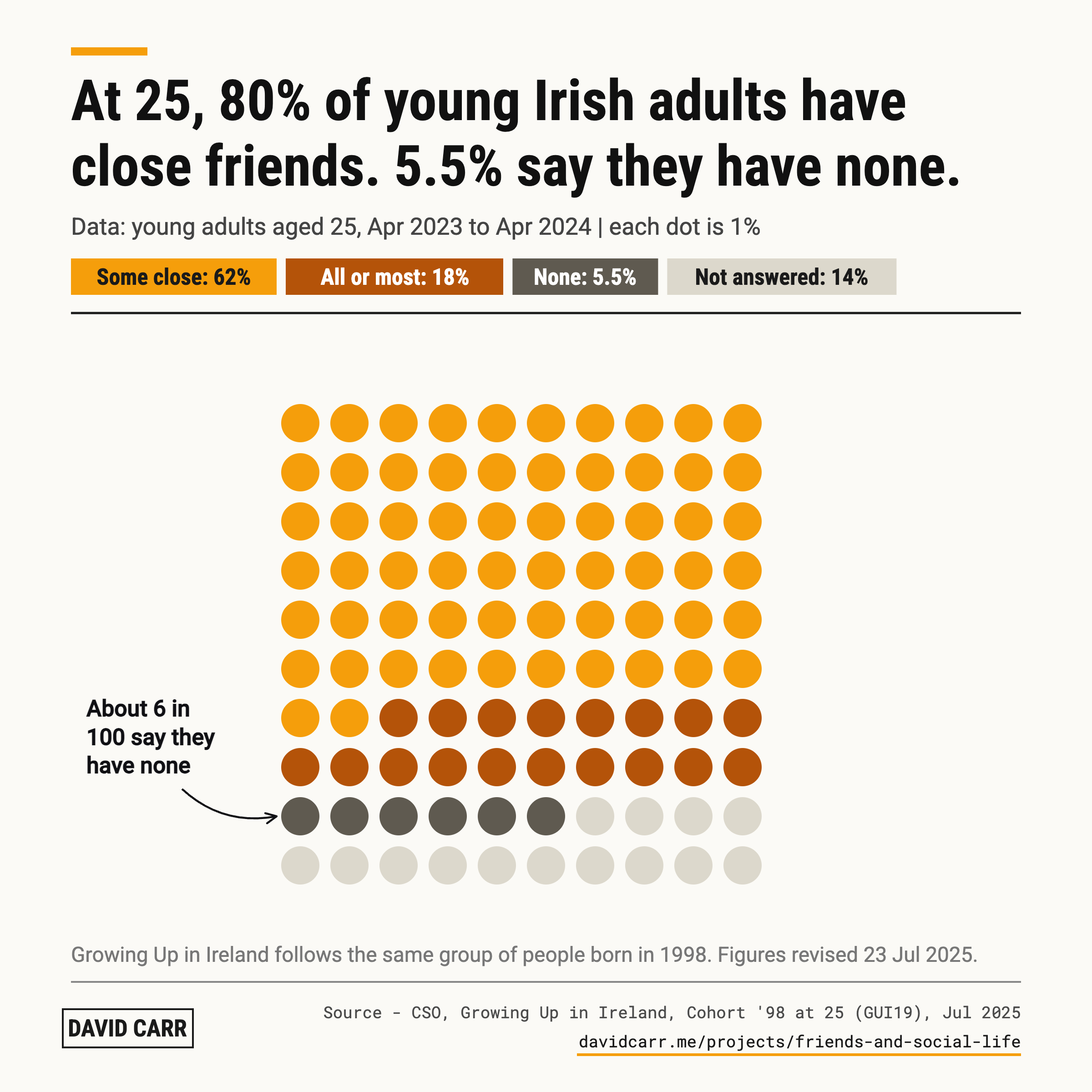
At 25, 80% of young Irish adults have close friends. 5.5% say they have none.
- Some of their friends are close: 62.4%
- All or nearly all are close: 17.7%
- No close friends: 5.5%
- Not answered: 14.3%
Friends come first for personal talk. Women at 25 most often shared their thoughts and feelings with a friend (48.2%), then a partner (47.3%), then their mother (41.4%). Men: friend 44.1%, partner 36.7%, mother 36.3%.
CSO, Growing Up in Ireland, Cohort '98 at age 25, table GUI19 (revised 23 July 2025). Talking figures from the release, 27 January 2025. Interviews April 2023 to April 2024.
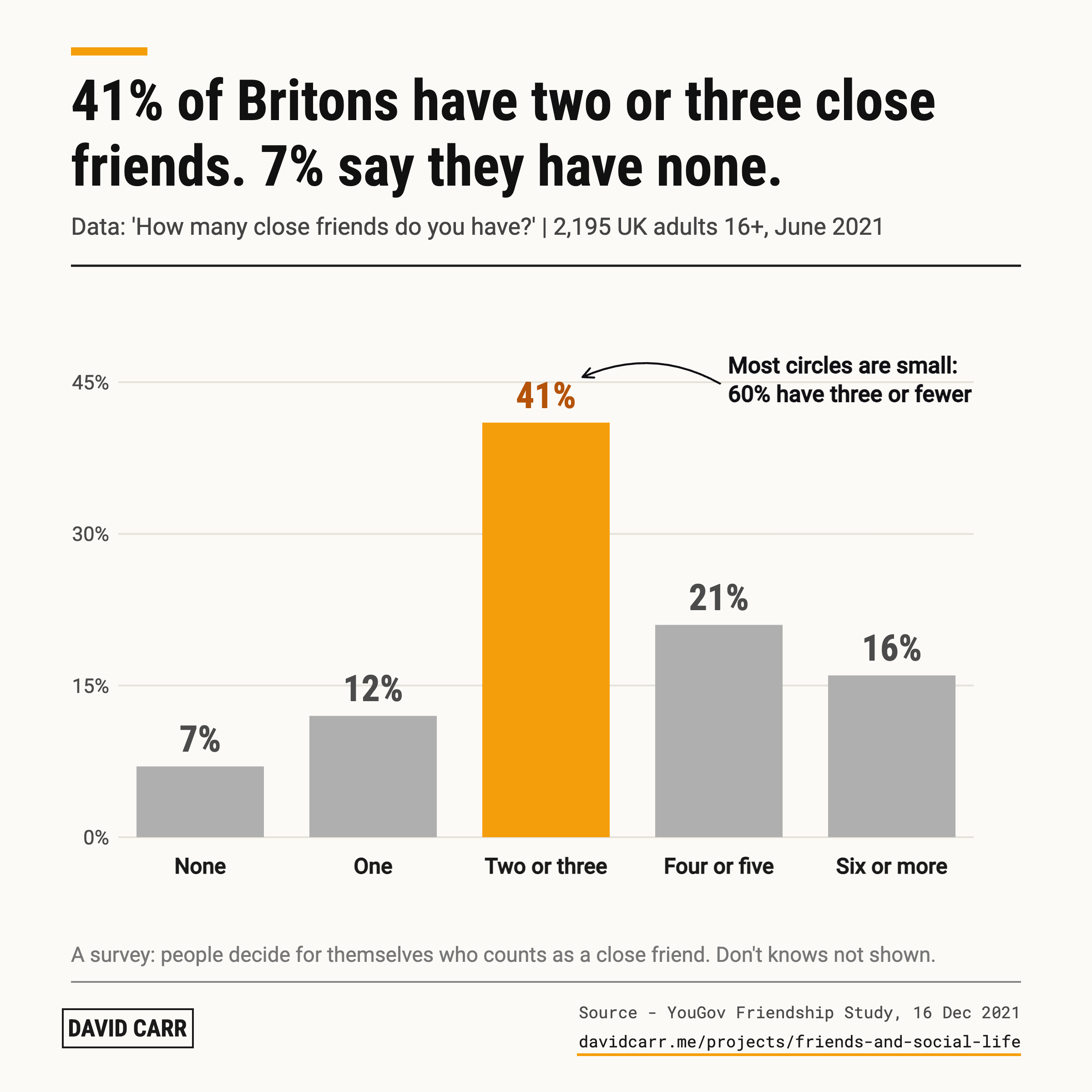
41% of Britons have two or three close friends. 7% say they have none.
- None: 7%
- One: 12%
- Two or three: 41%
- Four or five: 21%
- Six or more: 16%
Most people keep a small circle. In the same study, 67% of 16 to 24s made a new friend in the past year, against 21% of over-60s (YouGov, Part 3).
Survey: YouGov Friendship Study, 16 December 2021. 2,195 UK adults aged 16+, 16 to 22 June 2021.
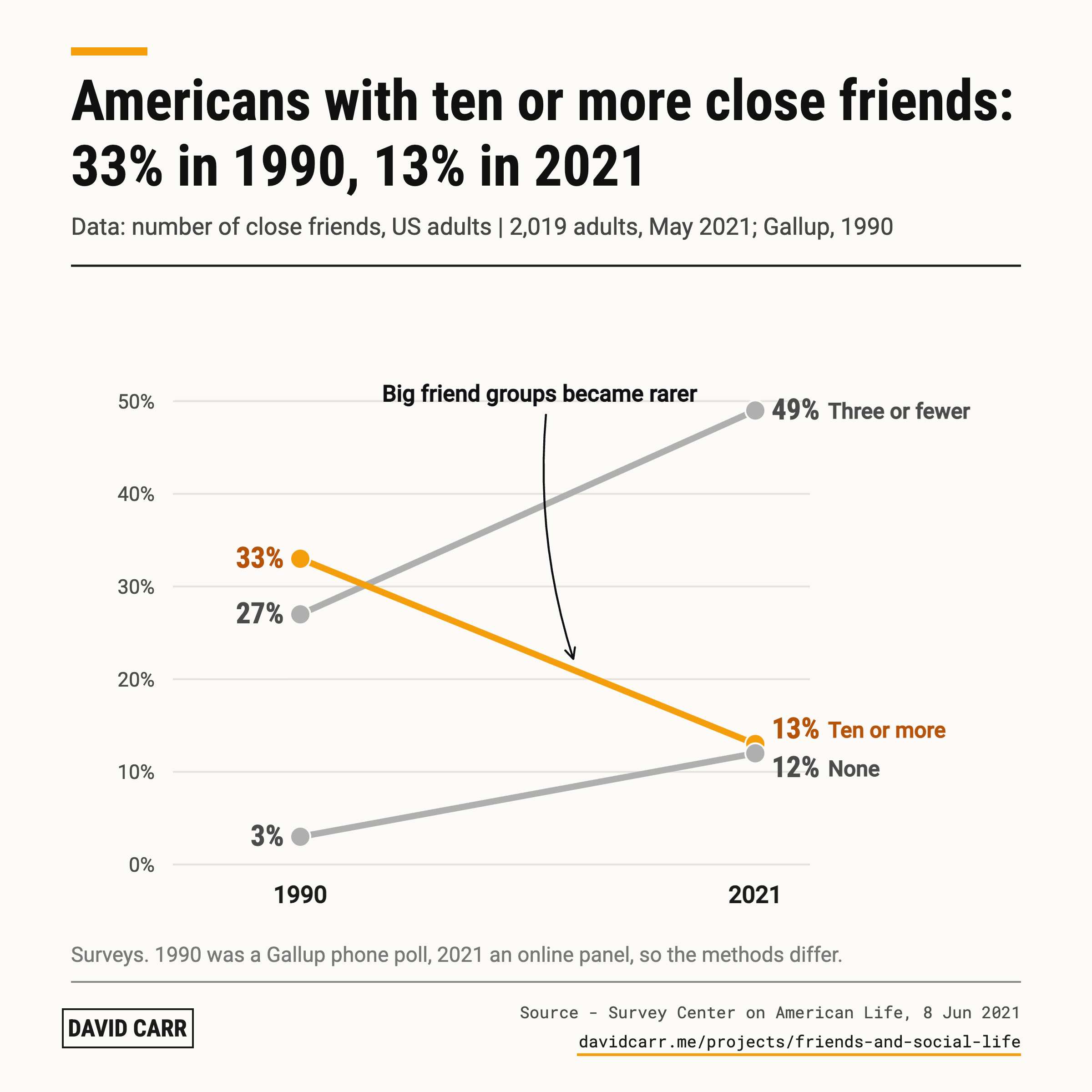
Americans with ten or more close friends: 33% in 1990, 13% in 2021
- Ten or more: 33% to 13%
- Three or fewer: 27% to 49%
- None: 3% to 12%
Circles have shrunk in the US over three decades. The two surveys used different methods, so treat the size of the change with care.
Survey Center on American Life, The State of American Friendship, Daniel A. Cox, 8 June 2021. 2,019 US adults, 14 to 23 May 2021. The 1990 figures are a Gallup phone poll, as cited there.
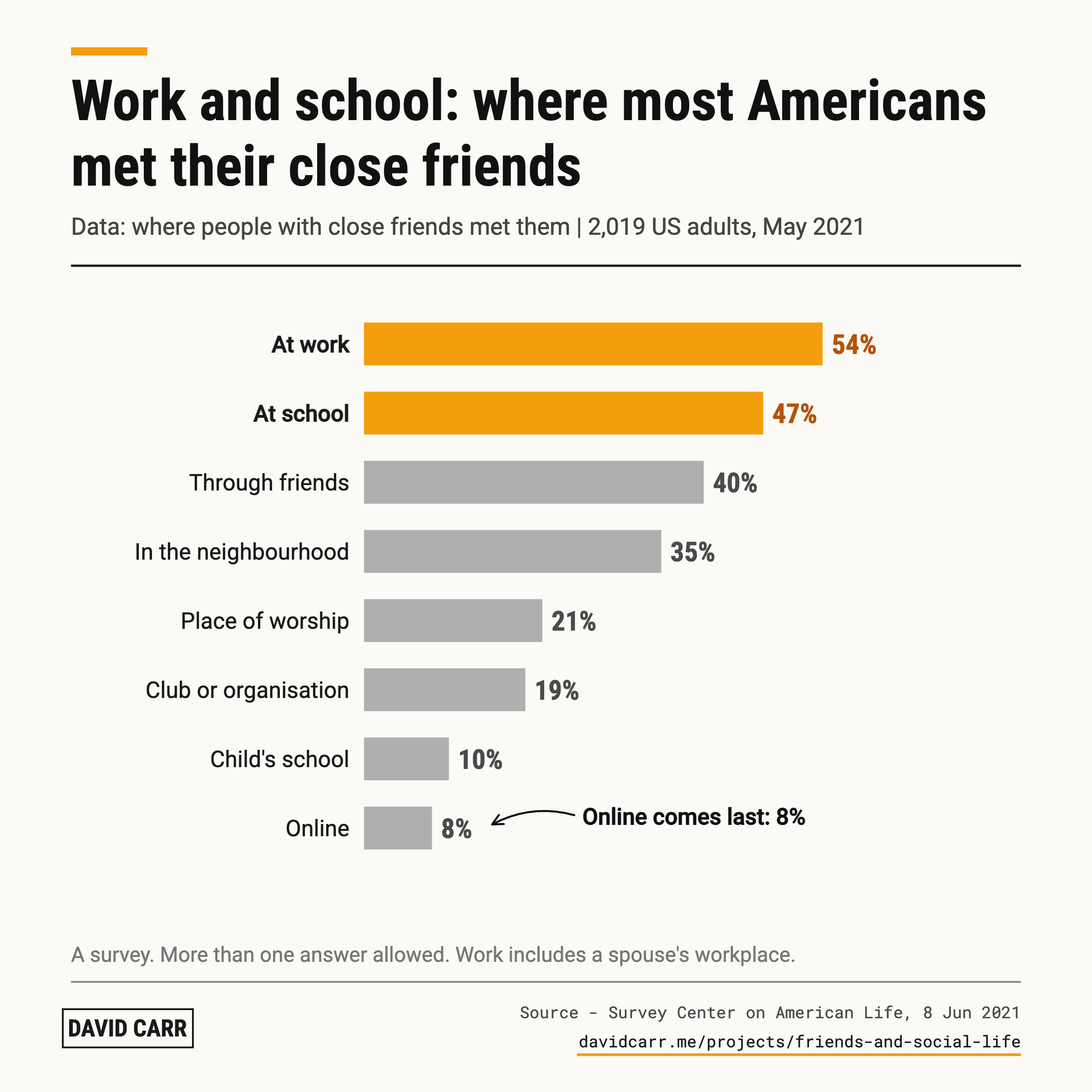
Work and school: where most Americans met their close friends
- Work: 54%
- School: 47%
- Through other friends: 40%
- Neighbourhood: 35%
- Online: 8%
Friendships mostly start in the places people see each other often. Among parents with children at home, 16% met a close friend through their child's school.
Same Survey Center on American Life survey, May 2021. People with at least one close friend; more than one answer allowed.
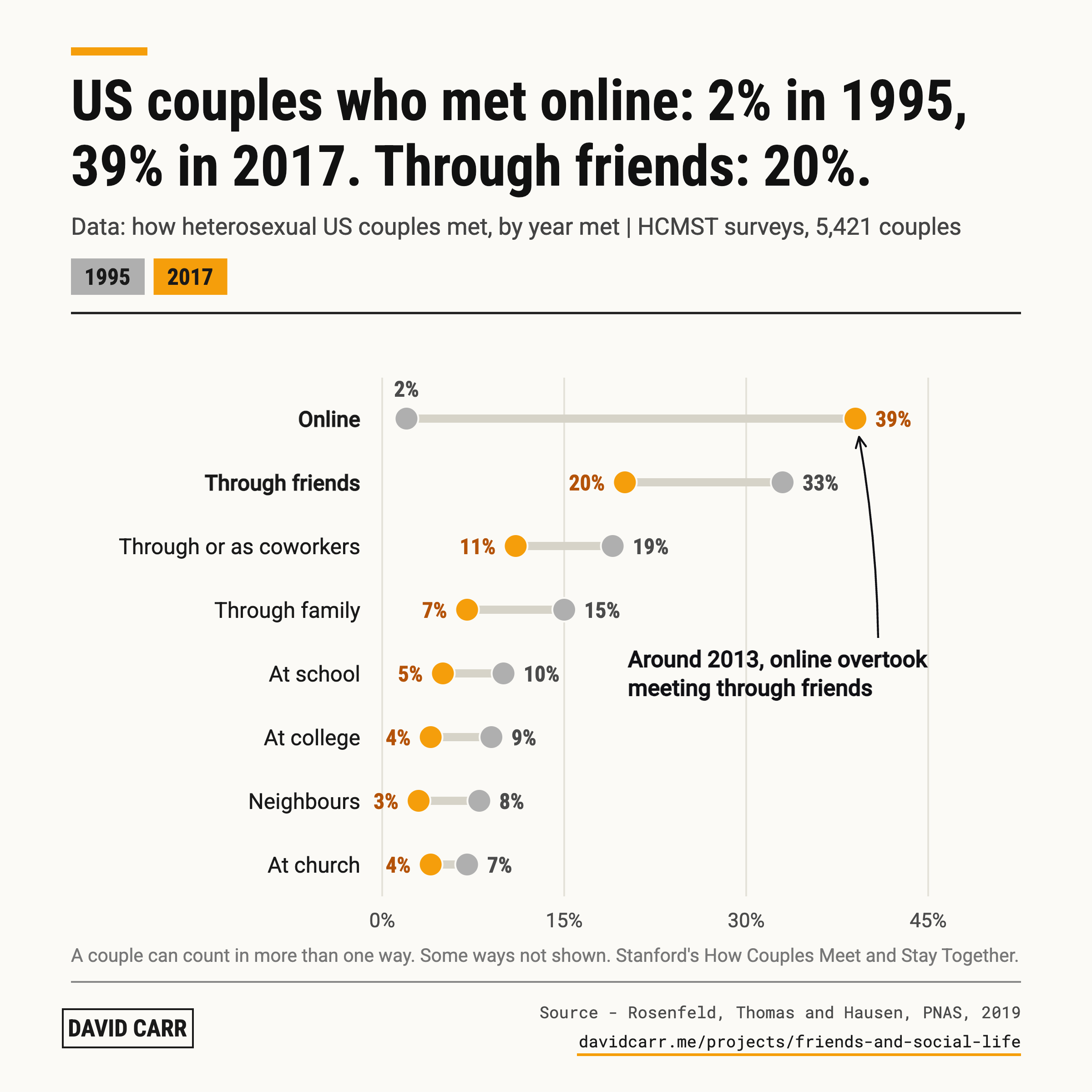
US couples who met online: 2% in 1995, 39% in 2017. Through friends: 20%.
- Online: 2% to 39%
- Through friends: 33% to 20%
- Coworkers: 19% to 11%
- Family: 15% to 7%
- Neighbours: 8% to 3%
Friends used to be the most common matchmakers. Online overtook them around 2013. For what happens next, see Engaged to married and Life milestones.
Rosenfeld, Thomas and Hausen, Disintermediating your friends, PNAS, 2019. Stanford's How Couples Meet and Stay Together surveys, 2009 and 2017: 5,421 heterosexual couples. A couple can count in more than one way.
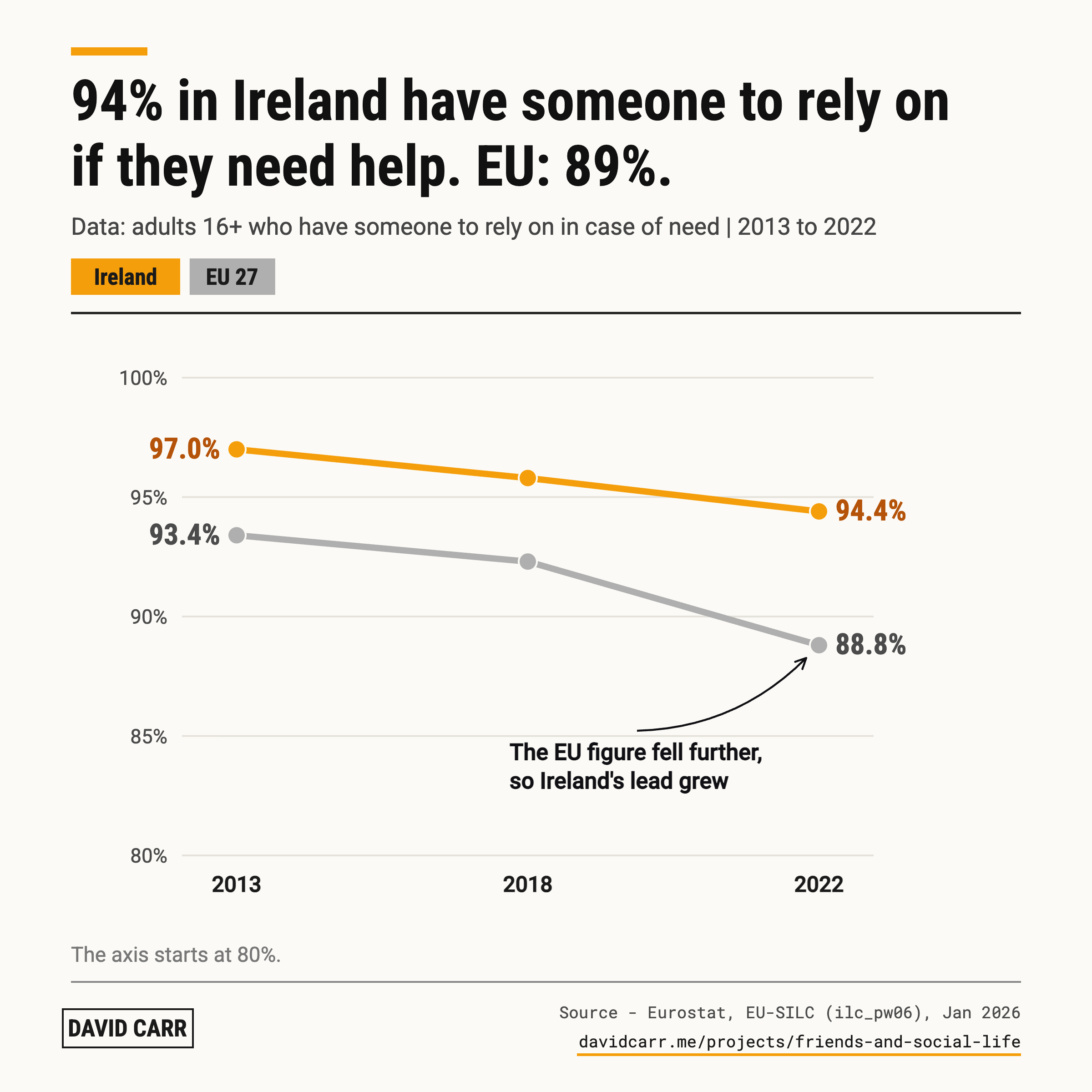
94% in Ireland have someone to rely on if they need help. EU: 89%.
- Ireland: 97.0% in 2013, 95.8% in 2018, 94.4% in 2022
- EU: 93.4%, 92.3%, 88.8%
- Highest in 2022: Norway 97.6%, Portugal 97.0%
Almost everyone in Ireland has someone to turn to. The share slipped a little, but less than across the EU.
Eurostat ilc_pw06, adults 16 and over: people who have someone to rely on in case of need.
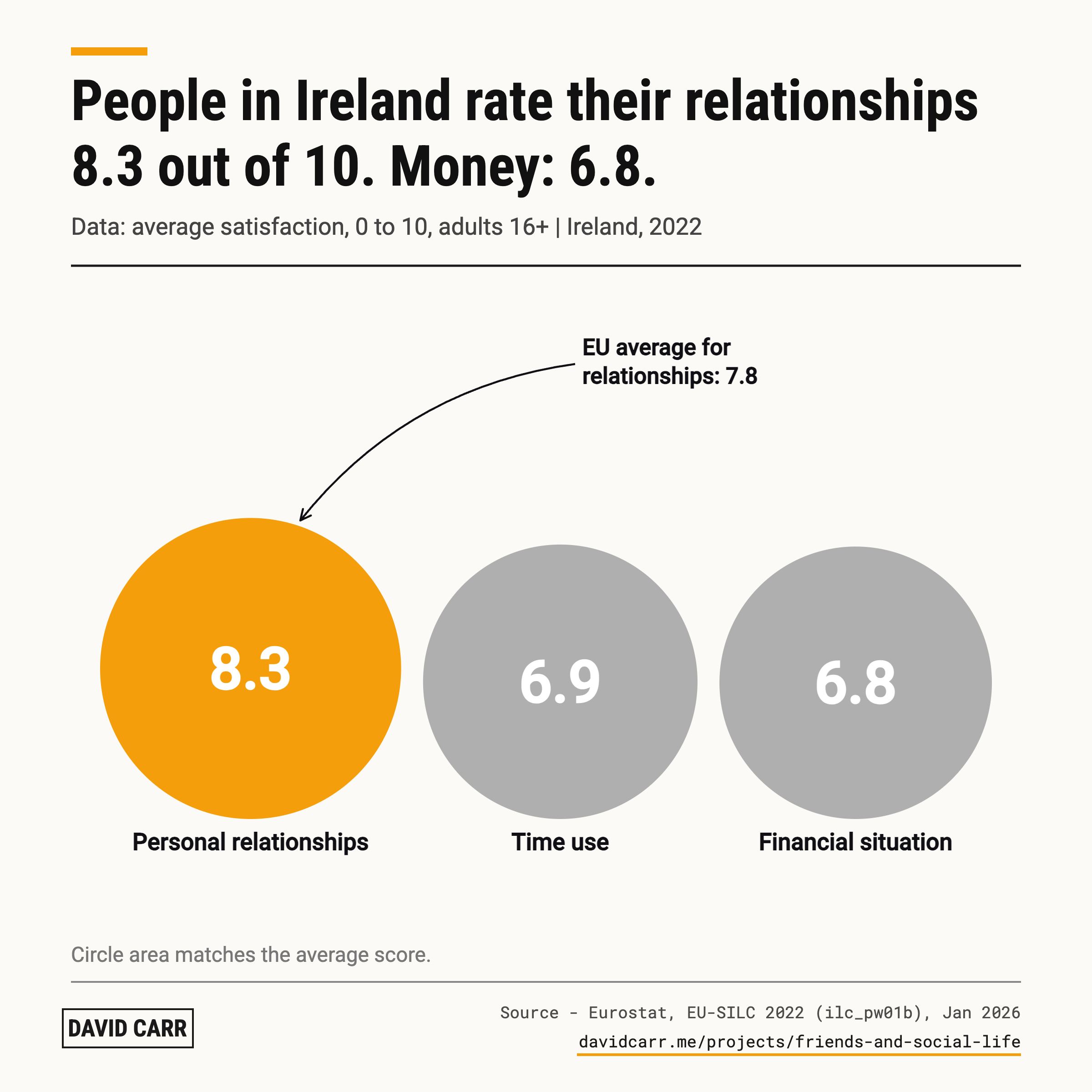
People in Ireland rate their relationships 8.3 out of 10. Money: 6.8.
- Personal relationships: 8.3 (EU 7.8)
- Time use: 6.9 (EU 6.8)
- Financial situation: 6.8 (EU 6.6)
- Relationships by age: 8.2 at 16 to 24, 8.6 at 75 and over
Relationships score highest of the three in Ireland and across the EU. Ireland is among the top countries, with Austria, Malta, Slovenia and Switzerland on 8.6.
Eurostat ilc_pw01b, 2022, average rating from 0 to 10.
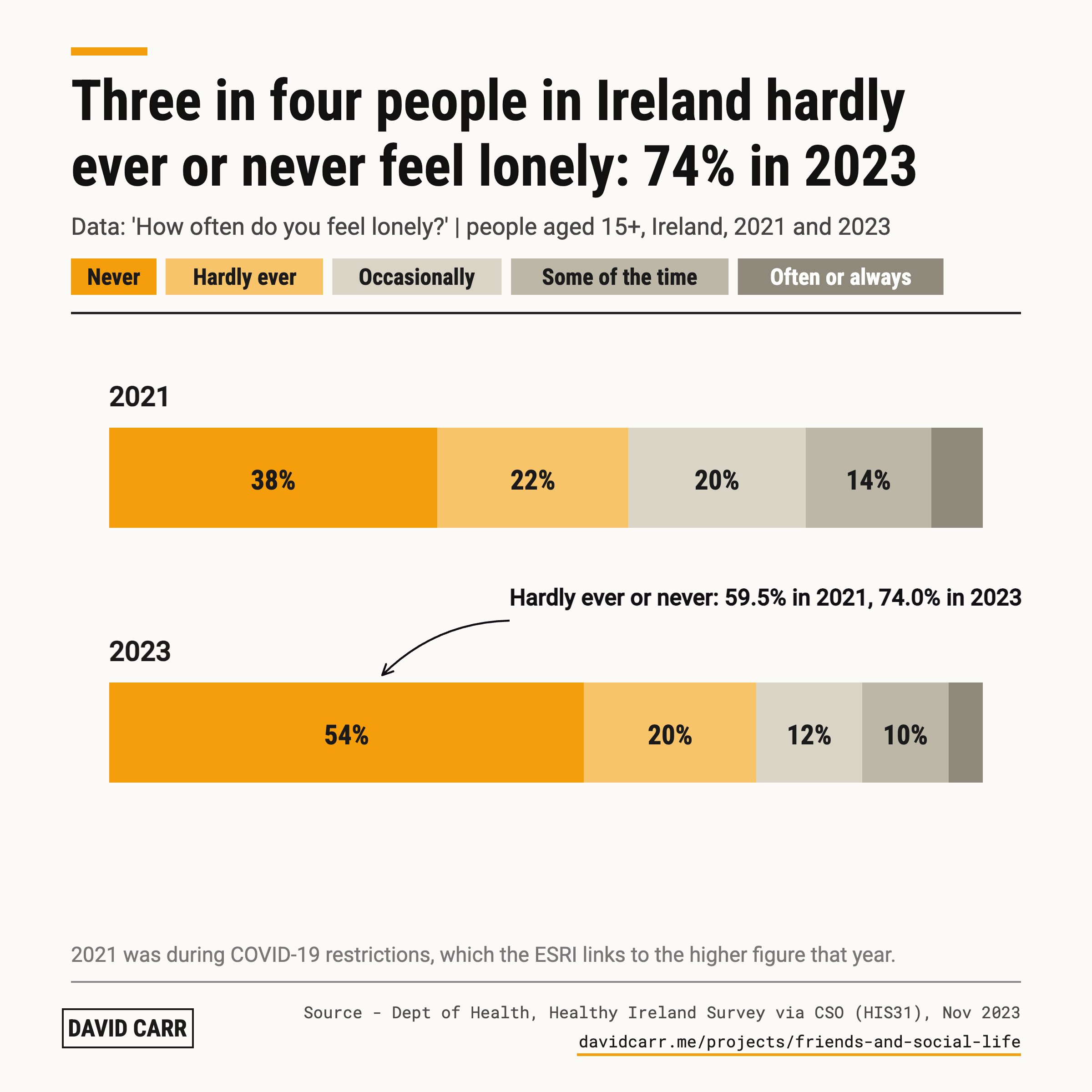
Three in four people in Ireland hardly ever or never feel lonely: 74% in 2023
- Never: 54.3% (2021: 37.6%)
- Hardly ever: 19.7% (21.9%)
- Occasionally: 12.1% (20.3%)
- Some of the time: 9.9% (14.4%)
- Often or always: 3.9% (5.9%)
Fewer people felt lonely in 2023 than in 2021. The ESRI links the higher 2021 figures to COVID-19 restrictions.
Department of Health, Healthy Ireland Survey, hosted by the CSO as table HIS31 (22 November 2023). People aged 15 and over. Context from the ESRI, 7 November 2025.
Method, caveats and sources
The short answer. About half of adults in Ireland meet friends in person every week, and three in four are in touch with friends by phone or online. Meet-ups are most common at 16 to 24 and least common from 35 to 54. Almost everyone (94%) has someone to rely on, people rate their relationships higher than their money or time, and most people hardly ever or never feel lonely.
Irish and European data. Eurostat EU-SILC ad-hoc modules: ilc_scp09, ilc_scp10, ilc_scp11, ilc_pw06 and ilc_pw01b, pulled from the Eurostat API on 29 November 2026. These questions are asked every few years, so 2022 is the latest. CSO tables GUI19 and HIS31, pulled the same day. HIS31 is Department of Health data from the Healthy Ireland Survey.
Surveys from elsewhere. There is no official count of close friends for Ireland beyond age 25, so the page uses YouGov (UK) and the Survey Center on American Life (US). These record what people say, and people decide for themselves who counts as a close friend. US data comes only from non-government sources.
Loneliness. Shown with official Irish data only, as how often people say they feel lonely. Eurostat also publishes a measure of feeling left out of society; it is a different question and is not used here. If loneliness is weighing on you, HSE mental health supports list free services.
Left out. Time spent socialising by age is on Time use, so it is not repeated. The OECD Better Life Index social support figure was not used; Eurostat's someone-to-rely-on table covers the same idea for Europe. In the couples chart, meeting in a bar or restaurant is not shown.
Related: Time use, Screen time, Social media, Engaged to married, Life milestones.