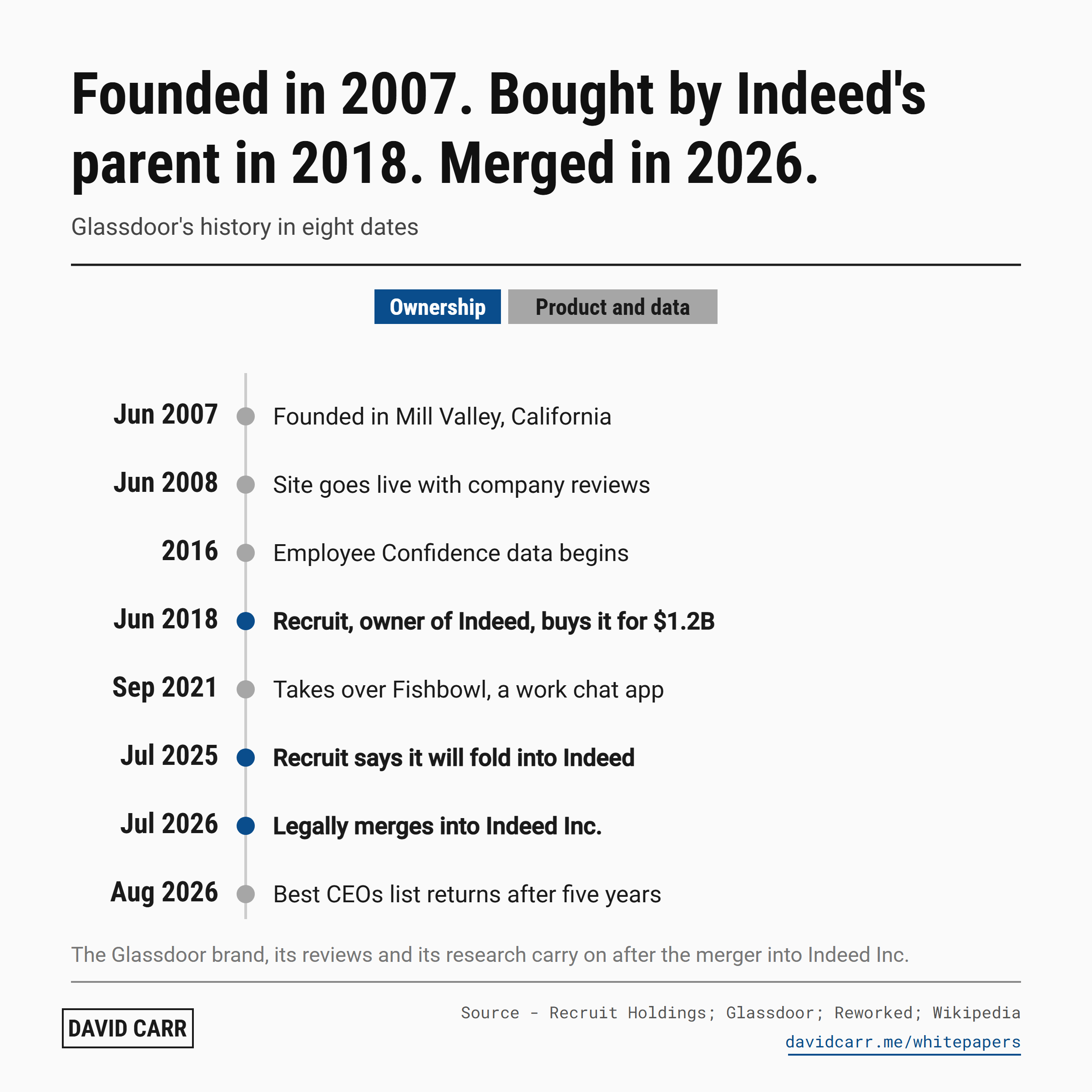
Founded in 2007. Bought by Indeed's parent in 2018. Merged in 2026.
Recruit has owned Indeed since 2012. For seven years the two sites ran side by side. The Glassdoor name, its reviews and its research carry on.
Founders: Robert Hohman, Rich Barton and Tim Besse. The site went live in June 2008.
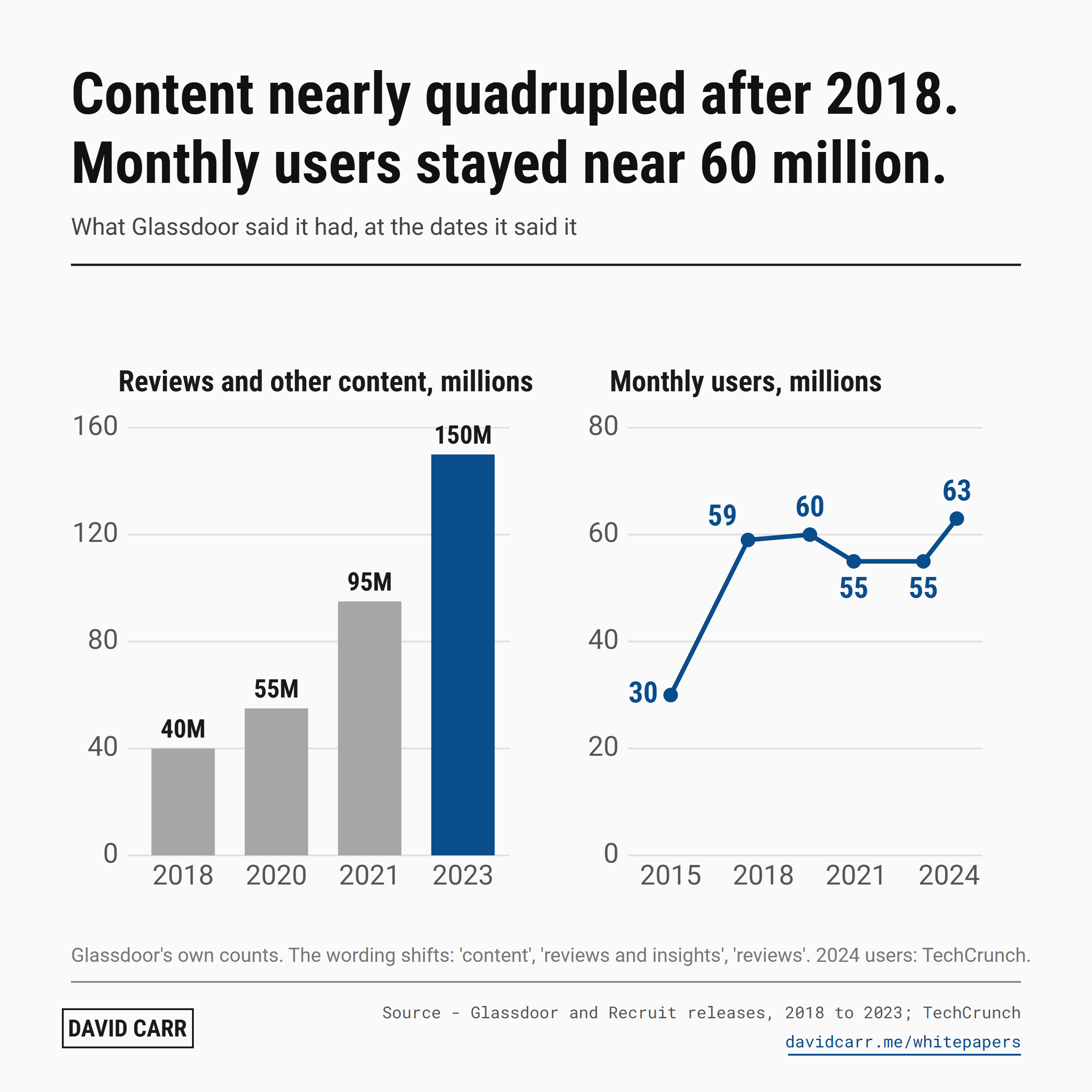
Content nearly quadrupled after 2018. Monthly users stayed near 60 million.
- January 2018: 40 million pieces of content, 59 million monthly users
- January 2020: 55 million reviews and insights, 60 million+
- 2021: 95 million reviews and insights, 55 million+
- 2023: 150 million reviews, 55 million+
The pile of reviews keeps growing. The audience reading them has held steady for most of a decade.
Glassdoor's own counts, and its wording changes from one release to the next. The 2024 figure of 63 million monthly visitors is from TechCrunch.
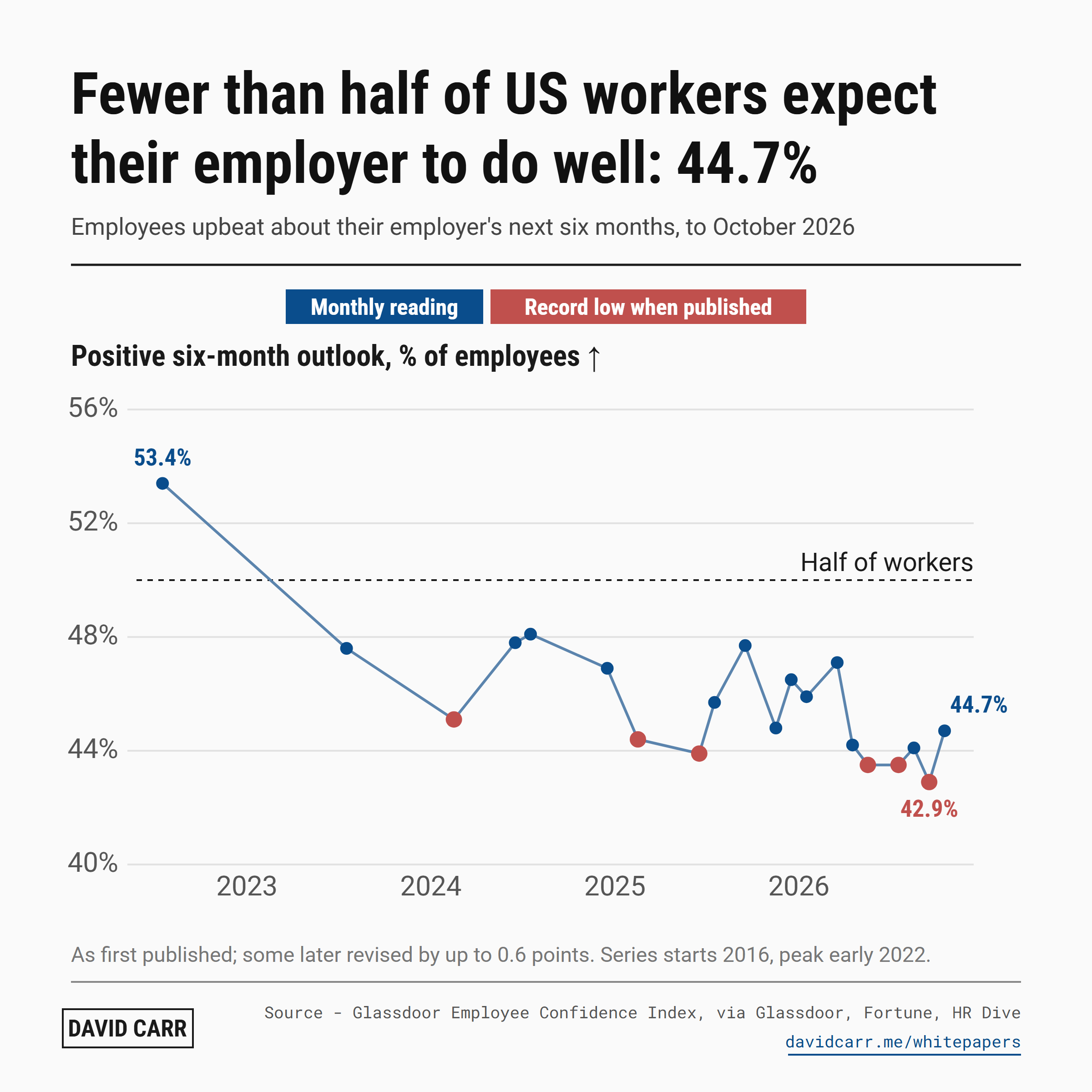
Fewer than half of US workers expect their employer to do well: 44.7%
Glassdoor's Employee Confidence Index asks reviewers whether they think their employer's business will get better over the next six months. It hit record lows five times between February 2025 and September 2026.
Each reading as first published. Glassdoor revises some later: September 2026 became 43.5%.
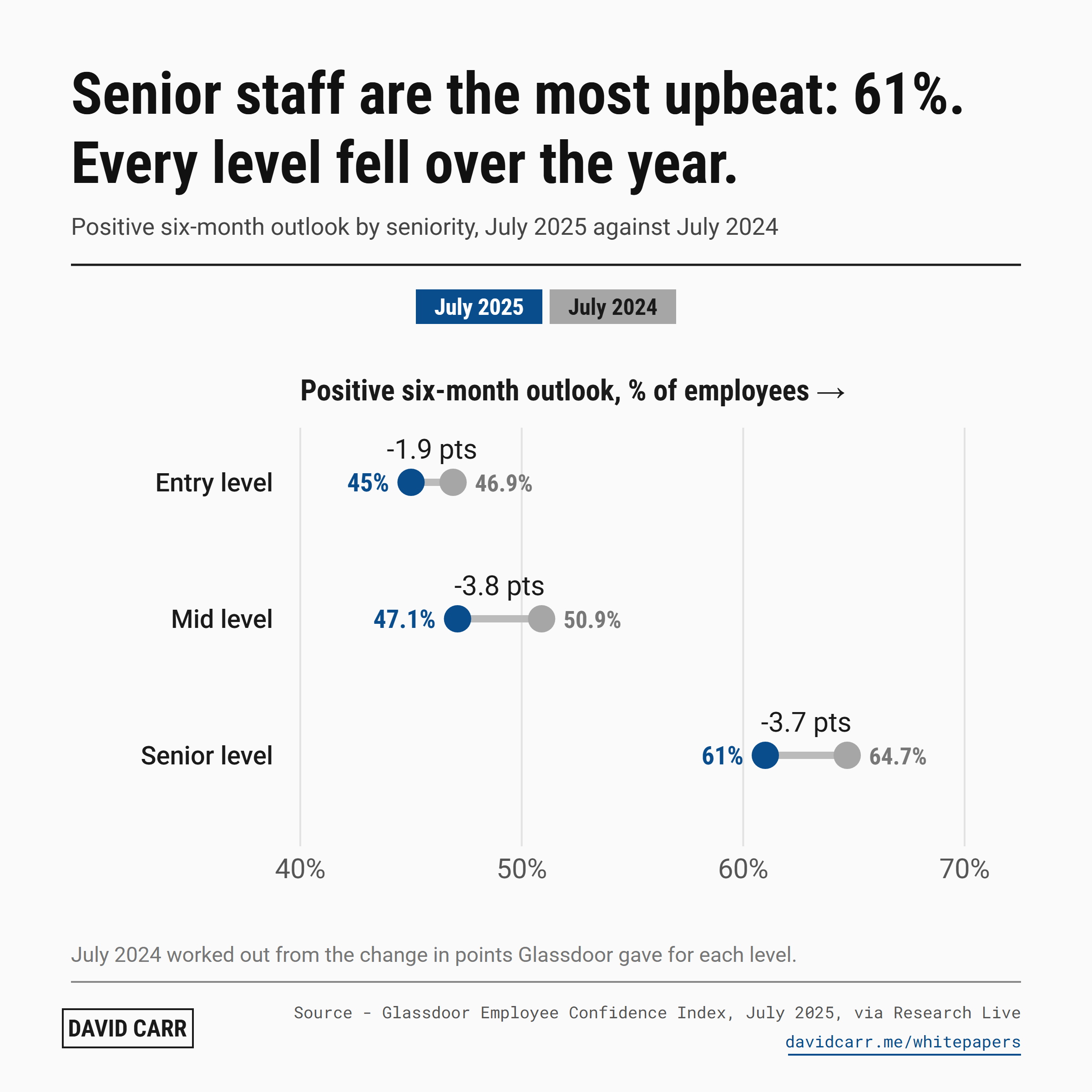
Senior staff are the most upbeat: 61%. Every level fell over the year.
- Senior level: 61%, down 3.7 points
- Mid level: 47.1%, down 3.8 points
- Entry level: 45%, down 1.9 points
The higher up you sit, the better the outlook. The gap between senior and entry level is 16 points.
July 2025 figures, from Glassdoor via Research Live. The July 2024 dots are worked out from the change in points.
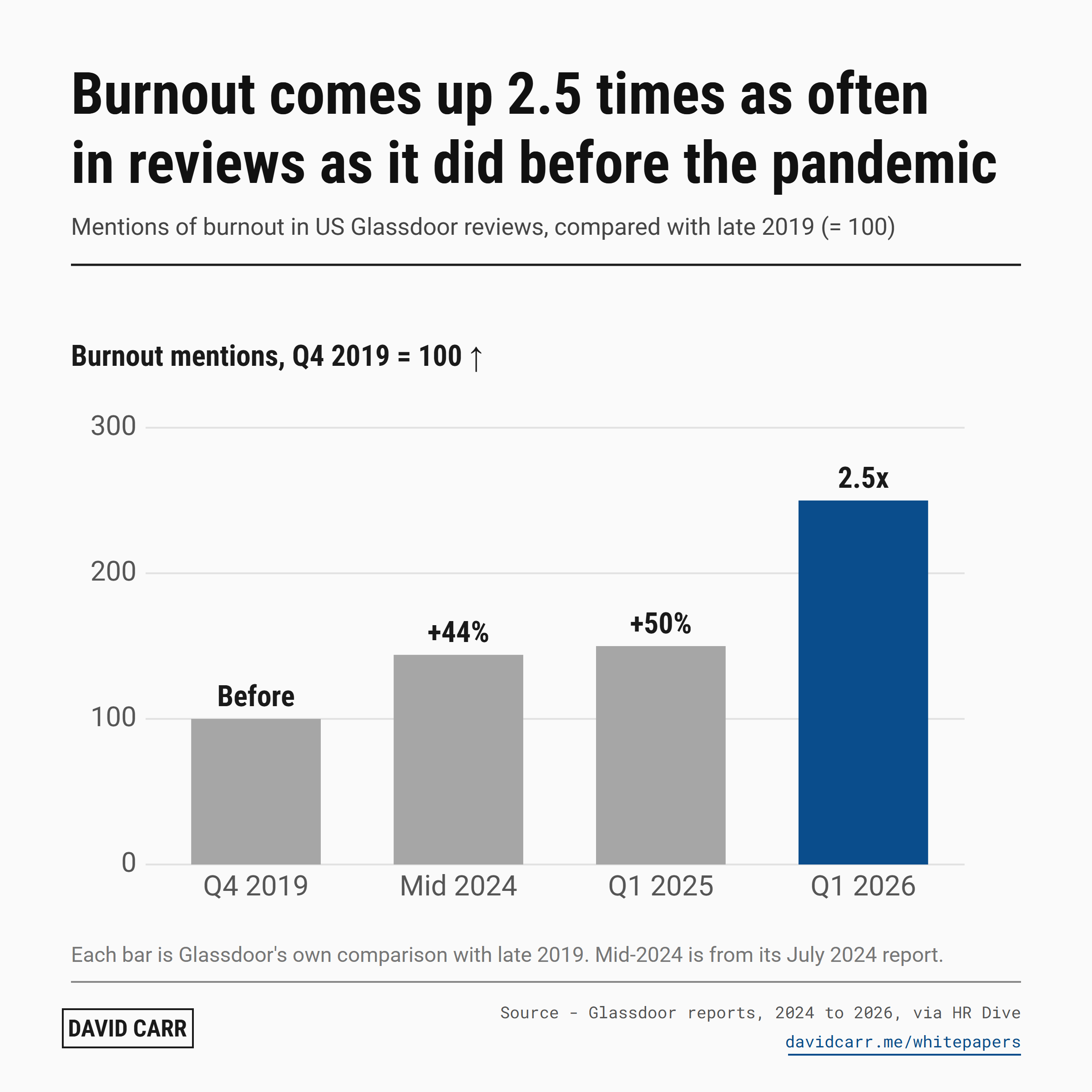
Burnout comes up 2.5 times as often in reviews as it did before the pandemic
- Mid-2024: 44% above late 2019
- Q1 2025: 50% above, up 32% on the year
- Q1 2026: about 2.5 times, up 65% on the year
Glassdoor has tracked the word since 2016. Each new report has been a new high.
Each figure is Glassdoor's own comparison with the last quarter of 2019. Glassdoor doesn't publish the raw share of reviews.
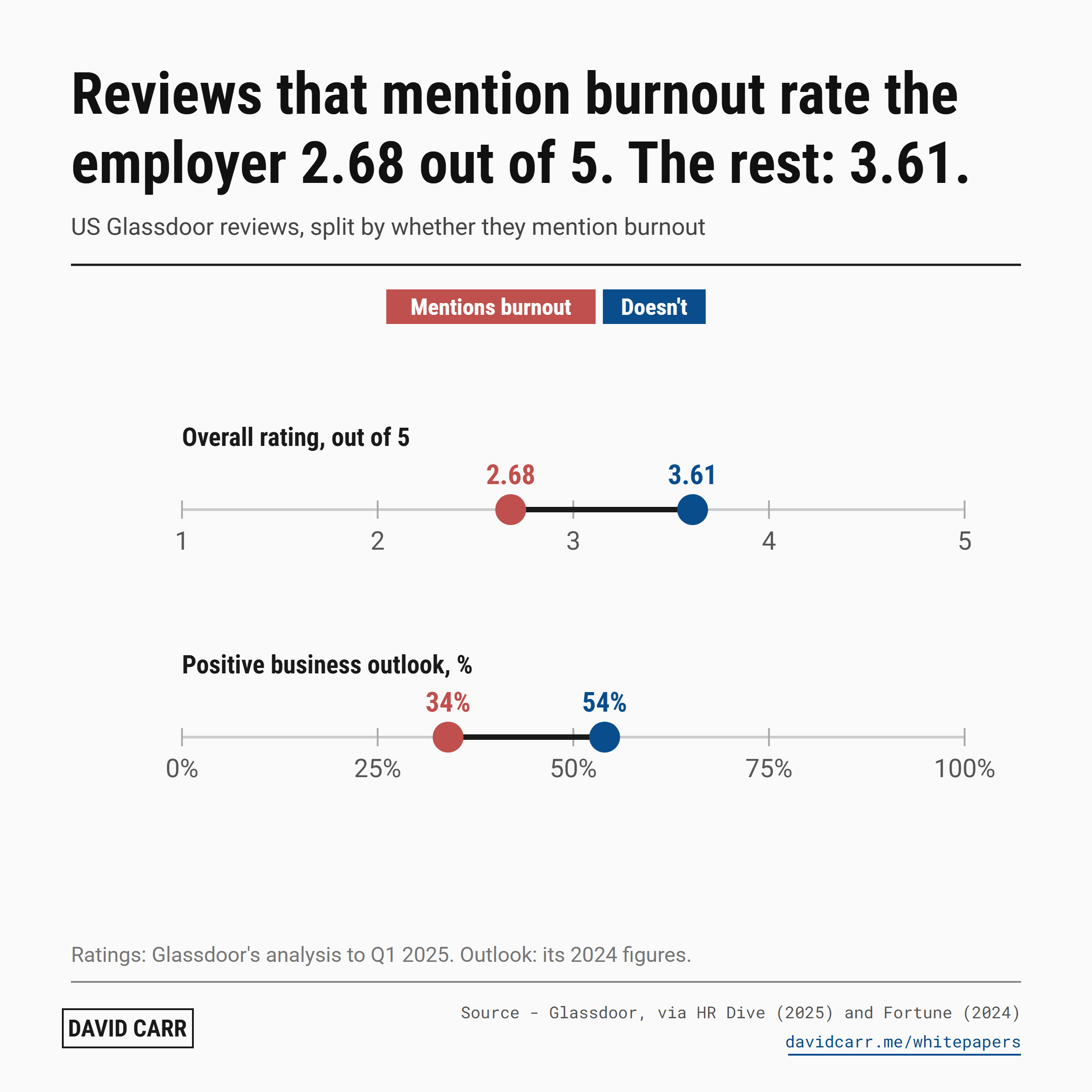
Reviews that mention burnout rate the employer 2.68 out of 5. The rest: 3.61.
Work-life balance takes the biggest hit: its rating is 34% lower in reviews that mention burnout.
Daniel Zhao, who leads Glassdoor's economic research, called burnout a "slow-burn problem".
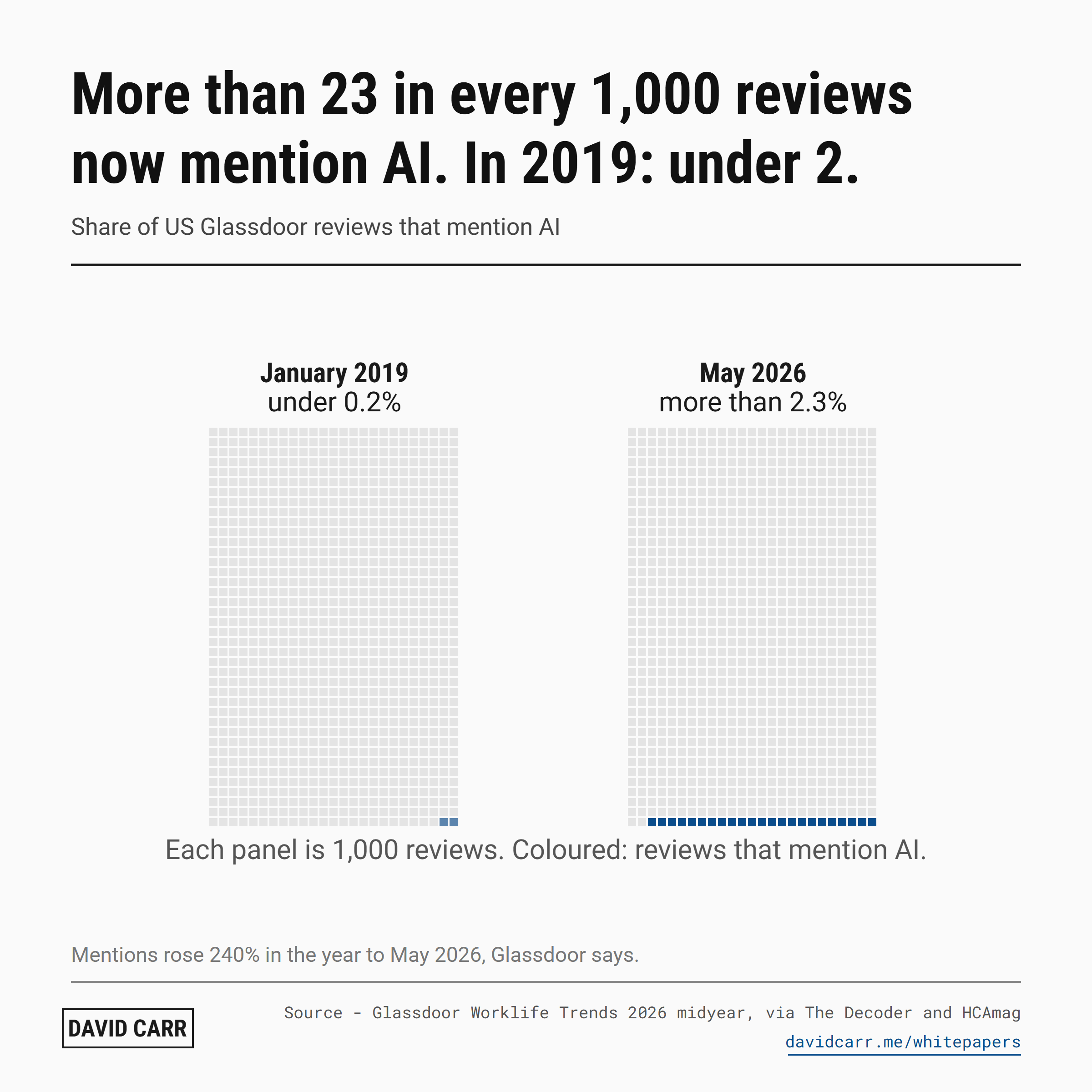
More than 23 in every 1,000 reviews now mention AI. In 2019: under 2.
- January 2019: under 0.2% of US reviews
- May 2026: more than 2.3%
- Up 240% in the year to May 2026
In 2019 AI was a rare word in a review. Mentions have grown more than tenfold since.
From Glassdoor's Worklife Trends 2026 midyear check-in, via The Decoder and HCAmag.
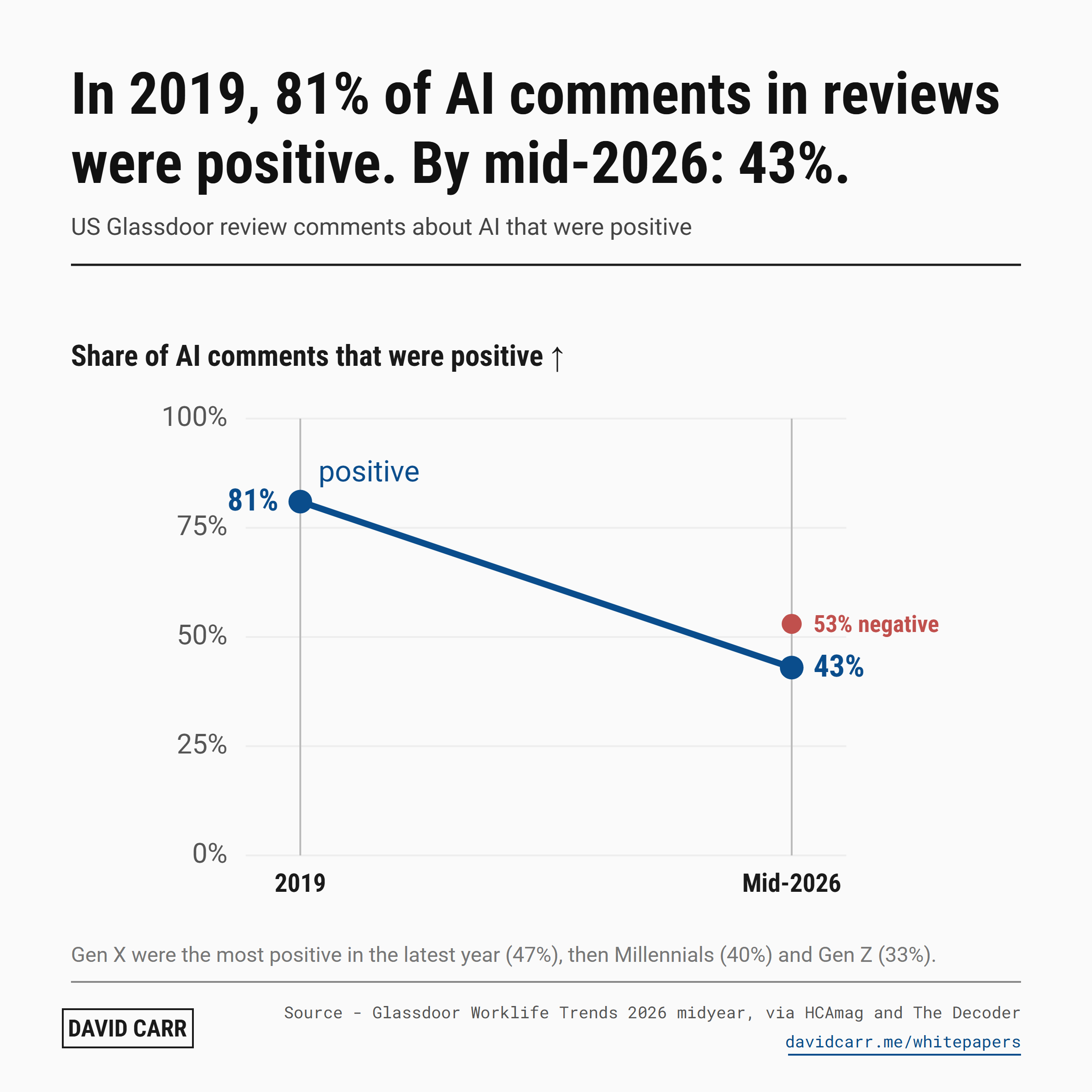
In 2019, 81% of AI comments in reviews were positive. By mid-2026: 43%.
- 2019: 81% positive
- Mid-2026: 43% positive, 53% negative
- Gen X 47% positive, Millennials 40%, Gen Z 33%
More people are talking about AI at work, and fewer of them like what they see. Executives were the most positive group.
Glassdoor's analysis of US reviews, via HCAmag. Reviews are self-selected, so they don't stand for the whole workforce.
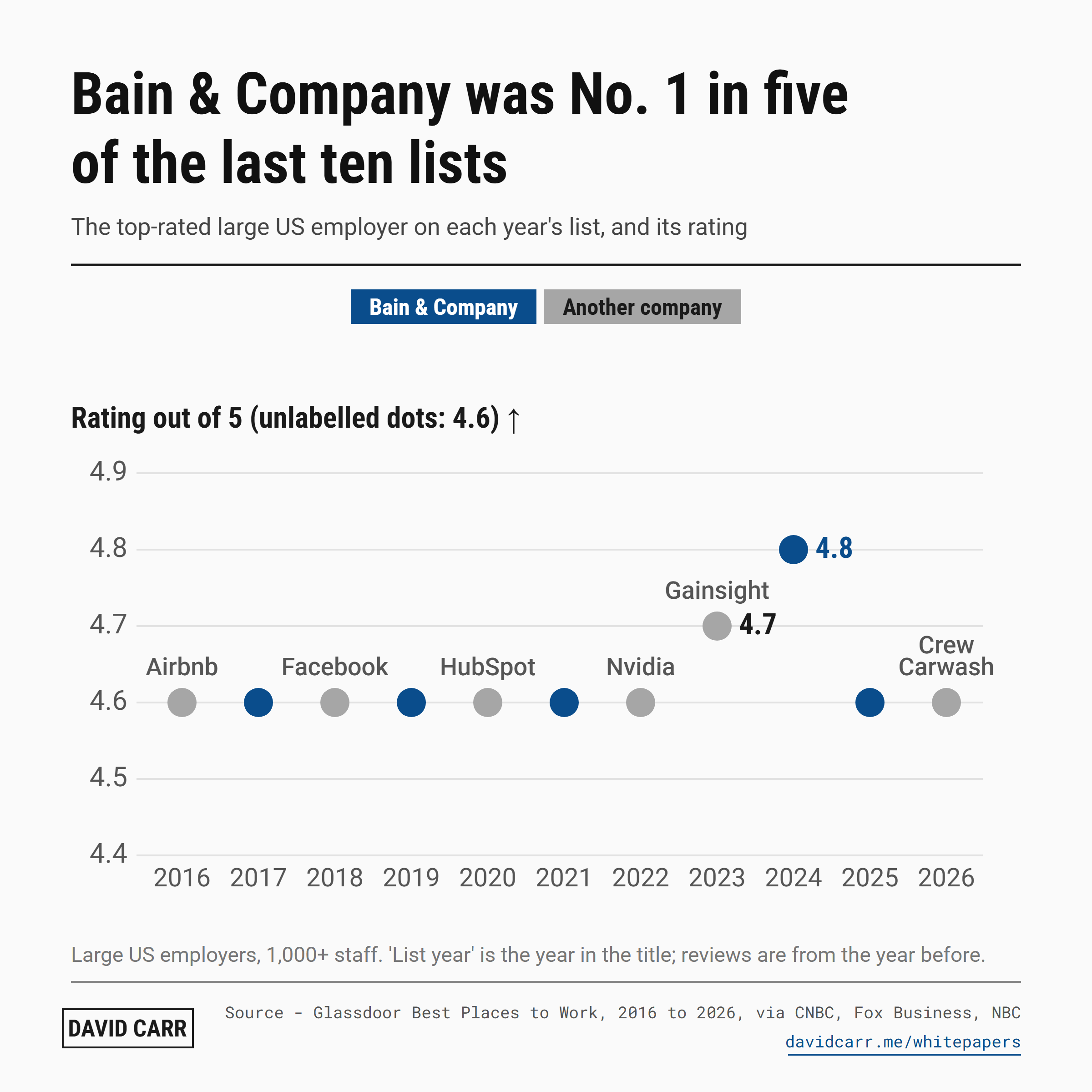
Bain & Company was No. 1 in five of the last ten lists
The winner's rating barely moves. Nine of the eleven winners since 2016 scored 4.6.
Large US employers with 1,000+ staff. A list year's rankings use reviews from the year before. Bain says it has ranked in the top four every year since the list began.
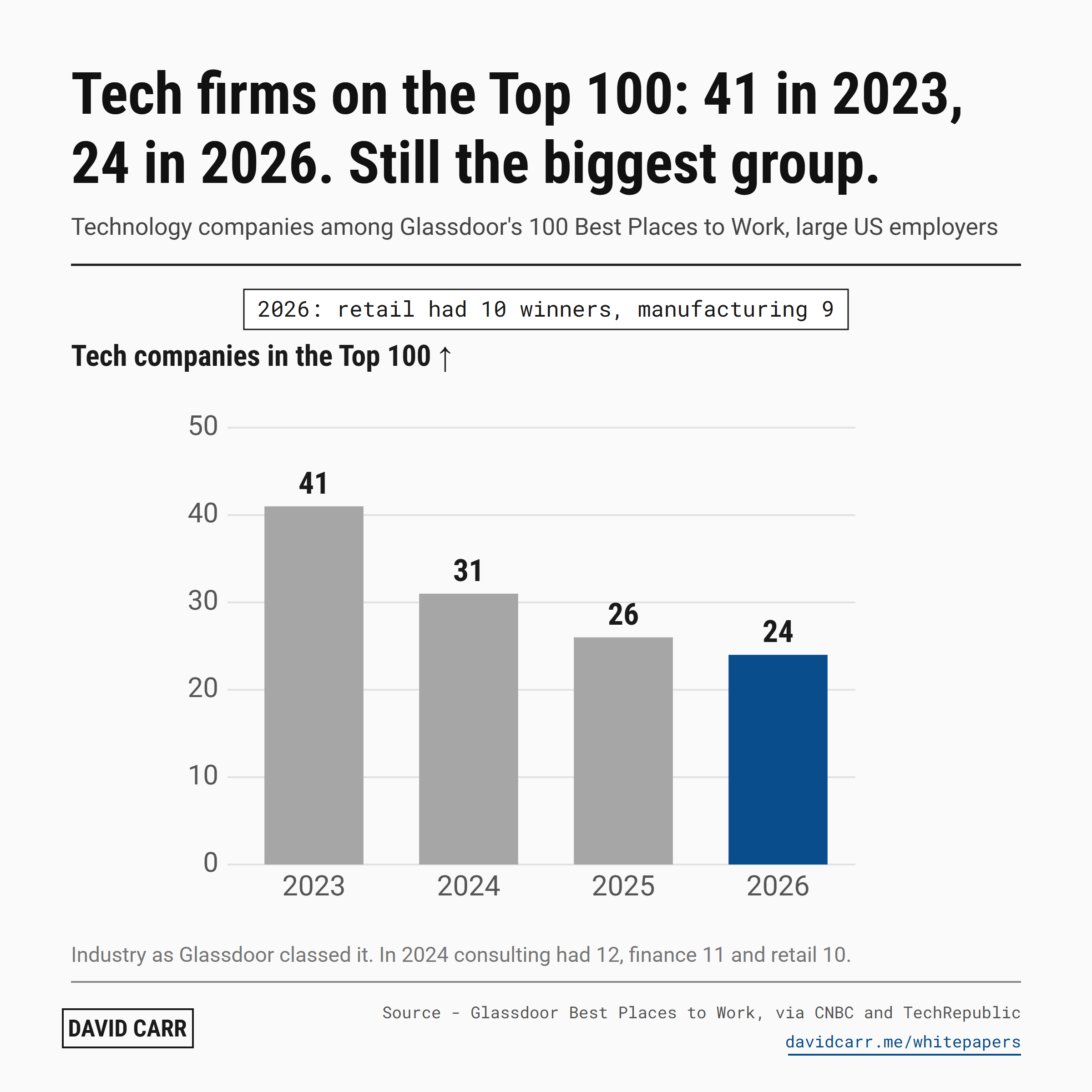
Tech firms on the Top 100: 41 in 2023, 24 in 2026. Still the biggest group.
Retail had 10 winners in 2026 and manufacturing 9. A car wash chain was No. 1.
Industries as Glassdoor classes them.
Method, caveats and sources
The short answer. Glassdoor has more reviews than ever and about the same number of monthly users as in 2018. Since July 2026 it is part of Indeed. Its data shows worker confidence setting record lows three times in 2026, burnout mentioned 2.5 times as often as before the pandemic, and AI going from a rare, mostly positive topic to a common, mostly negative one.
Glassdoor's research. The confidence, burnout and AI figures come from Glassdoor's economic research team, led by Daniel Zhao. Glassdoor's own pages block automated reading, so most figures were checked in its blog text and in the press that reported them: Fortune, HR Dive, Research Live, Newsweek, HCAmag and The Decoder. Each source is linked on its chart.
Employee Confidence. The share of US reviewers who expect their employer's business to improve over the next six months. Glassdoor revises recent months, so readings are shown as first published. The series starts in 2016 and peaked in early 2022. Earlier monthly values weren't found in a published form, so they're left out.
Reviews are self-selected. People choose to write them, so they don't stand for every worker. Glassdoor says this itself.
Best Places to Work. Ratings and ranks as Glassdoor published them, for large US employers. Rankings use more than the star rating, so companies with the same rating can rank differently.
Users and content. Glassdoor's own figures from its press releases and Recruit's. They measure slightly different things each time.
Also: Stripe, Indeed and LinkedIn.