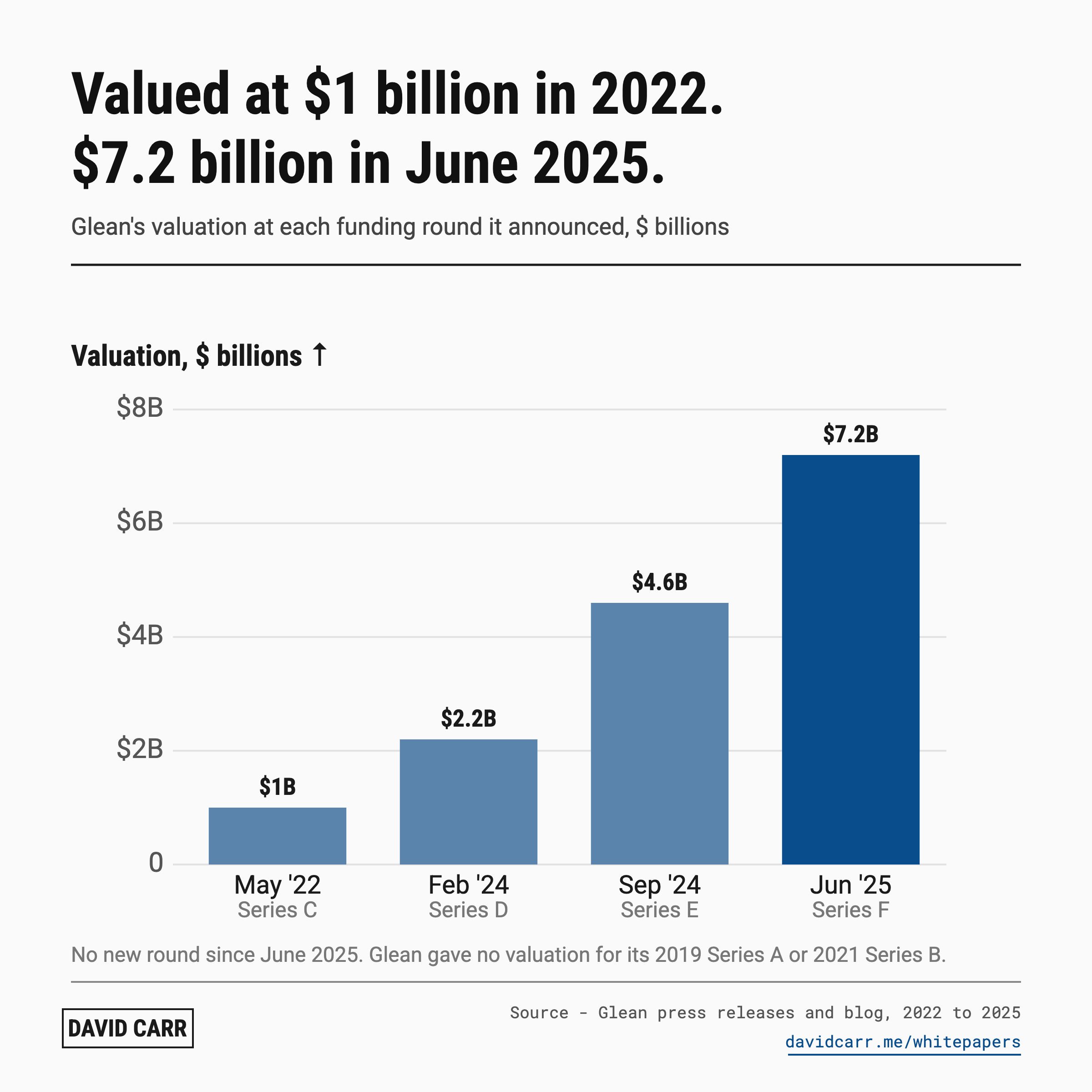
Valued at $1 billion in 2022. $7.2 billion in June 2025.
The value doubled in just over six months in 2024. There has been no new round since June 2025. Since then recurring revenue has gone from about $100 million to $300 million.
All four valuations are from Glean's own announcements.
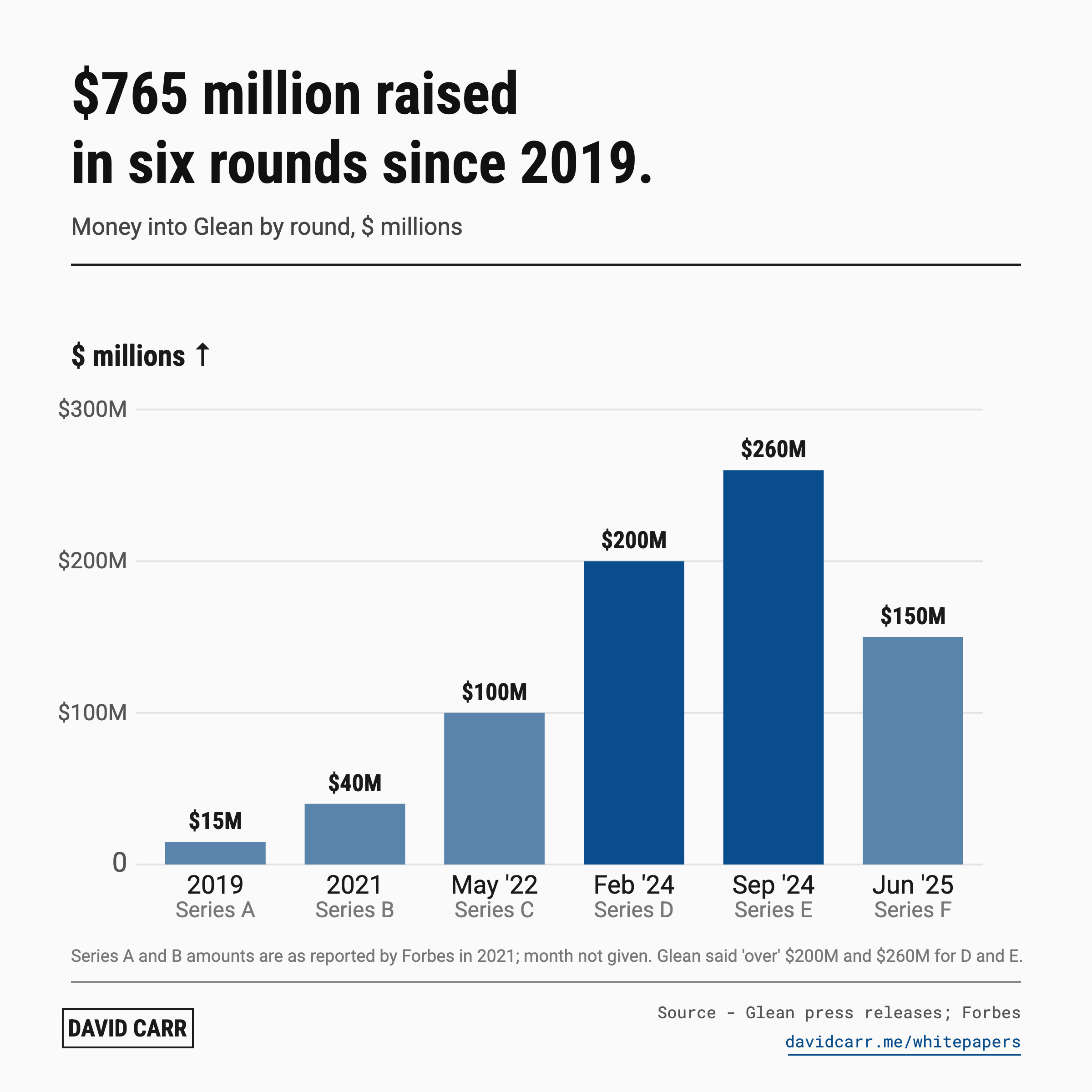
$765 million raised in six rounds since 2019.
- Series A, 2019: $15 million, led by Kleiner Perkins
- Series B, 2021: $40 million, General Catalyst
- Series C, May 2022: $100 million, Sequoia
- Series D, Feb 2024: over $200 million, Kleiner Perkins and Lightspeed
- Series E, Sep 2024: over $260 million, Altimeter and DST Global
- Series F, Jun 2025: $150 million, Wellington Management
Other companies invested too: the Series D included Capital One Ventures, Citi, Databricks Ventures and Workday Ventures.
$765 million is my sum. The Series A and B amounts are as Forbes reported them when Glean launched in 2021.
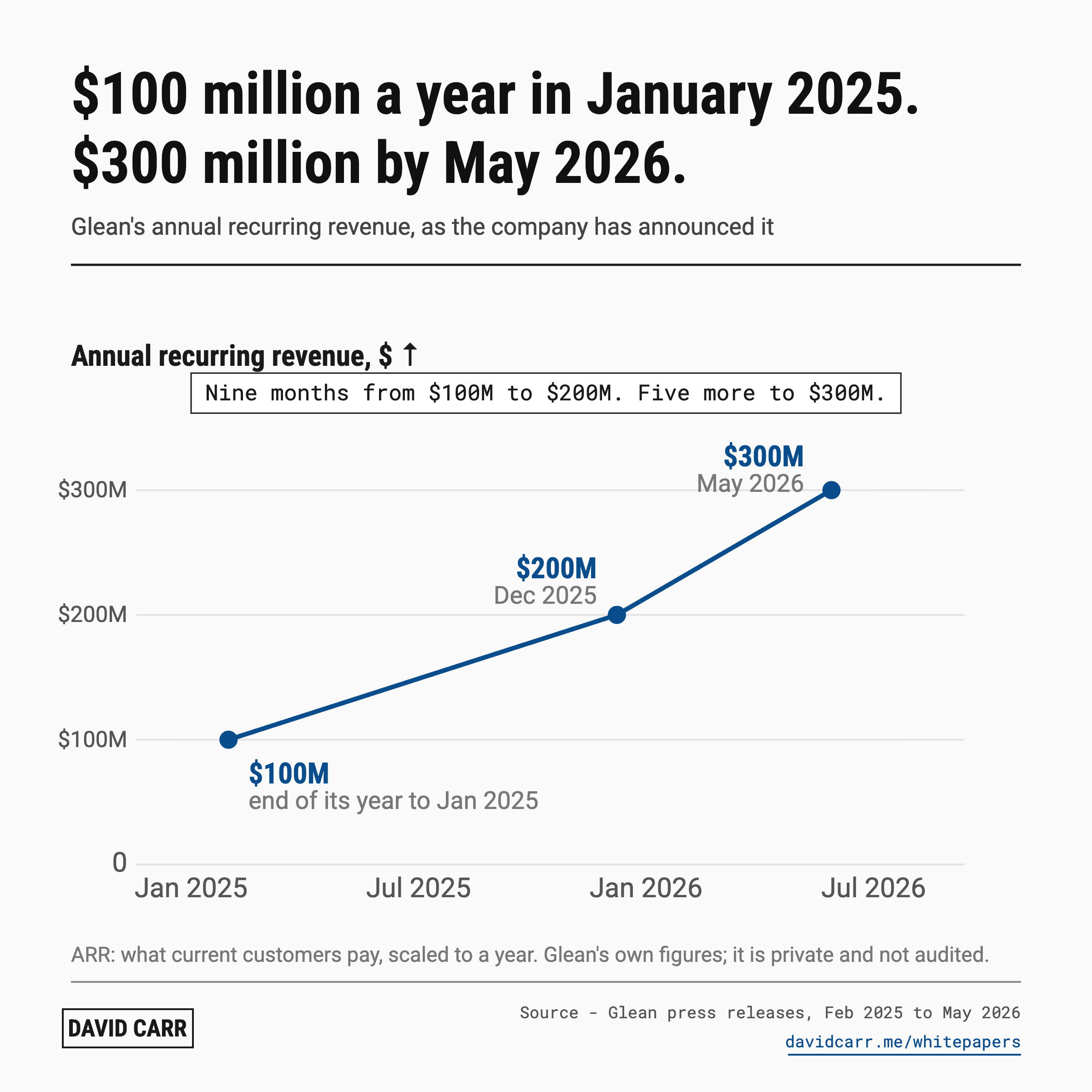
$100 million a year in January 2025. $300 million by May 2026.
It took nine months to go from $100 million to $200 million, and five more to reach $300 million.
ARR is annual recurring revenue: what current customers pay, scaled to a year. All three figures are Glean's own. The CEO told Fortune it counts subscriptions only, not services. Glean's year ends in January.
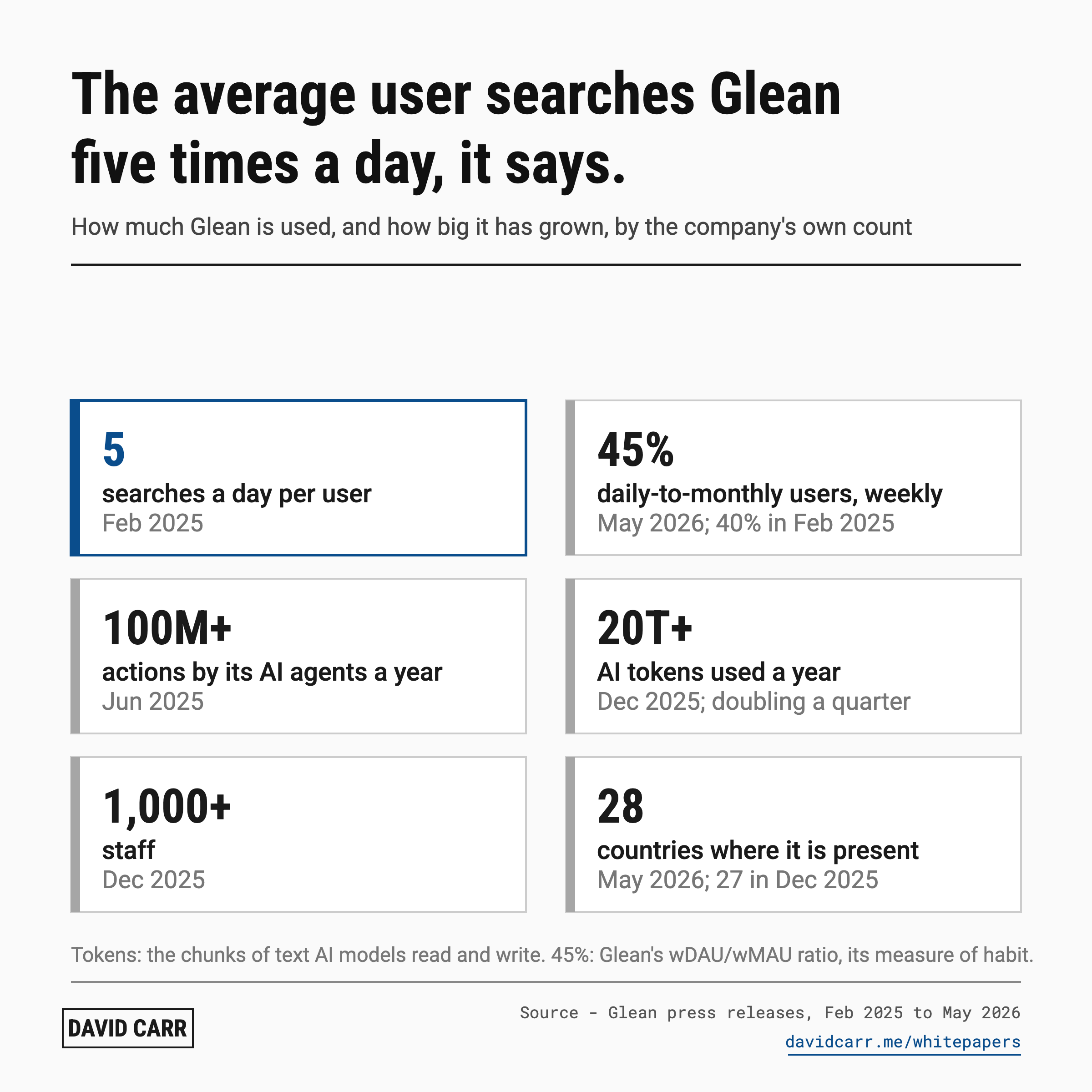
The average user searches Glean five times a day, it says.
Glean compares five searches a day with how people use web search. In June 2025 it set a goal of one billion agent actions by the end of that year; it has not said if it got there.
Every figure here is Glean's own. Tokens are the chunks of text AI models read and write.
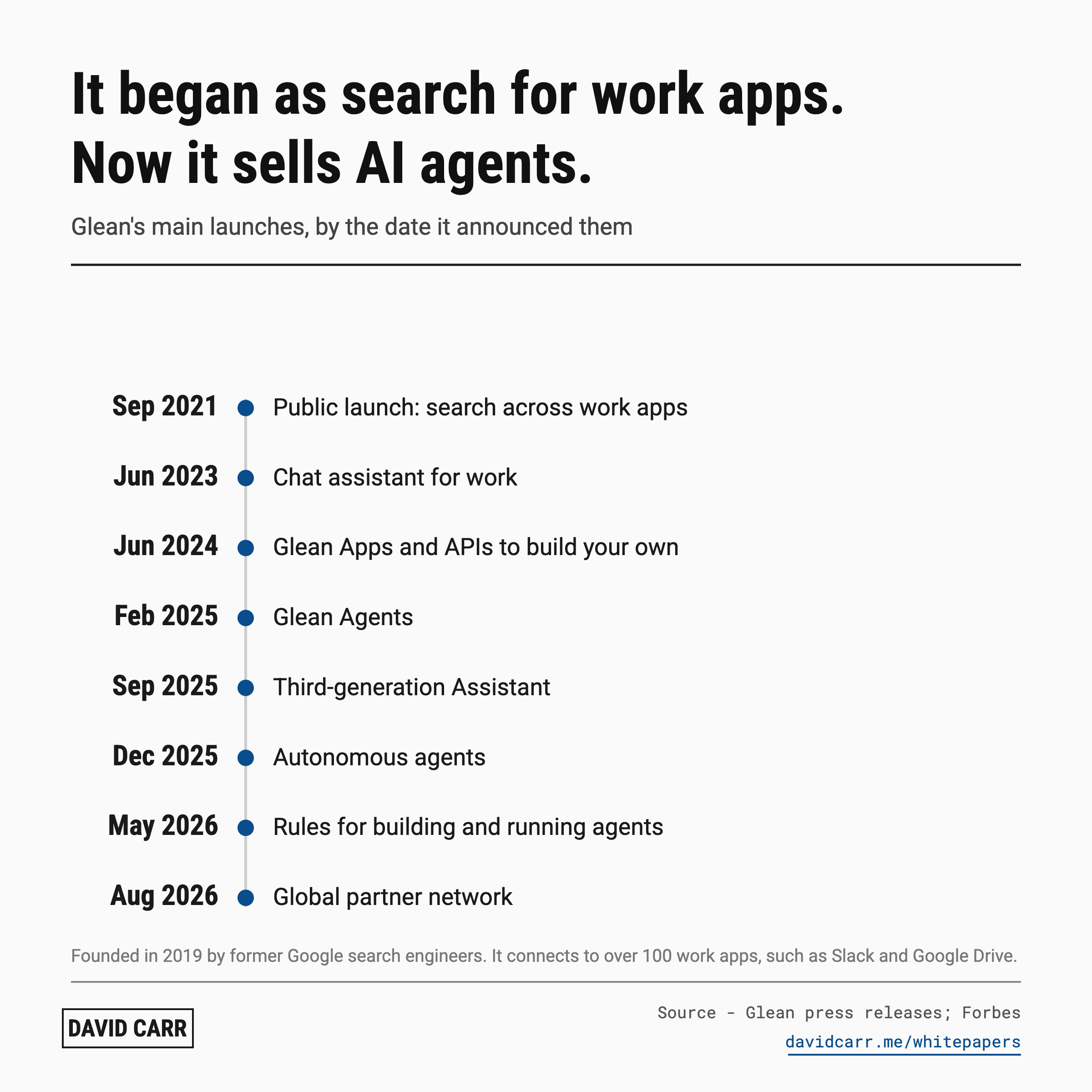
It began as search for work apps. Now it sells AI agents.
The founders built search at Google. Glean's pitch is the same idea for a company's own documents, chats and tickets, with AI on top.
Dates are when Glean announced each launch.
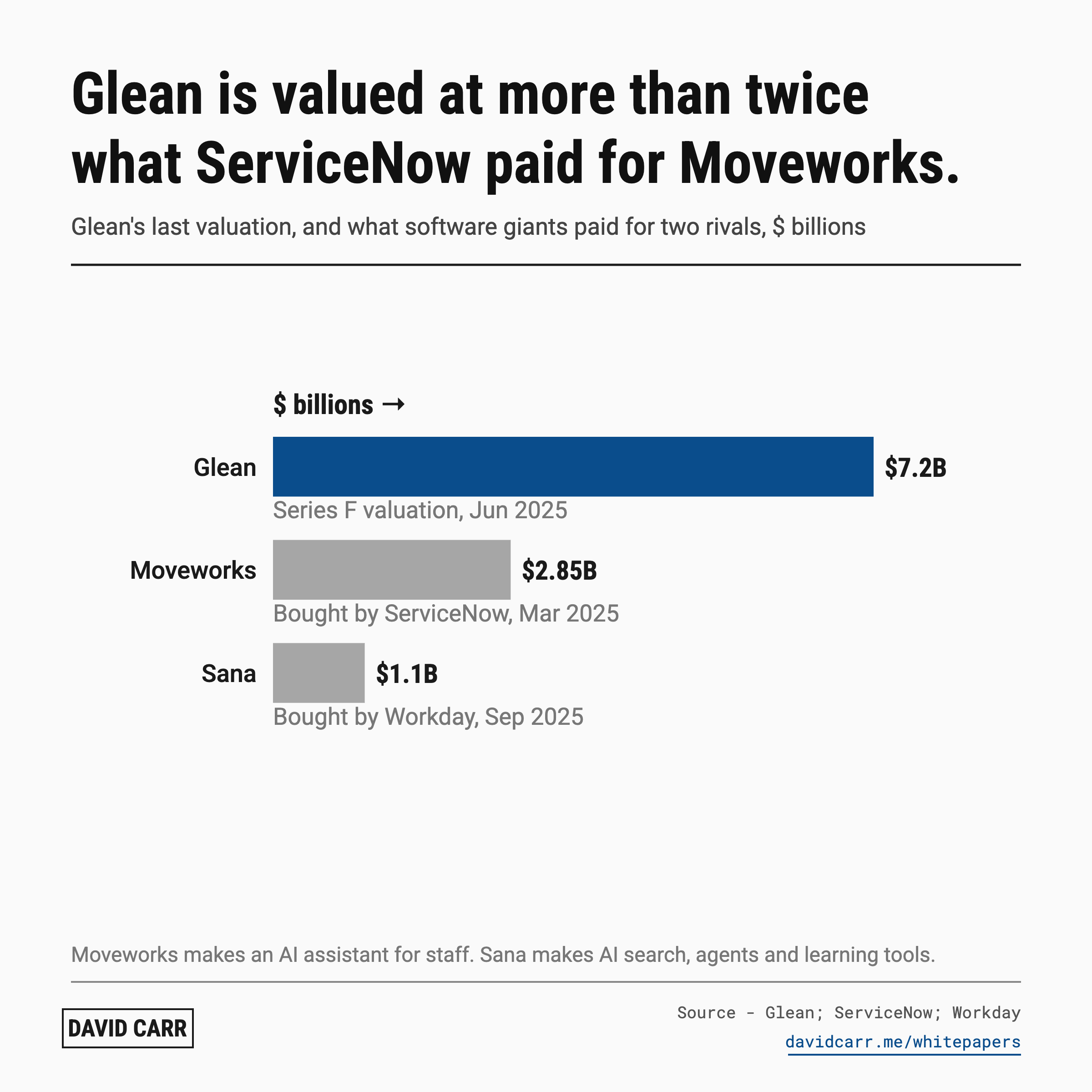
Glean is valued at more than twice what ServiceNow paid for Moveworks.
Two firms selling AI help for staff are now parts of bigger software companies. Glean is still independent.
Moveworks makes an AI assistant for staff questions. Sana makes AI search, agents and learning tools. Prices are what the buyers announced.
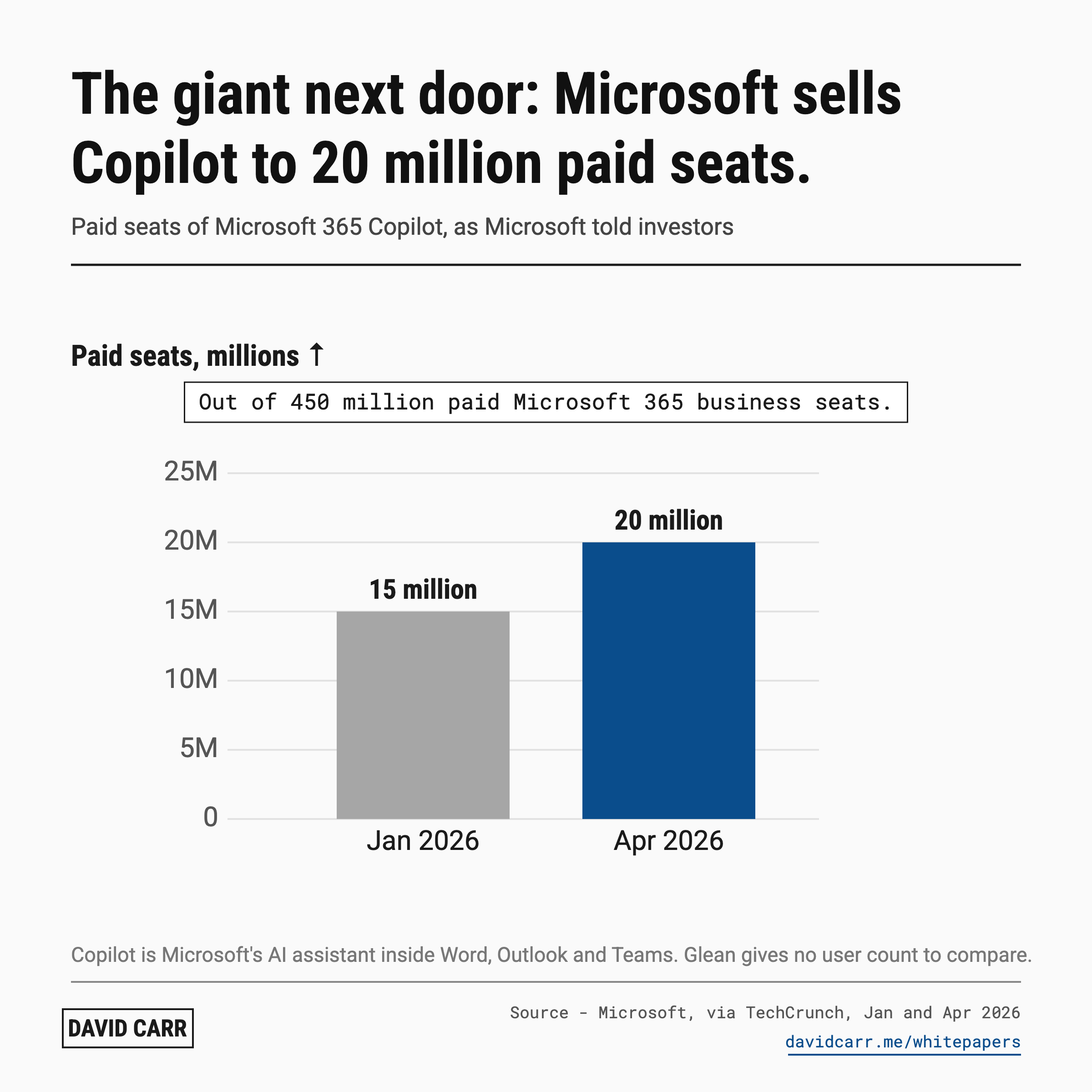
The giant next door: Microsoft sells Copilot to 20 million paid seats.
Microsoft has 450 million paid Microsoft 365 business seats, so 20 million is about one in 22 of them.
Figures are what Microsoft told investors, as reported by TechCrunch. Glean does not give a user count, so the two cannot be compared directly.
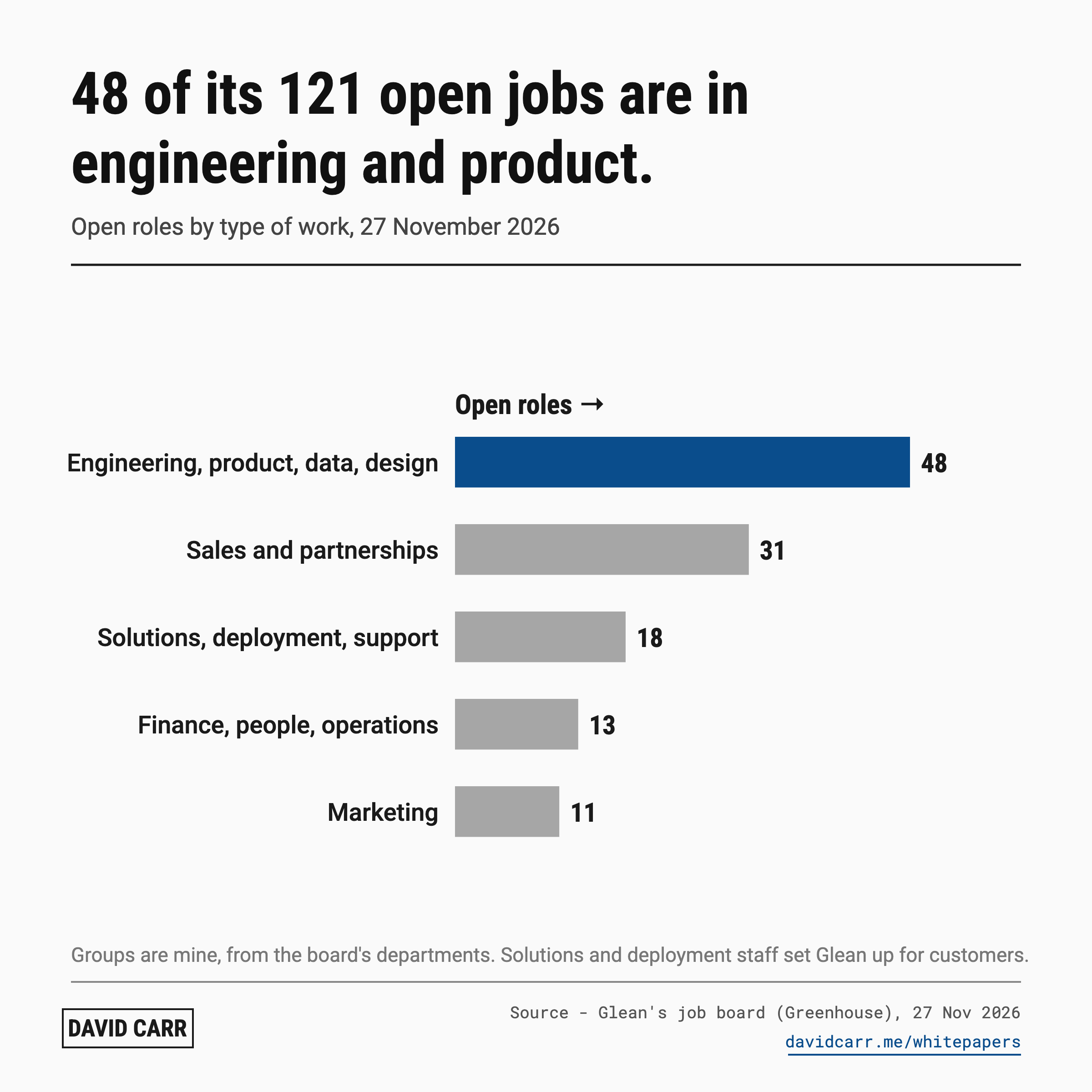
48 of its 121 open jobs are in engineering and product.
- Engineering, product, data, design: 48
- Sales and partnerships: 31
- Solutions, deployment, support: 18
- Finance, people, operations: 13
- Marketing: 11
Engineering is the biggest group, then sales. Most engineering roles are in Mountain View, San Francisco and Bangalore.
Glean's job board, 27 November 2026. Groups are mine, from the board's departments.
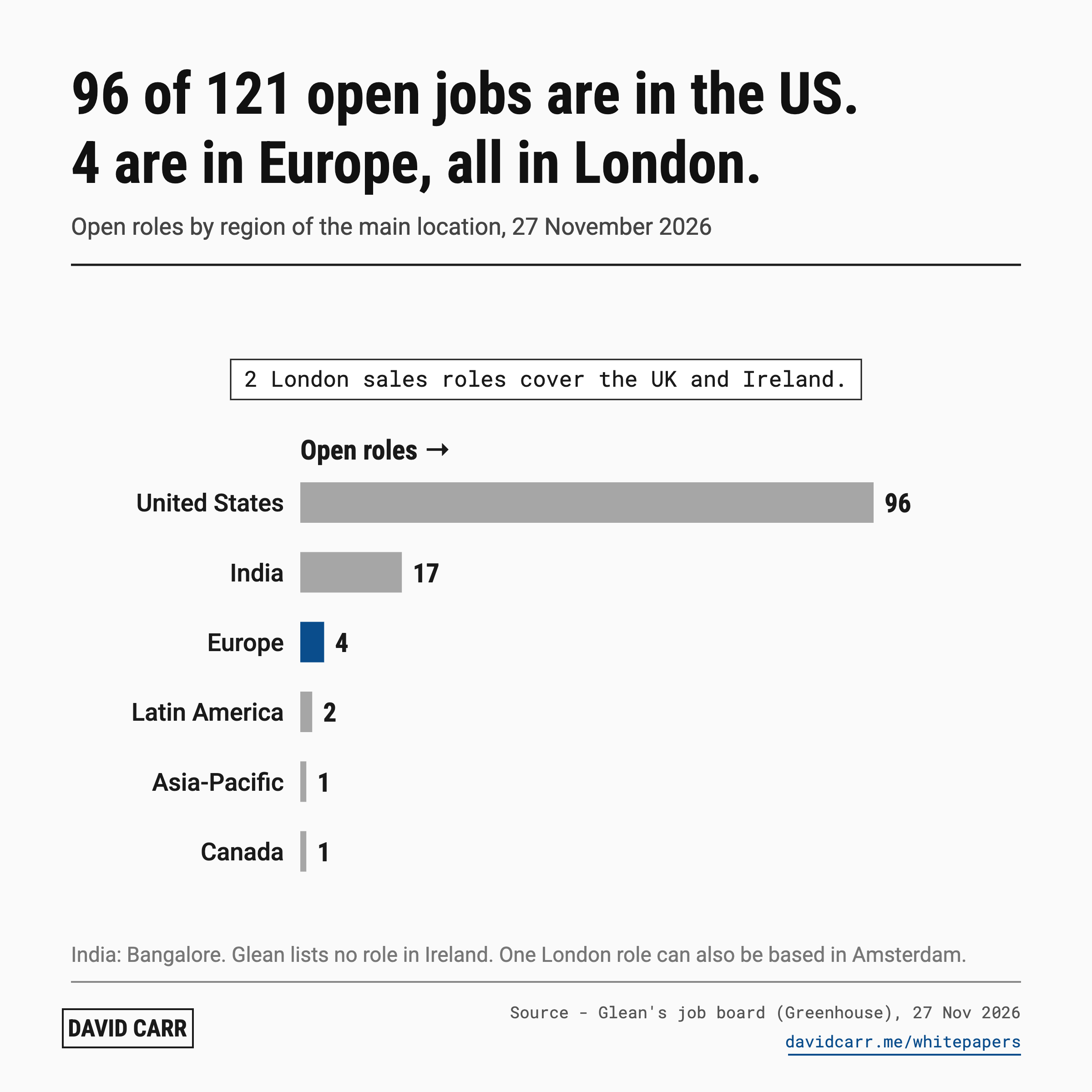
96 of 121 open jobs are in the US. 4 are in Europe, all in London.
- United States: 96
- India: 17
- Europe: 4
- Latin America: 2
- Asia-Pacific: 1
- Canada: 1
Two of the London roles sell to large companies in the UK and Ireland. I found no Glean office or named customer in Ireland.
Region is the main location. India is Bangalore. One London role can also be based in Amsterdam.
Method, caveats and sources
The short answer. Glean was valued at $7.2 billion in June 2025, up from $1 billion in 2022. It has raised $765 million. Its recurring revenue went from $100 million in January 2025 to $300 million in May 2026. It has more than 1,000 staff and customers in 28 countries. Microsoft sells its rival, Copilot, to 20 million paid seats. Most of Glean's 121 open jobs are in the US; four are in London.
Glean is private. It files no accounts. Valuations, revenue and usage figures are from Glean's own press releases. The Series A and B amounts are from Forbes. None is audited.
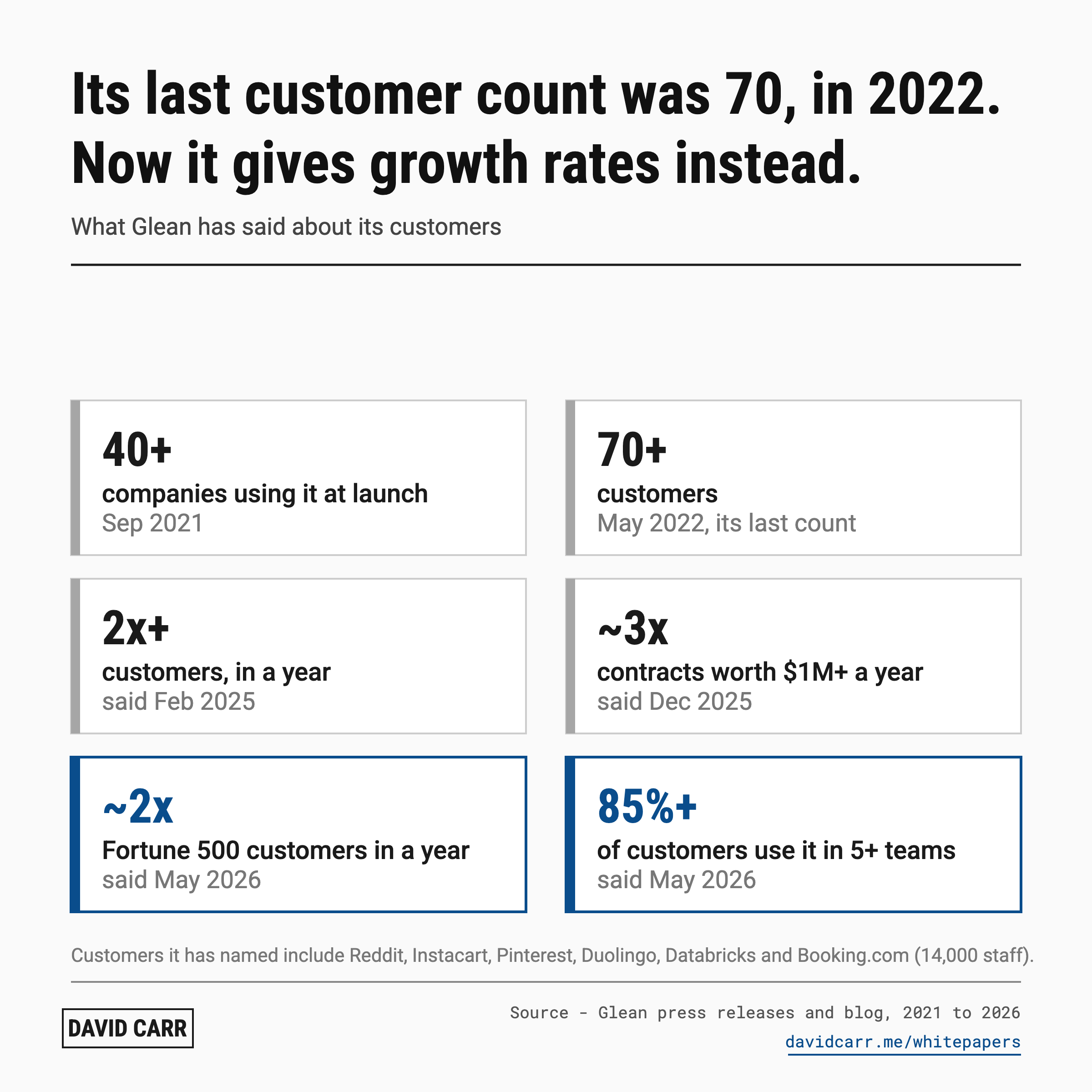
Customers. Glean gave a count of 70 customers in 2022 and has given growth rates since. I have not used any outside estimate of its customer count.
Rivals. Glean's valuation against what ServiceNow and Workday announced they would pay for Moveworks and Sana. Microsoft's Copilot seats are from its own investor calls, as TechCrunch reported them. A later, higher Copilot figure appears in one call summary but I could not confirm it, so it is not used.
Jobs. Every role on Glean's Greenhouse job board on 27 November 2026, 121 in all. Groups are mine. Region is the main location.
Also: Harvey, Perplexity, Anthropic and OpenAI, whose models power tools like Glean, and Duolingo, a Glean customer.