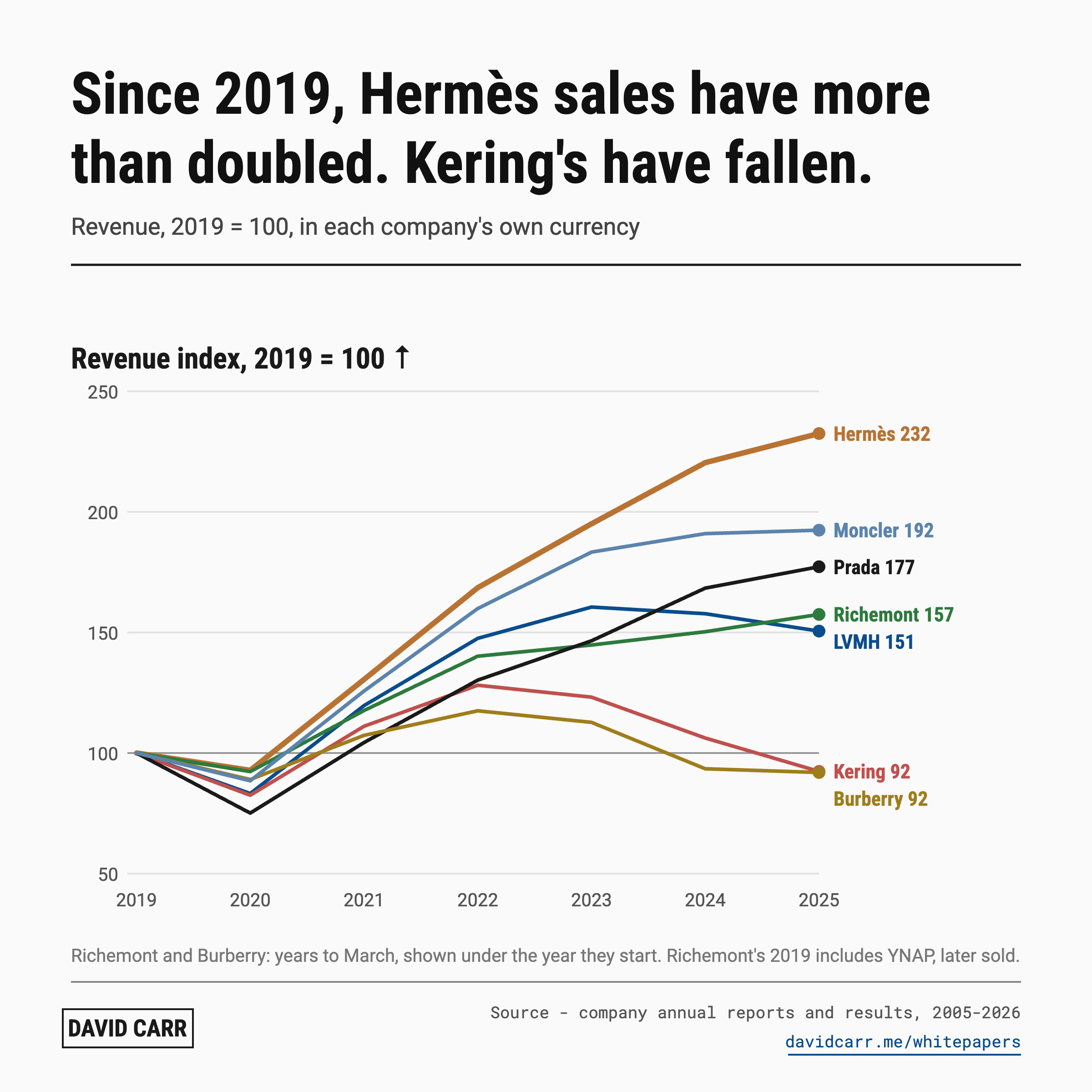
Since 2019, Hermès sales have more than doubled. Kering’s have fallen.
- Revenue in 2025 against 2019 (2019 = 100): Hermès 232, Moncler 192, Prada 177, Richemont 157, LVMH 151
- Kering 92 and Burberry 92: below where they were before the pandemic
- Every one of the seven fell in 2020 and grew in 2021
The seven moved together until 2022. Since then they have split into two groups: those still growing, and those back below 2019.
In each company’s own currency. Moncler includes Stone Island from 2021. Richemont’s 2019 year (to March 2020) includes the online business YNAP, later sold, which makes its growth look smaller.
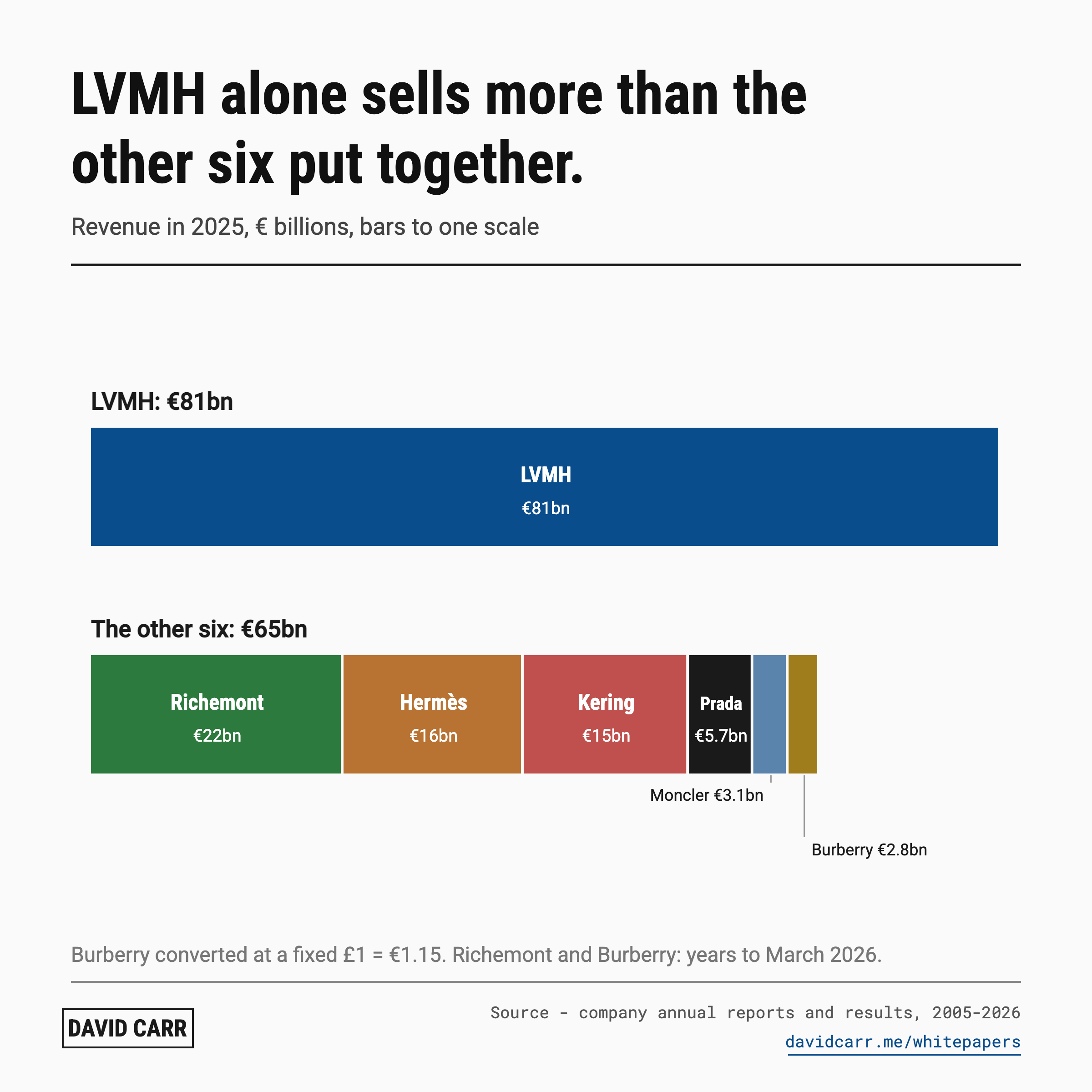
LVMH alone sells more than the other six put together.
- LVMH, 2025: €80.8bn
- The other six together: €64.7bn
- Richemont €22.4bn, Hermès €16.0bn, Kering €14.7bn, Prada €5.7bn, Moncler €3.1bn, Burberry £2.4bn
LVMH owns Louis Vuitton, Dior, Tiffany, Sephora, Moët and many more, so it is a group of groups. Even so, the gap is large.
Burberry converted at a fixed £1 = €1.15, used only for comparison. Richemont and Burberry: years to March 2026.
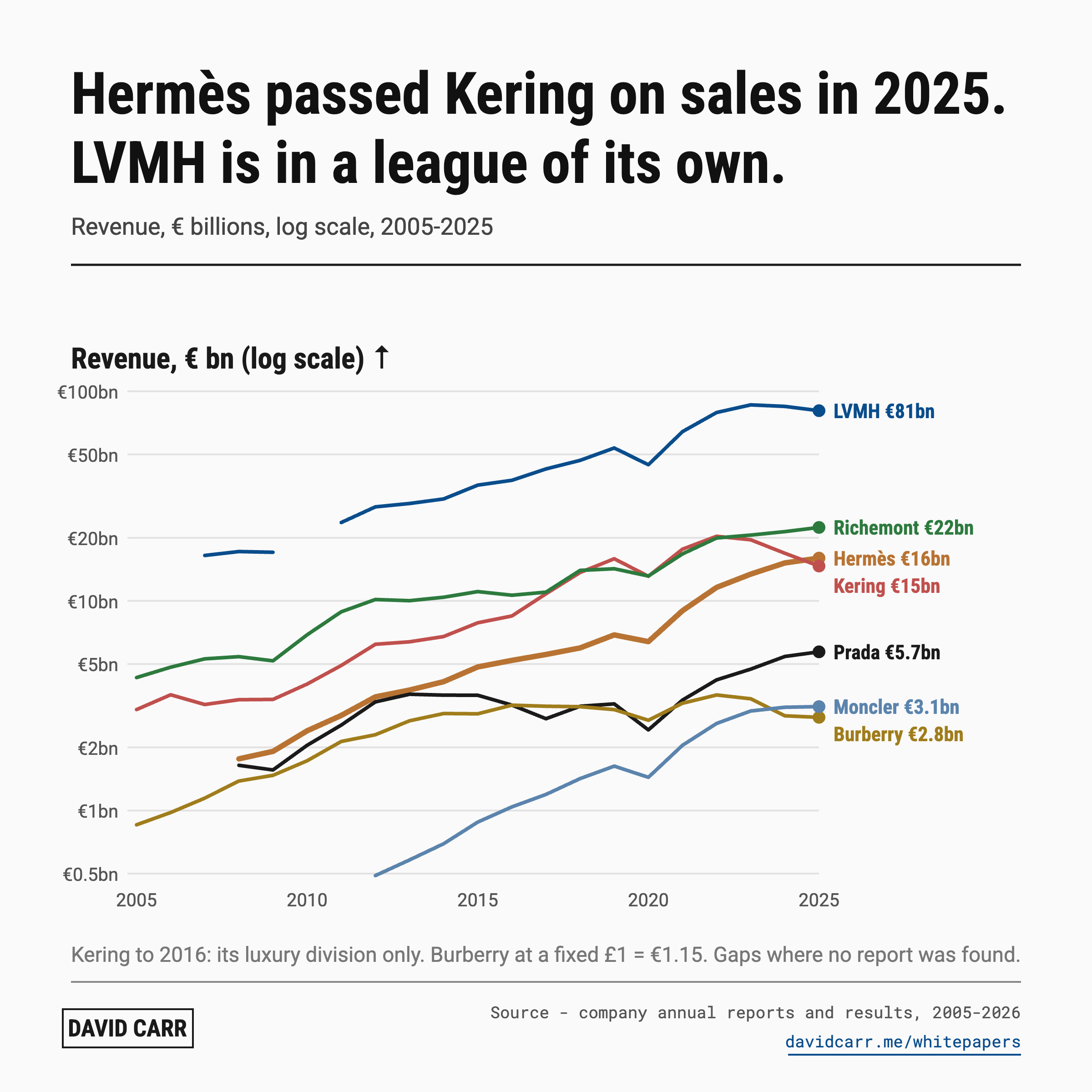
Hermès passed Kering on sales in 2025. LVMH is in a league of its own.
- 2025 revenue: Hermès €16.0bn, Kering €14.7bn
- Kering’s peak was €20.4bn in 2022; 2025 was 28% lower
- Hermès has grown every year in this record except 2020
- Moncler: €0.5bn in 2012, €3.1bn in 2025
A log scale shows growth rates as slopes, so companies of very different sizes can share one chart.
Kering to 2016 is its luxury division only (the group also owned retail chains and Puma then). Gaps are years where no company report was found.
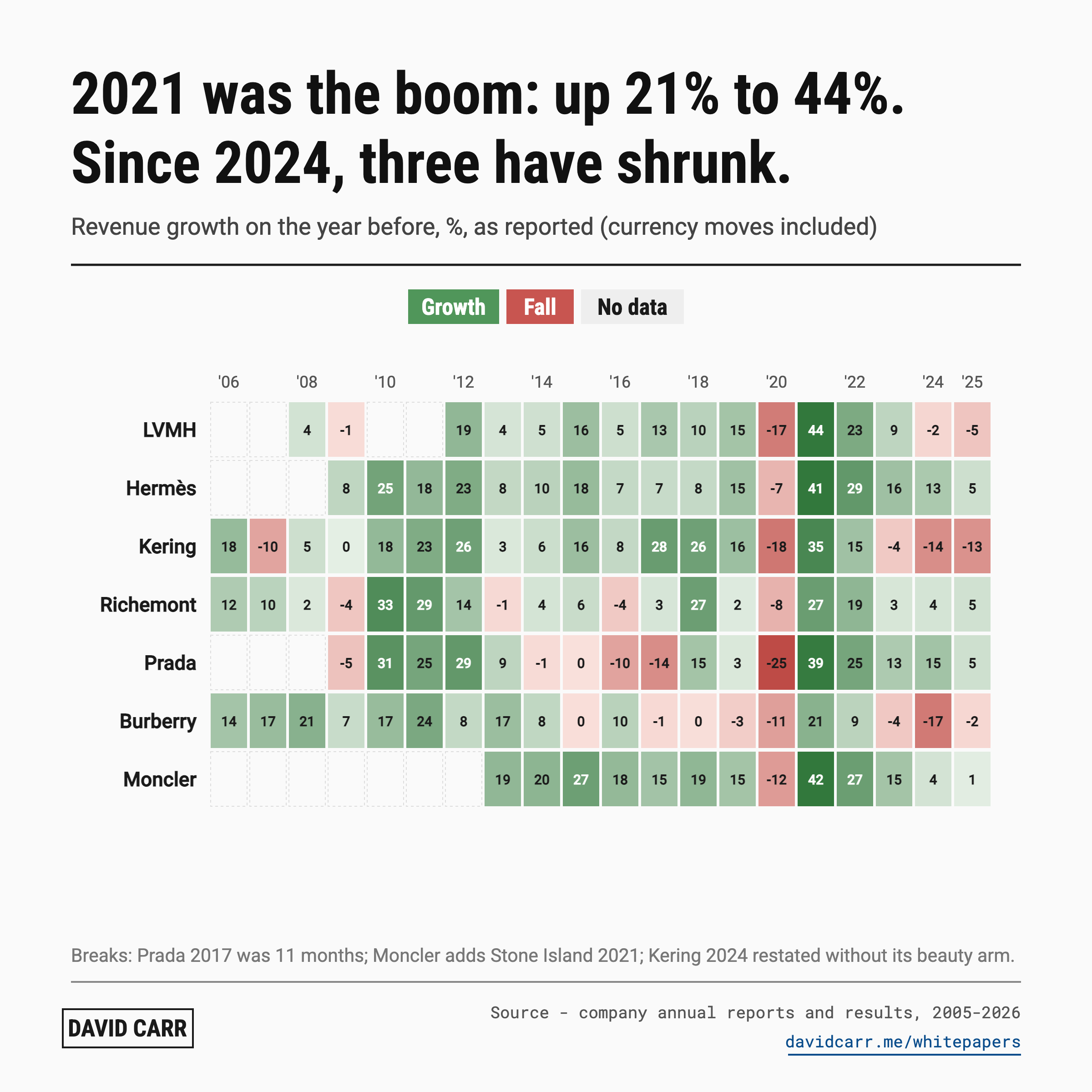
2021 was the boom: sales up 21% to 44%. Since 2024, LVMH, Kering and Burberry have shrunk.
- 2020: all seven fell, from −7% (Hermès) to −25% (Prada)
- 2021: LVMH +44%, Moncler +42%, Hermès +41%, Prada +39%, Kering +35%, Richemont +27%, Burberry +21%
- 2024: Burberry −17%, Kering −14%, LVMH −2%
- 2025: Kering −13%, LVMH −5%, Burberry −2%; Hermès, Richemont and Prada +5%, Moncler +1%
2021 was the biggest year of growth in this record for five of the seven: LVMH, Hermès, Kering, Prada and Moncler.
Growth as reported, including currency moves. Kering’s 2024 is restated without its beauty business, so its 2024 fall looks a little bigger (−12% on the figures first published).
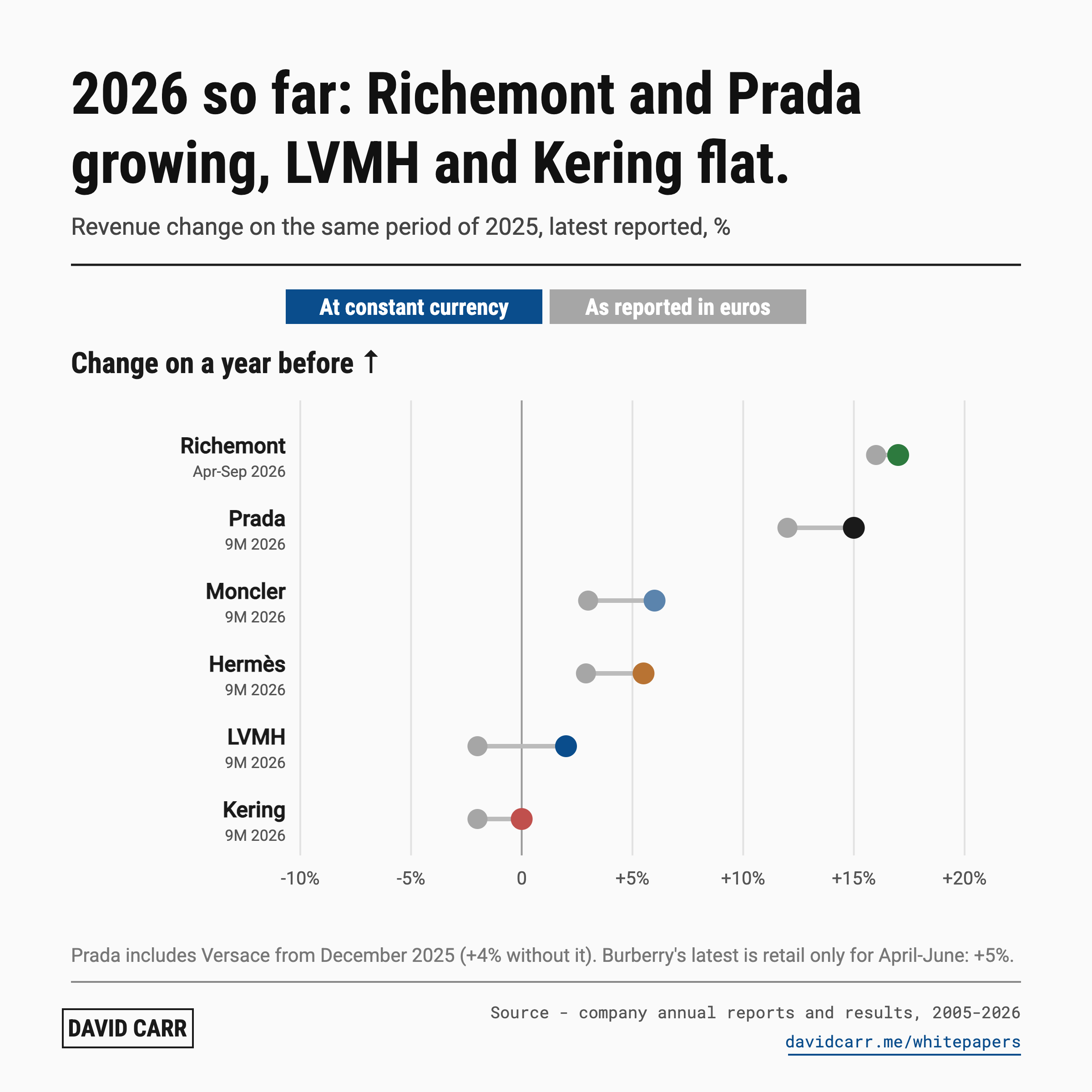
2026 so far: Richemont and Prada growing fast, LVMH and Kering flat.
- Richemont, April to September: +17% at constant currency, +16% reported
- Prada, first nine months: +15% constant, +12% reported, with Versace added; +4% without it
- Moncler +6%, Hermès +5.5%, LVMH +2%, Kering 0%, all at constant currency, first nine months
- Burberry, April to June: retail sales +4% constant, +5% reported
For all six with nine- or six-month figures, growth in euros was one to four points lower than at constant currency.
Latest figures each company has published, to 30 September 2026 (Burberry to 27 June). Constant currency is each company’s own measure.
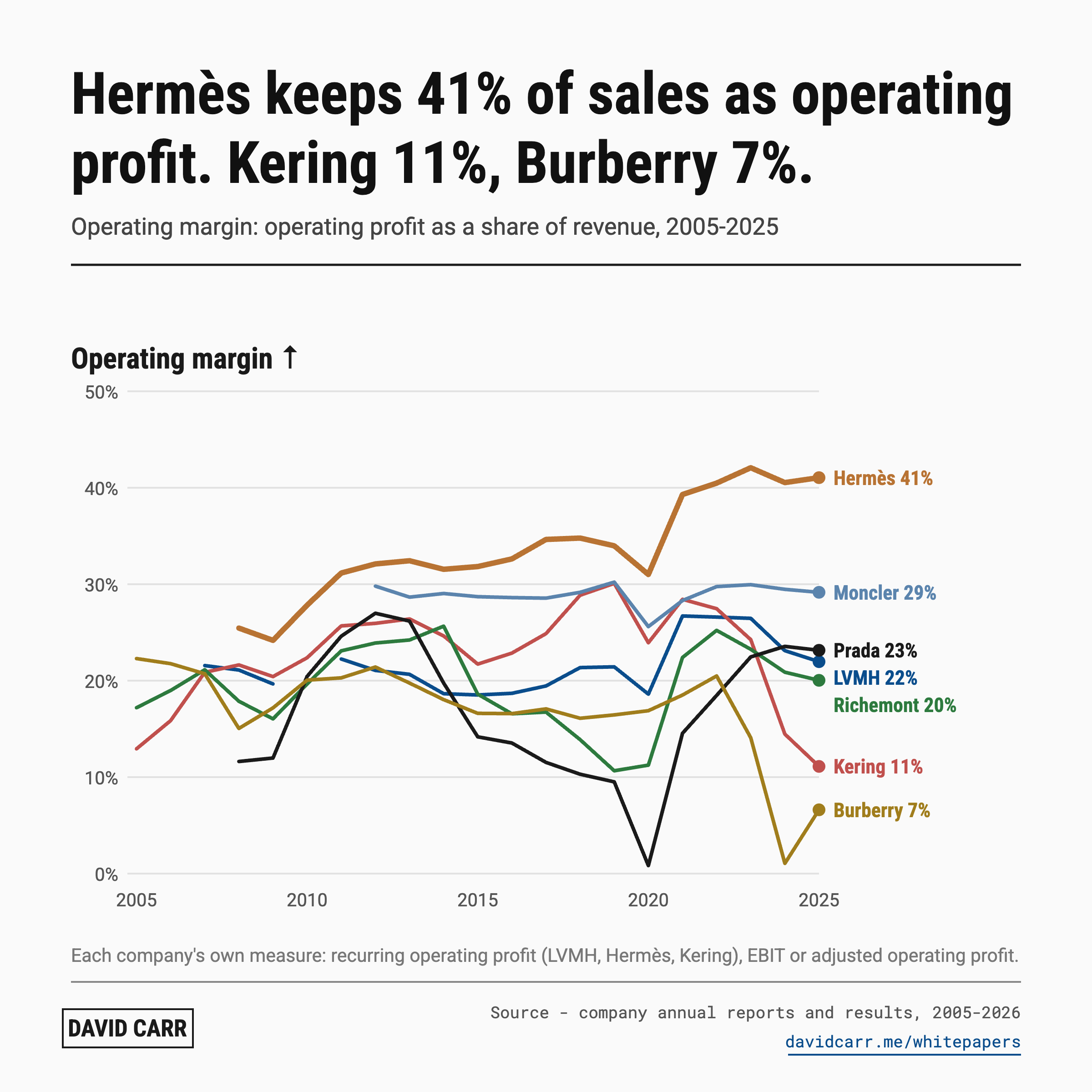
Hermès keeps 41% of its sales as operating profit. Kering keeps 11%, Burberry 7%.
- 2025 operating margin: Hermès 41%, Moncler 29%, Prada 23%, LVMH 22%, Richemont 20%, Kering 11%, Burberry 7%
- Kering in 2019: 30%. Burberry in its year to March 2023: 20%
- Hermès has had the highest margin of the seven every year since 2008
- Prada’s margin rose from under 1% in 2020 to 23%
Kering’s revenue fell 28% from 2022 to 2025. Its operating profit fell 71%, from €5.6bn to €1.6bn.
Each company’s own measure: profit from recurring operations (LVMH, Hermès, Kering), operating profit (Richemont), EBIT (Prada, Moncler), adjusted operating profit (Burberry).
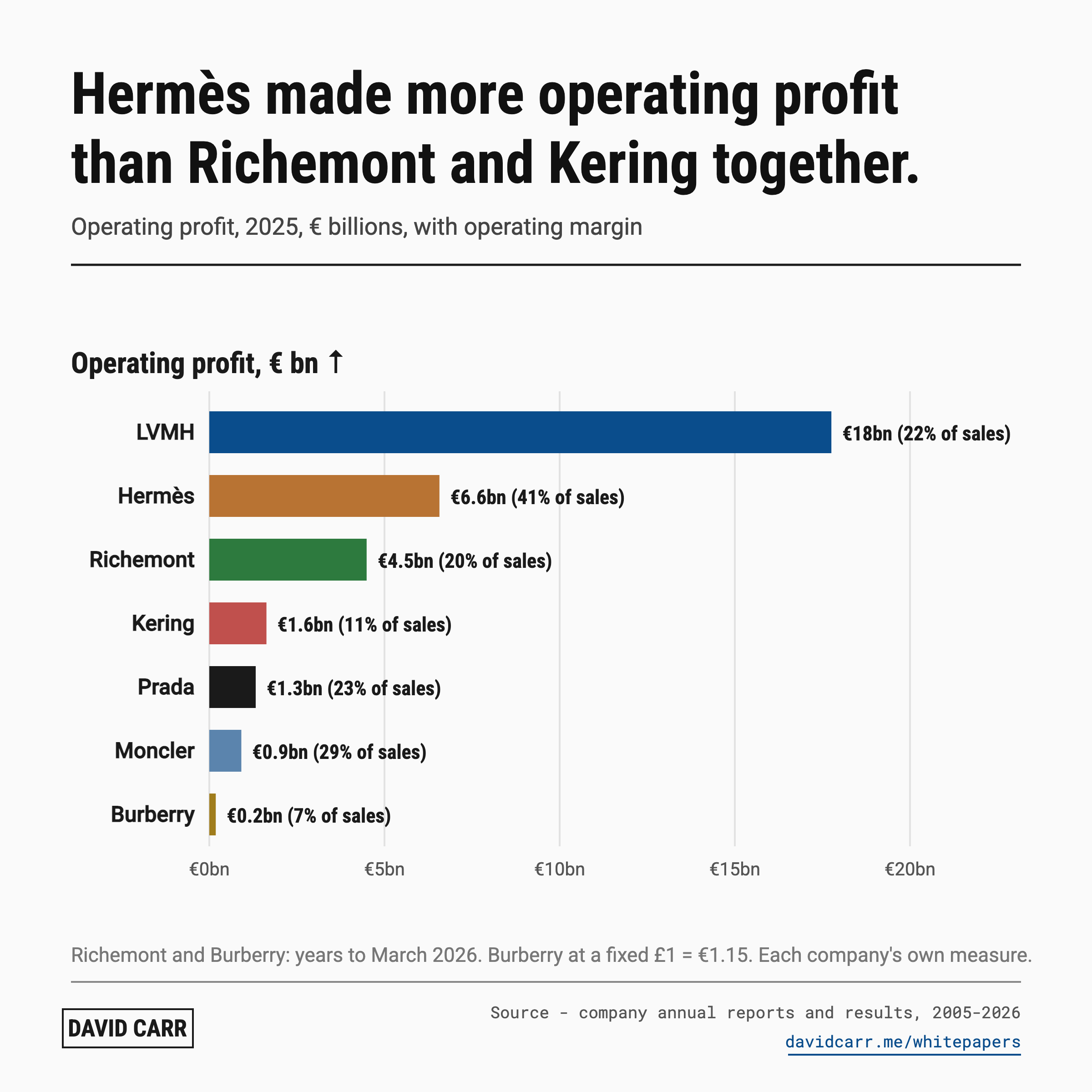
Hermès made more operating profit than Richemont and Kering together.
- 2025 operating profit: LVMH €17.8bn, Hermès €6.6bn, Richemont €4.5bn, Kering €1.6bn
- Prada €1.3bn, Moncler €0.9bn, Burberry £160m
- Hermès’ €6.6bn against €6.1bn for Richemont and Kering combined
Hermès is the fourth-largest of the seven by sales and the second-largest by profit.
Richemont and Burberry: years to March 2026. Burberry converted at a fixed £1 = €1.15 for the chart.
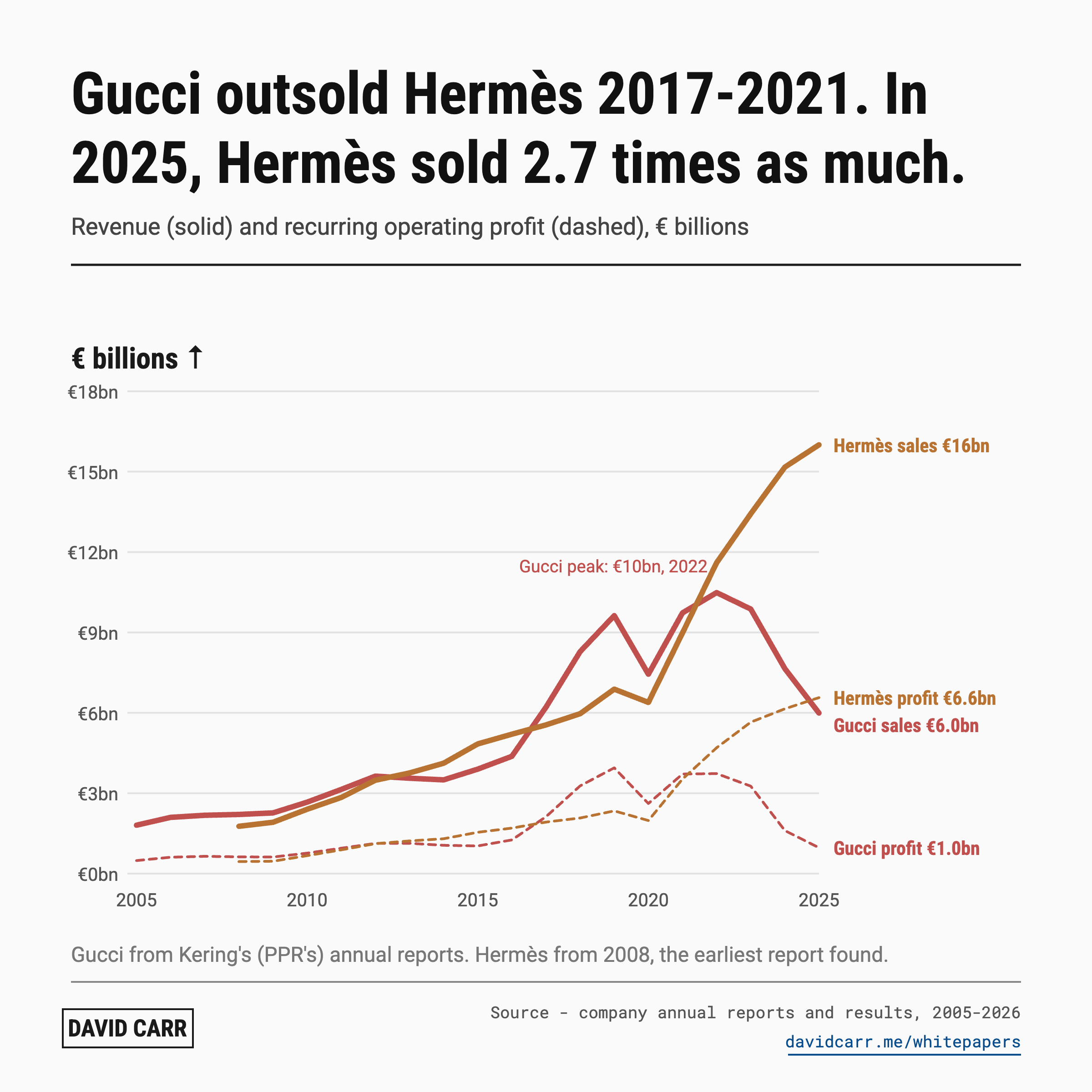
Gucci outsold Hermès from 2017 to 2021. In 2025, Hermès sold 2.7 times as much.
- Gucci: €1.8bn in 2005, a peak of €10.5bn in 2022, €6.0bn in 2025
- Hermès: €1.8bn in 2008, €16.0bn in 2025
- Operating profit, 2025: Hermès €6.6bn, Gucci €1.0bn. Gucci’s was €3.9bn in 2019
Gucci is Kering’s biggest brand, so its swing explains most of Kering’s. Hermès grew through the whole period.
Gucci’s figures are from Kering’s (PPR’s until 2013) annual reports. Hermès is a whole company; Gucci is one brand.
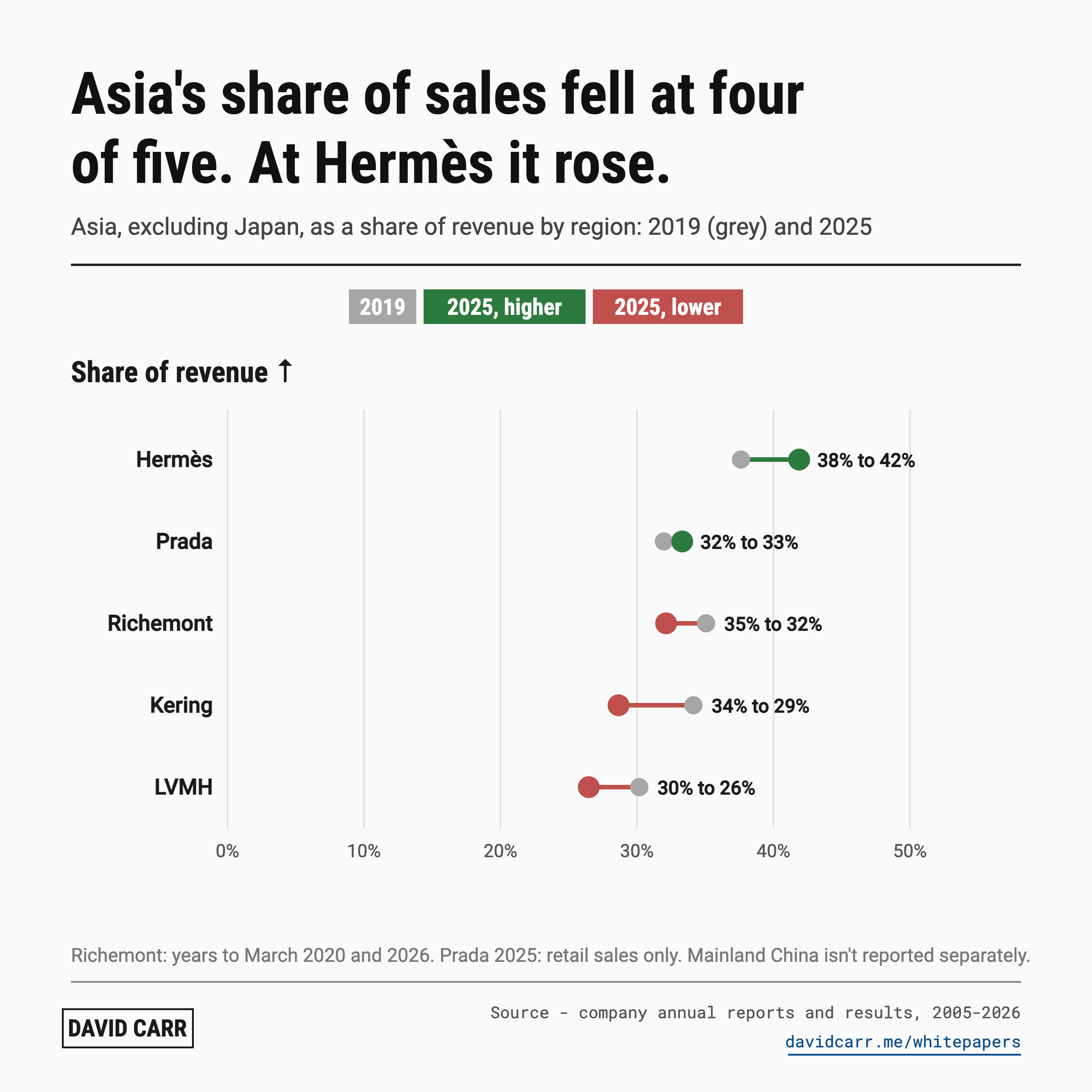
Asia’s share of sales fell at four of five companies. At Hermès it rose.
- Asia excluding Japan, 2019 to 2025: Hermès 38% to 42%, Prada 32% to 33%
- Richemont 35% to 32%, Kering 34% to 29%, LVMH 30% to 26%
- Burberry is the only one to report Greater China on its own: 28% of sales in the year to March 2026
Asia, led by China, drove much of the boom. In the slowdown, its share has fallen at most of these companies.
Share of the total across each company’s reported regions. Prada’s 2025 regions are retail sales only. Mainland China is not reported separately by the others.
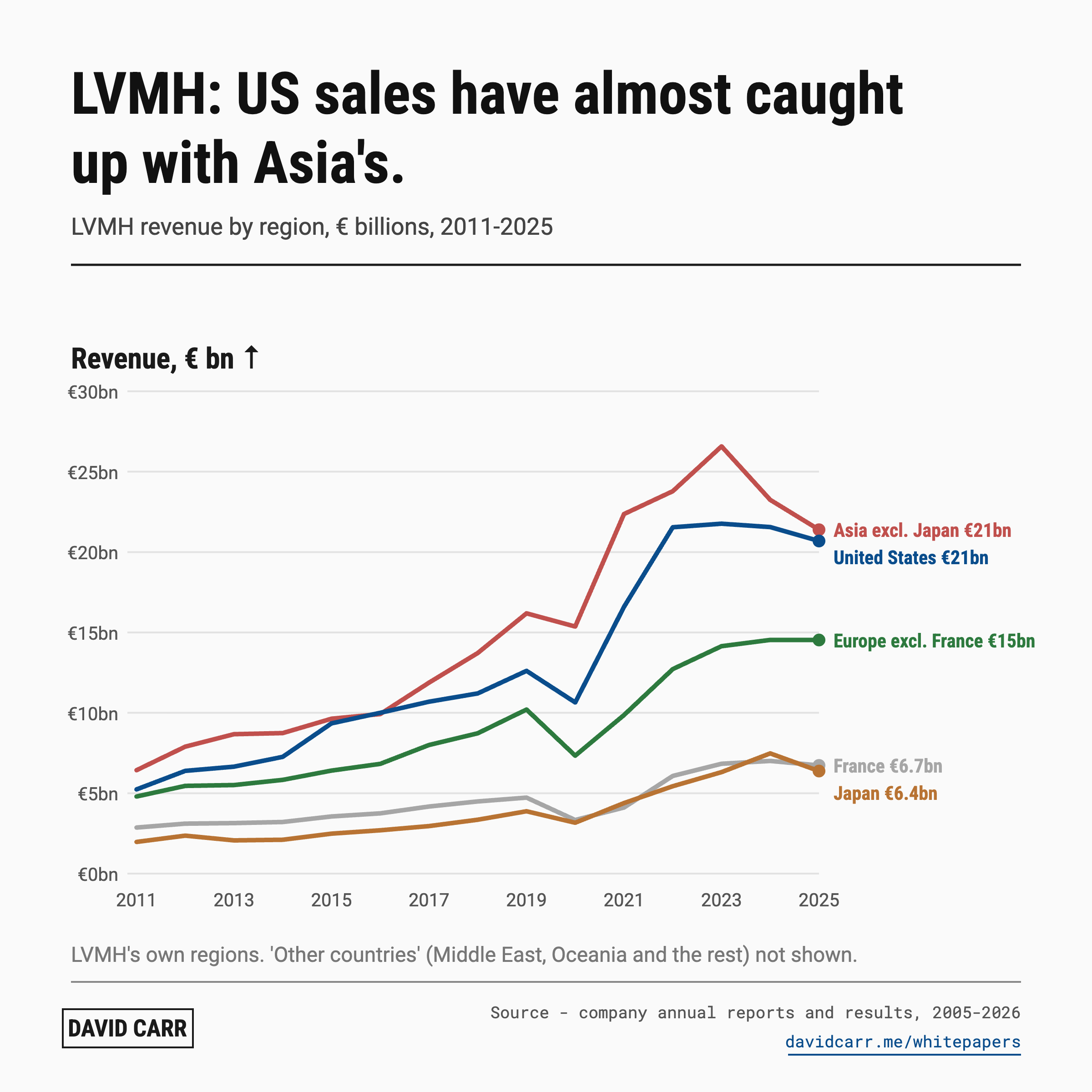
LVMH’s US sales have almost caught up with Asia’s.
- 2025: Asia excluding Japan €21.4bn, United States €20.7bn
- Asia peaked at €26.6bn in 2023
- Europe excluding France €14.5bn, France €6.7bn, Japan €6.4bn
Asia was LVMH’s biggest region every year from 2011 except 2016, when the US was just ahead. In 2025 the gap was the smallest since then.
LVMH’s own regions; ‘other countries’ (€11.1bn in 2025) not shown.
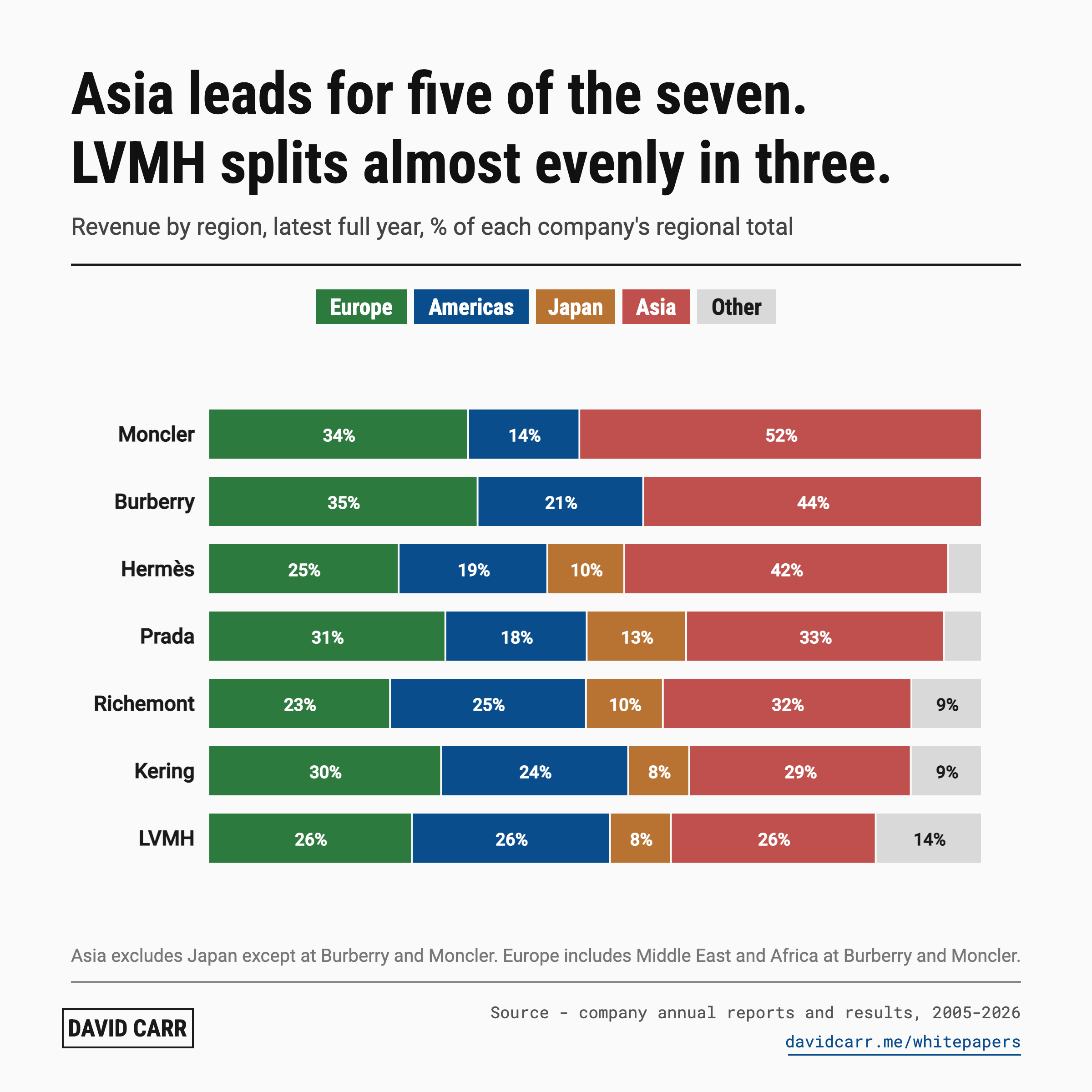
Asia is the largest region for five of the seven. LVMH splits almost evenly three ways.
- Asia’s share: Moncler 52%, Burberry 44%, Hermès 42%, Prada 33%, Richemont 32%
- Kering: Europe 30%, Asia 29%, Americas 24%
- LVMH: Asia 26%, Europe 26%, Americas 26%
Moncler sells more than half its goods in Asia.
Latest full year. Groupings are mine, from each company’s regions: Asia excludes Japan except at Burberry and Moncler, which do not split Japan out. Moncler’s regions are the Moncler brand only.
Method, caveats and sources
The short answer. The seven grew fast for most of the last 20 years, fell in 2020 and jumped in 2021. Since 2022 they have split. Hermès, Moncler, Prada and Richemont are above their 2019 sales by half or more; Kering and Burberry are below. Hermès stands apart: its sales more than doubled from 2019 to 2025, it passed Kering in 2025, and it keeps 41% of sales as operating profit, against 11% at Kering and 7% at Burberry. LVMH is bigger than the other six combined. Asia is the largest region for most of them, but its share has fallen since 2019 everywhere except Hermès and Prada.
Data. Each company’s own annual reports, universal registration documents, results releases and investor pages: LVMH, Hermès, Kering, Richemont, Prada, Burberry and Moncler. Where a company’s site no longer serves an old report, or blocks automated access, a Wayback Machine copy of the company’s own document was used. All pulled 27 November 2026. Gaps: LVMH 2005, 2006 and 2010; Hermès before 2008; Prada before its year to January 2009; Moncler before 2012.
Comparability. Figures are as each company reports them, in its own currency (euros, except Burberry in pounds). Where Burberry is set beside the others in euros, it is converted at a fixed £1 = €1.15, for comparison only. Richemont’s and Burberry’s years run to March, and are shown under the calendar year they start (the year to March 2026 as 2025). Operating profit is each company’s own headline measure, so margins are close but not identical measures. Companies change shape: Kering before 2017 is its luxury division only; Kering 2024 and 2025 exclude its beauty business; Richemont’s figures include the online retailer YNAP from 2018 to 2021; Moncler includes Stone Island from 2021; Prada’s 2017 covers 11 months and its 2025 includes one month of Versace; LVMH includes Tiffany from 2021. Growth is as reported, so currency moves are in it. Figures are not adjusted for inflation.
Also: The world’s most valuable brands, 2000 to 2026 and The sportswear race.