Built for games. Then came the AI turn.
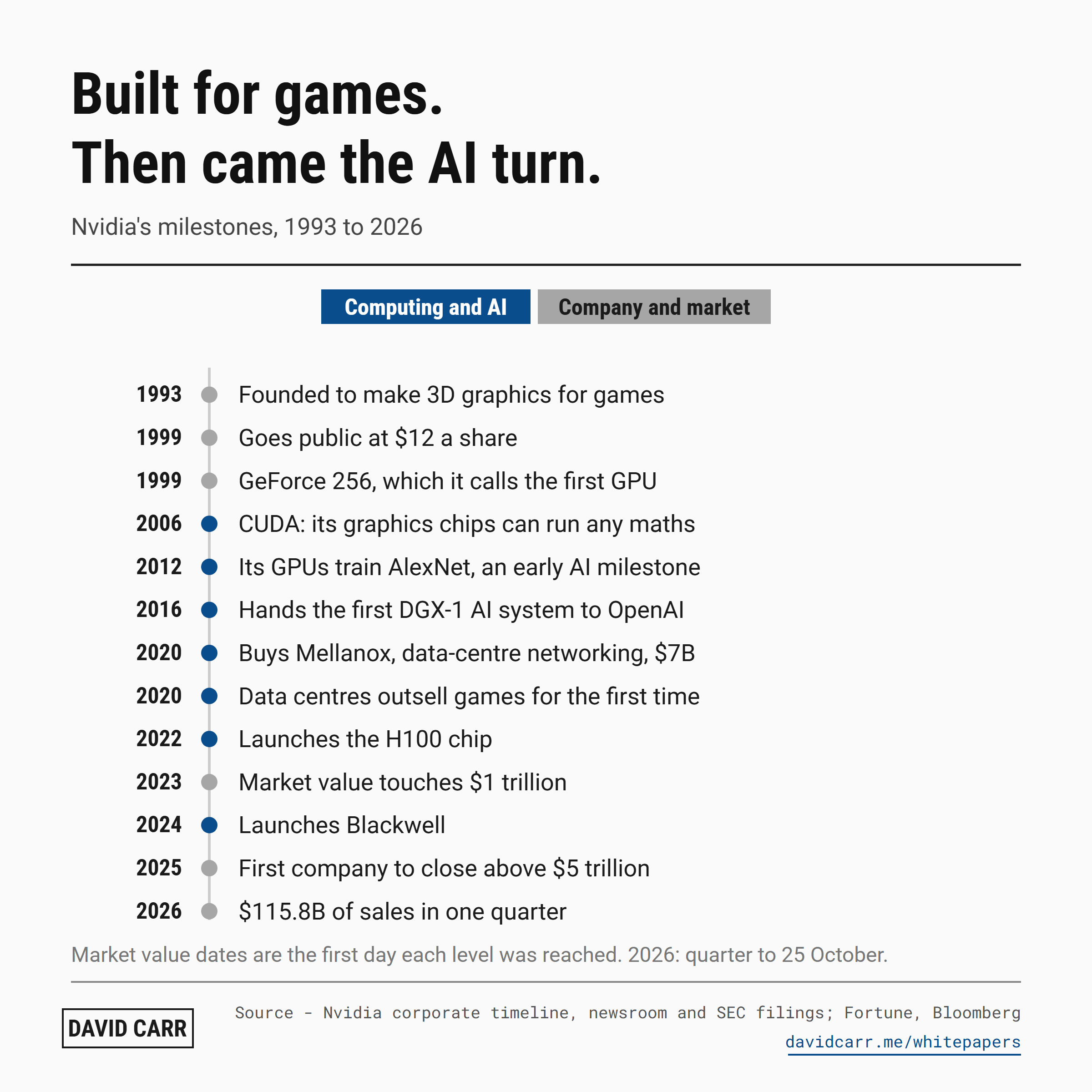
- 1993: founded to bring 3D graphics to games
- 1999: goes public at $12 a share, and launches the GeForce 256
- 2006: CUDA lets its graphics chips do general maths
- 2016: hands the first DGX-1 AI system to OpenAI
- 2020: buys Mellanox for $7 billion
- 2024: Blackwell; 2026: the Rubin ramp begins
For most of its life Nvidia was a games company. CUDA, in 2006, is the step that let the same chips be used for science, and later for AI.
Dates from Nvidia's corporate timeline, newsroom and investor pages, and the press.
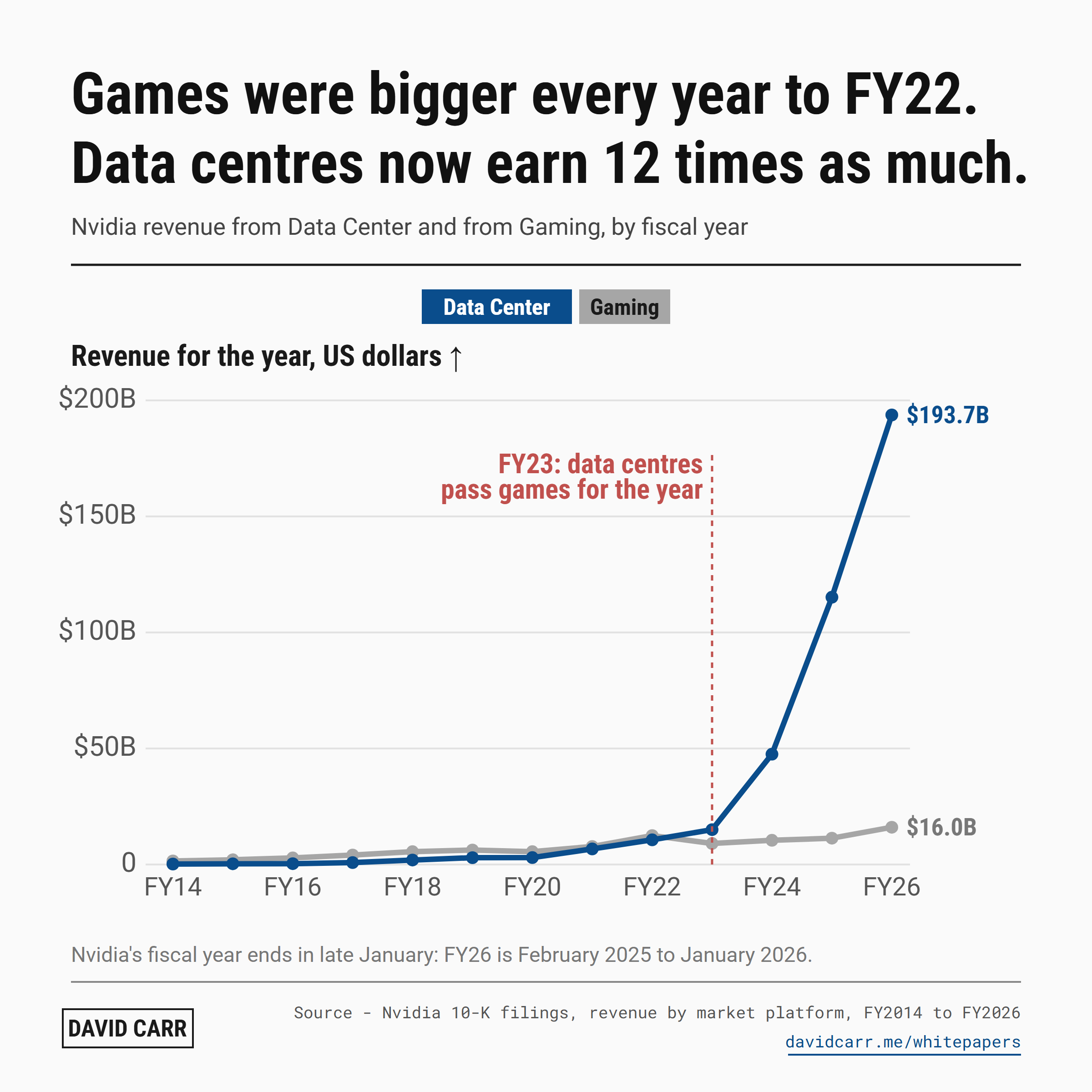
Games were bigger every year to FY22. Data centres now earn 12 times as much.
- FY16: Gaming $2.8B, Data Center $0.3B
- FY22: Gaming $12.5B, Data Center $10.6B
- FY23: Data Center $15.0B, Gaming $9.1B
- FY26: Data Center $193.7B, Gaming $16.0B
Gaming is still growing: it hit a record in FY26. It has just been left far behind.
Revenue by market platform from Nvidia's 10-K filings, for example FY2026 and FY2016. Nvidia's year ends in late January.
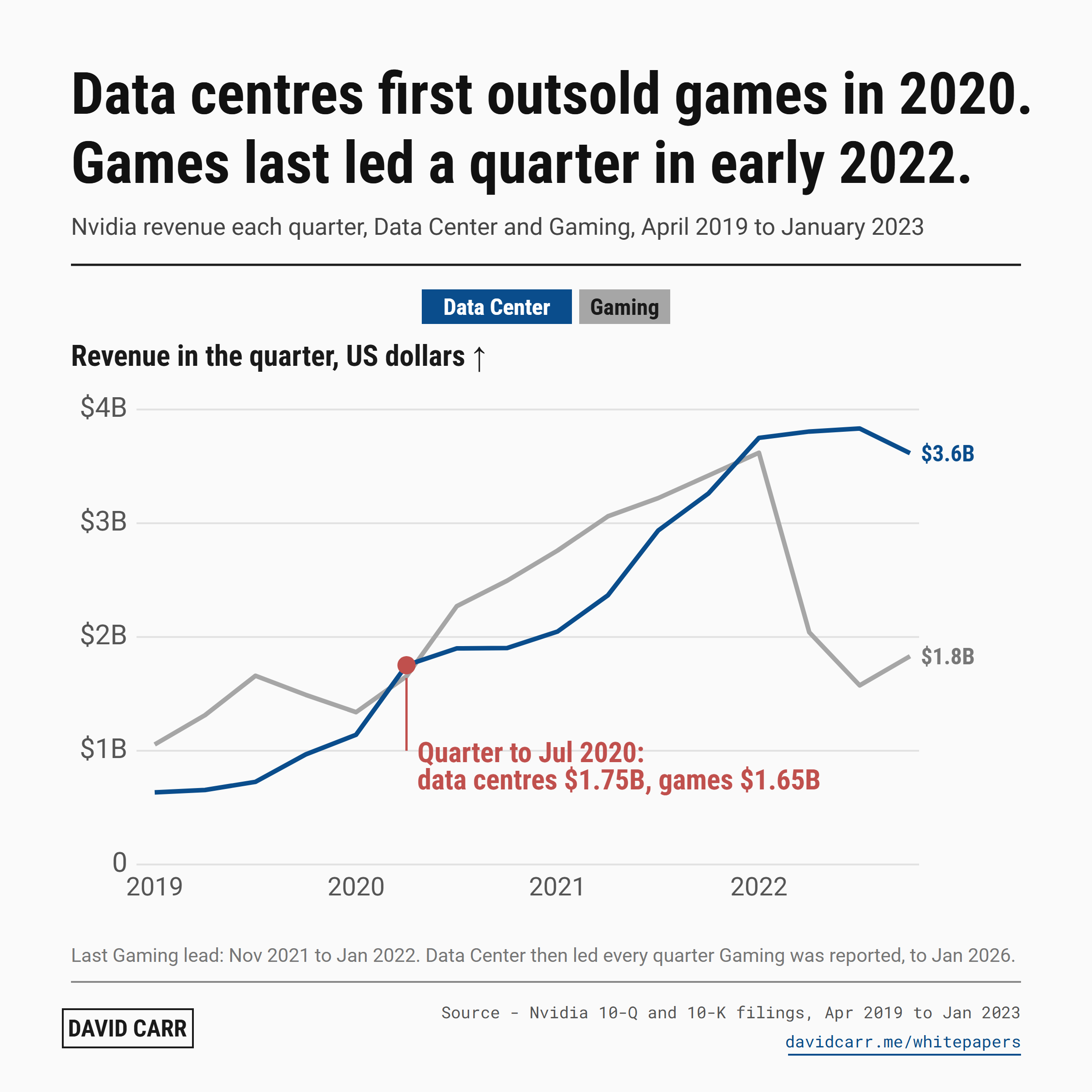
Data centres first outsold games in 2020. Games last led a quarter in early 2022.
- Quarter to July 2020: Data Center $1.75B, Gaming $1.65B
- Quarter to January 2022: Gaming $3.42B, Data Center $3.26B, the last Gaming lead
- Quarter to April 2022: Data Center $3.75B, Gaming $3.62B
The two ran neck and neck for two years. Then games fell back and data centres kept climbing.
From each quarter's 10-Q, for example July 2020. Fourth quarters are the year less the first nine months. From 2026 Nvidia reports Gaming inside Edge Computing, so this comparison ends in January 2026.
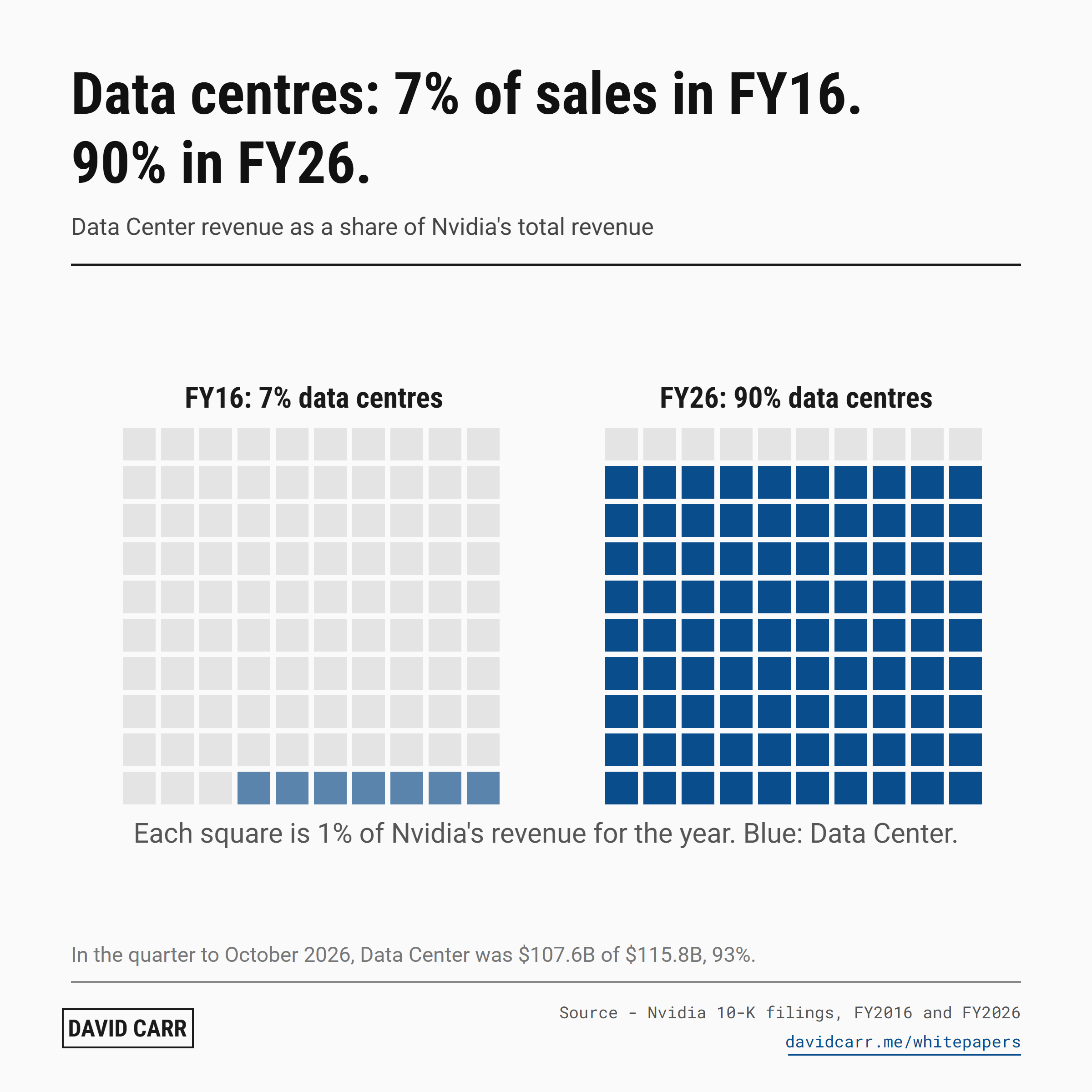
Data centres: 7% of sales in FY16. 90% in FY26.
- FY16: 6.8%
- FY22: 39.4%
- FY26: 89.7%
- Quarter to October 2026: 92.9%
In ten years the data-centre business went from a sideline to almost the whole company.
Data Center revenue over total revenue, from the 10-K and the latest CFO commentary.
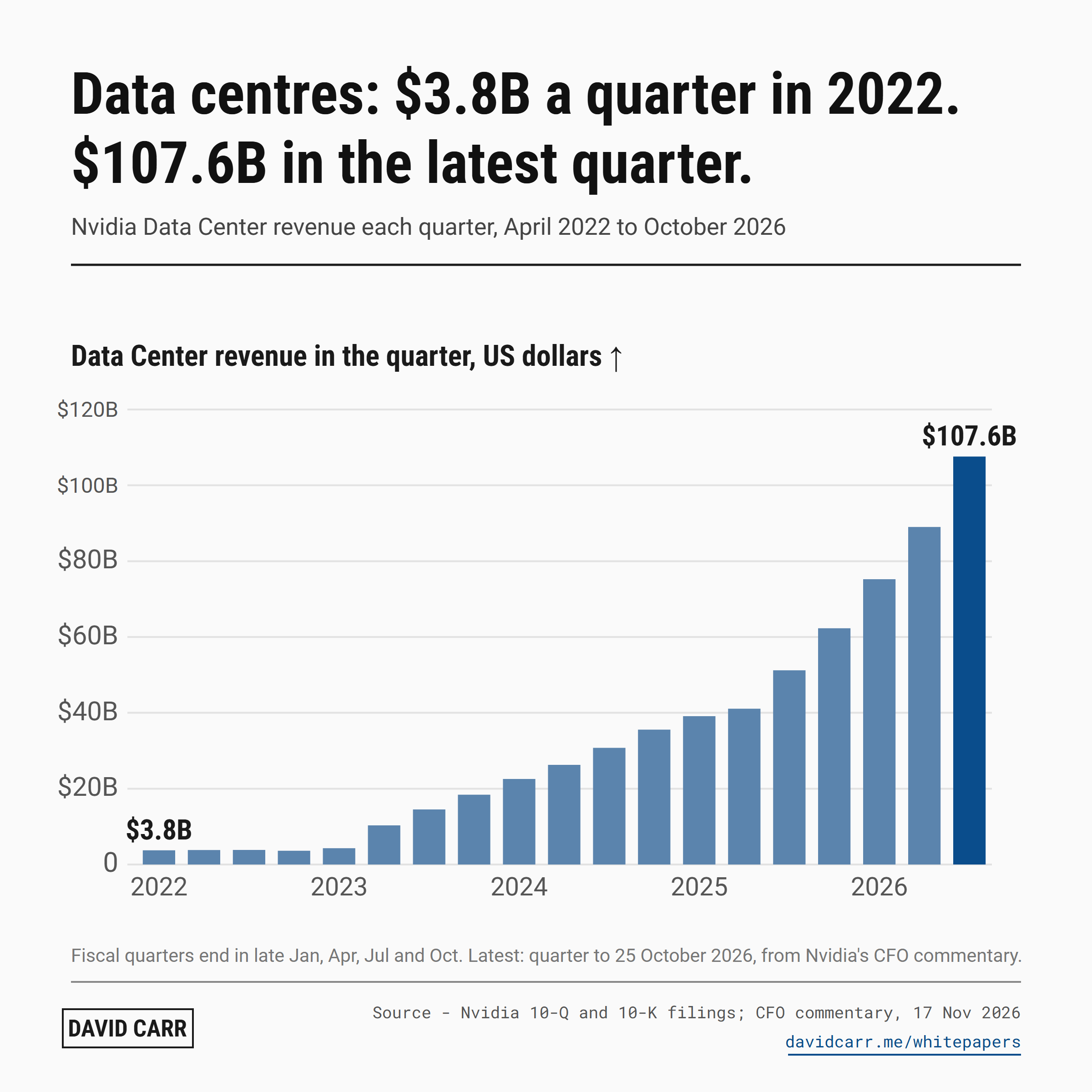
Data centres: $3.8B a quarter in 2022. $107.6B in the latest quarter.
- Quarter to April 2022: $3.75B
- Quarter to July 2023: $10.3B
- Quarter to January 2025: $35.6B
- Quarter to October 2026: $107.6B, up 110% on a year before
Data centres brought in more in the quarter to October 2026 than the whole company sold in any year before FY25.
10-Q and 10-K filings; the latest quarter is from Nvidia's CFO commentary of 17 November 2026. Its 10-Q had not been filed by 23 November.
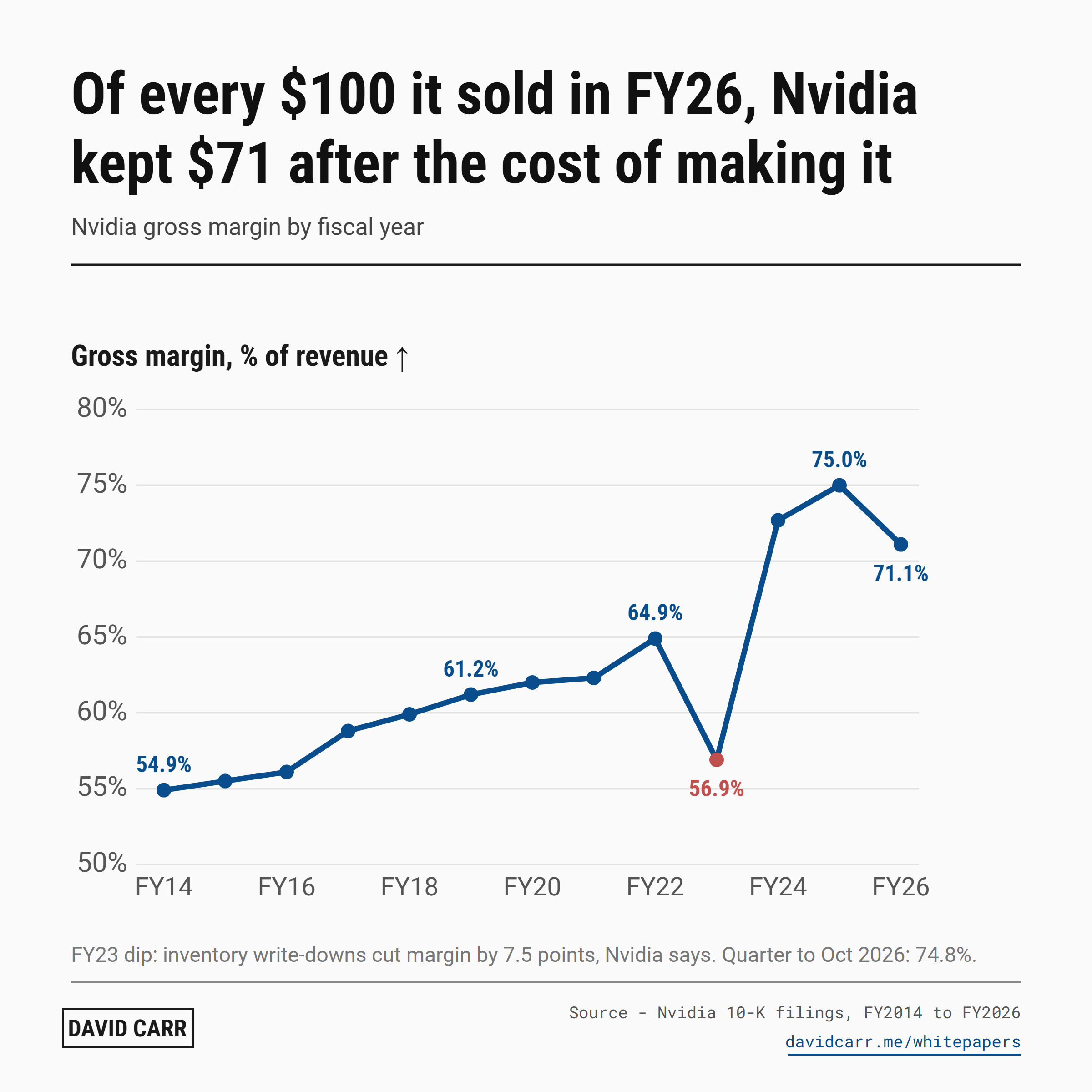
Of every $100 it sold in FY26, Nvidia kept $71 after the cost of making it
- FY14: 54.9%
- FY22: 64.9%
- FY23: 56.9%
- FY25: 75.0%
- FY26: 71.1%
- Quarter to October 2026: 74.8%
Gross margin is what is left after the cost of the product. Nvidia's rose from 55% in FY14 to a peak of 75% in FY25.
Gross profit over revenue from the 10-Ks. Nvidia says inventory write-downs took 7.5 points off FY23 (10-K), and that FY26 fell partly as it moved from Hopper systems to full Blackwell data-centre systems.
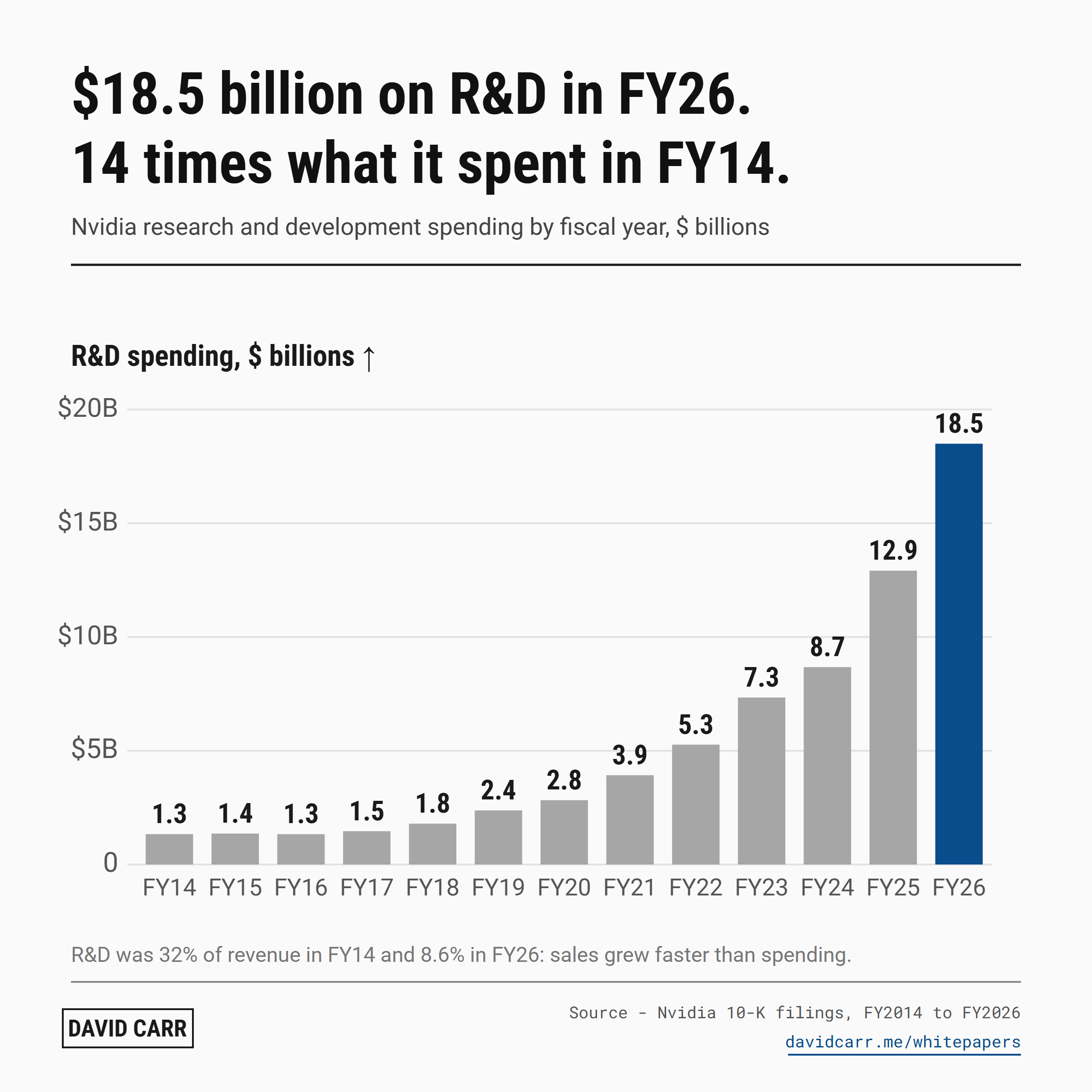
$18.5 billion on R&D in FY26. 14 times what it spent in FY14.
- FY14: $1.3B
- FY20: $2.8B
- FY24: $8.7B
- FY26: $18.5B
- First nine months of FY27: $20.8B, already more than all of FY26
Spending grew fast, but sales grew faster: R&D fell from 32% of revenue in FY14 to 8.6% in FY26.
Research and development expense from the 10-K income statements, and the supplemental financial information for the latest nine months.
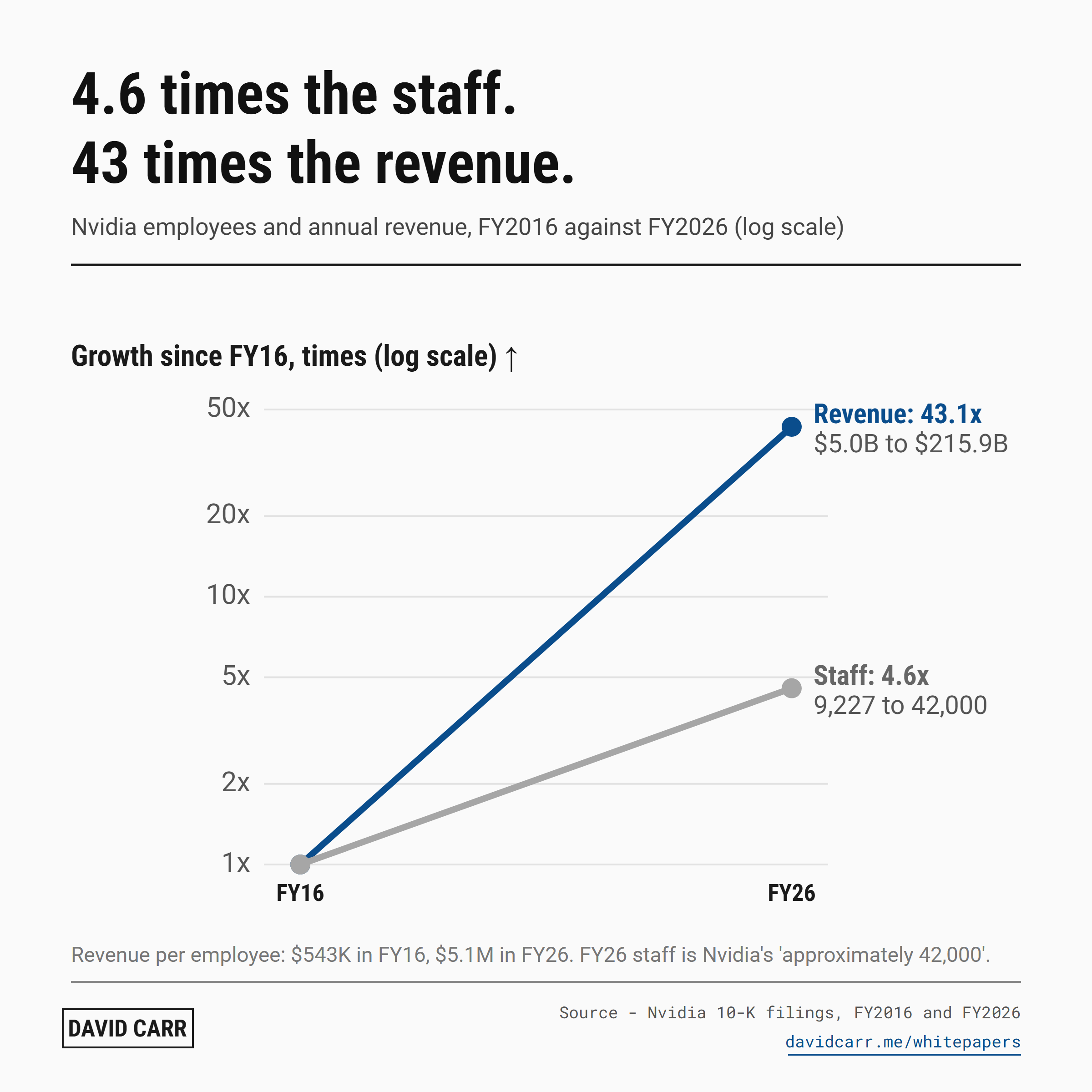
4.6 times the staff. 43 times the revenue.
- FY16: 9,227 staff, $5.0B revenue
- FY26: about 42,000 staff, $215.9B revenue
- 31,000 of the 42,000 work in research and development
Revenue per person went from about $543,000 to about $5.1 million.
Headcount as stated in each 10-K (FY2026: "approximately 42,000"). Revenue per person is my own division.
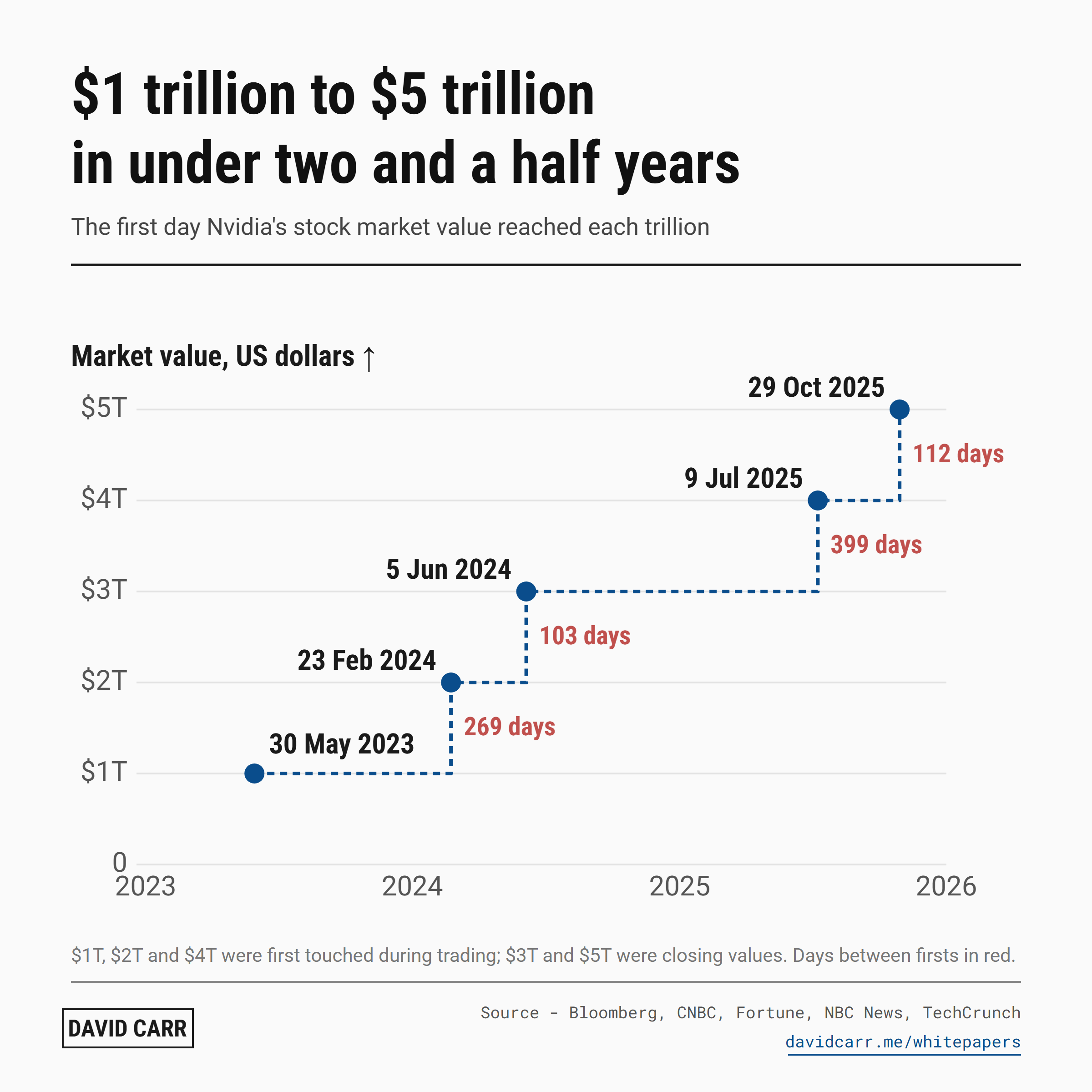
$1 trillion to $5 trillion in under two and a half years
It was the first company ever to reach $4 trillion and then $5 trillion.
First day reached, from press reports. $1T, $2T and $4T were first touched during trading and closed just under; $3T and $5T were closing values. Market value moves daily, so no current figure is shown.
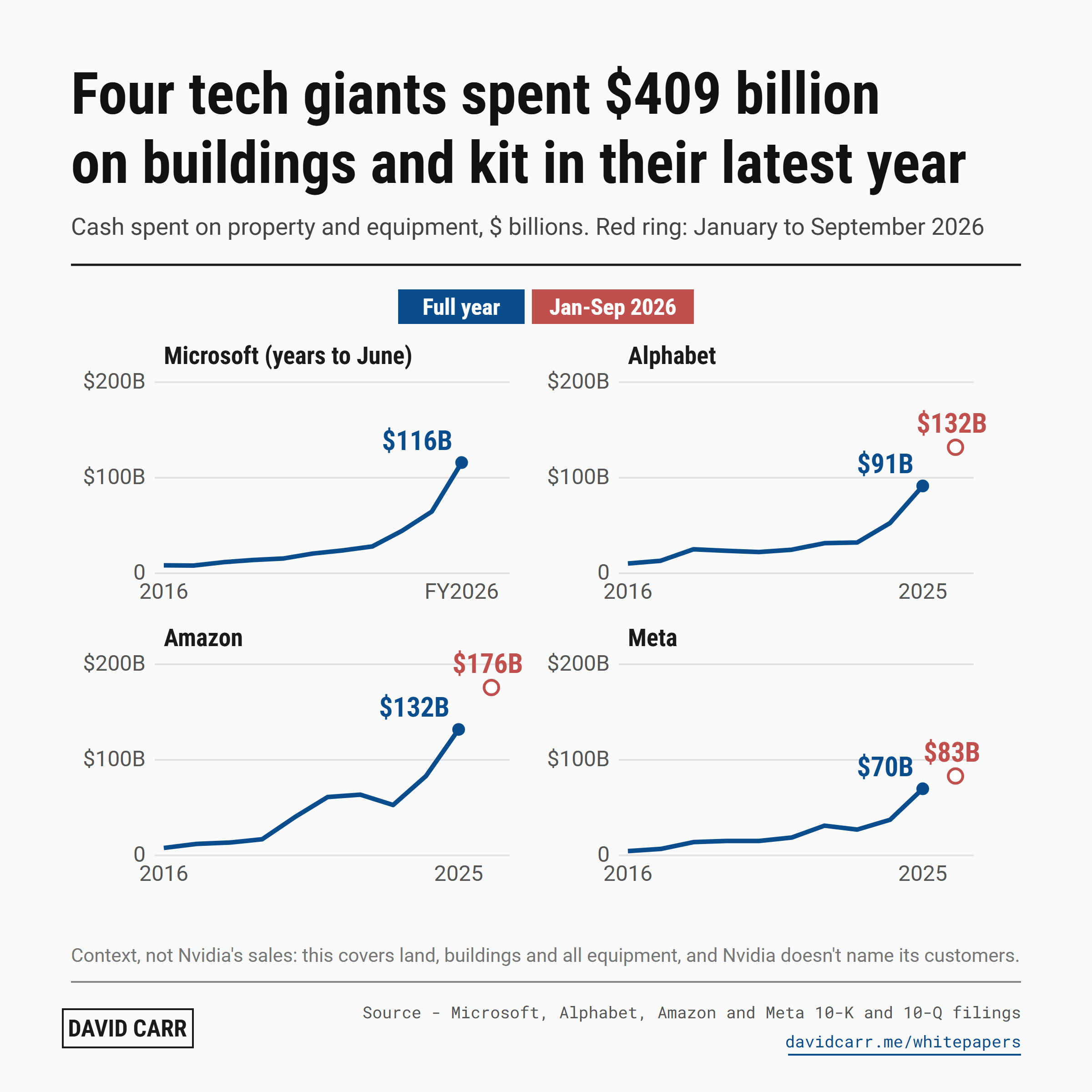
Four tech giants spent $409 billion on buildings and kit in their latest year
- Microsoft, year to June 2026: $116B
- Alphabet, 2025: $91B; January to September 2026: $132B
- Amazon, 2025: $132B; January to September 2026: $176B
- Meta, 2025: $70B; January to September 2026: $83B
Alphabet, Amazon and Meta had all spent more in the first nine months of 2026 than in all of 2025.
Cash spent on property and equipment, from each company's own filings. It covers land, buildings and every kind of equipment, not just chips. Nvidia doesn't name its customers, so this is context, not its sales.
Method, caveats and sources
The short answer. Nvidia sold $5.0 billion in FY16, most of it graphics chips for games. In FY26 it sold $215.9 billion, and 90% came from data centres. Data centres first beat games in a quarter in mid-2020 and for a full year in FY23. It keeps about 71 to 75 cents of each dollar after the cost of the product, spends $18.5 billion a year on R&D, and was the first company to close above $5 trillion.
Nvidia's own filings. Revenue, gross margin, R&D and the split by market platform come from Nvidia's 10-K and 10-Q filings on SEC EDGAR, read through the SEC's XBRL data and the filings themselves. Nvidia's fiscal year ends in late January, so FY26 is February 2025 to January 2026. Nvidia does not report a fourth quarter on its own; I took it as the year less the first nine months.
Gaming after 2025. From February 2026 Nvidia reports Data Center and Edge Computing, with Gaming inside Edge Computing. So Gaming-against-Data-Center comparisons stop at January 2026.
The latest quarter. The quarter to 25 October 2026 comes from Nvidia's CFO commentary and supplemental financial information of 17 November 2026. Its 10-Q had not been filed when the data was pulled on 23 November 2026.
Market value. The first day Nvidia reached each trillion, from Fortune, CNBC, NBC News and TechCrunch. Some were touched during trading and closed just below; the charts say which.
Big spenders. Microsoft, Alphabet, Amazon and Meta capital spending is the cash spent on property and equipment in each company's own 10-K and 10-Q. Microsoft's year ends in June. Nvidia doesn't name its customers, and this spending covers far more than chips, so it is context only.
Also: Stripe and AI costs.