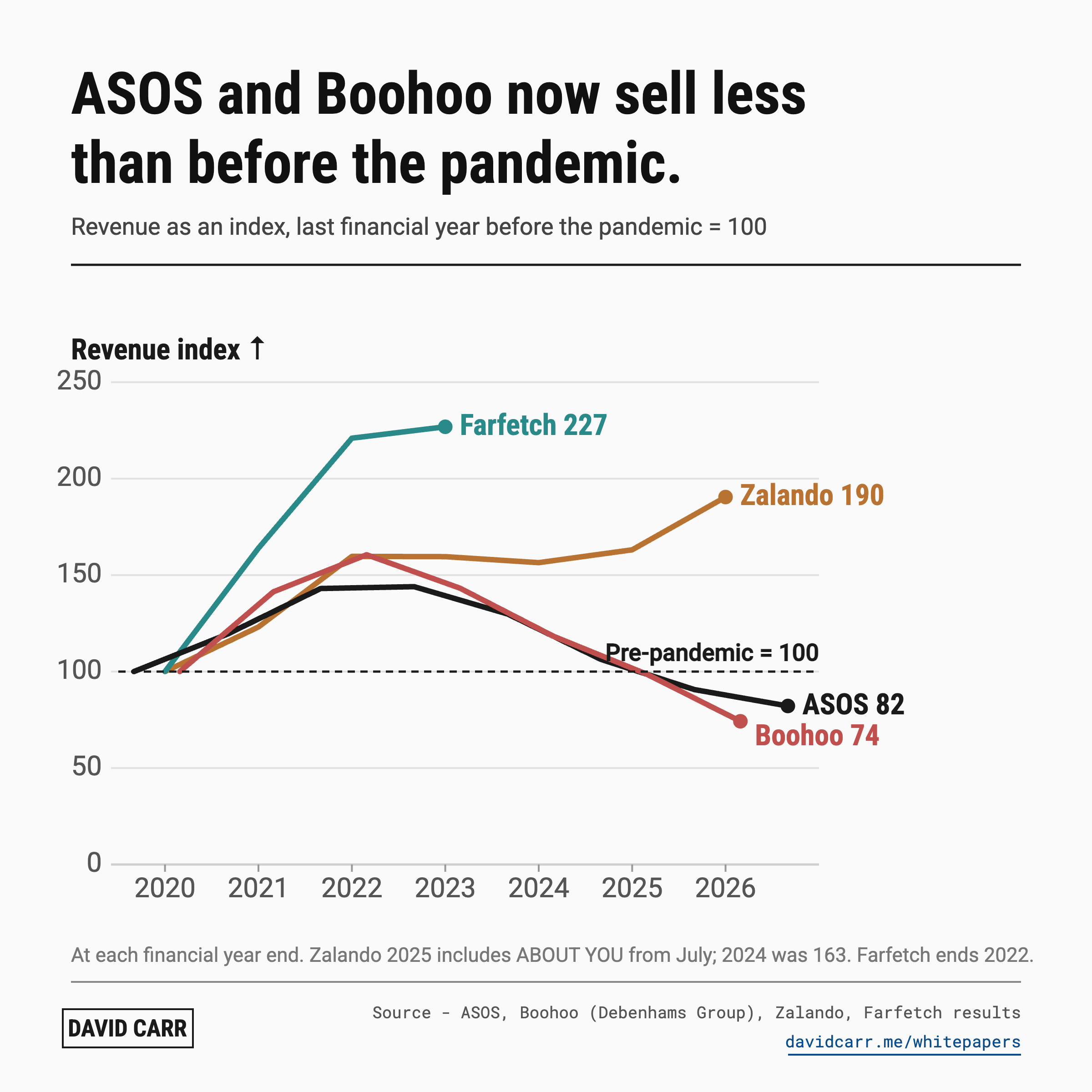
ASOS and Boohoo now sell less than they did before the pandemic.
- ASOS: £2.73bn in the year to August 2019, £2.25bn in the year to August 2026, an index of 82
- Boohoo: £1.23bn in the year to February 2020, £917m in the year to February 2026, 74
- Zalando: €6.48bn in 2019, €12.35bn in 2025, 190. Without ABOUT YOU, bought in 2025: 163 in 2024
- Farfetch: $1.02bn in 2019, $2.32bn in 2022, its last full year of results, 227
All four grew fast in 2020 and 2021. ASOS and Boohoo peaked in their 2022 financial years and have shrunk every year since. Zalando kept growing.
Each company’s revenue, in its own currency, as an index of its last financial year before the pandemic. Part of Boohoo’s fall in FY26 comes from moving to a marketplace, where only the commission counts as revenue.
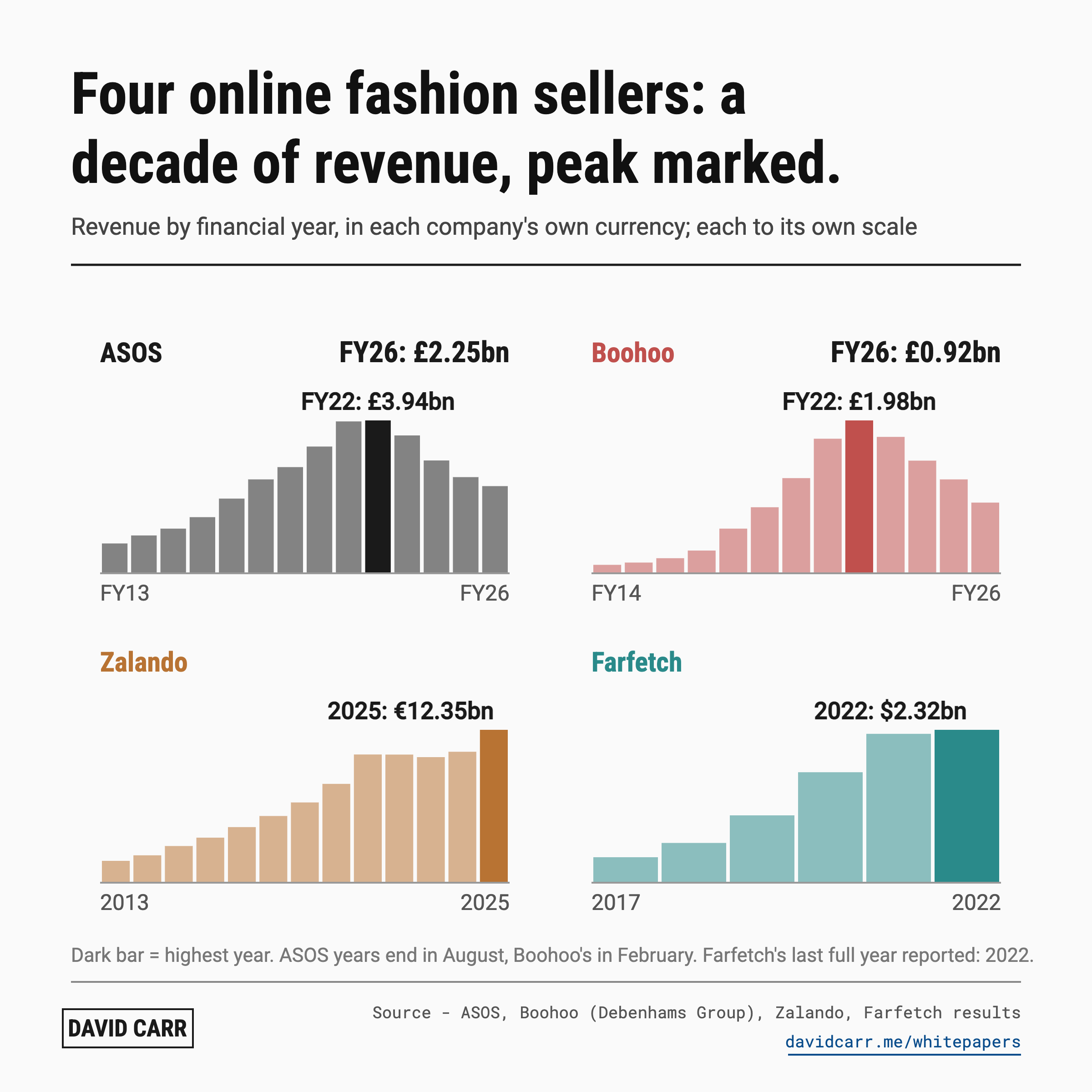
A decade of revenue: three peaked, and one is still climbing.
- ASOS: £0.77bn in FY13, a peak of £3.94bn in FY22, £2.25bn in FY26
- Boohoo: £0.11bn in FY14, a peak of £1.98bn in FY22, £0.92bn in FY26
- Zalando: €1.76bn in 2013, €12.35bn in 2025, a record
- Farfetch: $0.39bn in 2017, $2.32bn in 2022
Up to 2021 the four looked alike: years of fast growth. The split came after.
Statutory revenue as reported. ASOS years end in August, Boohoo’s in February, Zalando’s and Farfetch’s in December.
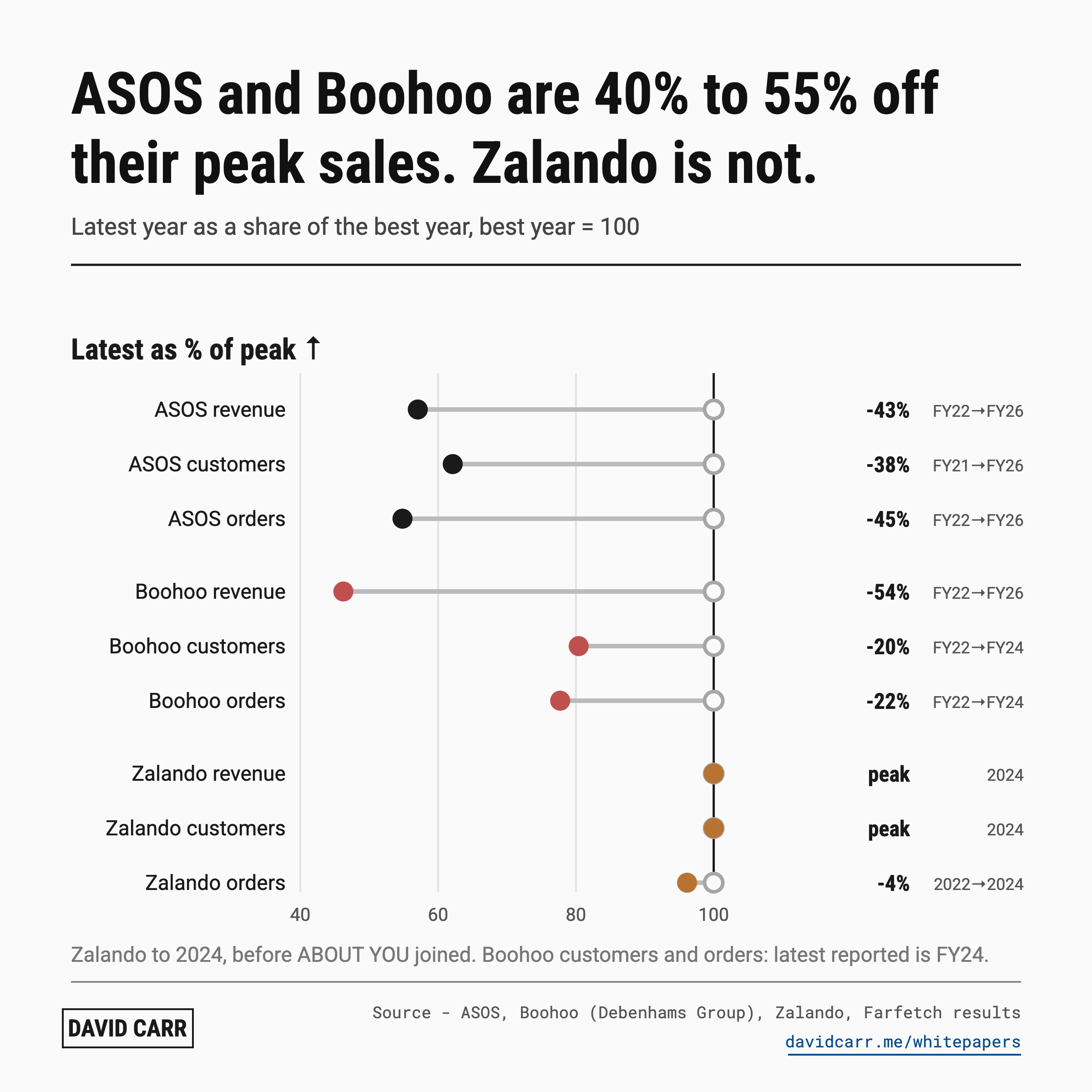
ASOS and Boohoo are 43% and 54% below their best year’s sales.
- ASOS, FY22 to FY26: revenue −43%, orders −45% (98.3m to 53.9m), active customers −38% from FY21
- Boohoo, FY22 to FY26: revenue −54%. Customers and orders −20% and −22% by FY24, the last year reported
- Zalando: revenue and customers at a record in 2024, before ABOUT YOU joined; orders 4% below 2022
At ASOS, revenue, orders and customers have all fallen by about two-fifths from their peaks.
Best year = the highest in each series. Zalando is measured to 2024 so the ABOUT YOU purchase does not flatter it.
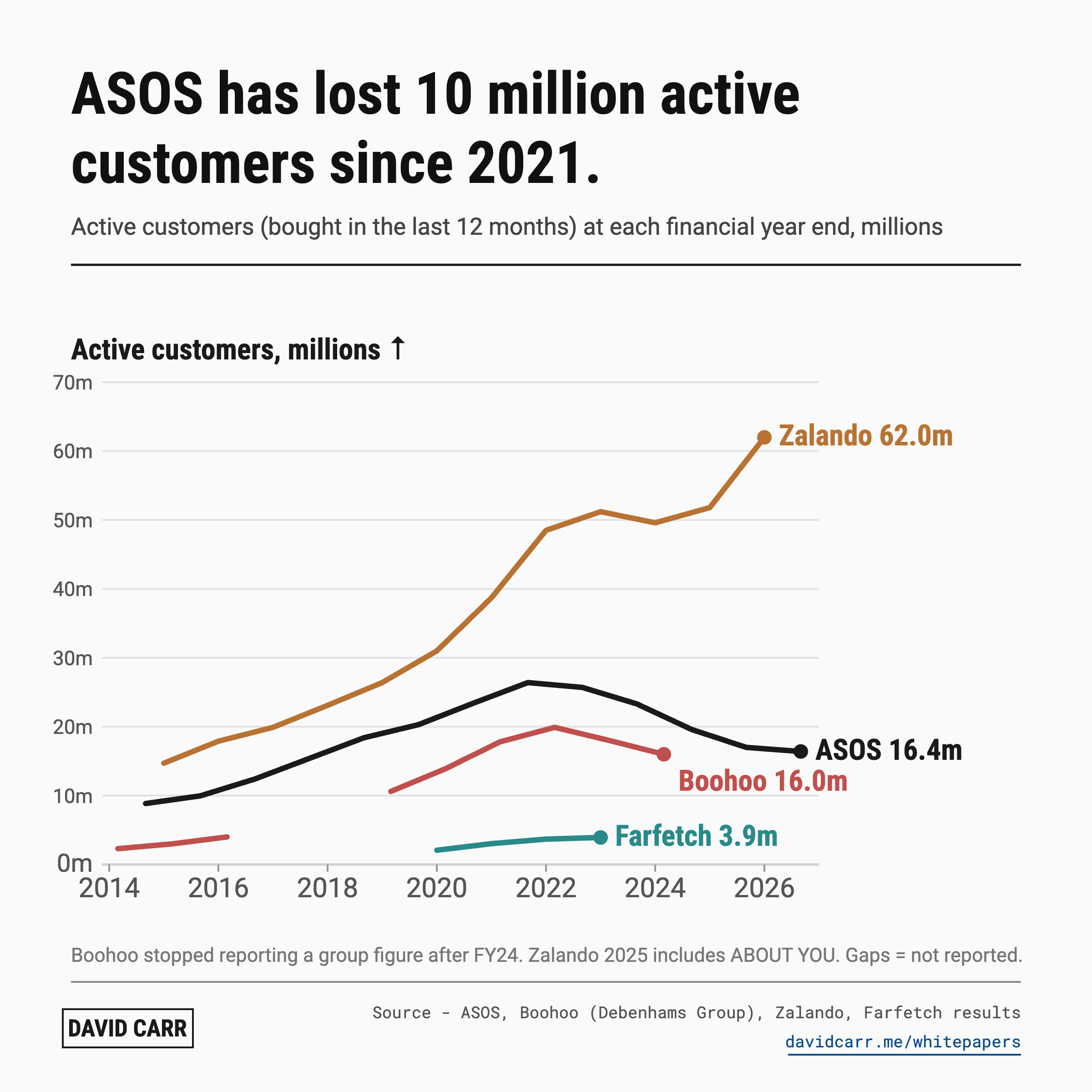
ASOS has 10 million fewer active customers than in 2021.
- ASOS: 26.4m in FY21, 16.4m in FY26
- Boohoo: 19.9m in FY22, 16.0m in FY24; not reported for the group since
- Zalando: 62.0m in 2025, 63.2m by September 2026; 51.8m in 2024, before ABOUT YOU
- Farfetch: 3.9m in 2022, 4.1m by June 2023
Active customers are people who bought at least once in the past year. On their latest figures, Zalando has more than ASOS, Boohoo and Farfetch together.
Each company’s own definition, at its financial year end. Definitions shifted a little over time; see the method.
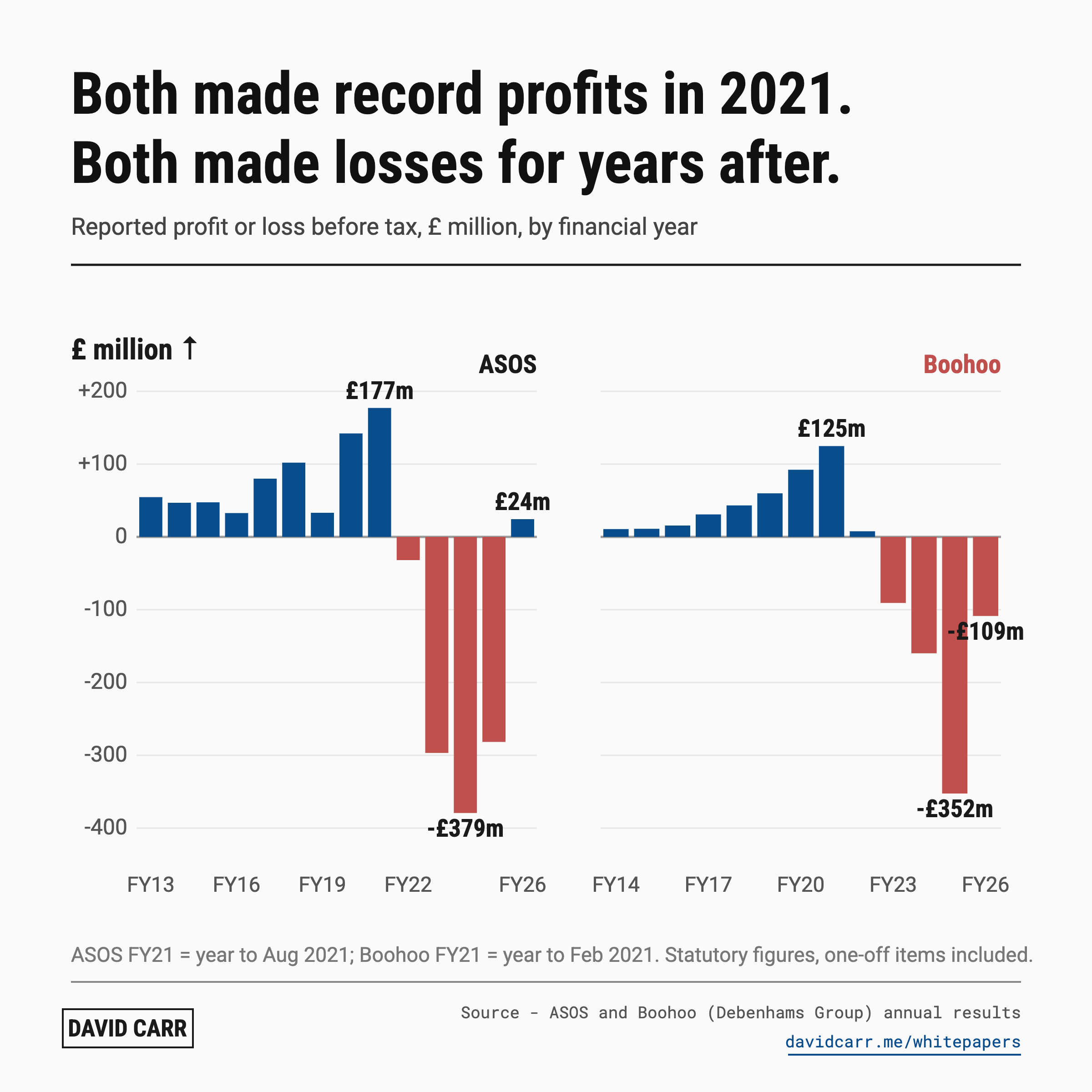
Both made record profits in 2021. Both then made losses for years.
- ASOS: £177m profit before tax in FY21; losses from FY22 to FY25, the biggest £379m in FY24
- ASOS FY26: a reported profit of £24m; −£46m on its adjusted measure
- Boohoo: £125m profit in FY21; losses in each year from FY23, the biggest £352m in FY25, then £109m in FY26
Record profits in 2021 were followed by four years of losses at ASOS, and four so far at Boohoo.
Reported (statutory) profit or loss before tax, which includes one-off items. ASOS FY21 runs to August 2021; Boohoo FY21 to February 2021.
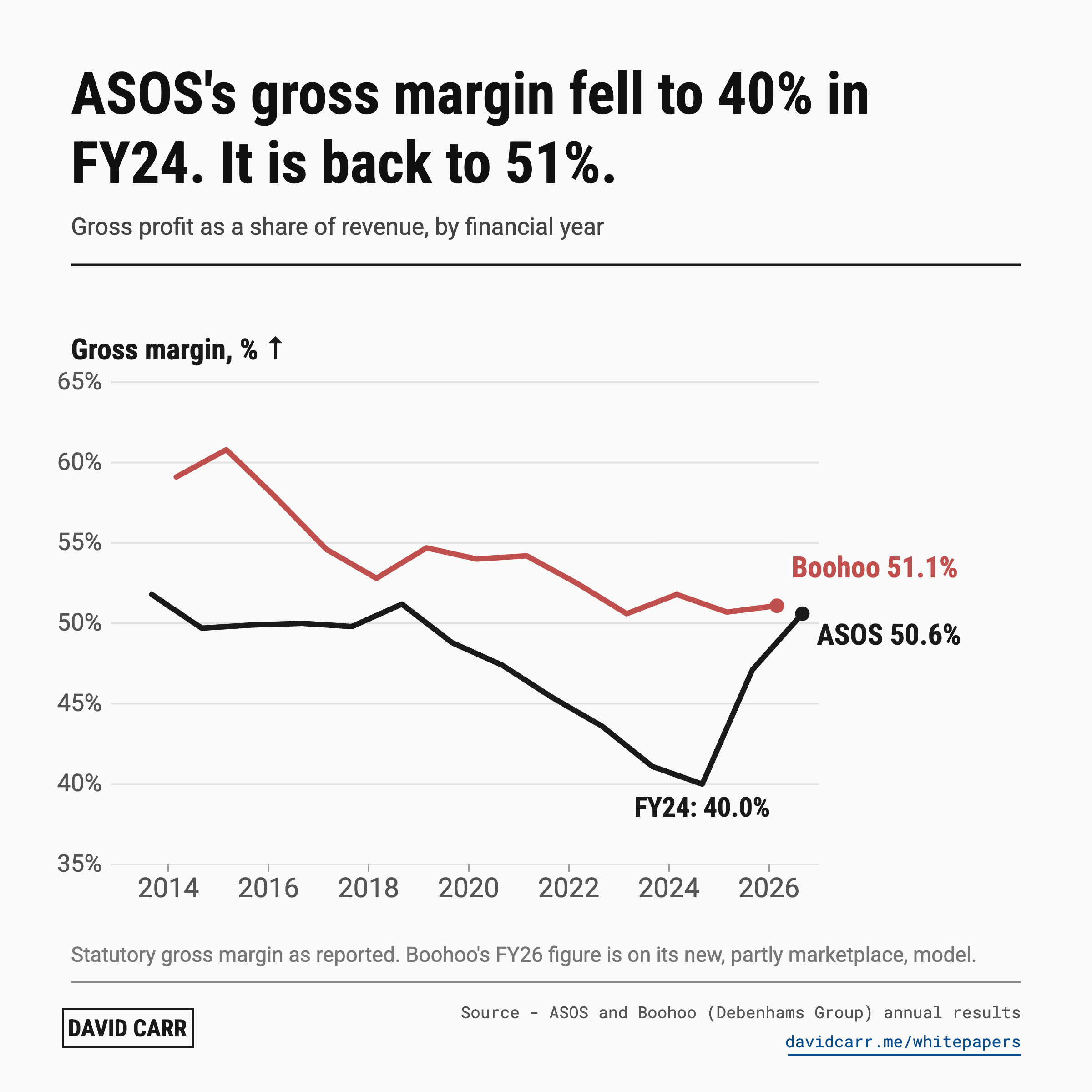
ASOS’s gross margin fell to 40% in FY24. It is back to 51%.
- ASOS: 51.2% in FY18, 40.0% in FY24, 50.6% in FY26
- Boohoo: 60.8% in FY15, 50.6% in FY23, 51.1% in FY26
Gross margin is what is left from each pound of sales after the cost of the goods. ASOS has rebuilt its margin to where it was before the pandemic, on lower sales.
Statutory gross margin as each company reports it. Boohoo’s FY26 figure is on its new, partly marketplace, model.
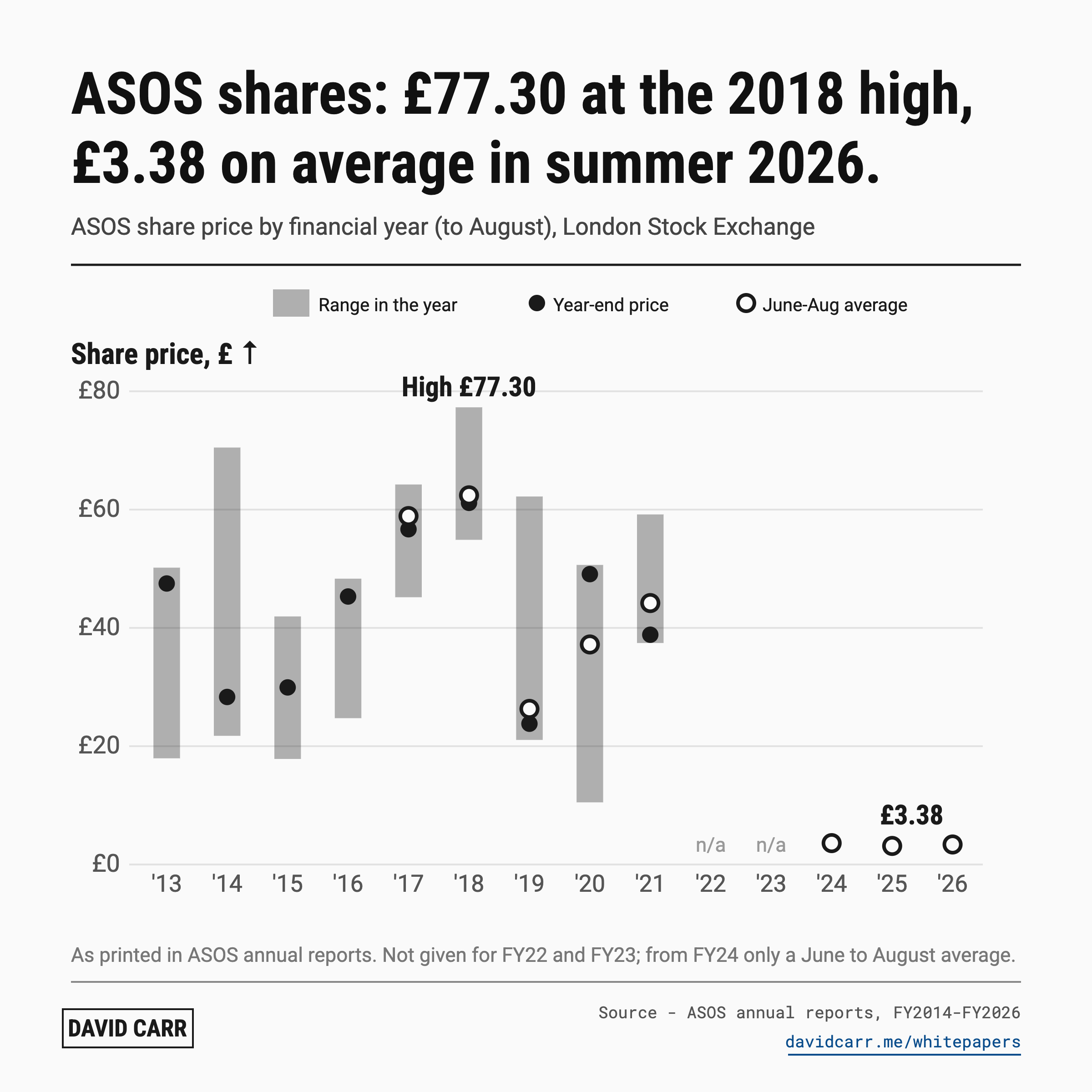
ASOS shares reached £77.30 in its 2018 financial year. They averaged £3.38 in summer 2026.
- Highest in the reports: £77.30, in the year to August 2018
- Lowest: £10.50, in the year to August 2020. That year ended at £49.09
- Average June to August: £3.62 in 2024, £3.14 in 2025, £3.38 in 2026
On these figures the share price in 2026 is less than a twentieth of its 2018 high.
Share prices as printed in ASOS’s annual reports. Reports for FY22 and FY23 were not found or gave none; from FY24 only a three-month average is given.
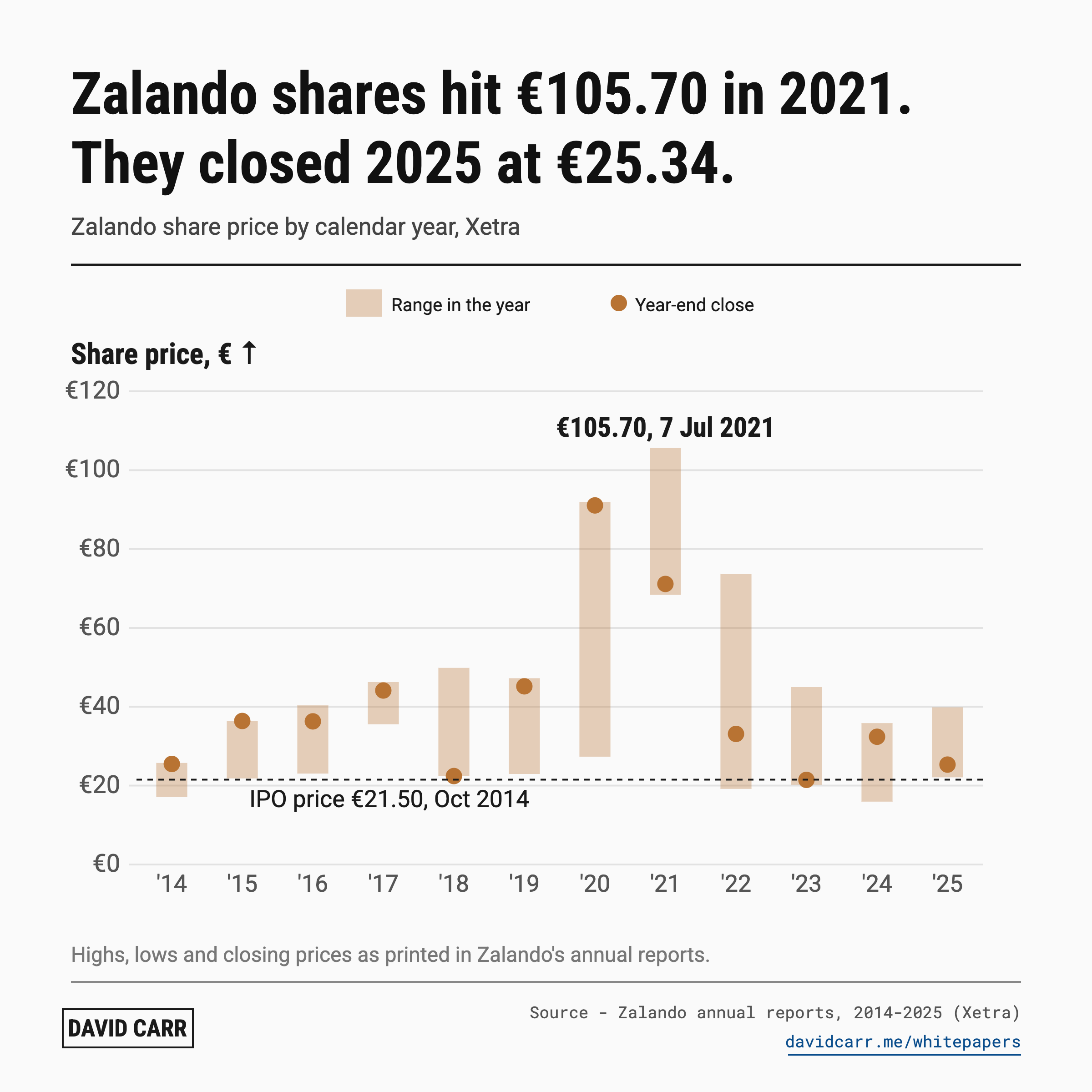
Zalando shares hit €105.70 in July 2021. They closed 2025 at €25.34.
- Floated at €21.50 in October 2014
- Year-end close: €45.18 in 2019, €91.06 in 2020, €71.14 in 2021
- €21.45 at the end of 2023, €32.39 at the end of 2024, €25.34 at the end of 2025
- The 2025 close was 76% below the 2021 high
Zalando’s sales kept growing, but its share price is back near where it floated.
Highs, lows and closing prices as printed in Zalando’s annual reports (Xetra).
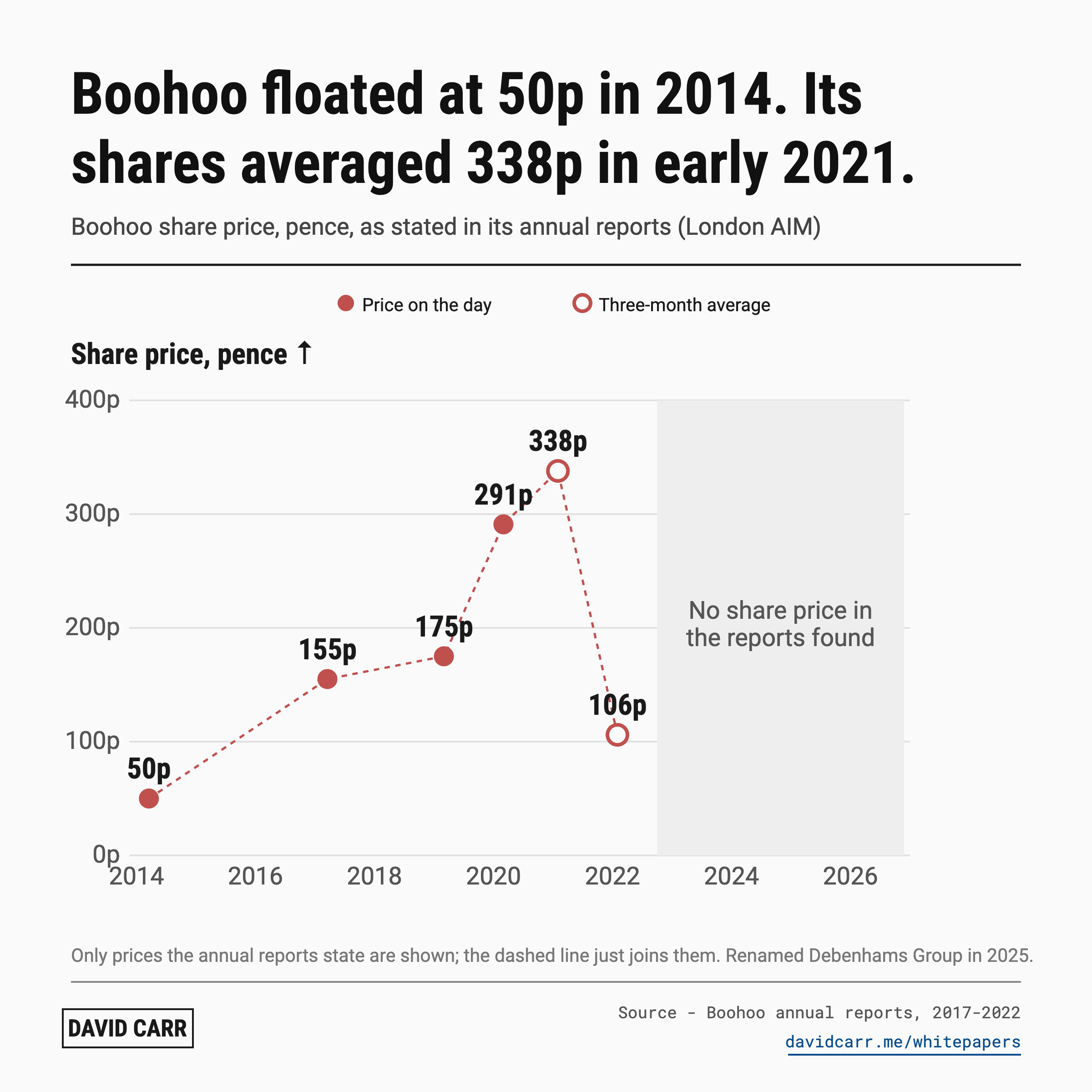
Boohoo floated at 50p in 2014. Its shares averaged 338p in early 2021.
- 50p at the float in March 2014; 155p in March 2017
- 175p at the end of February 2019; 291p at the end of February 2020
- Average over the last three months of each year: 338p to February 2021, 106p to February 2022
The annual reports found give no share price after February 2022, so the chart stops there. The company was renamed Debenhams Group in 2025.
Only prices stated in Boohoo’s annual reports. Three of them are prices on the day, two are three-month averages, and the float price is from a share-scheme note.
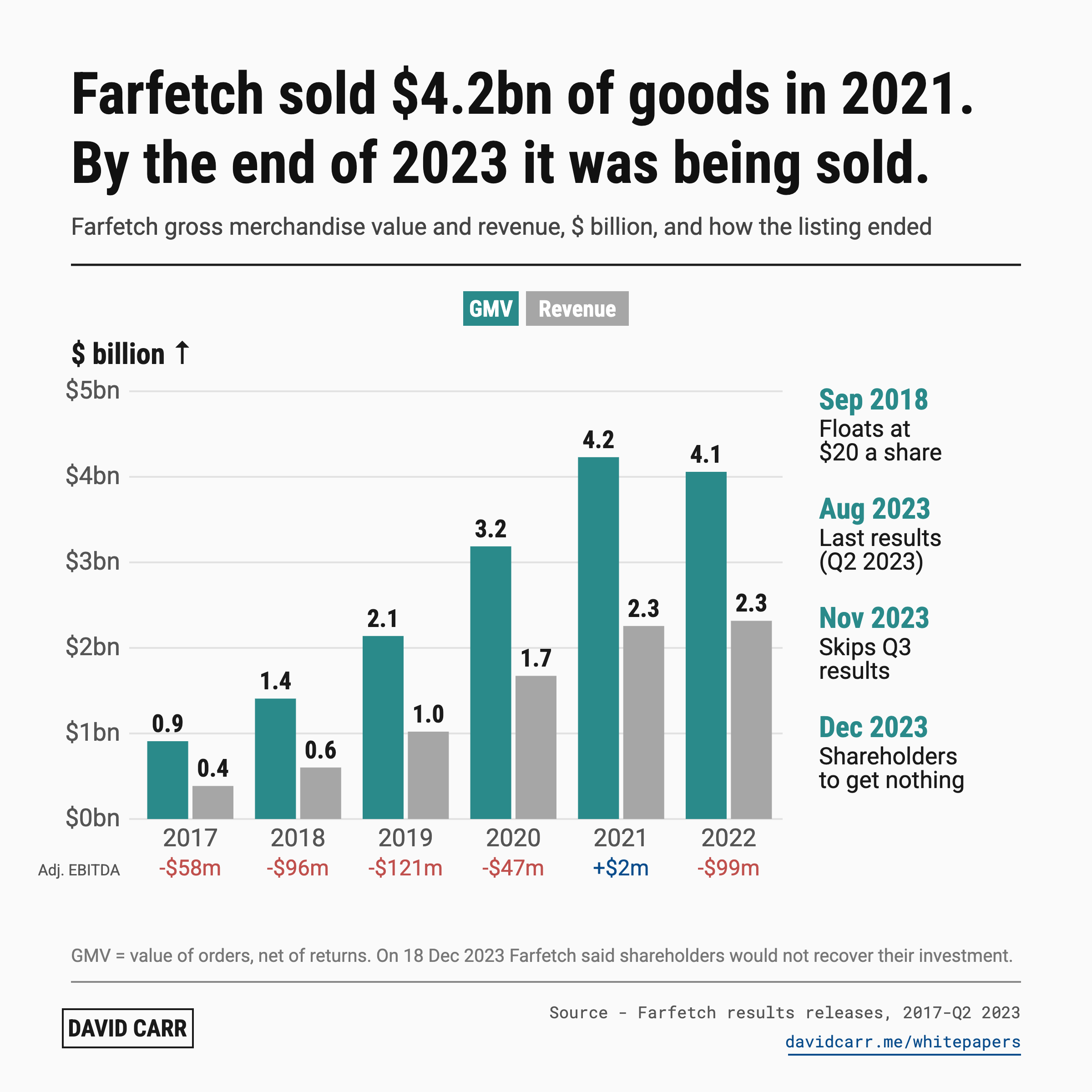
Farfetch sold $4.2bn of goods in 2021. By the end of 2023 it was being sold.
- Gross merchandise value: $0.9bn in 2017, $4.2bn in 2021, $4.1bn in 2022
- Revenue: $0.4bn in 2017, $2.3bn in 2022
- Adjusted EBITDA was positive in one year, 2021, by $2m
- Floated in New York at $20 in September 2018; last results August 2023, for the second quarter
In November 2023 Farfetch said it would not publish third-quarter results. On 18 December 2023 it announced the sale of its business to a company owned by Coupang and Greenoaks funds, and said shareholders were expected to recover nothing.
From Farfetch’s own results releases and announcements, read from Internet Archive copies, because its investor site is gone.
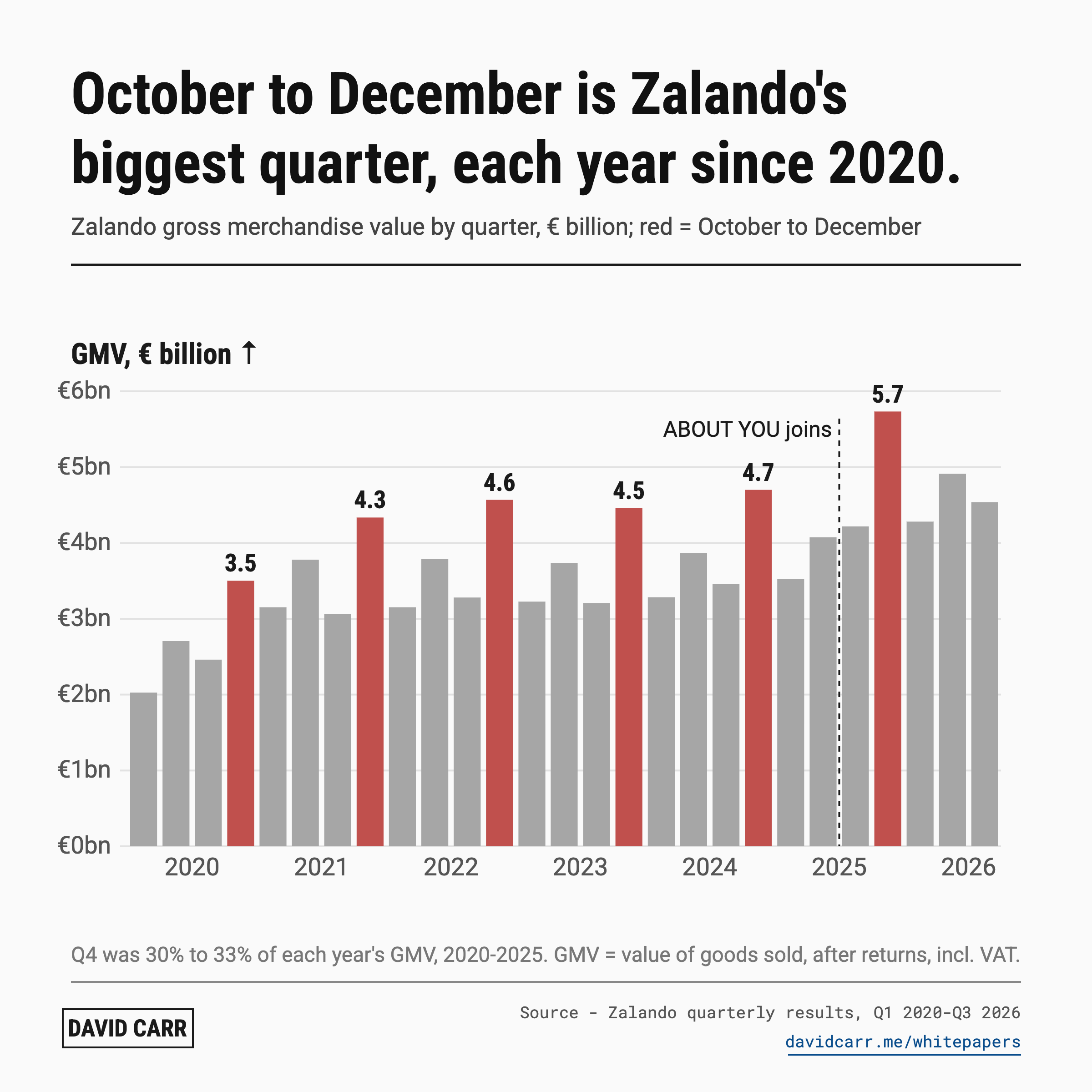
October to December is Zalando’s biggest quarter, every year since 2020.
- Q4 2025: €5.7bn of goods sold, the most of any quarter
- Q4 was 30% to 33% of each year’s gross merchandise value, 2020 to 2025
- ABOUT YOU’s sales are included from July 2025
Black Friday, Cyber Week and Christmas all fall in the fourth quarter. Zalando does not give a separate Black Friday figure.
Gross merchandise value: the value of goods sold, after returns, including VAT. ASOS and Boohoo do not publish quarterly sales in the documents used.
Method, caveats and sources
The short answer. All four grew fast through 2020 and 2021. After that they split. ASOS and Boohoo peaked in their 2022 financial years; by 2026 their sales were 43% and 54% below those peaks, and below where they were before the pandemic. ASOS has 10 million fewer active customers than in 2021. Both went from record profits in 2021 to years of losses; ASOS made a small reported profit again in FY26. Zalando kept growing and had a record 2025, helped by buying ABOUT YOU. Farfetch grew to $4.2bn of goods sold in 2021, stopped reporting in 2023 and announced the sale of its business that December, with shareholders expected to recover nothing. Share prices, as printed in the annual reports, are far below their 2018 to 2021 highs at ASOS and Zalando.
Sources. Annual reports, results releases and key-figure spreadsheets from ASOS, Debenhams Group (formerly Boohoo), Zalando and Farfetch, pulled 27 November 2026. Older ASOS and Boohoo documents and all Farfetch releases were read from Internet Archive copies of the companies’ own files, because the originals have been moved or removed. Latest years: ASOS FY26 (to 30 August 2026), Boohoo FY26 (to 28 February 2026), Zalando 2025 and the third quarter of 2026, Farfetch 2022 and the second quarter of 2023.
Share prices. Only prices printed in the companies’ own annual reports, or in their announcements, are used; nothing from market-data sites. That leaves gaps: ASOS gives none for FY22 and FY23 and only a three-month average from FY24; no Boohoo price was found after February 2022; no Farfetch price after its float was found in its own documents.
Caveats. Each company reports in its own currency and its own financial year, so the page compares shapes and percentages, not amounts. Zalando’s 2025 figures include ABOUT YOU from 11 July 2025, and its customer count includes ABOUT YOU’s for the full year. Boohoo moved part of its business to a marketplace in FY25-26, which lowers reported revenue, and it stopped reporting group customers and orders after FY24. Customer definitions changed a little over time at all four. Profit is reported profit before tax and includes one-off items. This page reports what the companies published and does not try to explain the changes.
Also: Zara, H&M and Primark in numbers and Second-hand goes mainstream