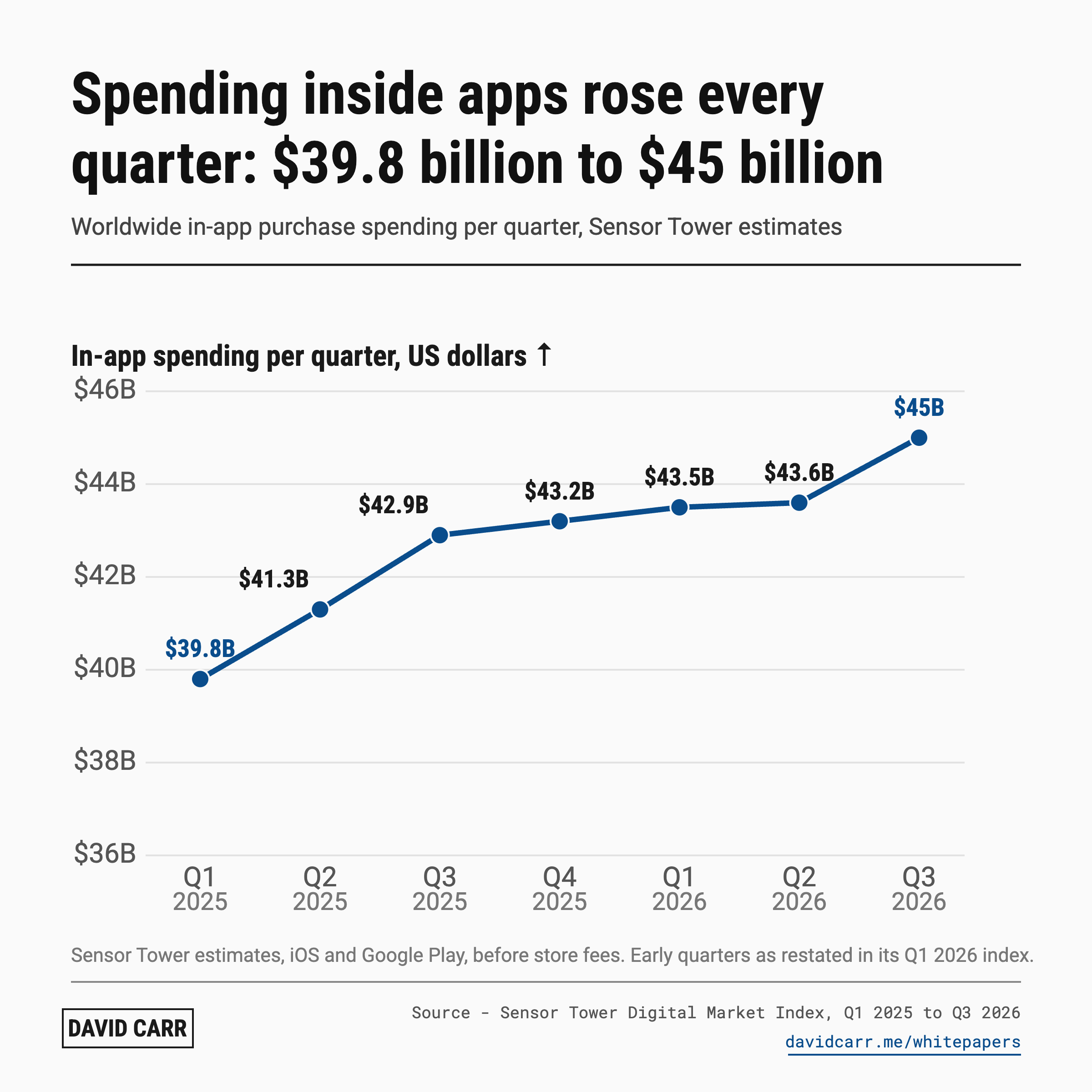
Spending inside apps rose every quarter: $39.8 billion to $45 billion
- Q1 2025: $39.8 billion
- Q4 2025: $43.2 billion
- Q2 2026: $43.6 billion
- Q3 2026: $45 billion, up 4.4% on a year earlier
The market keeps growing, but more slowly. Growth was about 11% a year in 2025 and 4.4% by the third quarter of 2026.
Sensor Tower estimates for the iOS App Store and Google Play, before store fees. Early quarters as restated in its Q1 2026 index; later ones from its Q2 and Q3 2026 posts.
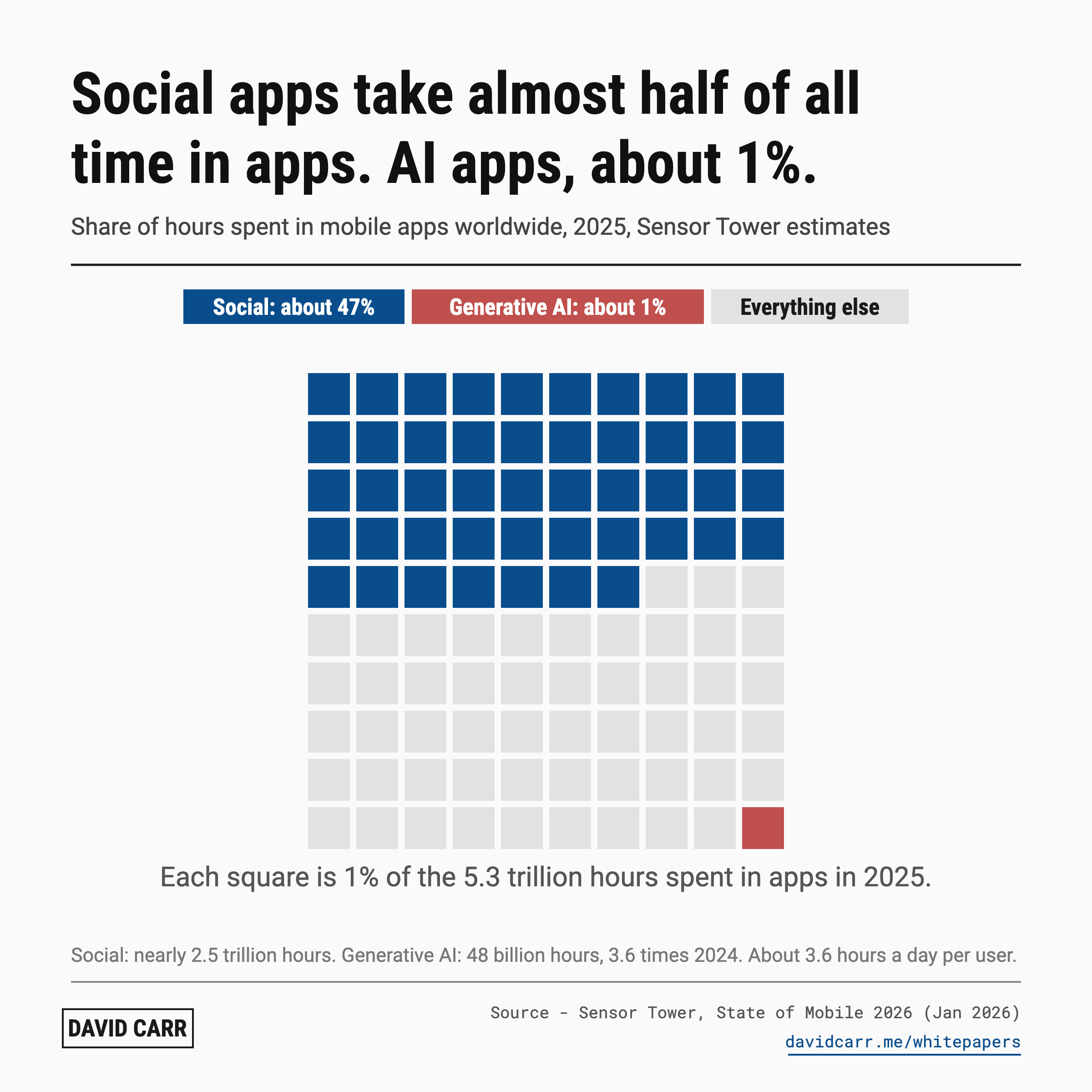
Social apps take almost half of all time in apps. AI apps, about 1%.
- All apps: 5.3 trillion hours in 2025
- Social apps: nearly 2.5 trillion hours
- Generative AI apps: 48 billion hours
- About 3.6 hours a day per user
AI apps are growing fast from a small base. Social apps still hold most of people's attention.
From Sensor Tower's State of Mobile 2026 and press release. Shares are the hours divided by the total.
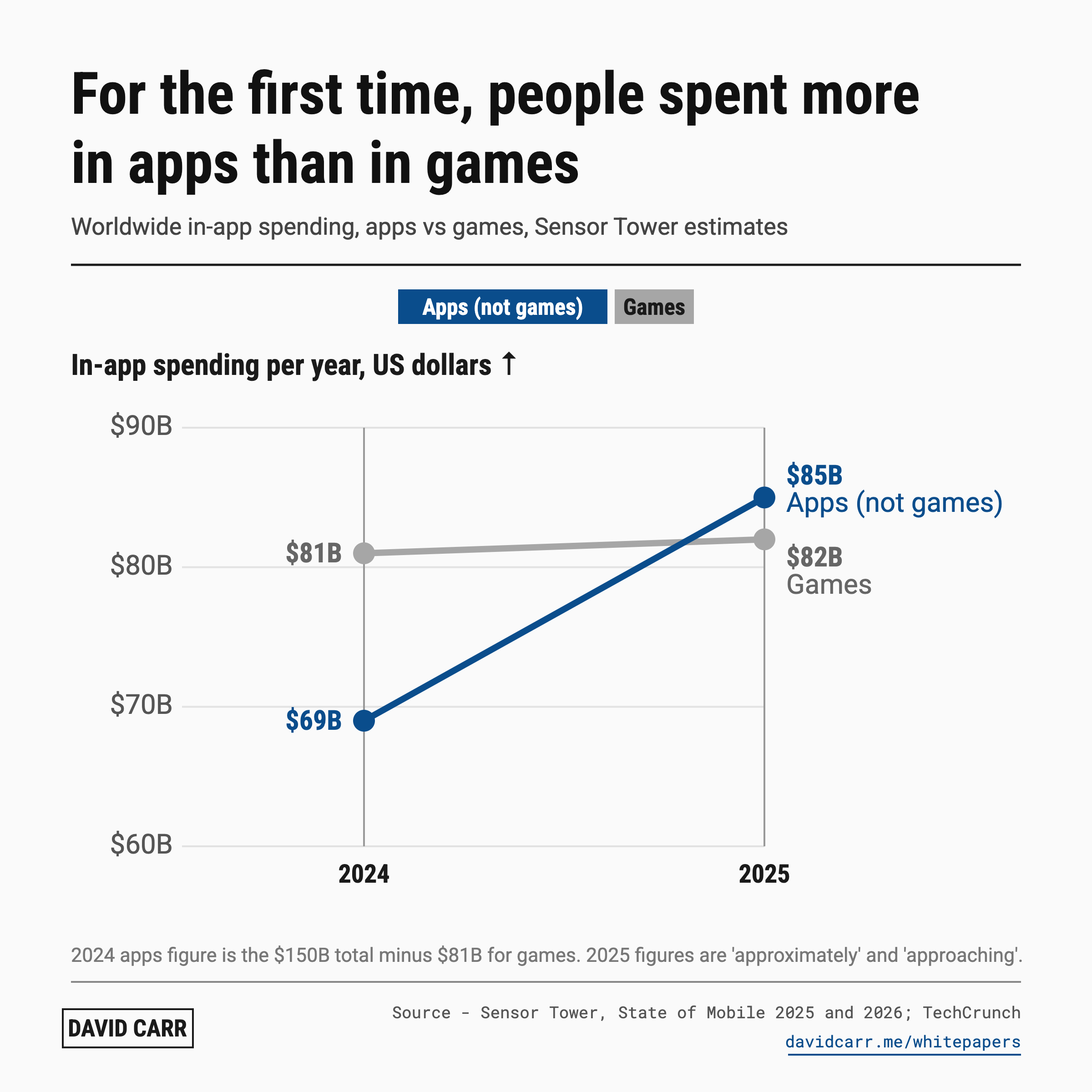
For the first time, people spent more in apps than in games
- 2024: games $81 billion, apps about $69 billion
- 2025: apps about $85 billion, games about $82 billion
- Apps grew 21% in a year. Games grew 1.3%.
Subscriptions to AI, streaming, social and dating apps pushed apps past games worldwide in 2025.
Sensor Tower estimates from State of Mobile 2025 and 2026, with the apps total from TechCrunch. The 2024 apps figure is the total minus games.
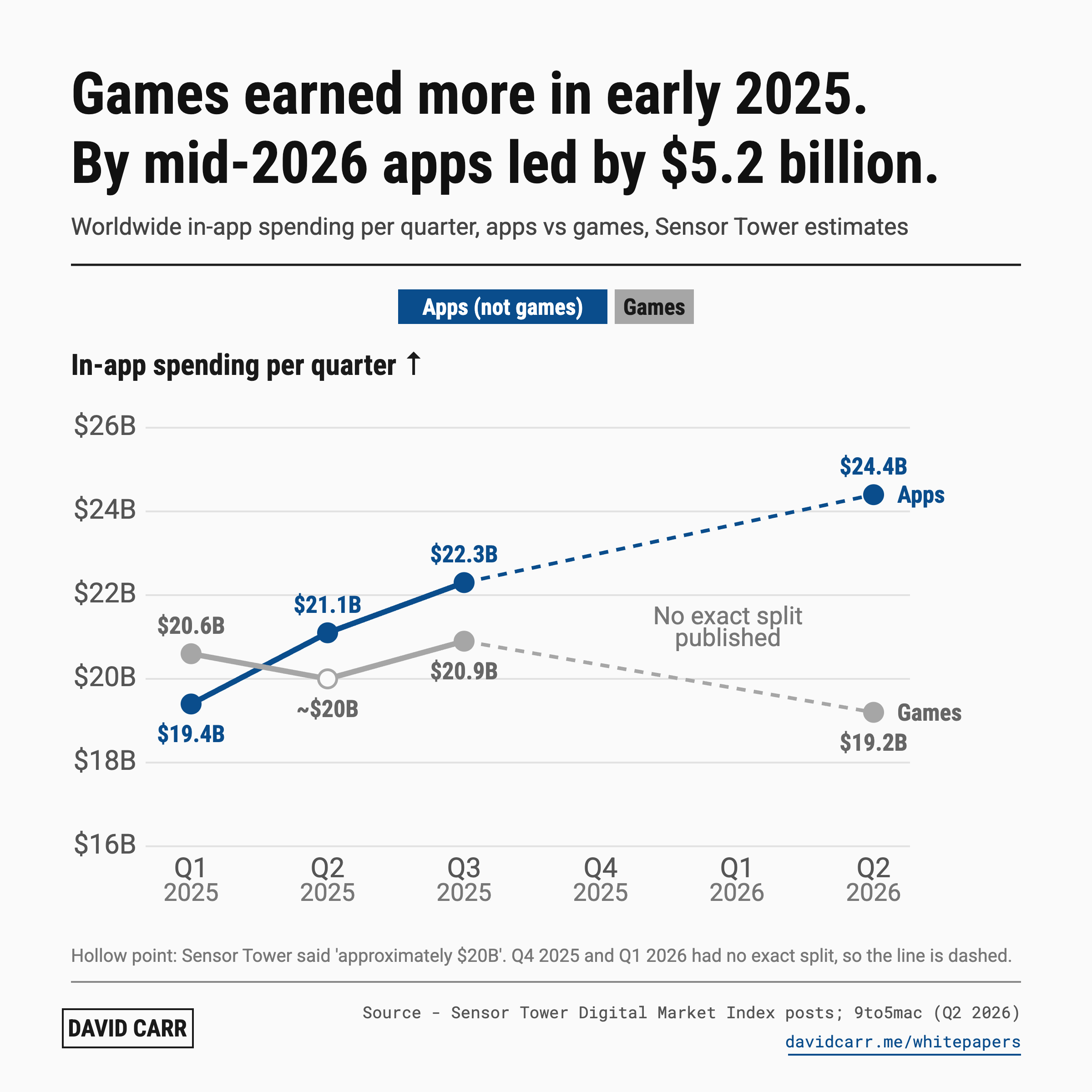
Games earned more in early 2025. By mid-2026 apps led by $5.2 billion.
- Q1 2025: games $20.6 billion, apps $19.4 billion
- Q3 2025: apps $22.3 billion, games $20.9 billion
- Q2 2026: apps $24.4 billion, games $19.2 billion
The gap has widened each time Sensor Tower published the split. Game spending fell 4.5% in Q2 2026.
From Sensor Tower's Q1, Q2 and Q3 2025 posts, and its Q2 2026 figures via 9to5Mac.
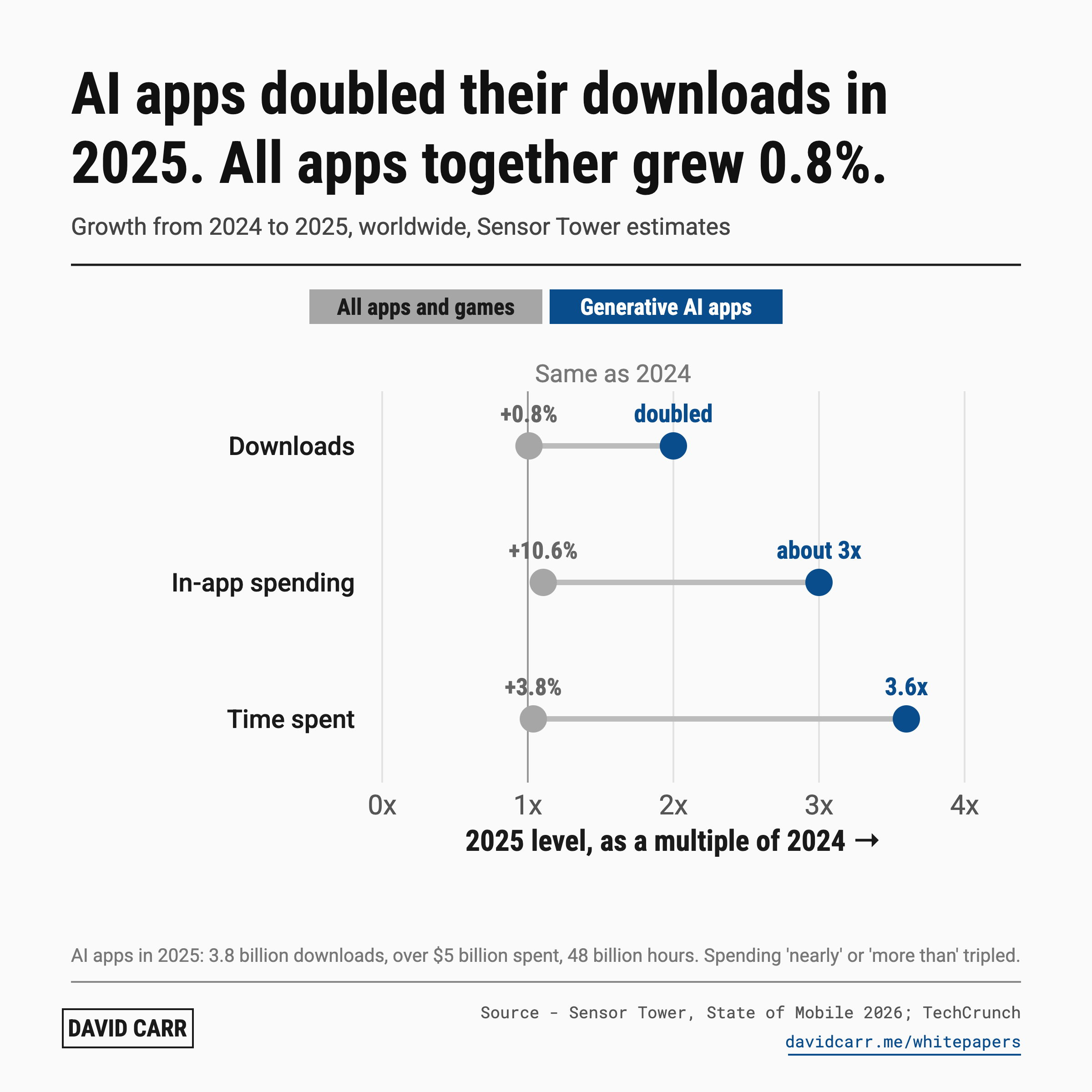
AI apps doubled their downloads in 2025. All apps together grew 0.8%.
- Downloads: AI apps doubled to 3.8 billion. All apps: +0.8%
- Spending: AI apps about tripled, to over $5 billion. All apps: +10.6%
- Time: AI apps 3.6 times 2024. All apps: +3.8%
Almost all of the new growth in apps came from AI.
Sensor Tower estimates from State of Mobile 2026. Its blog says AI spending "nearly tripled"; TechCrunch says "more than tripled".
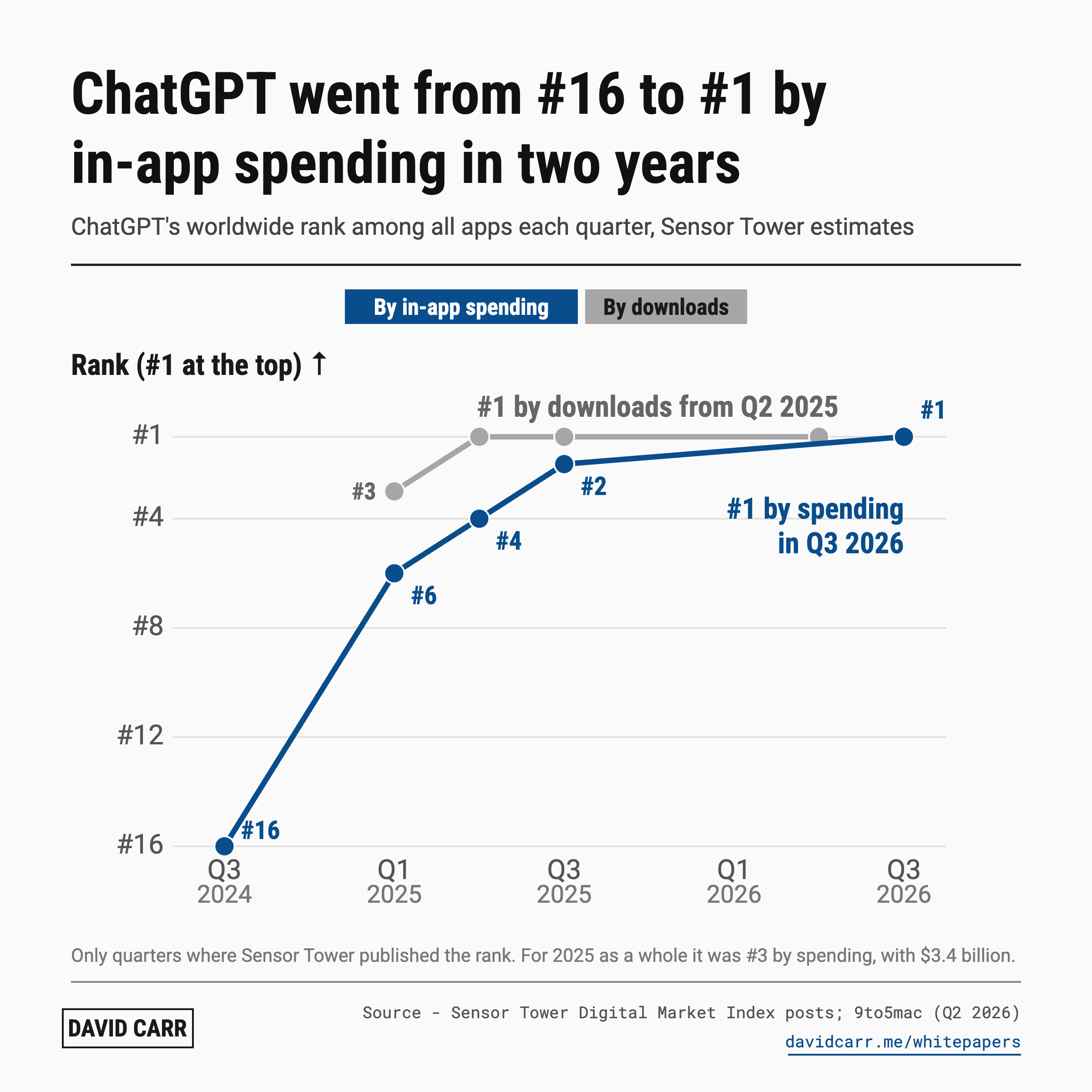
ChatGPT went from #16 to #1 by in-app spending in two years
- Q3 2024: #16 by spending
- Q2 2025: #1 by downloads, passing TikTok
- Q3 2025: #2 by spending
- Q3 2026: #1 by spending for the first time
ChatGPT took $3.4 billion in app spending in 2025, third behind TikTok and Google One. By late 2026 it was top.
Ranks from Sensor Tower's Q1, Q2 and Q3 2025 and Q3 2026 indexes. Quarters with no published rank are left out.
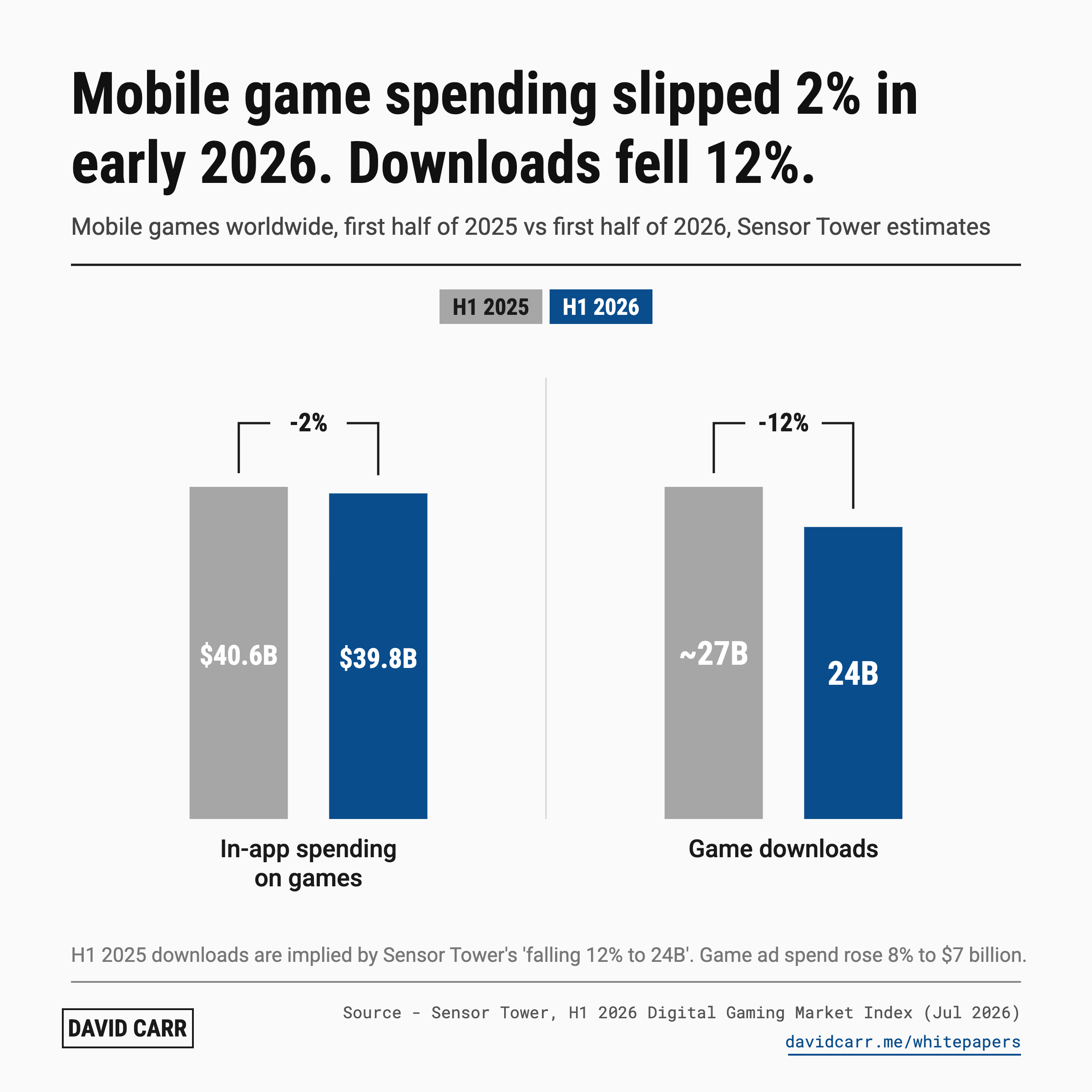
Mobile game spending slipped 2% in early 2026. Downloads fell 12%.
- In-app spending on games: $40.6 billion to $39.8 billion
- Game downloads: down 12% to 24 billion
- Ad spending by games: up 8% to $7 billion
Fewer new players are arriving, and spending is holding up only just.
First half of each year, from Sensor Tower's H1 2026 Digital Gaming Market Index. The H1 2025 download figure is implied by the 12% fall.
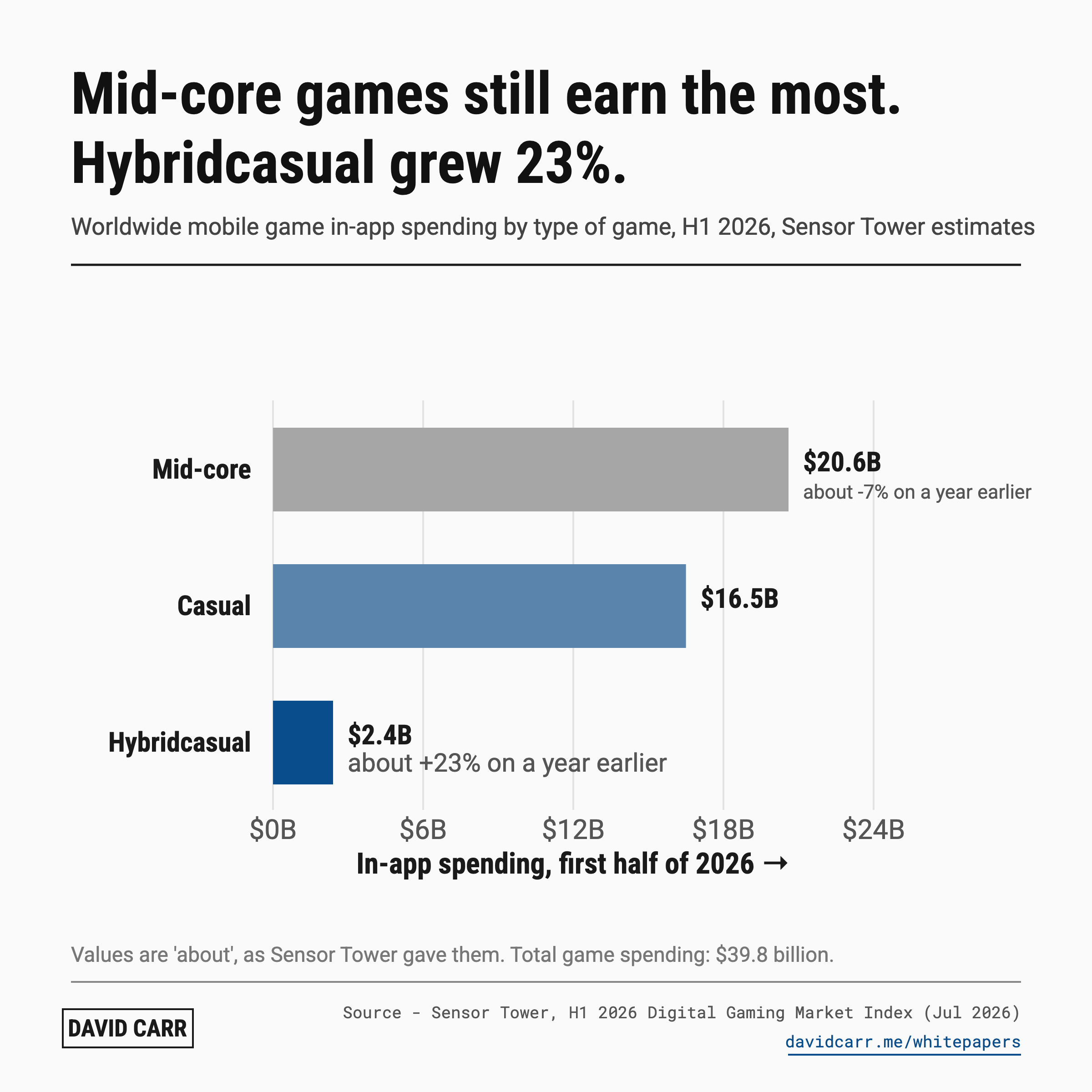
Mid-core games still earn the most. Hybridcasual grew 23%.
- Mid-core: about $20.6 billion, down about 7%
- Casual: about $16.5 billion
- Hybridcasual: about $2.4 billion, up about 23%
Simple games with deeper ways to pay are the growing corner of mobile gaming.
First half of 2026, from Sensor Tower's gaming index. Values are "about", as given.
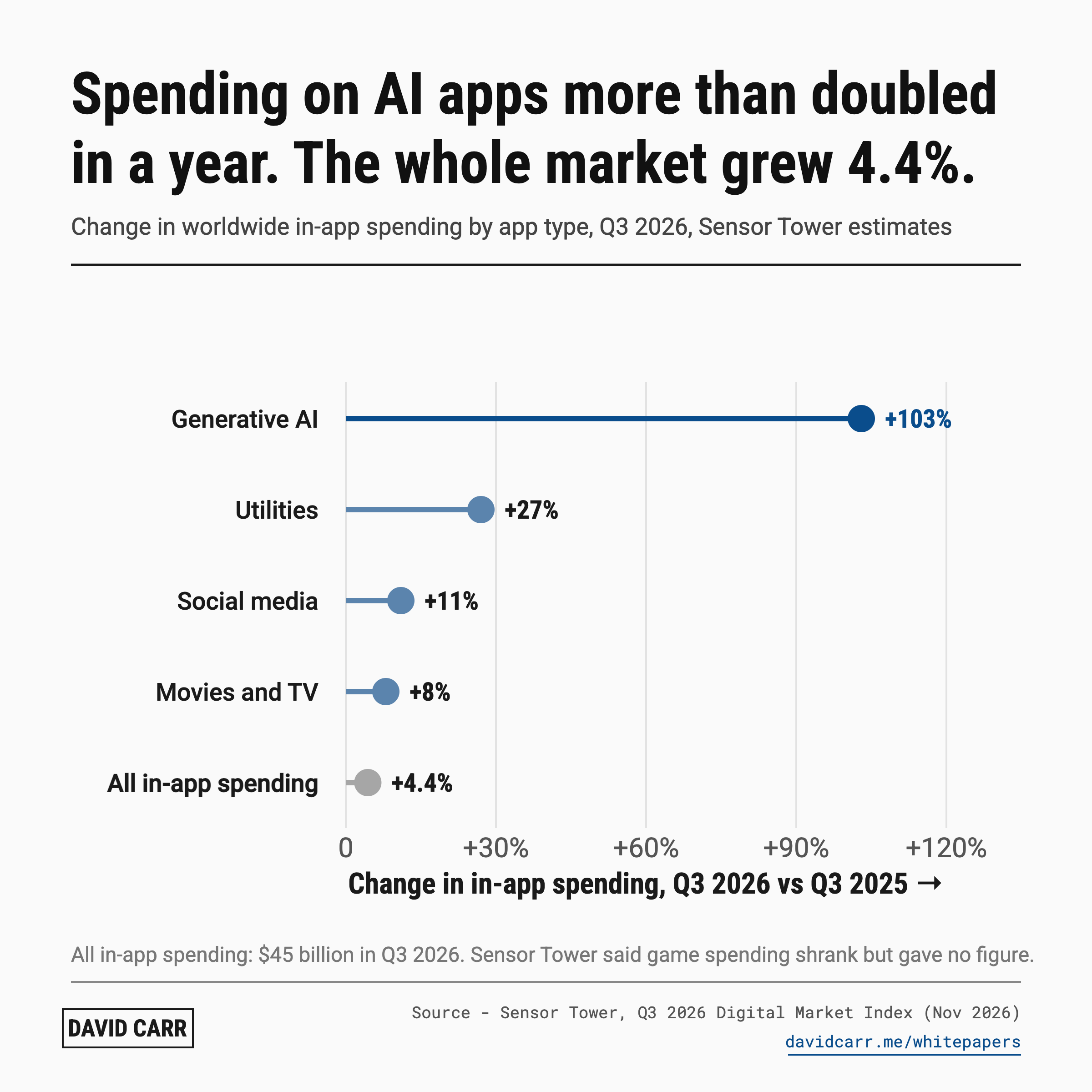
Spending on AI apps more than doubled in a year. The whole market grew 4.4%.
- Generative AI: +103%
- Utilities: +27%
- Social media: +11%
- Movies and TV: +8%
- All in-app spending: +4.4%
Apps that sell subscriptions carried the market while game spending shrank.
Q3 2026 against Q3 2025, from Sensor Tower's Q3 2026 Digital Market Index.
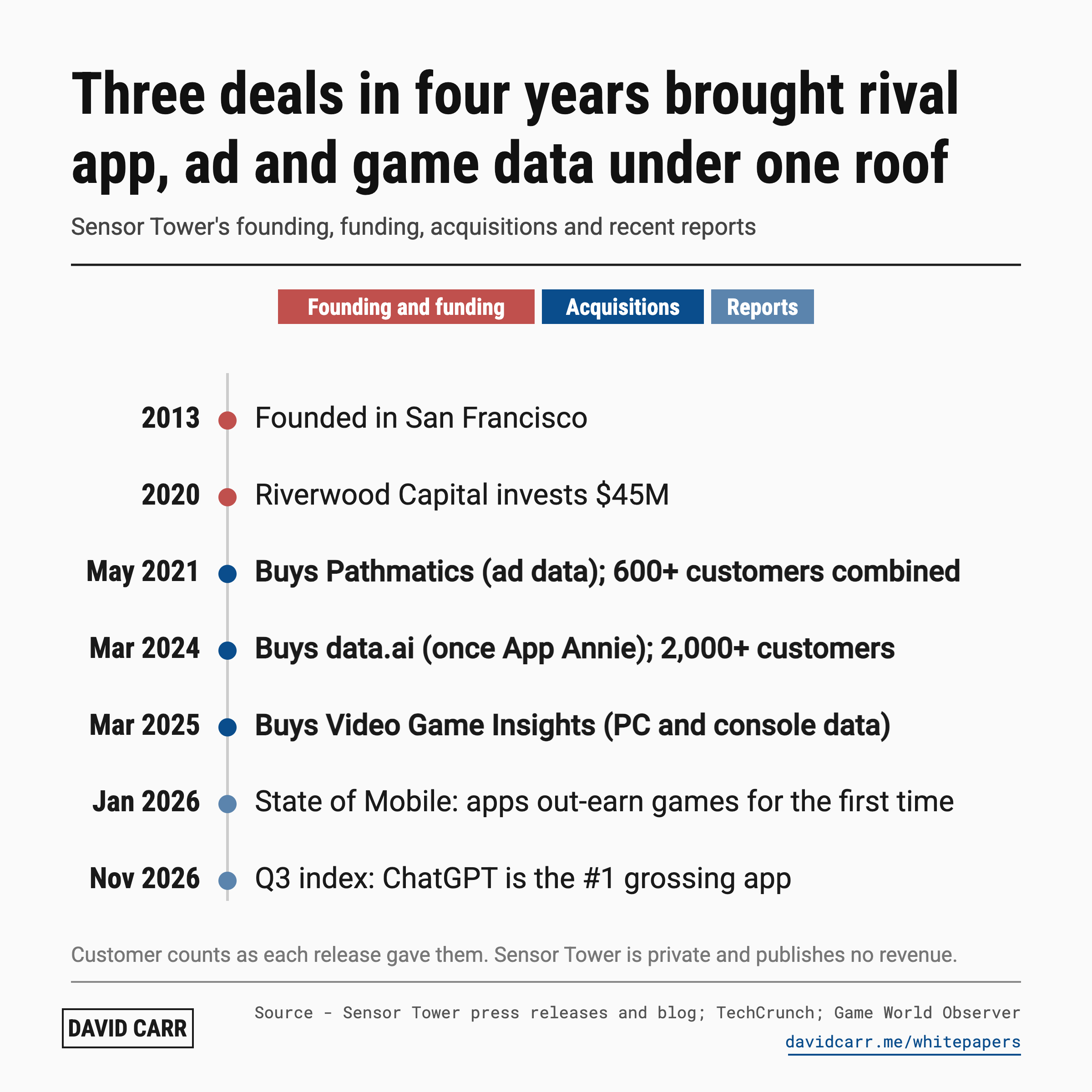
Three deals in four years brought rival app, ad and game data under one roof
- 2013: founded in San Francisco
- May 2021: buys Pathmatics, its first acquisition
- March 2024: buys data.ai, formerly App Annie
- March 2025: buys Video Game Insights
Sensor Tower went from more than 350 enterprise customers in 2021 to 2,000+ combined after the data.ai deal.
Customer counts as each announcement gave them. Sensor Tower is private and publishes no revenue.
Method, caveats and sources
The short answer. Sensor Tower estimates that people spent $167 billion inside apps in 2025, and $45 billion in the third quarter of 2026 alone. In 2025 apps out-earned games for the first time, and the gap has kept growing. AI apps drove most of the new growth: ChatGPT went from #16 to #1 by spending in two years. Mobile game spending is flat to slightly down.
Every figure is a Sensor Tower estimate. Sensor Tower models downloads and spending from app store data and its own panels. Its figures cover the iOS App Store and Google Play only, so they leave out other Android stores. Spending is gross, before Apple's and Google's fees.
Revisions. Sensor Tower revises its numbers. Its 2025 report gave 136 billion downloads and 4.2 trillion hours for 2024; its 2026 report implies higher 2024 figures, so the two reports are never joined into one series here. Quarterly spending for 2025 uses the restated values from its Q1 2026 index, which add up to the $167 billion annual total.
Left out. Full top-ten lists of apps and games for 2025 were not in any page I could read, so only ChatGPT's ranks are shown. Sports betting apps grew fast but are left out. Sensor Tower is private and publishes no revenue, profit or headcount. An outside analyst's guess at the data.ai price is not used.
Sources. Sensor Tower's State of Mobile 2025 and 2026, its quarterly Digital Market Index posts (read 24 November 2026), its H1 2026 gaming index and press releases; TechCrunch, 9to5Mac, Mobile Marketing Reads and Game World Observer where they quote Sensor Tower's figures.
Also: Stripe, OpenAI and Spotify.