A snowboard shop in 2004. $378 billion of sales in 2025.
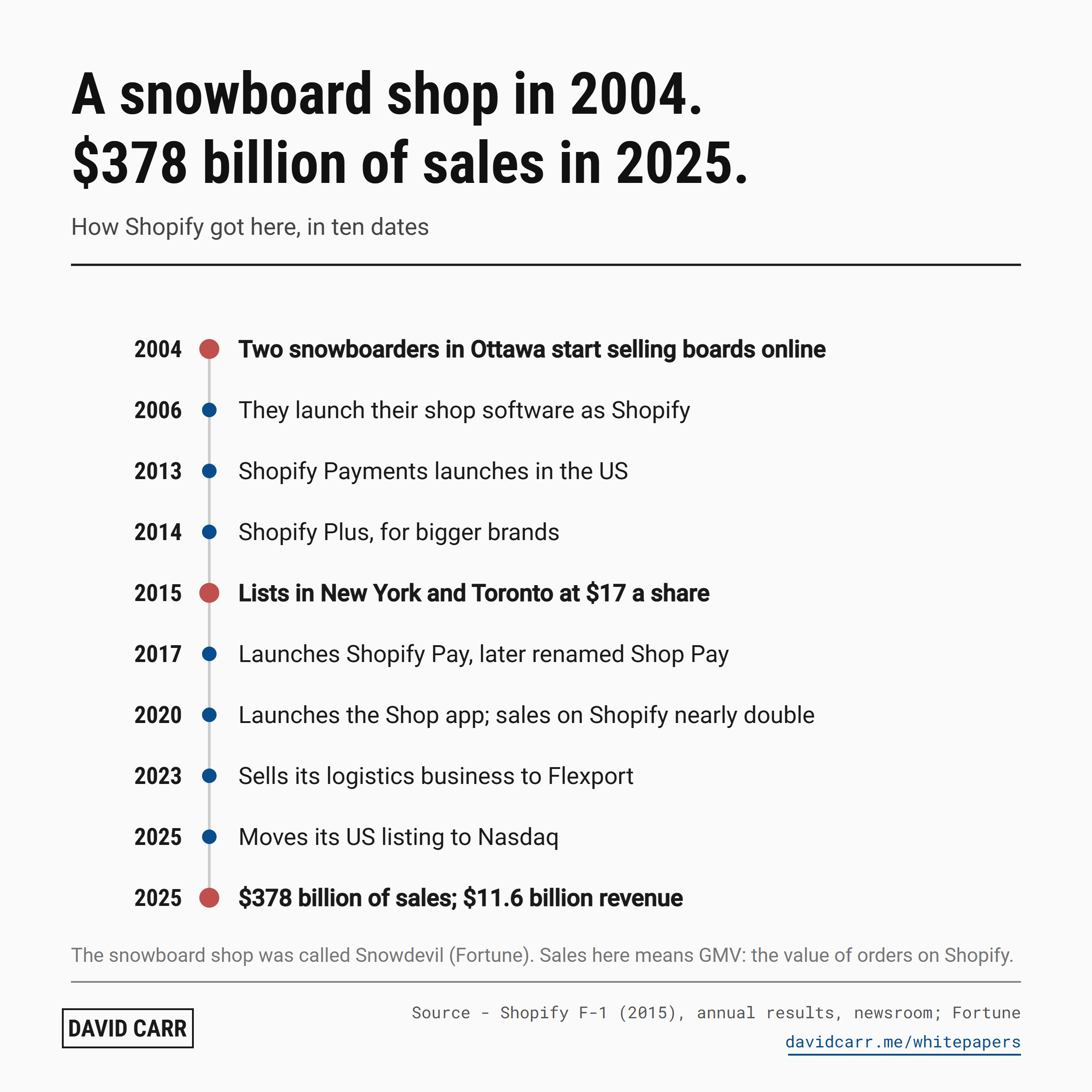
- 2004: an online snowboard shop in Ottawa
- 2006: the shop's software launches as Shopify
- 2015: listed in New York and Toronto at $17 a share
- 2025: $378 billion of sales, $11.6 billion revenue
The founders couldn't find shop software they liked, so they wrote their own. The software became the business.
From Shopify's 2015 IPO filing and Fortune, which gives the shop's name, Snowdevil. Later dates from Shopify's own releases on Flexport and Nasdaq.
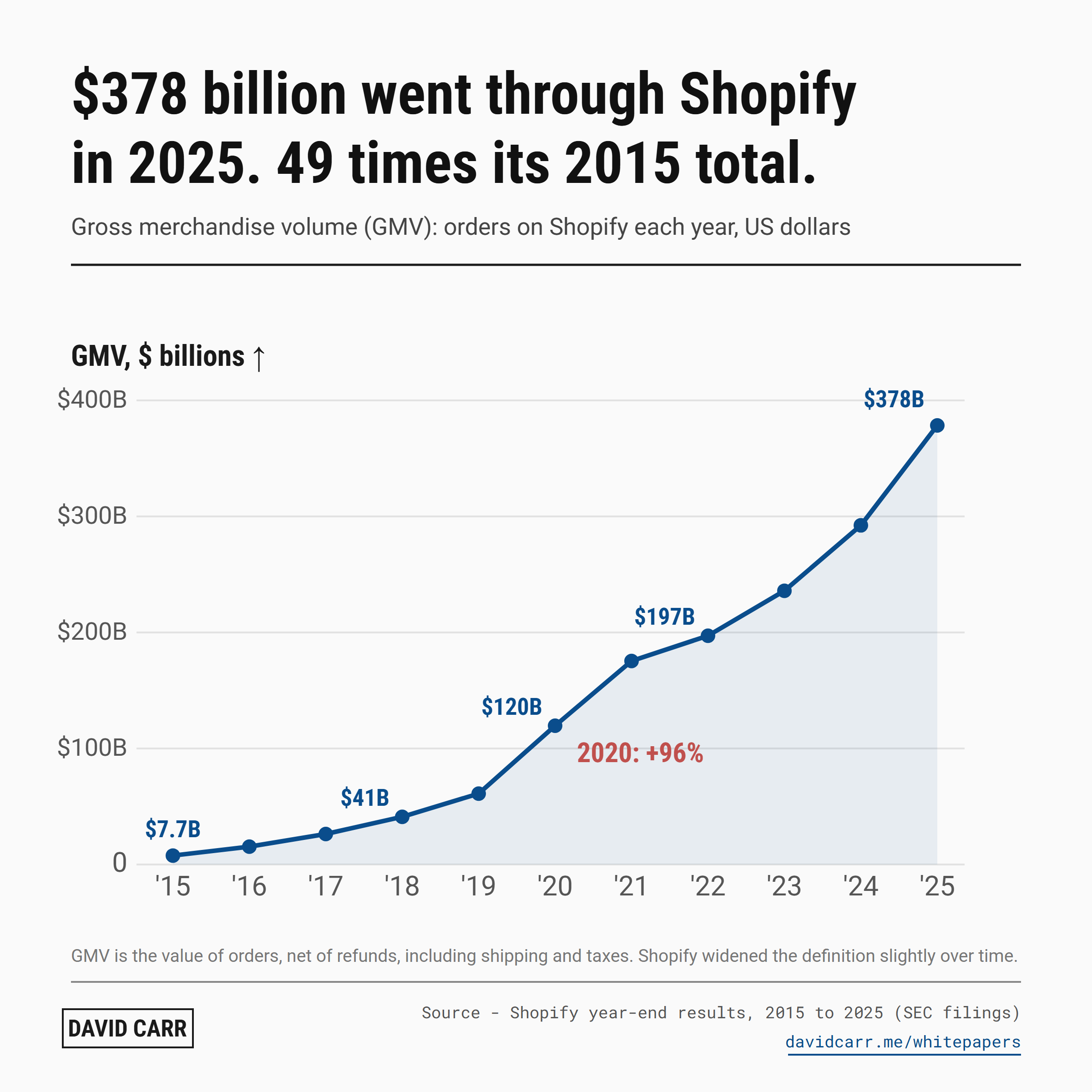
$378 billion went through Shopify in 2025. 49 times its 2015 total.
- 2015: $7.7 billion
- 2019: $61 billion
- 2020: $120 billion, up 96%
- 2025: $378 billion
The 2020 jump never reversed. Growth slowed to 12% in 2022, then climbed back to 29% in 2025.
Gross merchandise volume from Shopify's year-end results, for example 2015, 2020 and 2025.
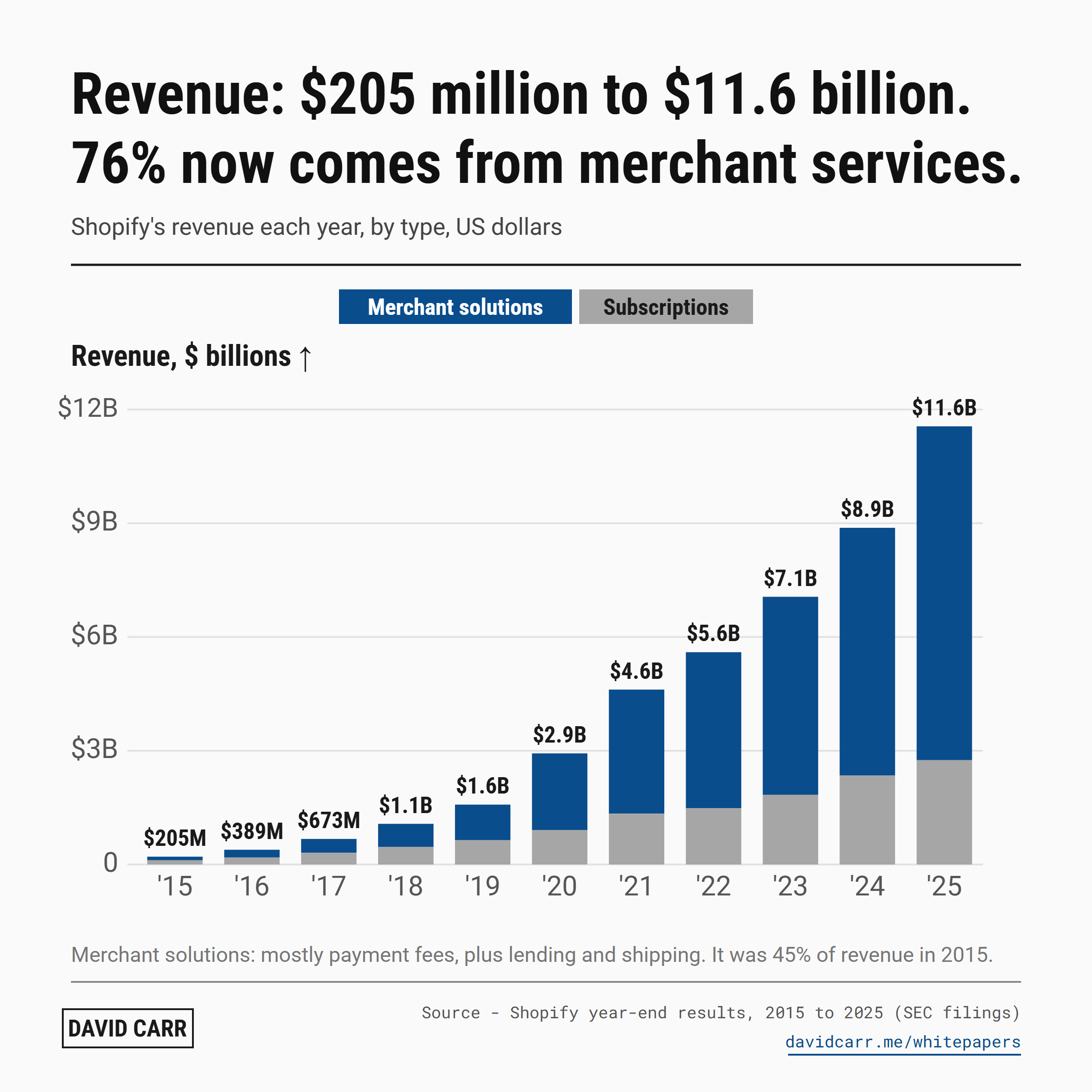
Revenue: $205 million to $11.6 billion. 76% now comes from merchant services.
- 2015: $205 million, 45% from merchant solutions
- 2020: $2.9 billion, 69%
- 2025: $11.6 billion, 76%
Shopify started out selling monthly plans. Now most of its money comes from a cut of what its merchants sell.
Revenue split from the year-end results; totals match Shopify's 10-K and earlier 40-F filings.
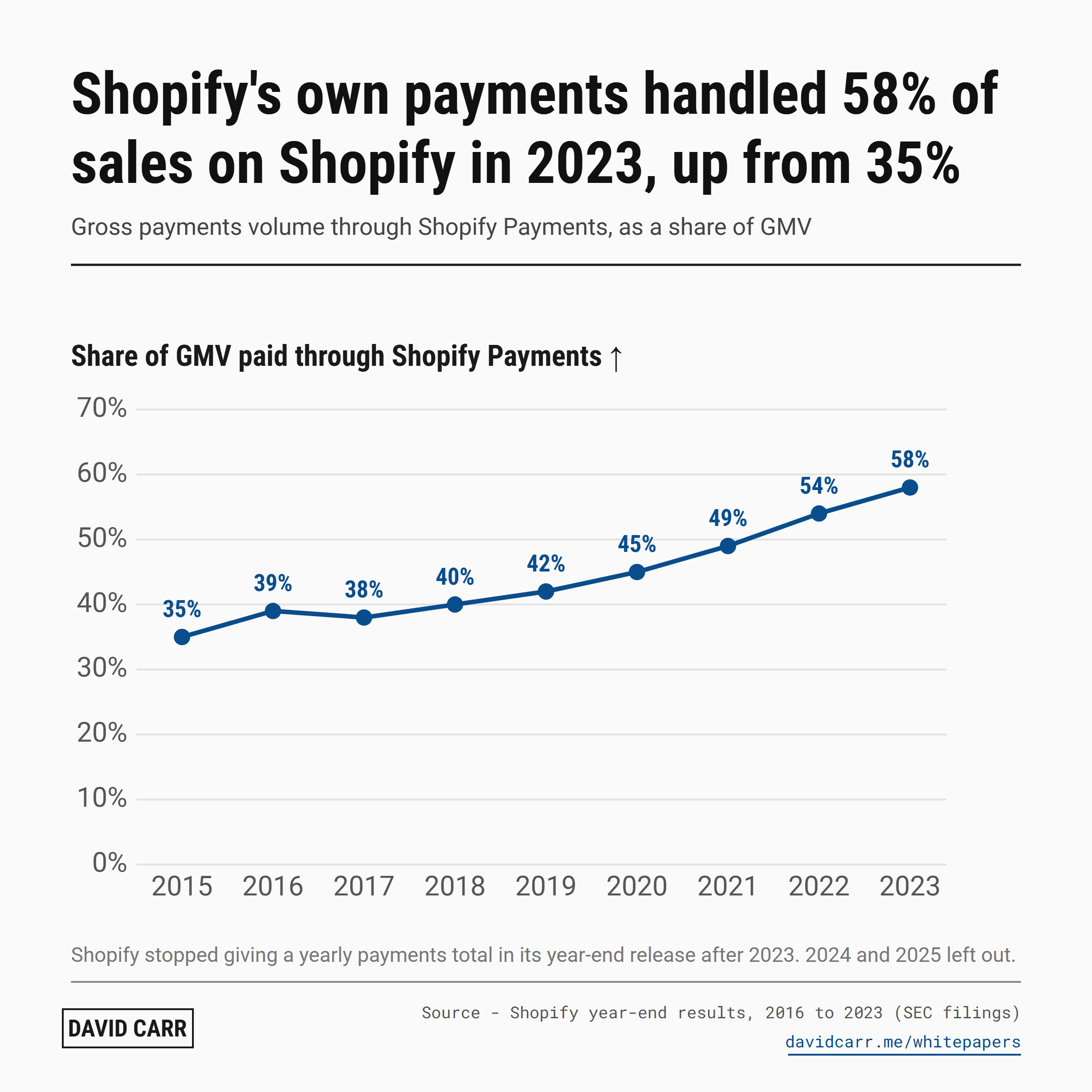
Shopify's own payments handled 58% of sales on Shopify in 2023, up from 35%
- 2015: $2.7 billion, 35%
- 2019: $25.7 billion, 42%
- 2023: $137 billion, 58%
Every sale paid through Shopify Payments earns Shopify a fee. This is the engine behind the revenue chart.
Gross payments volume as a share of GMV, from the year-end results up to 2023. Shopify's later year-end releases give growth, not a total, so 2024 and 2025 are left out.
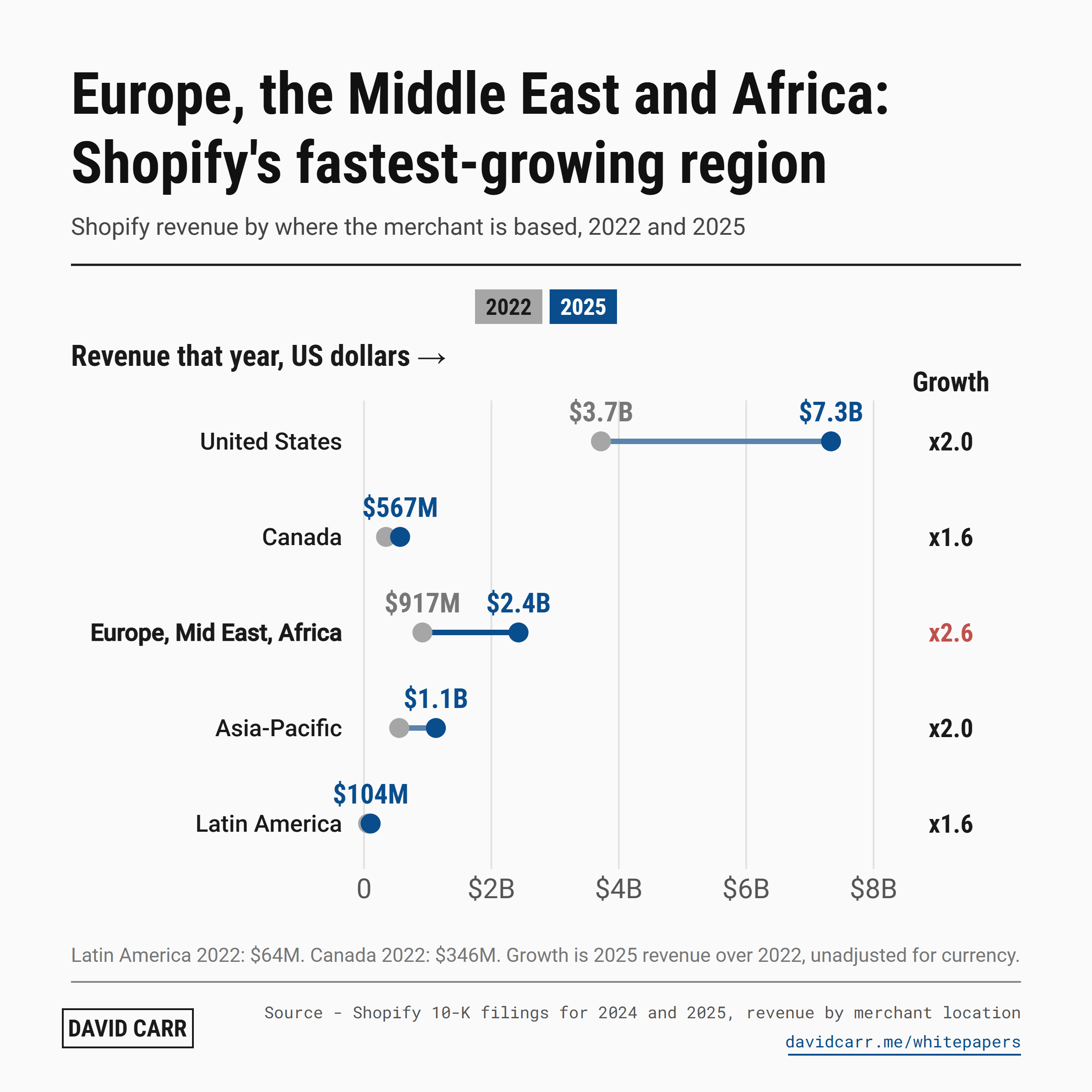
Europe, the Middle East and Africa: Shopify's fastest-growing region
- Europe, Middle East and Africa: $917M to $2.4B, x2.6
- Asia-Pacific: $553M to $1.1B, x2.0
- United States: $3.7B to $7.3B, x2.0
- Canada: $346M to $567M, x1.6
The US is still close to two-thirds of revenue. The rest of the world is catching up.
Revenue by where the merchant is based, from the 2024 and 2025 10-K filings. Not adjusted for currency.
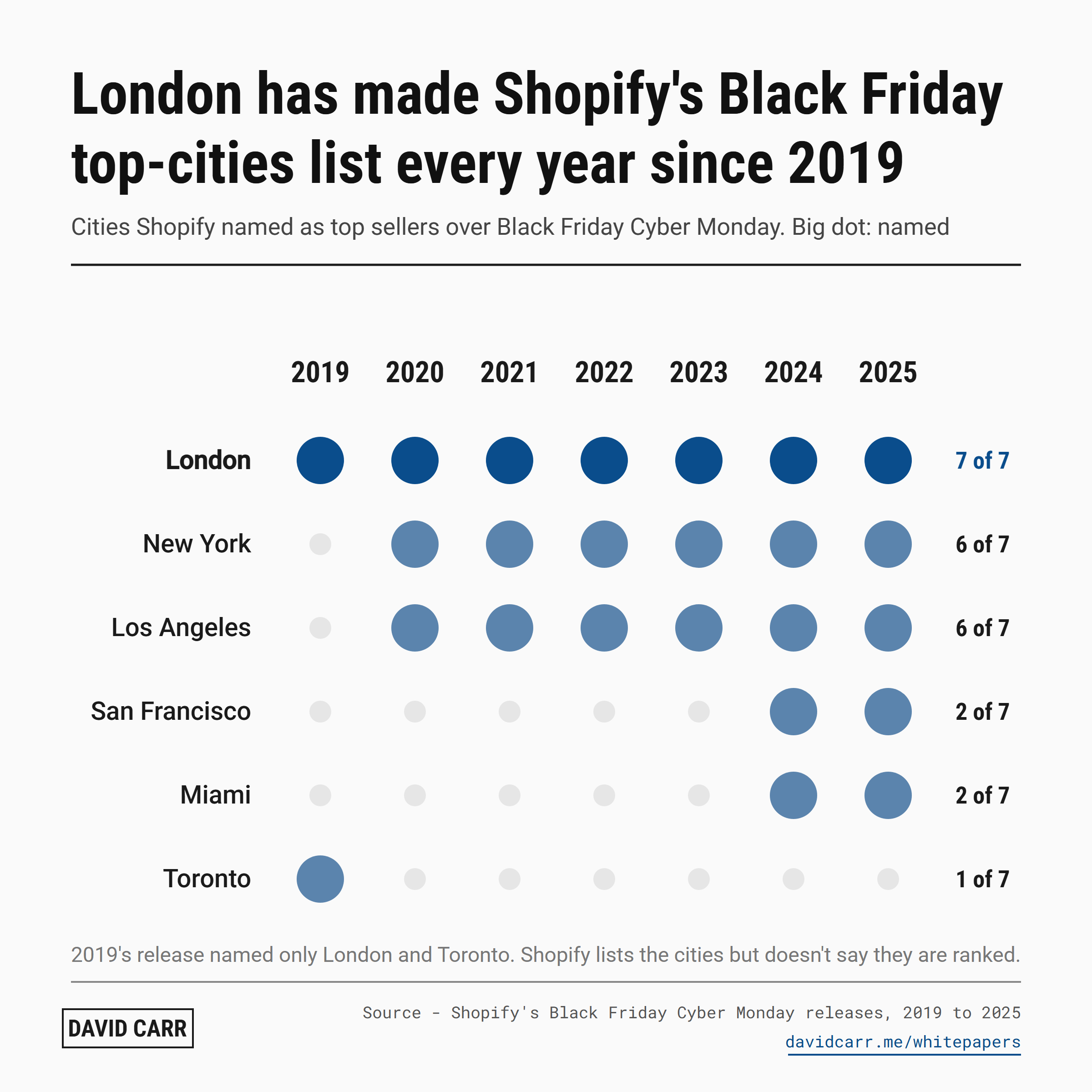
London has made Shopify's Black Friday top-cities list every year since 2019
- London: 7 of 7 years
- New York and Los Angeles: 6 of 7
- San Francisco and Miami: 2024 and 2025
- Toronto: 2019
The top countries in 2025: the US, the UK, Australia, Germany and Canada.
Cities as named in Shopify's Black Friday releases, for example 2019 and 2025. Shopify doesn't say the lists are ranked.
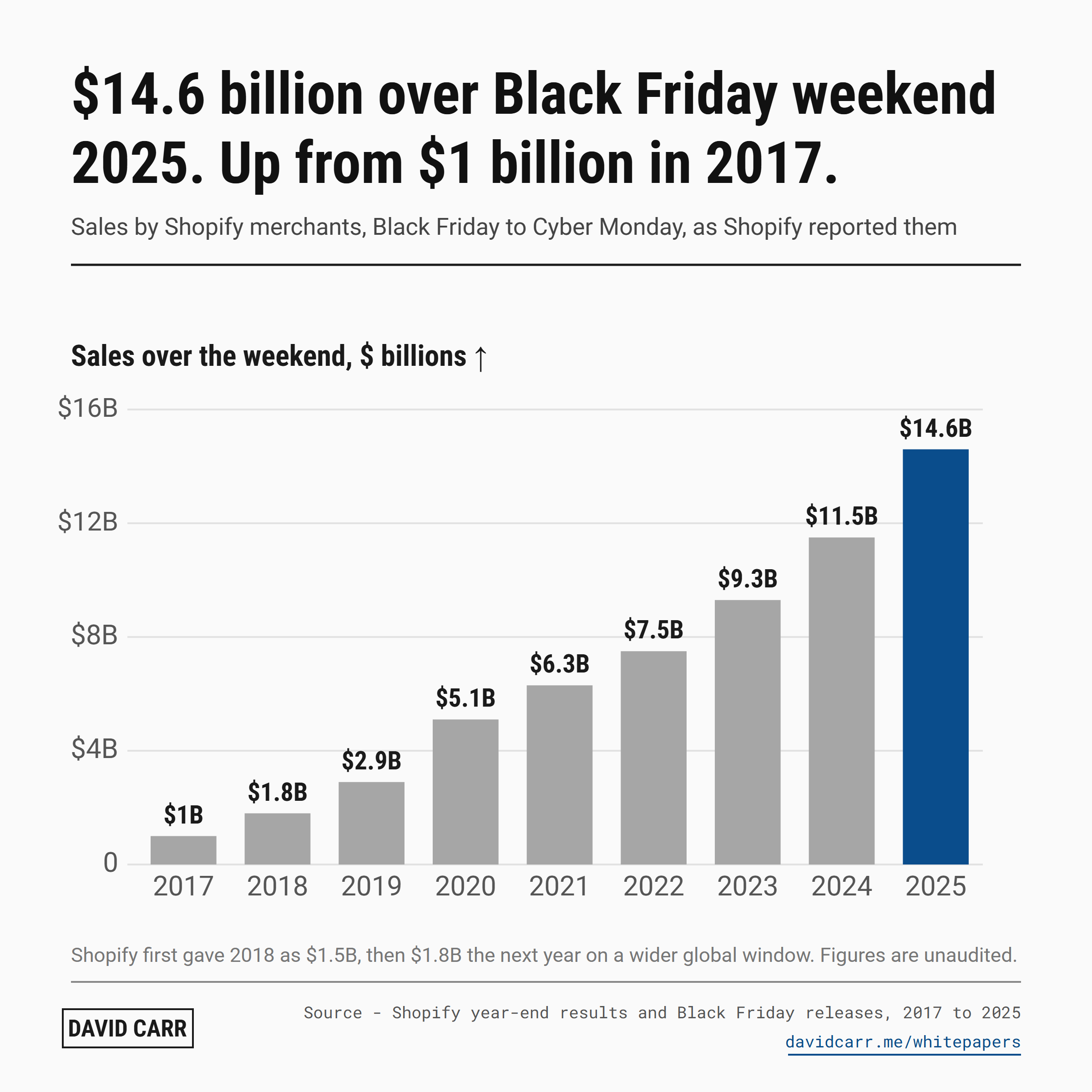
$14.6 billion over Black Friday weekend 2025. Up from $1 billion in 2017.
- 2017: $1 billion
- 2020: $5.1 billion
- 2023: $9.3 billion
- 2025: $14.6 billion, up 27%
Since 2019 Shopify has published these numbers within a day or two of Cyber Monday.
From Shopify's 2017 results and its Black Friday releases. Shopify first gave 2018 as $1.5 billion, then $1.8 billion on a wider global window.
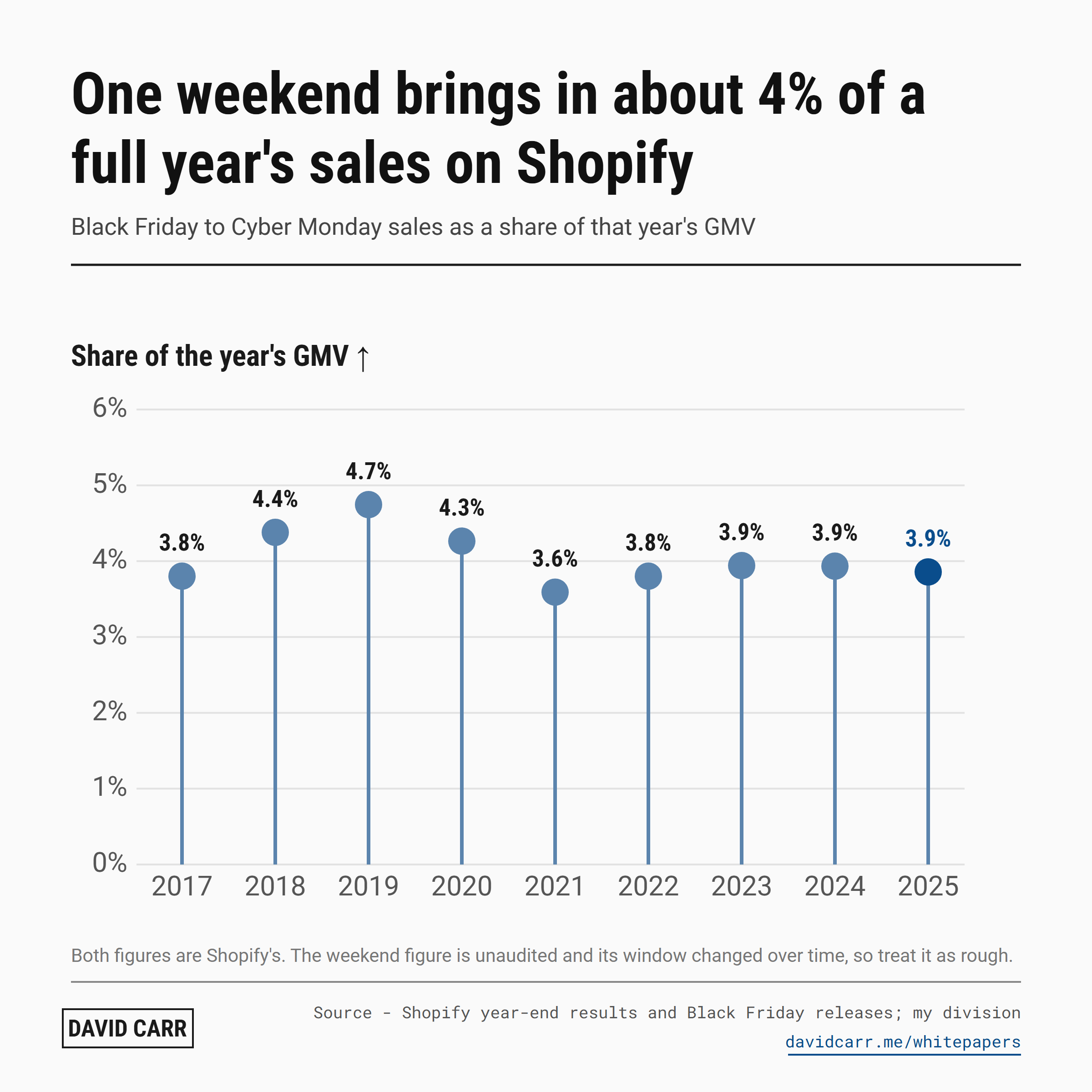
One weekend brings in about 4% of a full year's sales on Shopify
- 2017: 3.8%
- 2019: 4.7%, the highest
- 2021: 3.6%, the lowest
- 2025: 3.9%
The share has barely moved, even as the totals grew fourteen-fold.
My division of Shopify's weekend figure by its full-year GMV. The weekend figure is unaudited and its window changed over time, so treat it as rough.
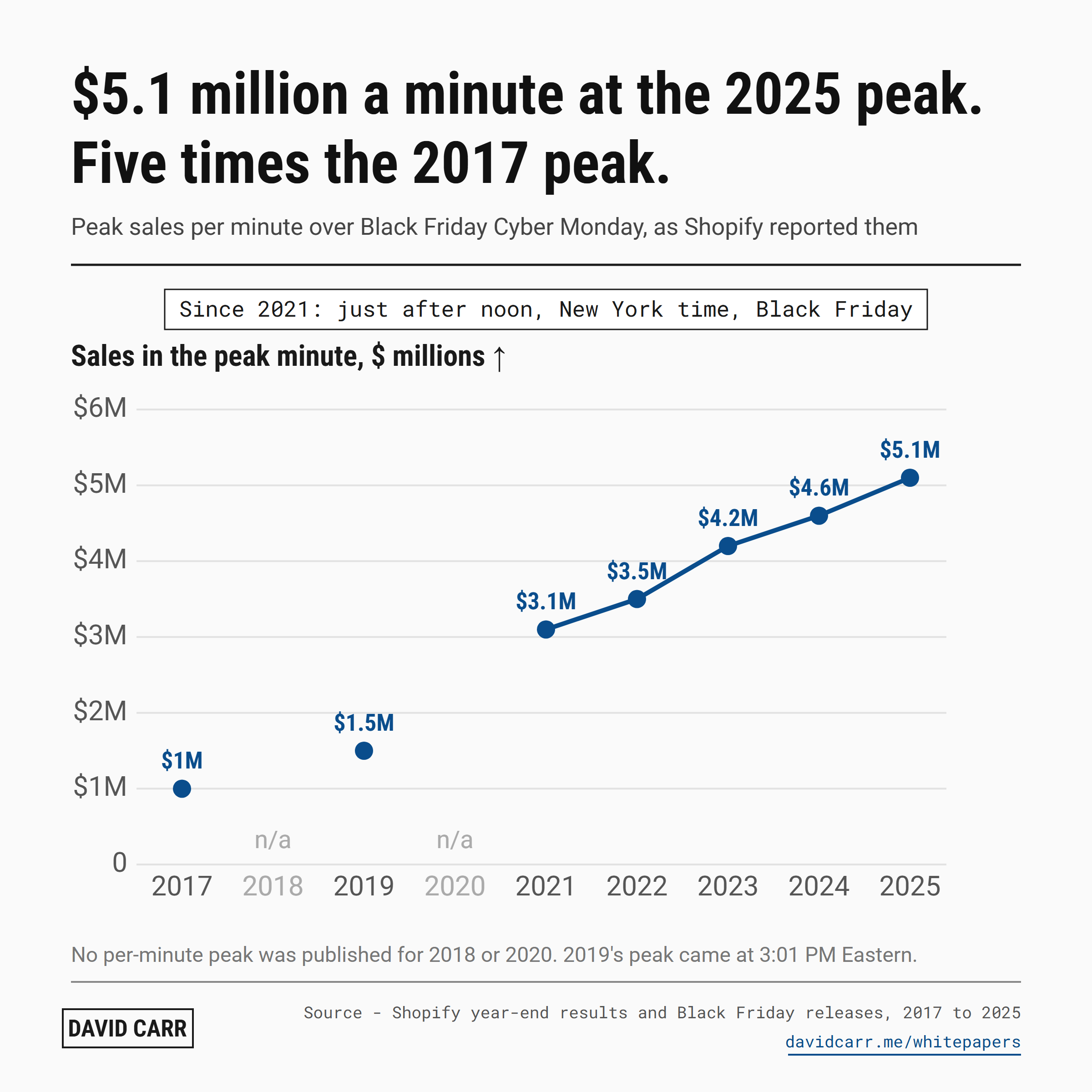
$5.1 million a minute at the 2025 peak. Five times the 2017 peak.
- 2017: $1 million a minute
- 2019: $1.5 million, at 3:01 PM Eastern
- 2021: $3.1 million, at 12:02 PM
- 2025: $5.1 million, at 12:01 PM
Since 2021 the busiest minute has come just after noon, New York time, on Black Friday.
Shopify's own figures, from the 2021, 2023 and 2025 releases among others. No per-minute peak was published for 2018 or 2020.
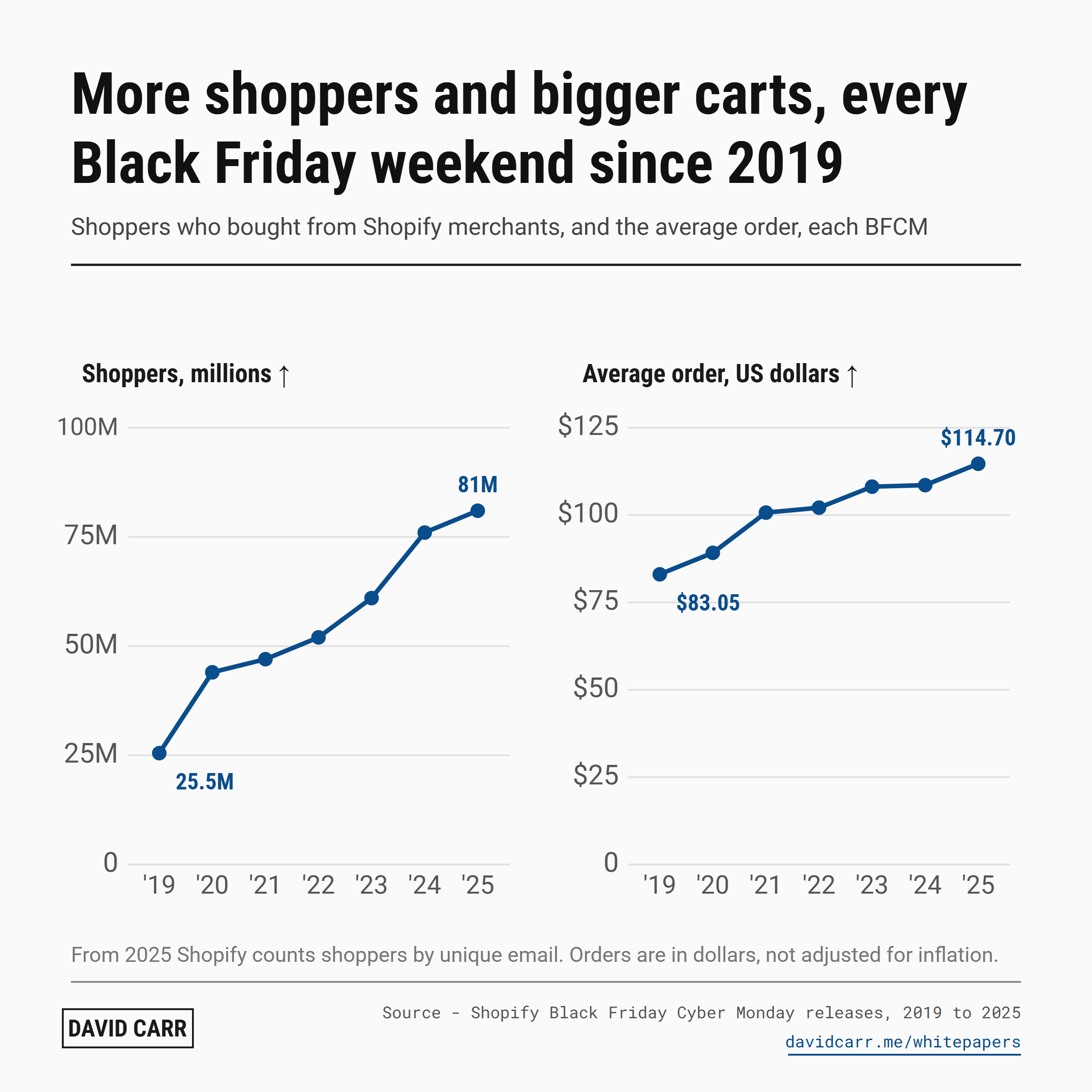
More shoppers and bigger carts, every Black Friday weekend since 2019
- Shoppers: 25.5 million (2019) to 81 million (2025)
- Average order: $83.05 (2019) to $114.70 (2025)
Both went up every single year.
From Shopify's Black Friday releases. From 2025 shoppers are counted by unique email. Order values are in US dollars, not adjusted for inflation.
Method, caveats and sources
The short answer. $378 billion went through Shopify in 2025, 49 times its 2015 total. Revenue reached $11.6 billion, and 76% of it now comes from merchant services, mostly payments. Black Friday weekend brought in $14.6 billion, about 4% of the year, peaking at $5.1 million a minute.
Shopify is listed. Every yearly figure comes from its year-end results as filed with the SEC, read on 23 November 2026. Revenue matches the SEC's own data for every year. Revenue by region comes from the 10-K filings.
Black Friday. All weekend figures are Shopify's own, from its year-end results (2017, 2018) or from releases published within days of Cyber Monday. Shopify says they are approximate and unaudited, and that its method varies year to year. The window runs from the start of Black Friday in New Zealand to the end of Cyber Monday in California. The 2026 weekend falls after this page was built.
What's left out. Payments volume for 2024 and 2025, because Shopify's year-end releases stopped giving a total. A per-minute peak for 2018 and 2020, because Shopify didn't publish one.
Also: Stripe and Christmas shopping.