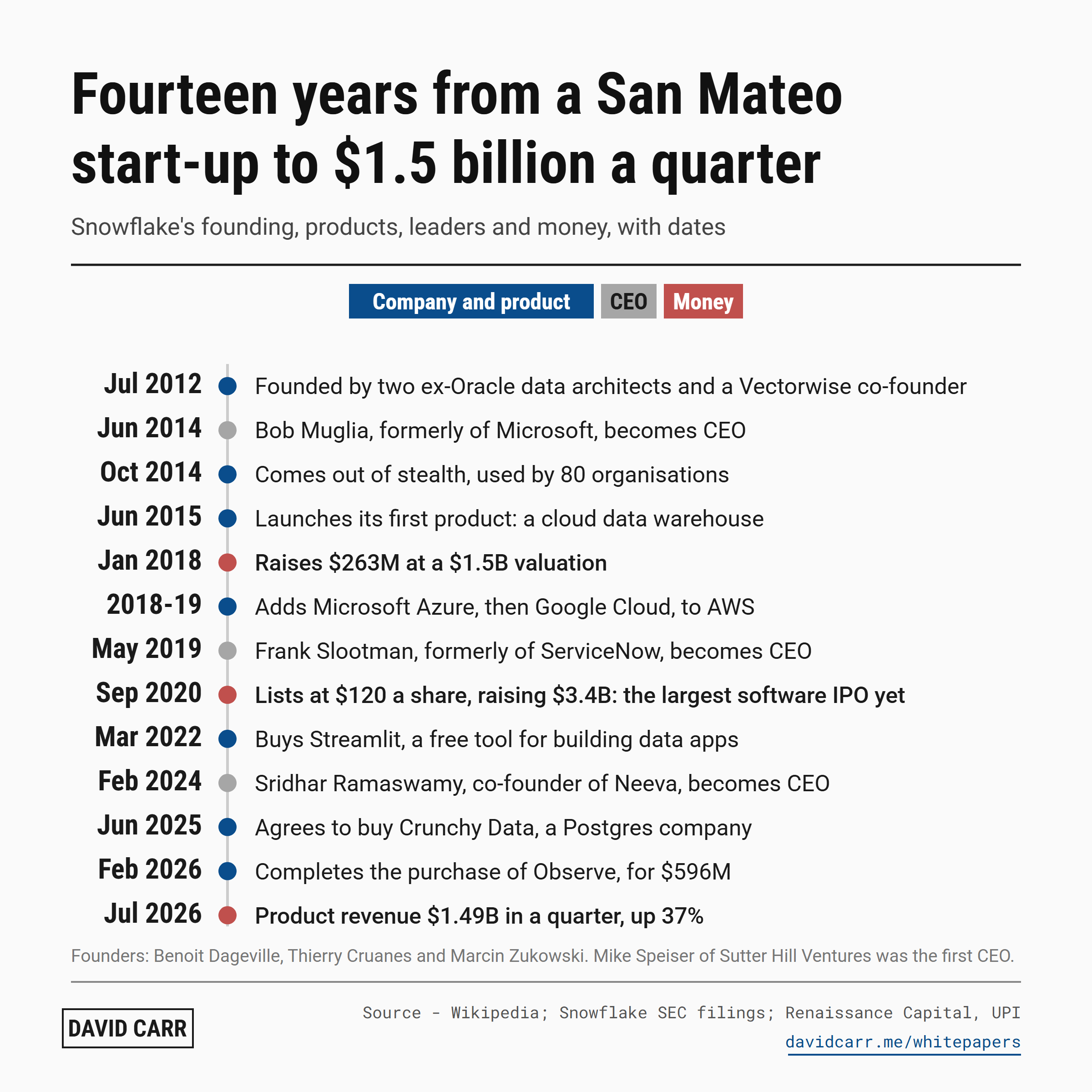
Fourteen years from a San Mateo start-up to $1.5 billion a quarter
- 2012: founded by Benoit Dageville and Thierry Cruanes, both data architects at Oracle, and Marcin Zukowski, a co-founder of Vectorwise (Wikipedia)
- 2015: its first product, a data warehouse that runs in the cloud
- 2020: the largest software IPO to that date, raising $3.4 billion at $120 a share
- 2024: Sridhar Ramaswamy succeeds Frank Slootman as CEO
- July 2026: $1.49 billion of product revenue in a quarter
It started as a data warehouse on Amazon Web Services and now runs on Microsoft Azure and Google Cloud too. The question is how fast it got big, and what it was worth along the way.
Mike Speiser of Sutter Hill Ventures, an early investor, was the first CEO. Snowflake's own prospectus says it was incorporated in July 2012 and first sold its platform in 2014.
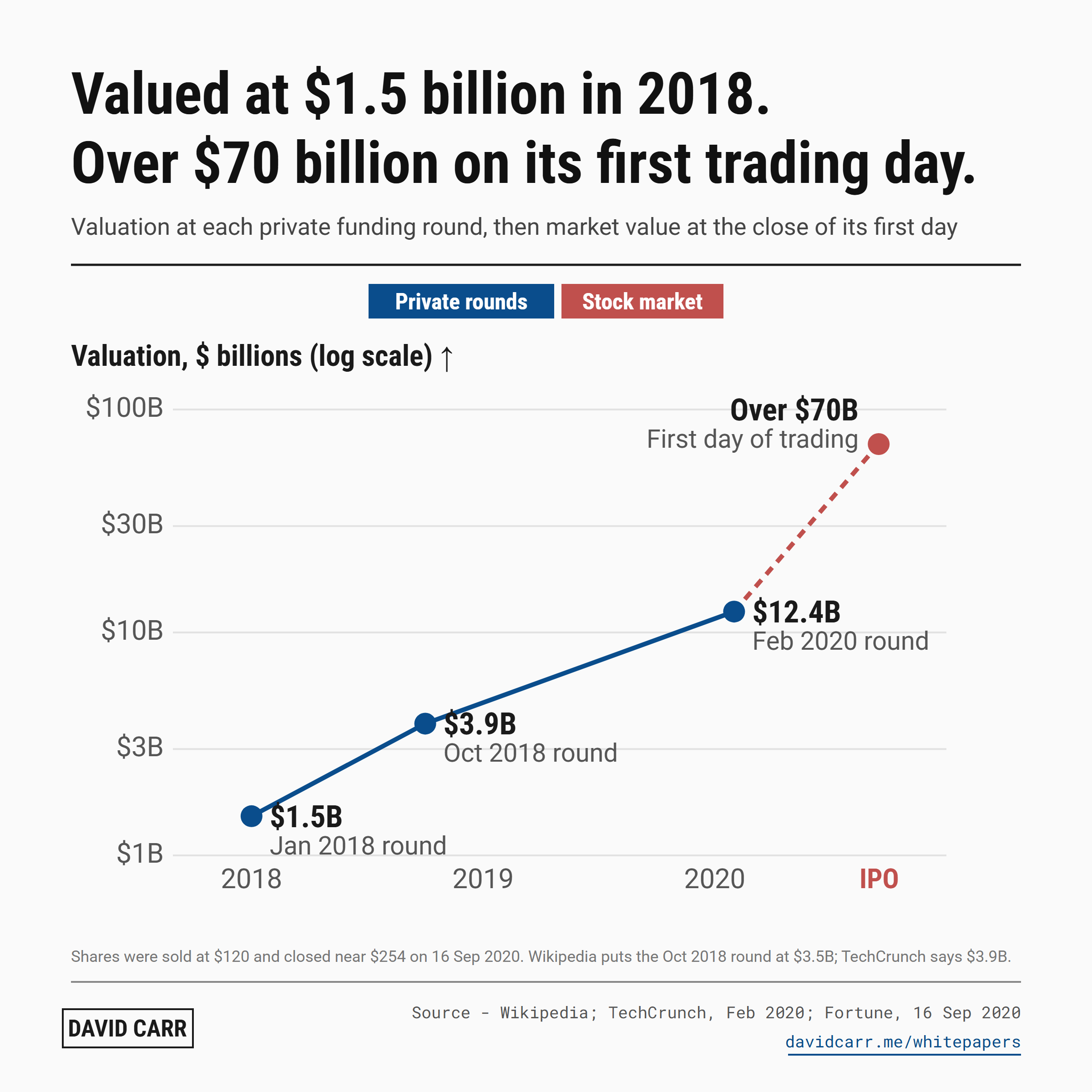
Valued at $1.5 billion in 2018. Over $70 billion on its first trading day.
The shares were sold at $120 and closed near $254. UPI reported that the previous record for a software IPO was VMware's in 2007, which raised less than $1 billion. Snowflake raised about $3.4 billion.
Wikipedia puts the October 2018 round at $3.5 billion; TechCrunch says $3.9 billion. The chart uses TechCrunch. A market value on the first day is not the same thing as a funding-round valuation.
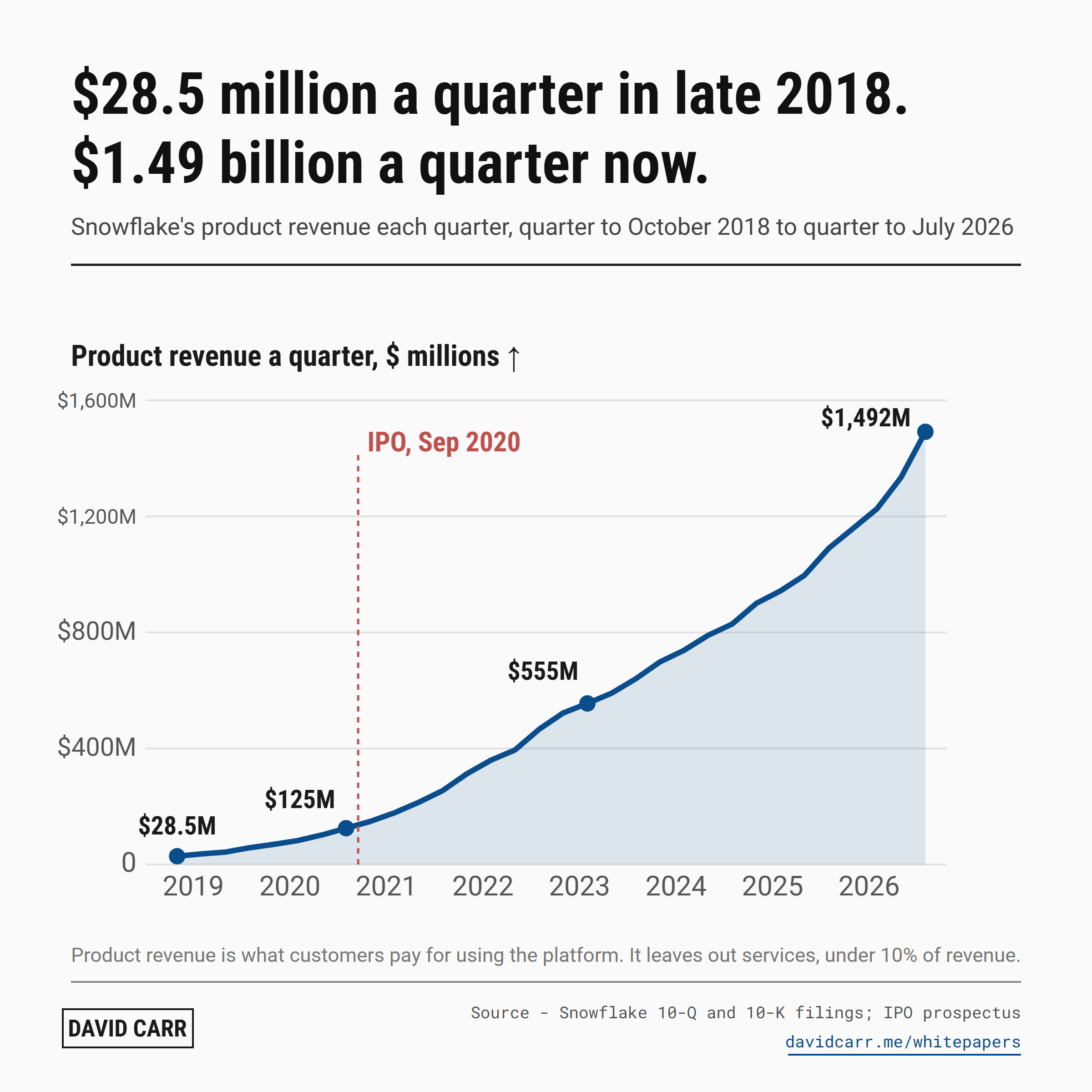
$28.5 million a quarter in late 2018. $1.49 billion a quarter now.
- Quarter to October 2018: $28.5 million (IPO prospectus)
- Quarter to July 2020, just before the IPO: $125 million
- Quarter to January 2023: $555 million
- Quarter to July 2026: $1,492 million, up 37% on a year before
Product revenue is what customers pay to use the platform, and it is the number Snowflake itself leads with. It was 52 times bigger in the quarter to July 2026 than in the quarter to October 2018. The next question is how fast it is growing now.
Every quarter from Snowflake's own 10-Q and 10-K filings, as first reported. Services and other revenue, under 10% of the total, are left out.
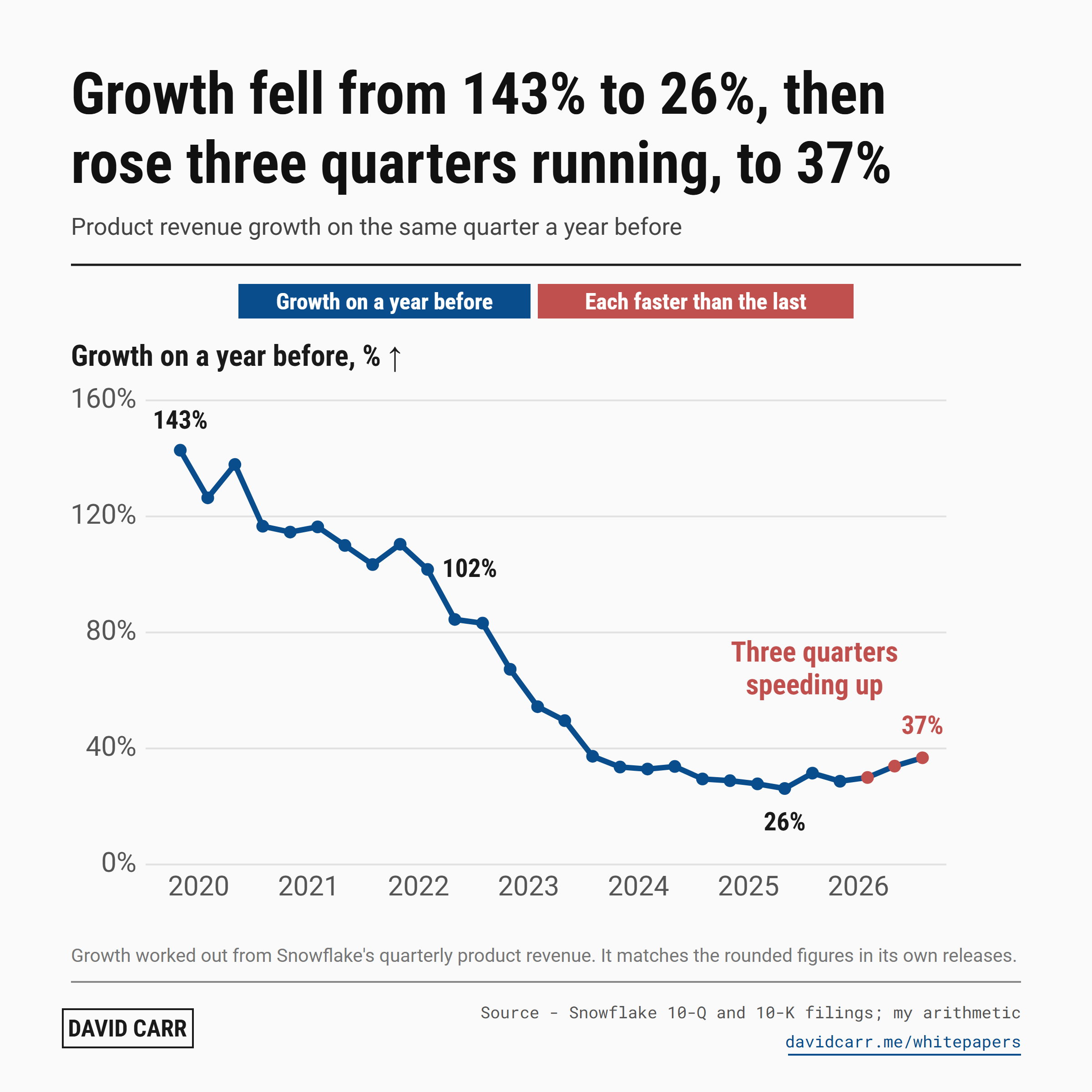
Growth fell from 143% to 26%, then rose three quarters running, to 37%
Growth slows as a company gets bigger: the same dollars added count for less. What stands out is the turn in 2025. Snowflake put it down to "strength in both our core data platform and a meaningful step-up in AI revenue". It has not given a figure for AI revenue.
Growth is my arithmetic from the quarterly product revenue. Each one matches the rounded figure in Snowflake's own results.
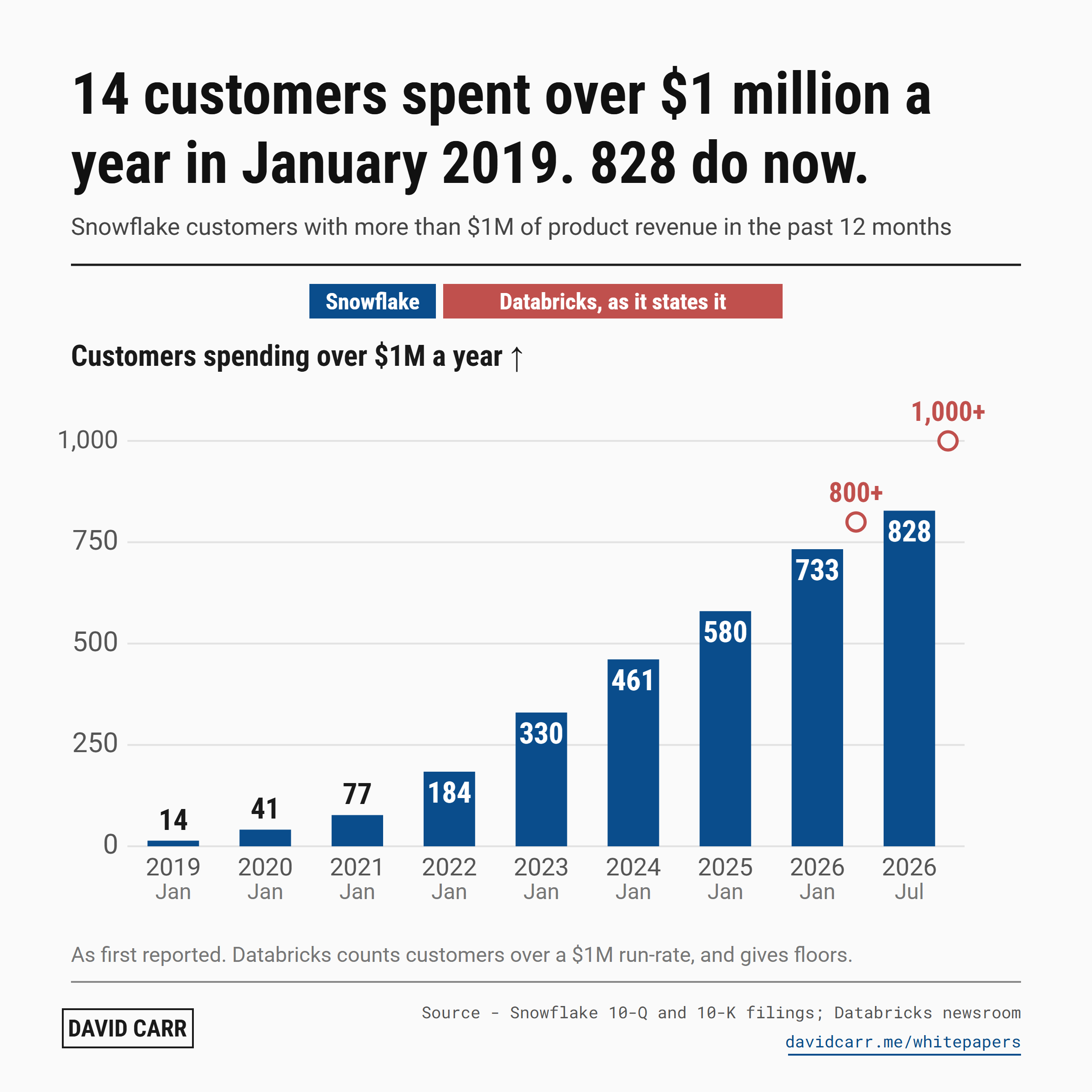
14 customers spent over $1 million a year in January 2019. 828 do now.
- January 2019: 14
- January 2021: 77
- January 2024: 461
- July 2026: 828
- Databricks, for comparison: over 800 in January 2026, over 1,000 in July 2026
The money comes from big customers spending more. The number crossing $1 million a year has risen every quarter since the IPO. Databricks, a private rival, publishes a similar count; it is higher, though measured differently.
Snowflake counts customers with over $1 million of product revenue in the past 12 months. Databricks counts customers above a $1 million annual run-rate and gives floors. The two are not like-for-like.
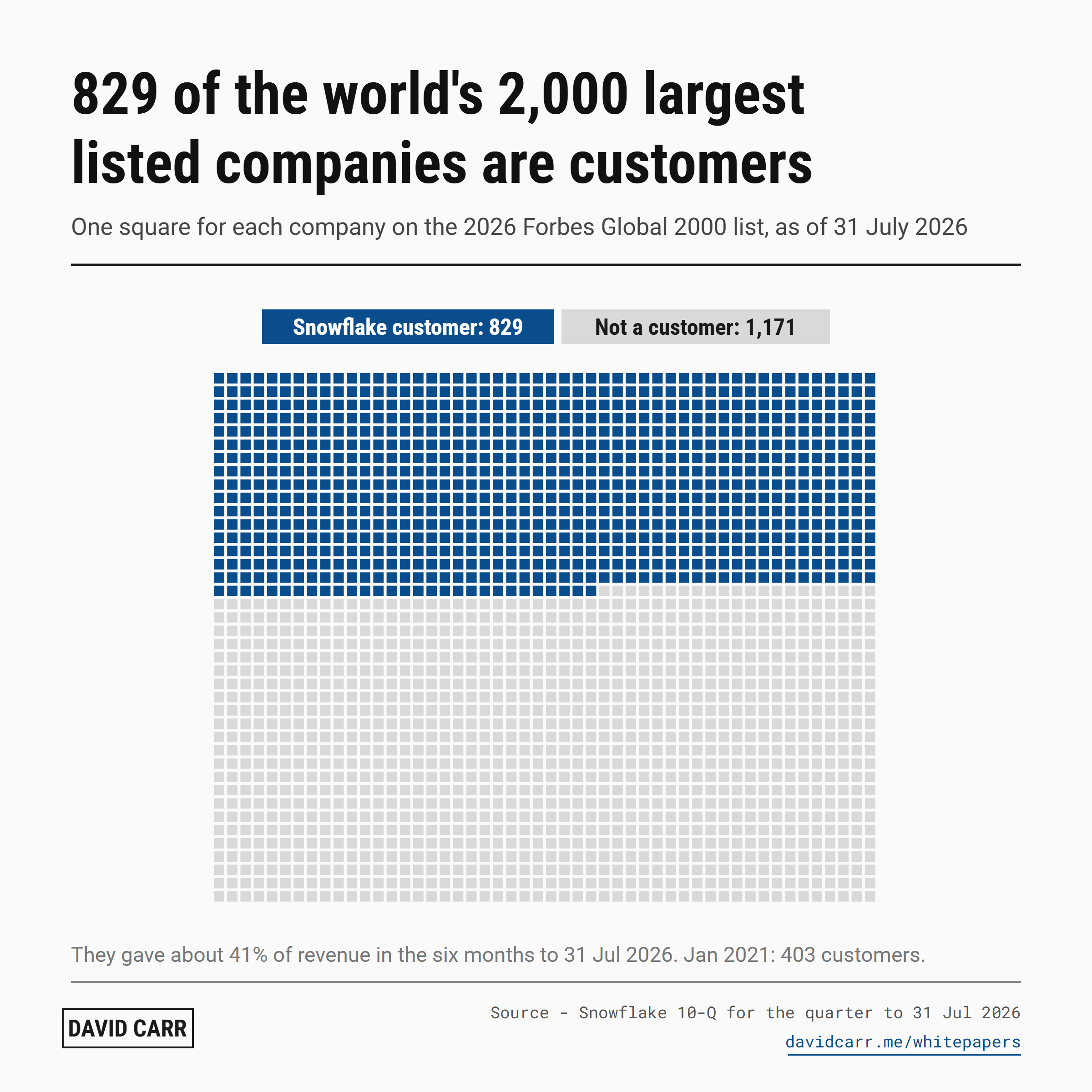
829 of the world's 2,000 largest listed companies are customers
- 31 July 2026: 829 of the 2026 Forbes Global 2000
- Those 829 gave about 41% of revenue in the six months to July 2026
- January 2021: 403, on the 2020 list
That is 41% of the list, and they give about 41% of revenue. The share of revenue has been 41% or 42% each July since 2022, while the count went from 510 to 829.
Snowflake re-bases this count each year to the newest Forbes list, so year-to-year changes include companies joining and leaving the list.
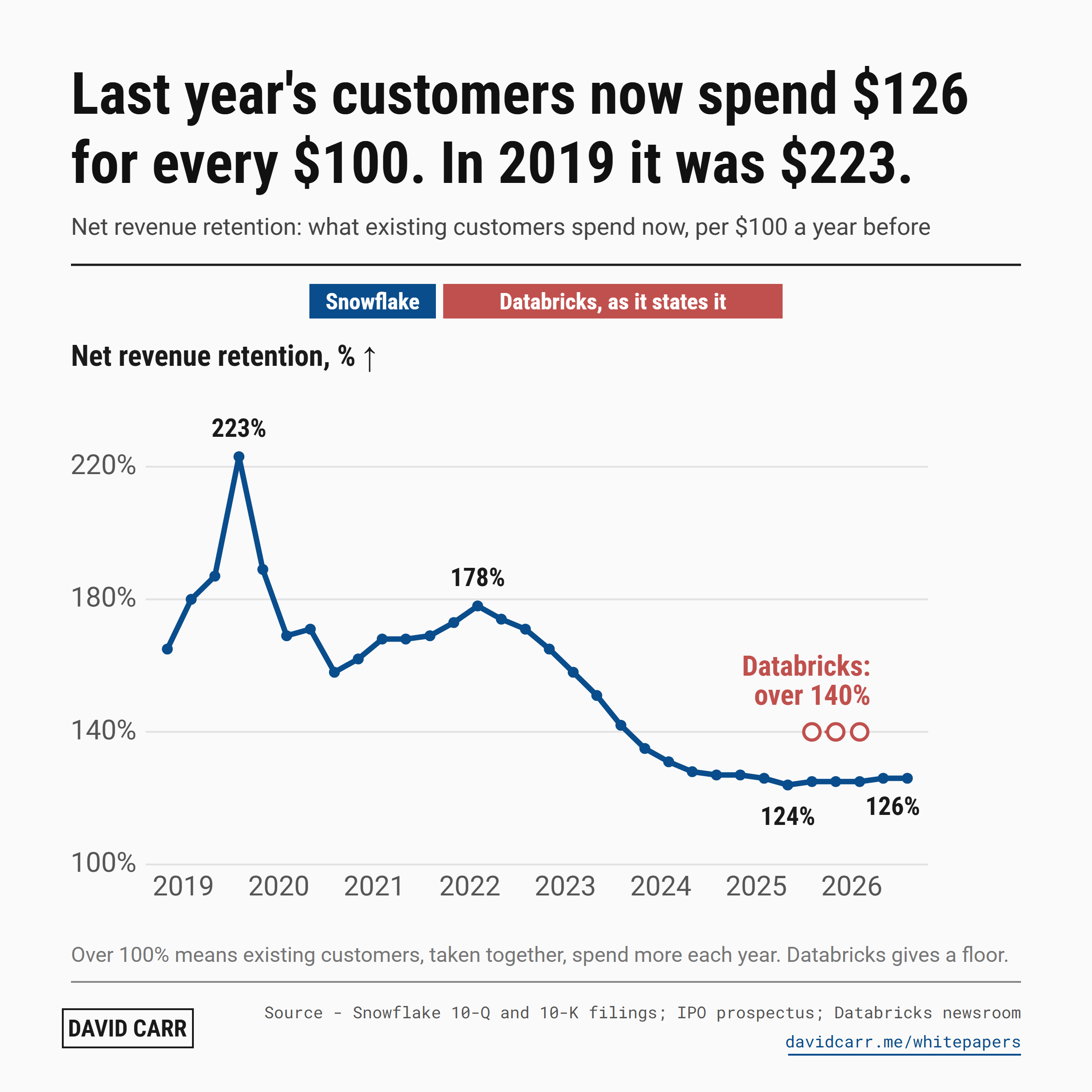
Last year's customers now spend $126 for every $100. In 2019 it was $223.
- July 2019: 223%, the highest
- January 2022: 178%
- April 2025: 124%, the lowest
- July 2026: 126%
- Databricks: over 140% from July 2025 to January 2026
Customers pay for what they use, so revenue grows when existing customers use more. Snowflake said at its IPO that it expected this figure to fall over time, as long-standing customers became a bigger share of the base. It fell, and has stayed between 124% and 127% since mid-2024.
Snowflake compares product revenue from a fixed group of customers over two years. Databricks gives a floor and has not published its method. Databricks' August 2026 release did not give a figure.
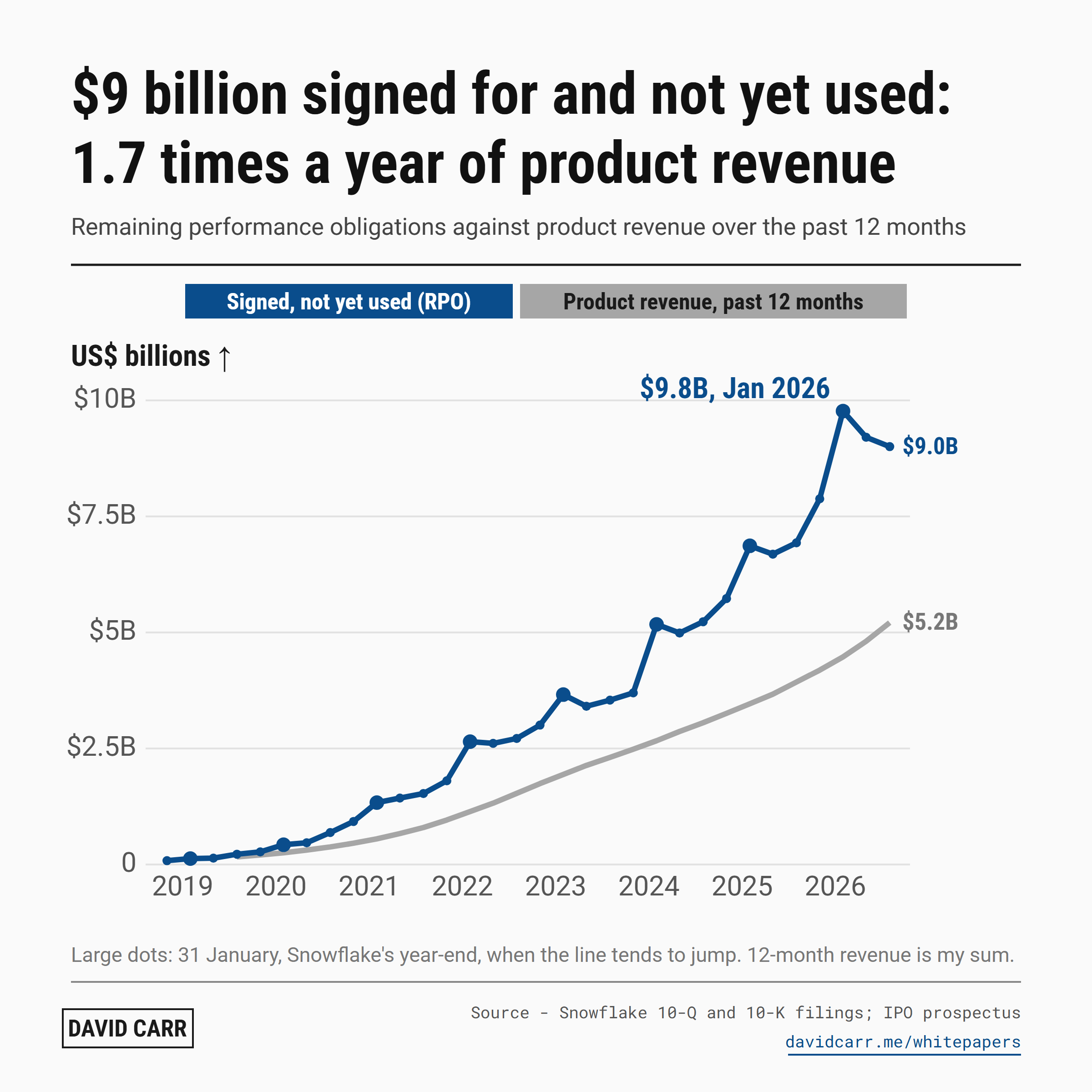
$9 billion signed for and not yet used: 1.7 times a year of product revenue
- 31 July 2026: $9.0 billion of remaining performance obligations
- Product revenue in the 12 months to July 2026: $5.2 billion
- 31 January 2026: $9.8 billion, the highest
Customers usually sign one- to four-year deals for a block of capacity, then draw it down. This is the part signed for but not yet used. It jumps most Januaries, at the end of Snowflake's financial year.
Remaining performance obligations leave out pay-as-you-go use. Snowflake warns it is not a forecast of product revenue, because customers choose when to use what they bought. Past-12-month revenue is my sum of four quarters.
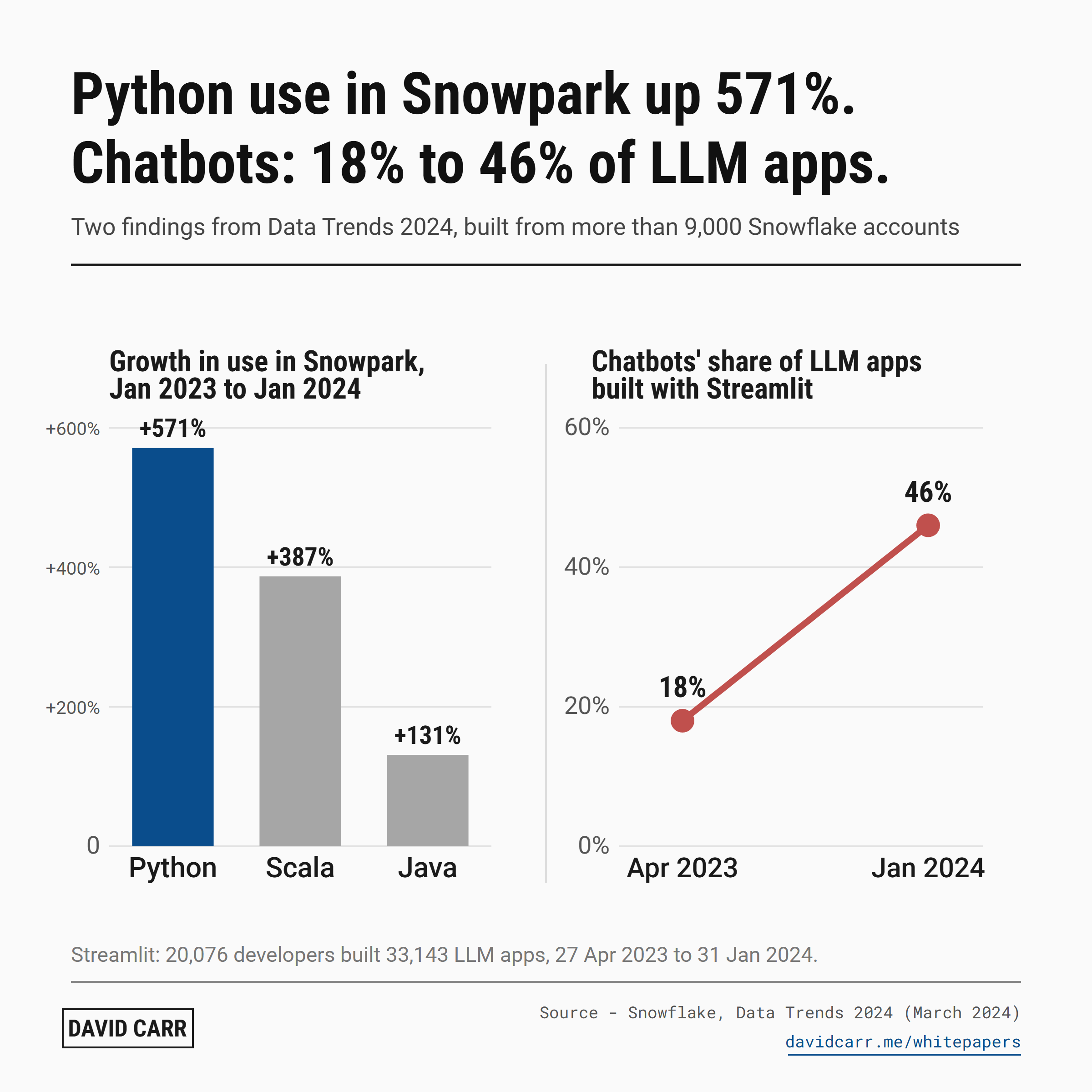
Python use in Snowpark up 571%. Chatbots: 18% to 46% of LLM apps.
- Snowpark, January 2023 to January 2024: Python up 571%, Scala up 387%, Java up 131%
- Streamlit, 27 April 2023 to 31 January 2024: 20,076 developers worked on 33,143 apps built on large language models
- Chatbots: 18% of those apps in the week from 30 April 2023, 46% by the end of January 2024
Snowflake publishes reports built from how its customers use the platform. This one, from March 2024, looked at more than 9,000 accounts. The report calls Python "the language of choice for AI programming". Streamlit is the free app tool Snowflake bought in 2022.
Snowpark lets developers run Python, Java and Scala inside Snowflake. The report gives growth rates, not the counts behind them.
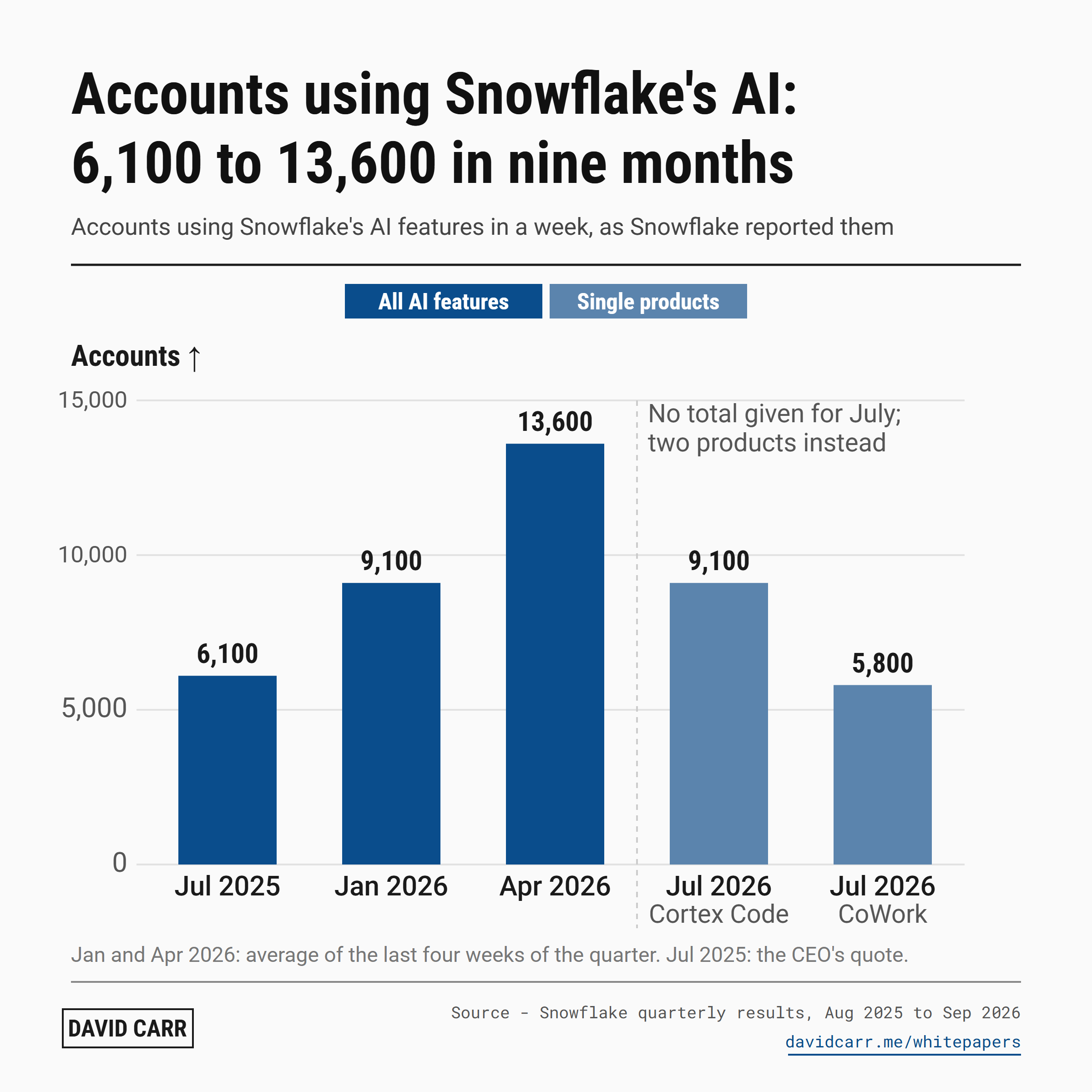
Accounts using Snowflake's AI: 6,100 to 13,600 in nine months
These are the figures Snowflake has chosen to publish about AI. It has not said how much revenue they bring in, beyond calling the step-up "meaningful". Customers pay for what they use, and AI use counts towards it.
Accounts are not the same as customers: one customer can have several accounts. January and April 2026 are averages of weekly use over the last four weeks of the quarter.
Method, caveats and sources
The short answer. Snowflake was founded in 2012 to run data warehouses in the cloud. It listed in 2020 in the largest software IPO up to then, and its product revenue reached $1.49 billion in the quarter to July 2026. Growth fell from 143% in 2019 to 26% in early 2025, then rose three quarters in a row to 37%. 828 customers spend over $1 million a year, and 829 of the Forbes Global 2000 are customers.
Snowflake's filings. Product revenue, net revenue retention, customers over $1 million, Forbes Global 2000 customers and remaining performance obligations come from the Key Business Metrics tables in Snowflake's 10-Q and 10-K filings and its IPO prospectus, pulled from SEC EDGAR on 23 November 2026. Each quarter is shown as first reported; Snowflake later revises some counts slightly. Results for the quarter to October 2026 were not out on that date.
AI. Account counts come from Snowflake's quarterly results. The usage findings come from its Data Trends 2024 report. Snowflake does not publish AI revenue.
Databricks. Its figures are its own press releases. It is private, files no accounts and gives floors ("more than"). Its measures are close to Snowflake's but not the same, so the comparison is a rough one.
History and valuations. From Wikipedia, TechCrunch, Renaissance Capital, UPI and Fortune. Where they disagree, the page says so.
Also: Stripe and Databricks.