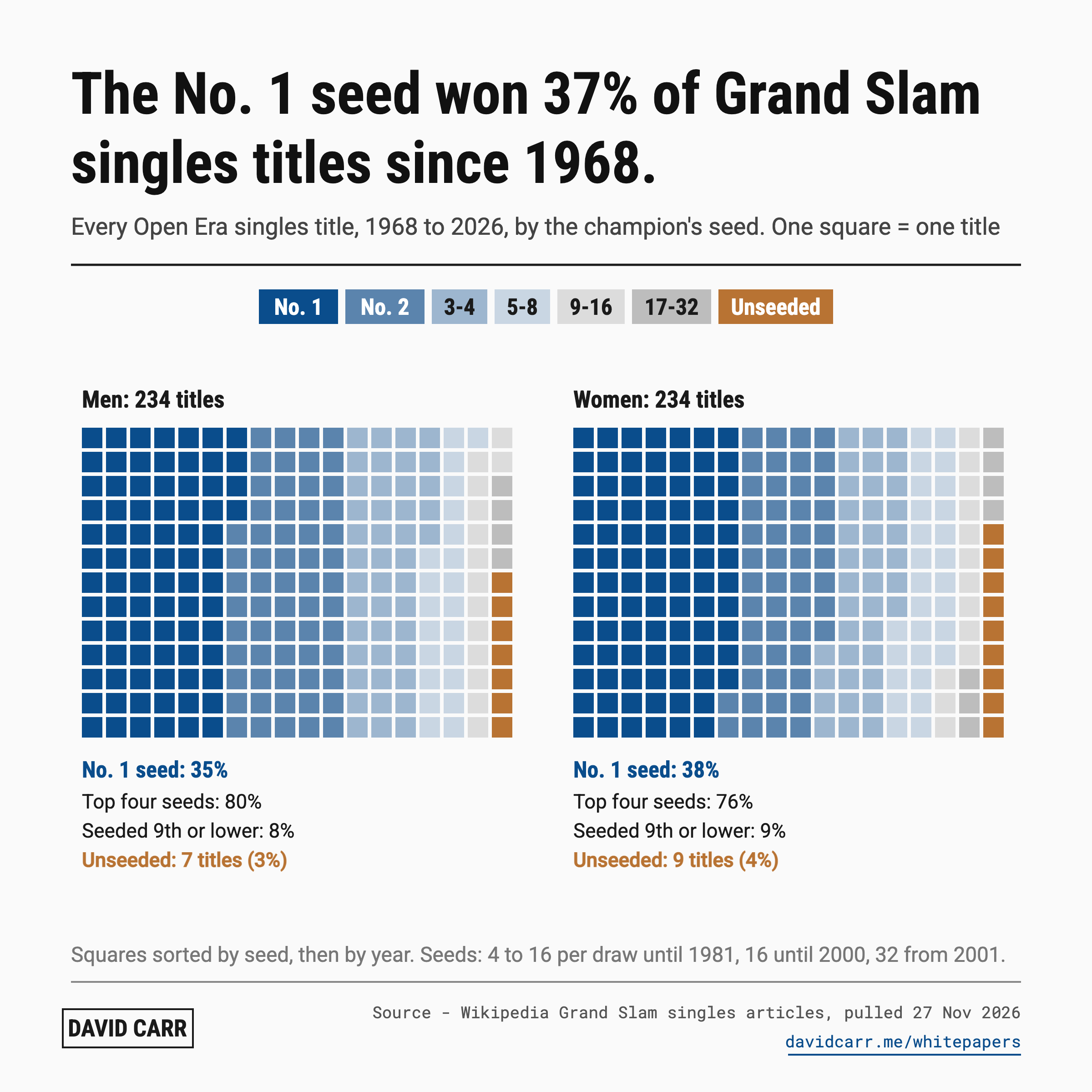
The No. 1 seed won 37% of Grand Slam singles titles since 1968.
- 171 of 468 Open Era singles titles went to the No. 1 seed
- Men: 82 of 234 (35%). Women: 89 of 234 (38%)
- A top-four seed won 78% of titles: 80% for men, 76% for women
- Seeded ninth or lower: 18 men's titles and 20 women's
The favourite wins a Slam a bit more than one time in three. Most titles go to one of the top four seeds, and very few come from deep in the draw.
Every men's and women's singles title from the 1968 French Open, the first open Slam, to the 2026 US Open. Seeds are as listed in the draw.
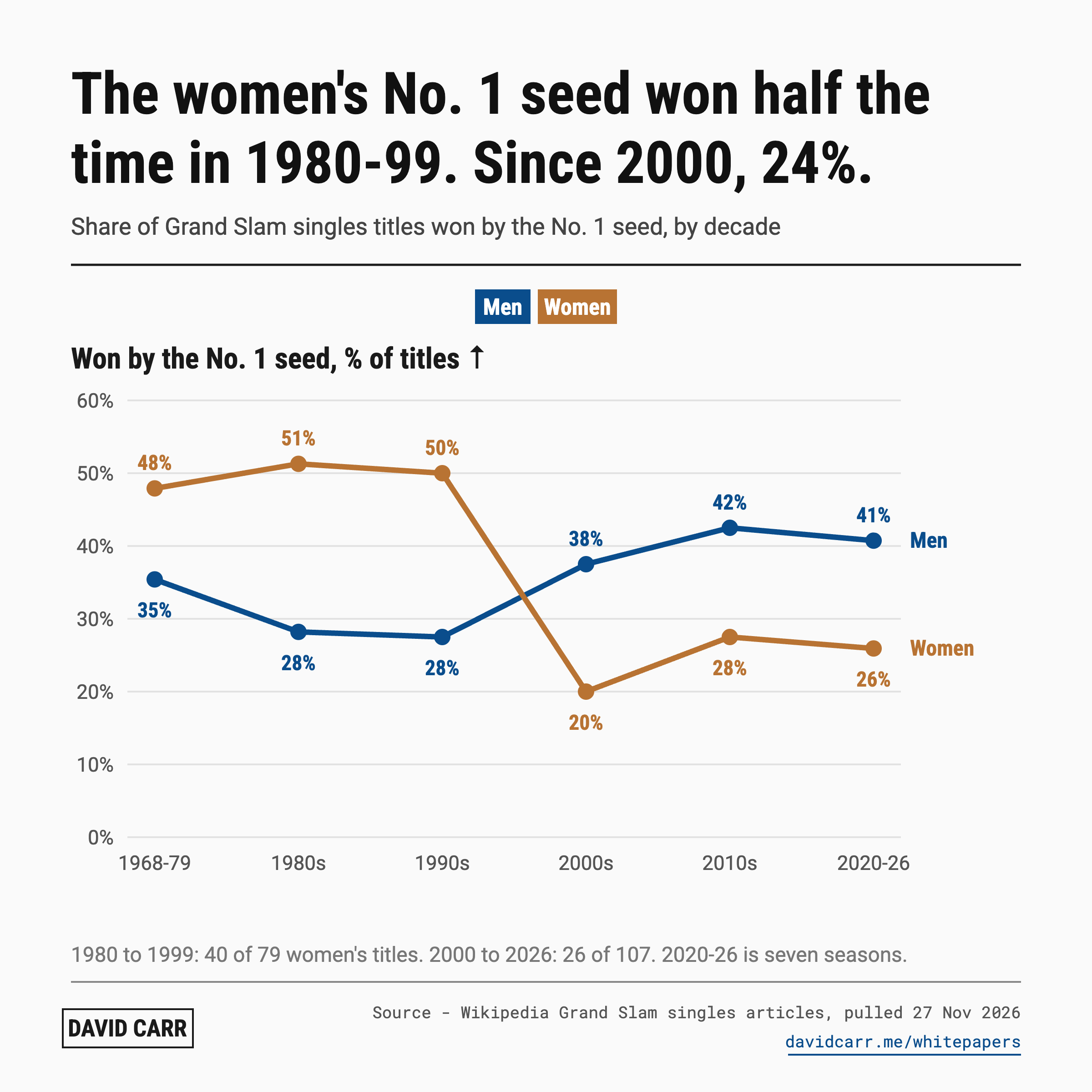
The women's No. 1 seed won half the time in 1980-99. Since 2000, 24%.
- Women's No. 1 seed: 48% in 1968-79, 51% in the 1980s, 50% in the 1990s
- Then 20% in the 2000s, 28% in the 2010s, 26% in 2020-26
- Men's No. 1 seed: 35% in 1968-79, 28% in the 1980s and 1990s, 38% in the 2000s, 43% in the 2010s, 41% in 2020-26
The two tours moved in opposite directions. Women's Slams have been harder to call since 2000, and men's Slams easier.
Decades are 1968 to 1979, then each ten years, then 2020 to 2026. About 40 titles per tour per decade, so one title moves a share by 2 to 3 points.
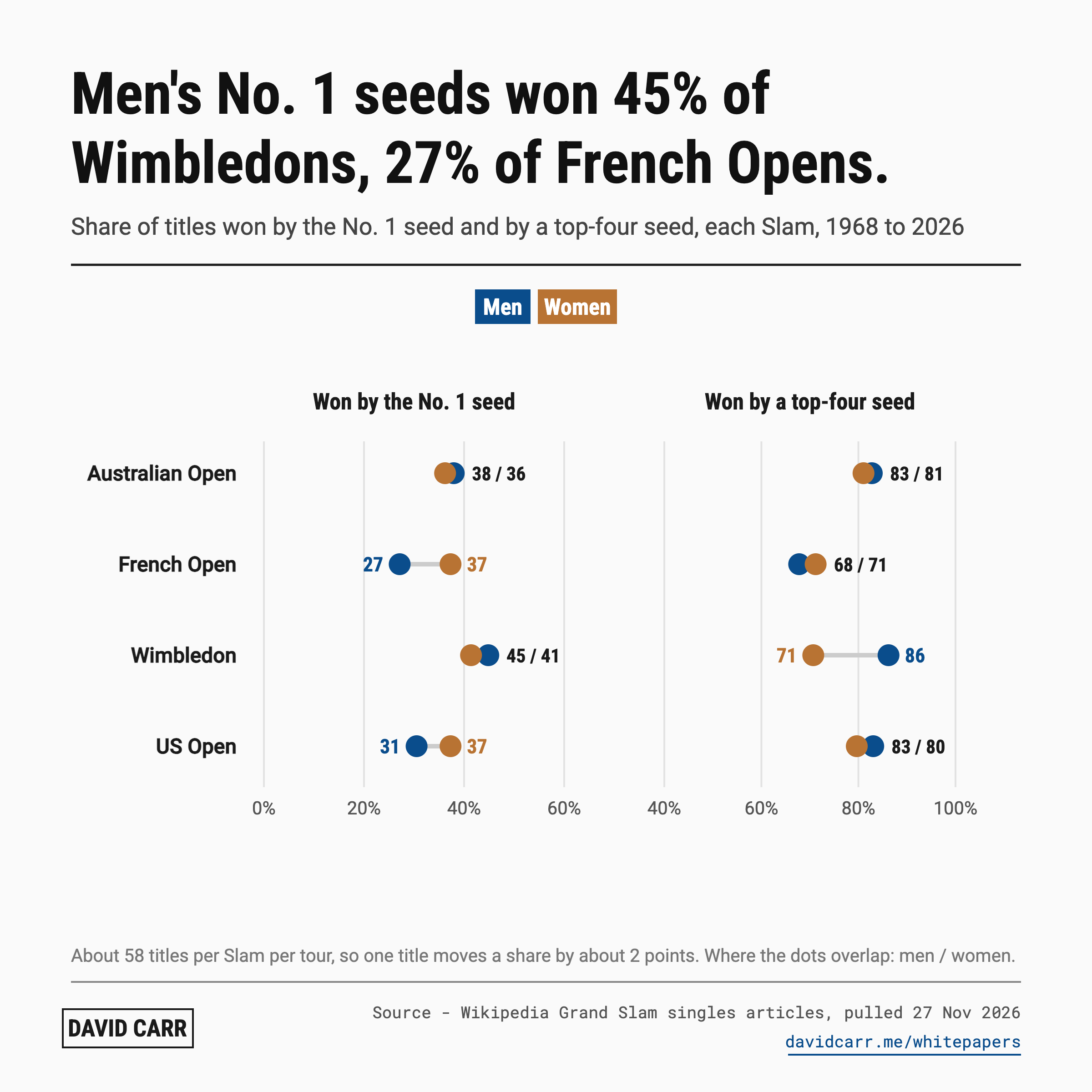
Men's No. 1 seeds won 45% of Wimbledons and 27% of French Opens.
- Men's No. 1 seed: Australian Open 38%, French Open 27%, Wimbledon 45%, US Open 31%
- Women's No. 1 seed: 36%, 37%, 41% and 37%
- A top-four seed won 86% of men's Wimbledons and 68% of men's French Opens
For men, the clay of Paris has been the least predictable Slam for the top seeds and the grass of Wimbledon the most. For women, the four Slams look much alike for the No. 1 seed.
About 58 titles per Slam per tour since 1968. The men's French Open had three unseeded champions; no other men's Slam had more than two.
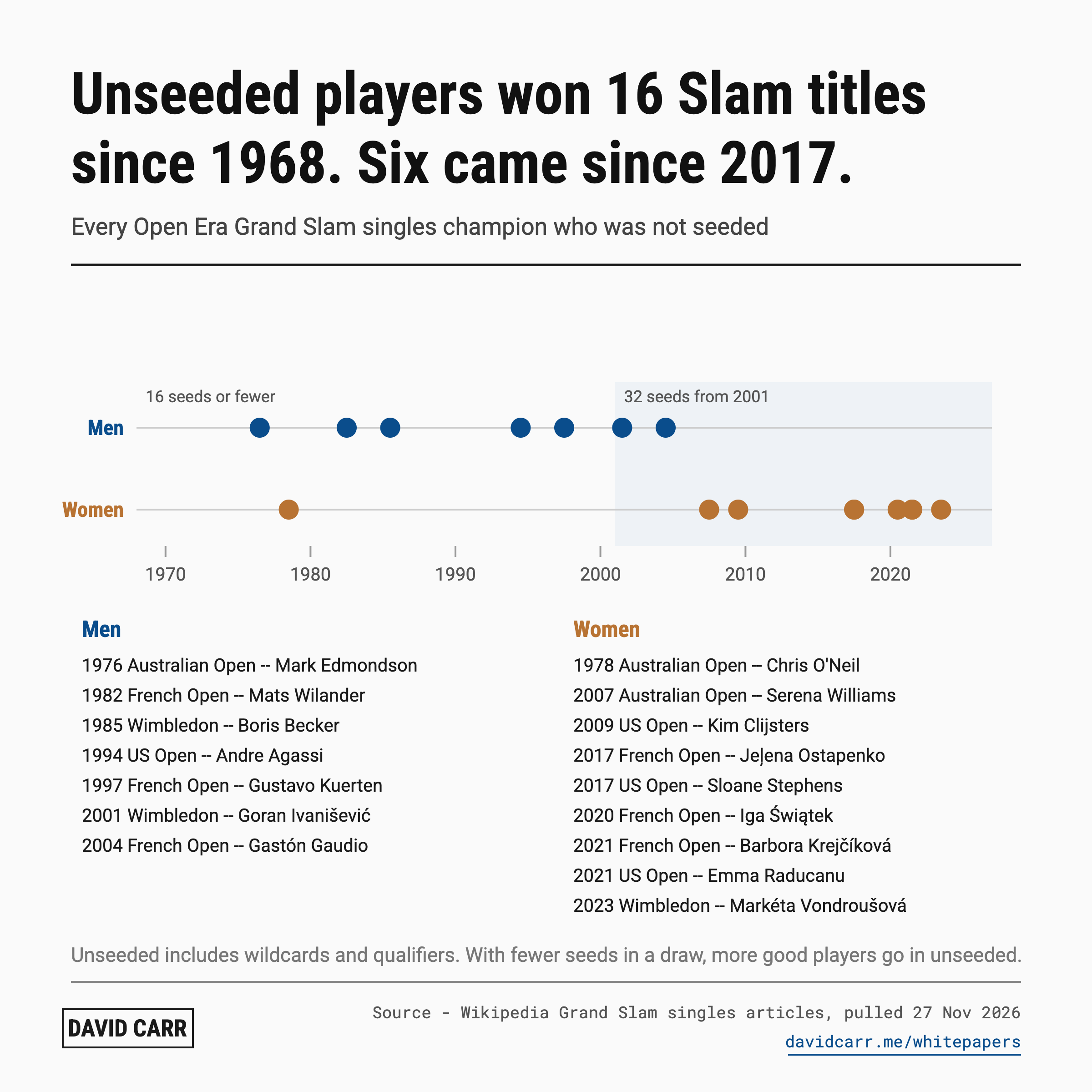
Unseeded players won 16 Slam titles since 1968. Six came since 2017.
- Men: 7, the last at the 2004 French Open
- Women: 9, six of them from 2017 to 2023
- Wimbledon 2001 was won by a wildcard and the 2021 US Open by a qualifier
- The French Open has six unseeded champions, more than any other Slam
Unseeded champions are rare, about one Slam in 30. Since 32 seeds came in, two men have done it, and eight women.
Unseeded includes wildcards, qualifiers and players returning on a protected ranking. Before 2001 there were 16 seeds or fewer, so more strong players went in unseeded.
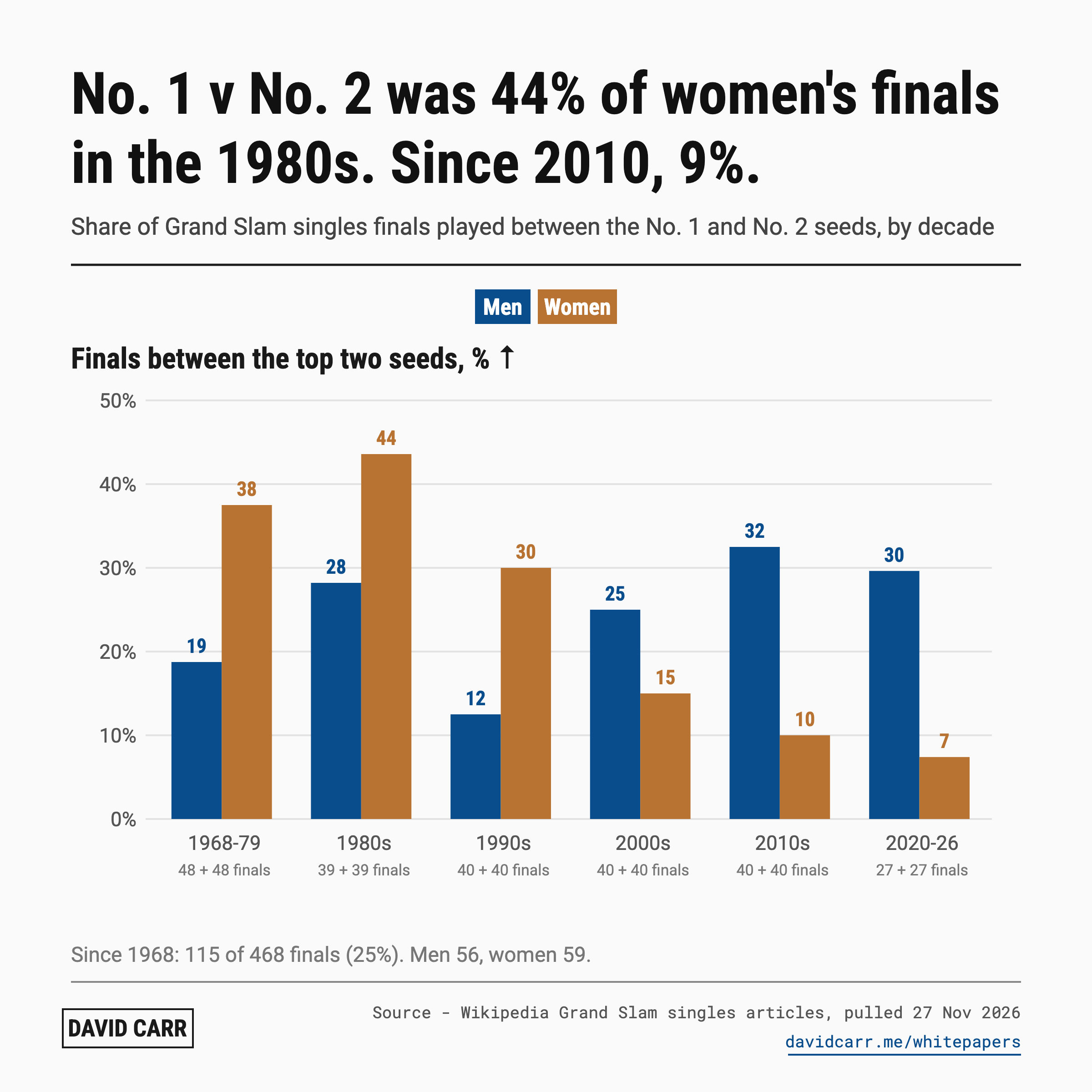
No. 1 v No. 2 was 44% of women's finals in the 1980s. Since 2010, 9%.
- 115 of 468 finals since 1968 were No. 1 against No. 2 (25%)
- Women: 38% in 1968-79, 44% in the 1980s, 30% in the 1990s, 15% in the 2000s, 10% in the 2010s, 7% in 2020-26
- Men: 32% in the 2010s and 30% in 2020-26, against 12% in the 1990s
The final the draw is built for happens about one time in four. On the women's side it has become rare: 6 of the last 67.
Counted when the champion and the runner-up were the top two seeds, in either order.
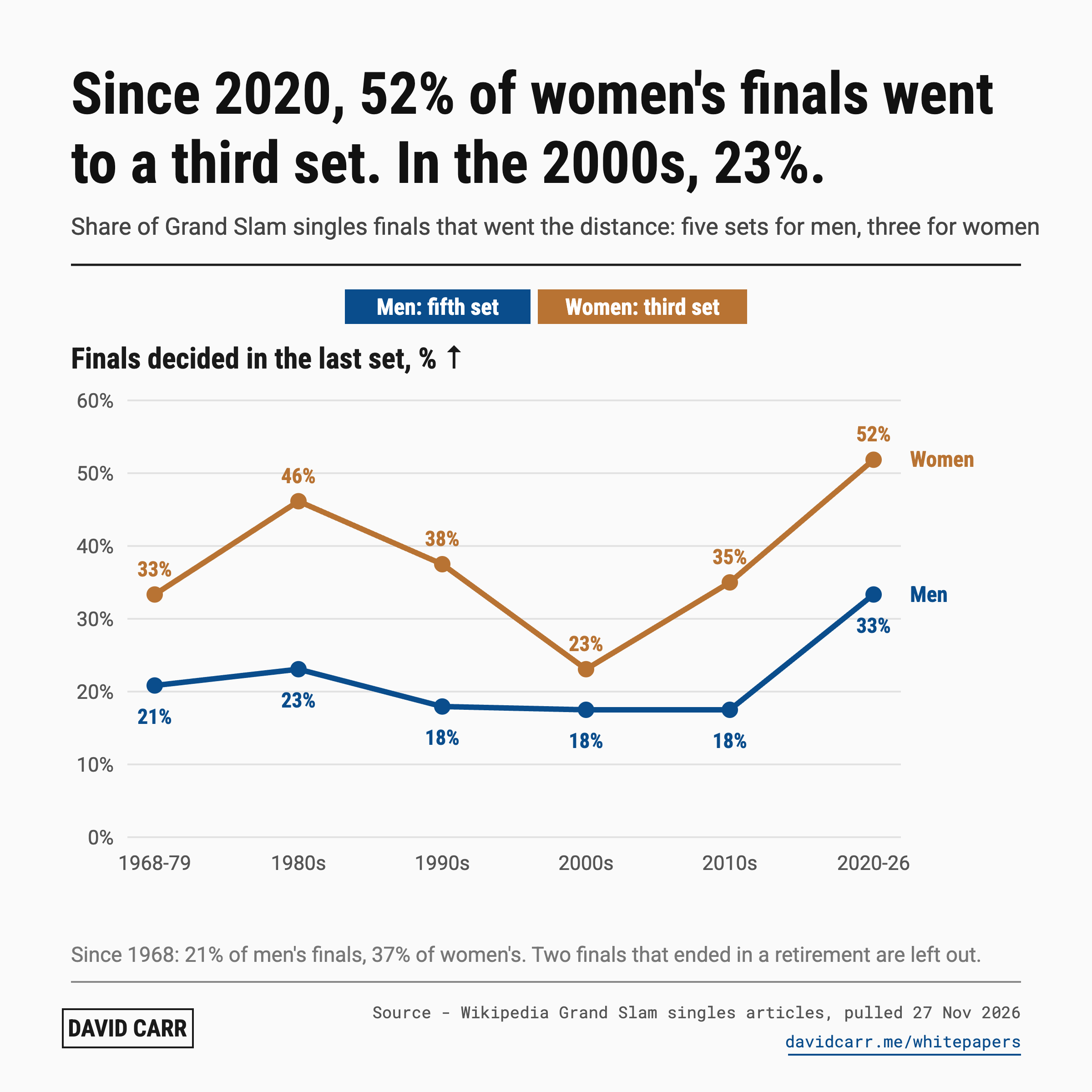
Since 2020, 52% of women's finals went to a third set. In the 2000s, 23%.
- Women's finals that went three sets: 33% in 1968-79, 46% in the 1980s, 38% in the 1990s, 23% in the 2000s, 35% in the 2010s, 52% in 2020-26
- Men's finals that went five sets: 21%, 23%, 18%, 18%, 18% and 33%
- Since 1968: 37% of women's finals and 21% of men's went the distance
Finals have been closer since 2020 on both tours. 2020-26 is only 27 finals each, so a couple of matches move the figure a lot.
Sets counted from the final score. Two finals that ended in a retirement (1990 Australian Open men's and 2006 Australian Open women's) are left out.
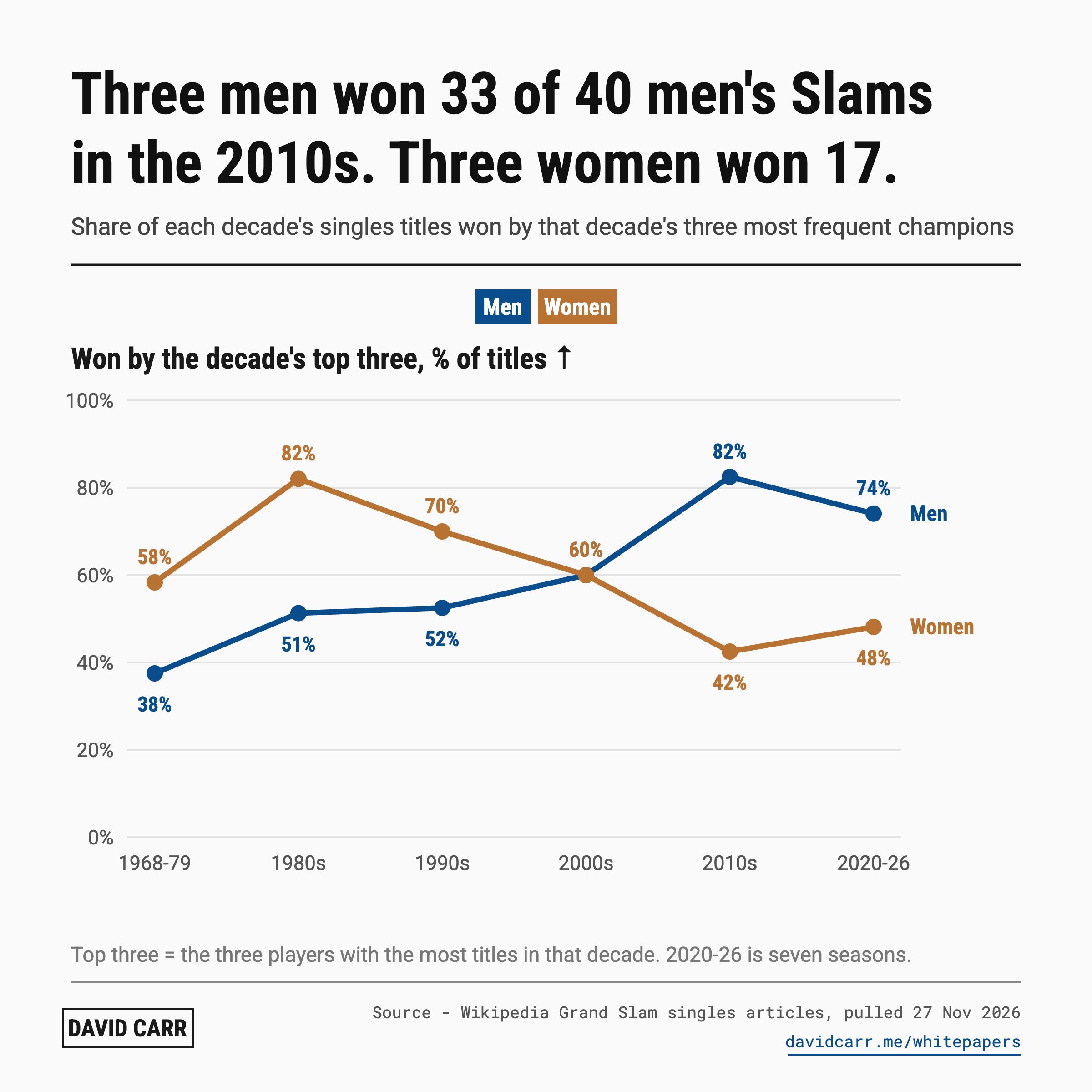
Three men won 33 of 40 men's Slams in the 2010s. Three women won 17.
- Men's top three: 38% of titles in 1968-79, 51% in the 1980s, 52% in the 1990s, 60% in the 2000s, 82% in the 2010s, 74% in 2020-26
- Women's top three: 58%, 82%, 70%, 60%, 42% and 48%
- 2010s: 6 different men won Slams, and 19 different women
The tours swapped places. Women's titles were most concentrated in the 1980s, men's in the 2010s.
Top three = the three players with the most titles in that decade, whoever they were. Where third place is tied, the share is the same whichever player is counted.
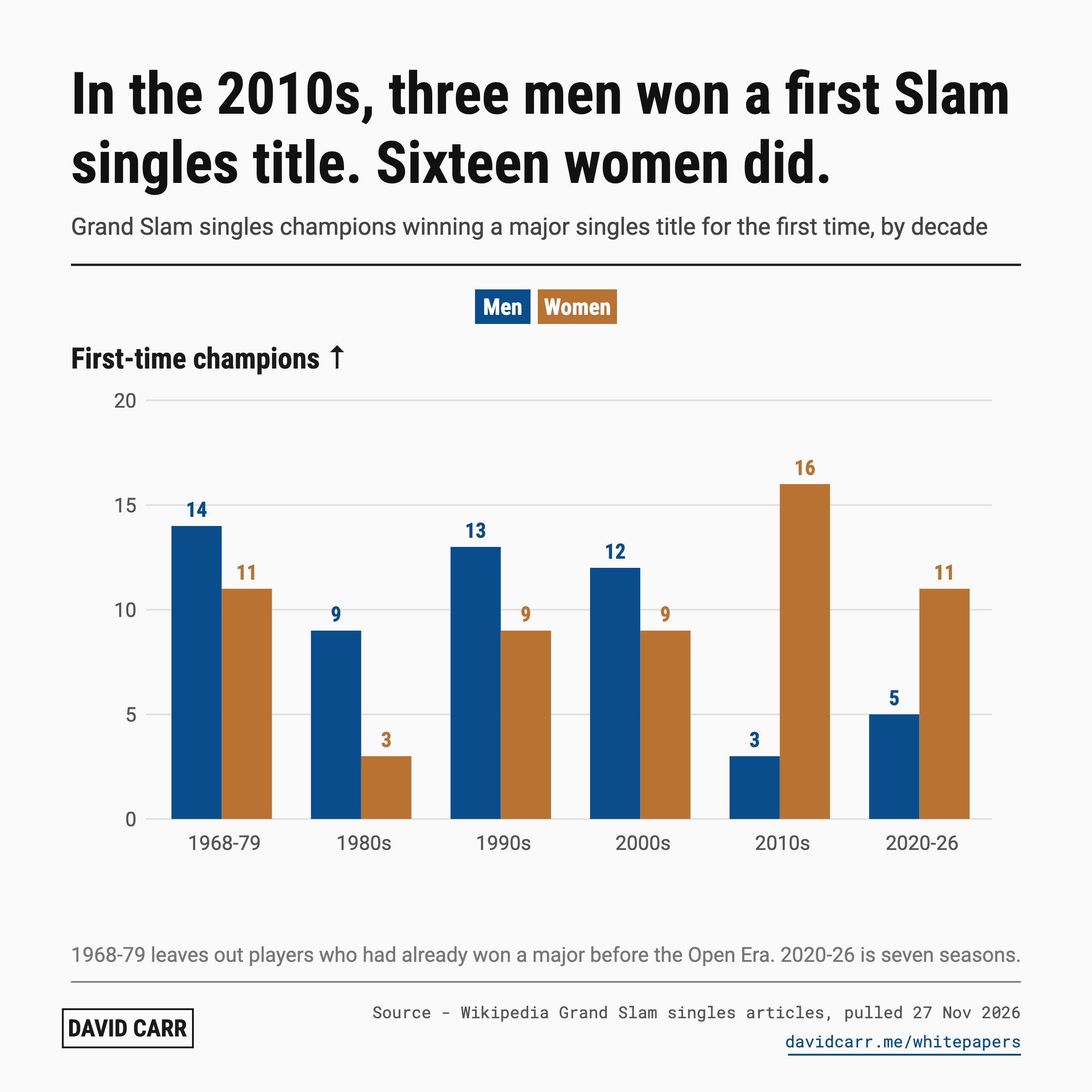
In the 2010s, three men won a first Slam singles title. Sixteen women did.
- Men: 14 first-time champions in 1968-79, 9 in the 1980s, 13 in the 1990s, 12 in the 2000s, 3 in the 2010s, 5 in 2020-26
- Women: 11, 3, 9, 9, 16 and 11
- The three men in the 2010s: Andy Murray (2012 US Open), Stan Wawrinka (2014 Australian Open), Marin Čilić (2014 US Open)
Since 2010, about two women's Slams in five have gone to a first-time champion. On the men's tour, about one in eight.
First-time = the player's first major singles title. Players who won a major before 1968, the amateur era, are not counted as first-time in the Open Era.
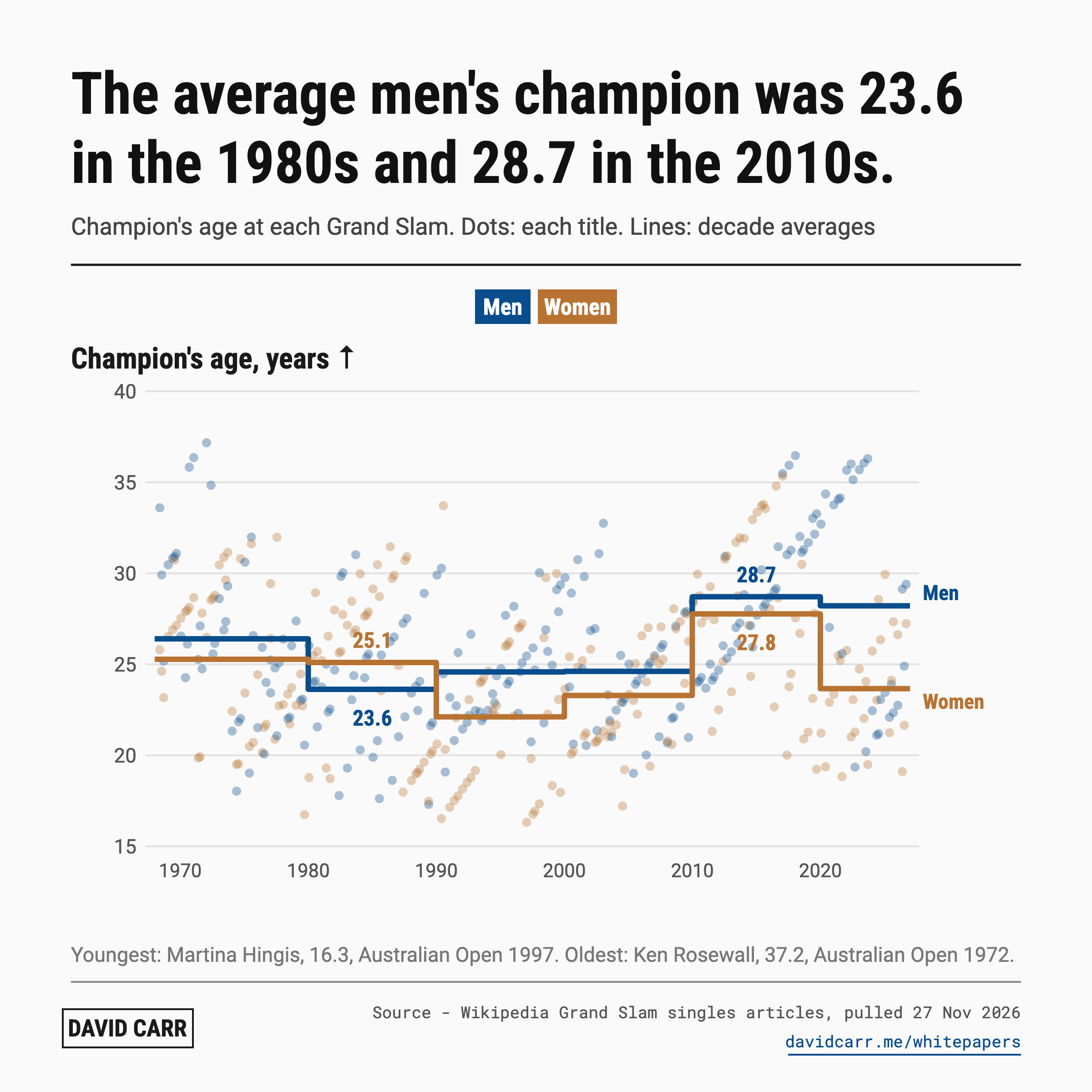
The average men's champion was 23.6 in the 1980s and 28.7 in the 2010s.
- Men: 26.4 in 1968-79, 23.6 in the 1980s, 24.6 in the 1990s and 2000s, 28.7 in the 2010s, 28.2 in 2020-26
- Women: 25.3, 25.1, 22.1, 23.3, 27.8, 23.7
- Youngest: Martina Hingis, 16, 1997 Australian Open. Oldest: Ken Rosewall, 37, 1972 Australian Open
Both tours got older in the 2010s. Since 2020 the women's champions are back to about 24, while the men's average has stayed above 28.
Age on the last day of the tournament, from the birth date in each champion's Wikipedia article. Decade averages are over titles, so a player who won often counts often.
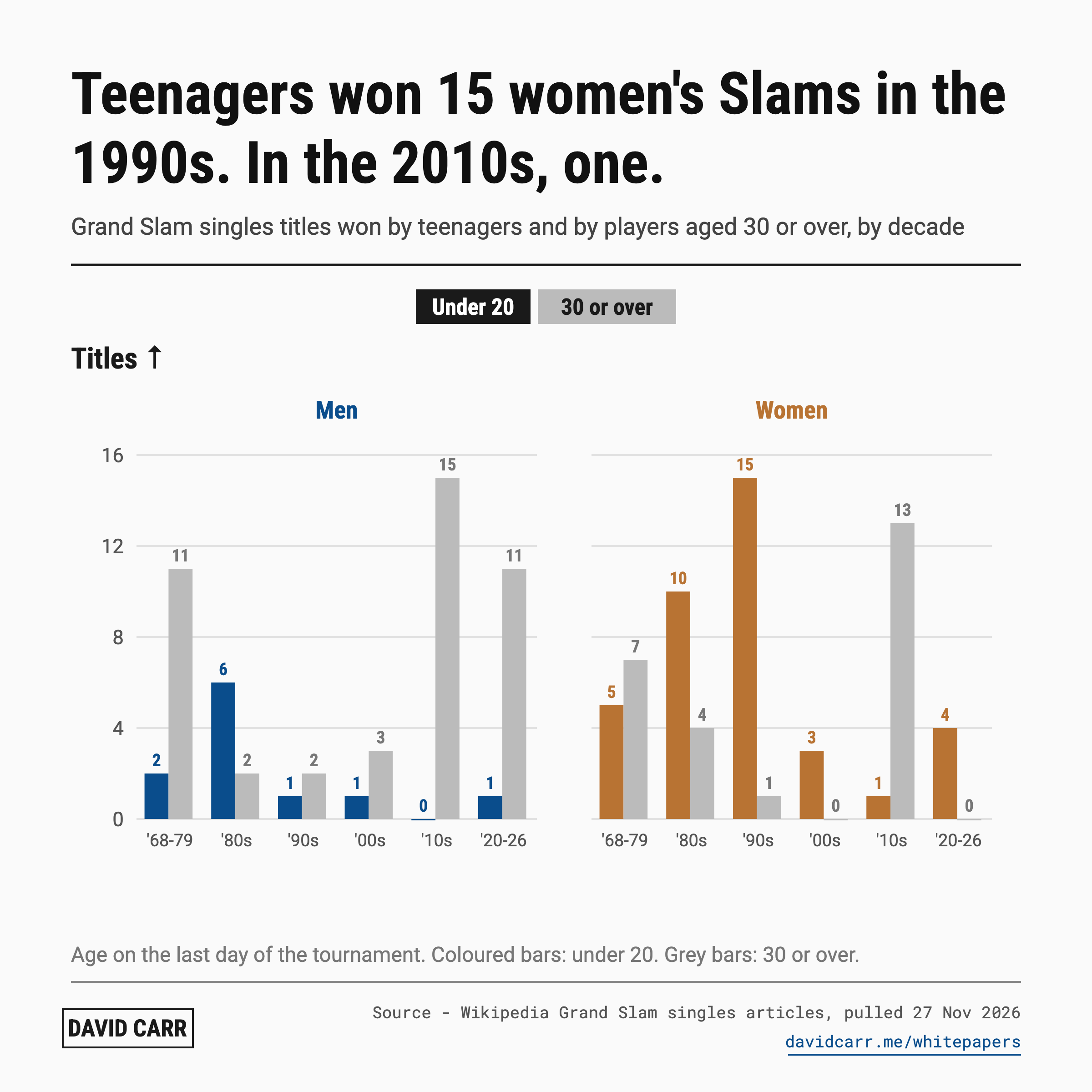
Teenagers won 15 women's Slams in the 1990s. In the 2010s, one.
- Women, titles won by teenagers: 5 in 1968-79, 10 in the 1980s, 15 in the 1990s, 3 in the 2000s, 1 in the 2010s, 4 in 2020-26
- Men, titles won by players aged 30 or over: 11 in 1968-79, 2 or 3 a decade from 1980 to 2009, 15 in the 2010s, 11 in 2020-26
- Women aged 30 or over won 13 Slams in the 2010s and none since 2020
The 1990s were the decade of the teenage women's champion. The 2010s were the decade of the champion over 30, on both tours.
Under 20 and 30 or over, on the last day of the tournament. Titles, not players.
Method, caveats and sources
The short answer. The favourite wins often, but not usually. The No. 1 seed won 37% of the 468 Grand Slam singles titles from the 1968 French Open to the 2026 US Open, and a top-four seed won 78%. Unseeded players won 16. The women's No. 1 seed won half the titles from 1980 to 1999 and 24% since 2000; the men's No. 1 seed has gone the other way, from 28% in the 1980s and 1990s to 43% in the 2010s. For men, the No. 1 seed won 45% of Wimbledons and 27% of French Opens. One final in four was No. 1 against No. 2. Three men won 33 of the 40 men's Slams in the 2010s, while 16 women won a first Slam in that decade. The average men's champion was 23.6 in the 1980s and 28.7 in the 2010s.
Data. The English Wikipedia article for every men's and women's singles event at the four Slams from 1968 to 2026 (468 events), read through the MediaWiki API as raw wikitext on 27 November 2026. From each article: champion, runner-up and final score from the infobox, and both finalists' seeds from the finals draw, checked against the article's list of seeds (the two agree wherever both name the player). Birth dates come from each champion's Wikipedia article and tournament dates from the main article for each Slam. First-time champions use the List of Grand Slam men's singles champions and women's lists to find players who had won a major before 1968. Every figure on this page is my own count on that data. Wikipedia text is available under CC BY-SA 4.0.
Seeding and draws. The number of seeds changed. Up to 1981, events seeded anywhere from 4 to 20 players, and draws ranged from about 30 to 148 players. From 1982 every Slam seeded 16. Every Slam has had a 128-player singles draw since 1990 at the latest. Wimbledon and the US Open moved to 32 seeds in 2001, and the Australian and French Opens in 2002. With fewer seeds, more strong players went in unseeded, so the unseeded and seeded-ninth-or-lower figures are not like for like across eras. The 1968 Australian Championships, played before the Open Era began, are left out. The Australian Open was held twice in 1977 and not at all in 1986; Wimbledon was not held in 2020.
Caveats. Seeds mostly follow the rankings, but not always exactly, and a player coming back from injury or a break can go in unseeded however good they are. Decades hold about 40 titles per tour, and 2020 to 2026 holds 27, so one title moves a share by 2 to 4 points. These are counts of what happened, not predictions.
Also: Upsets, Does pole position win? and Sports.