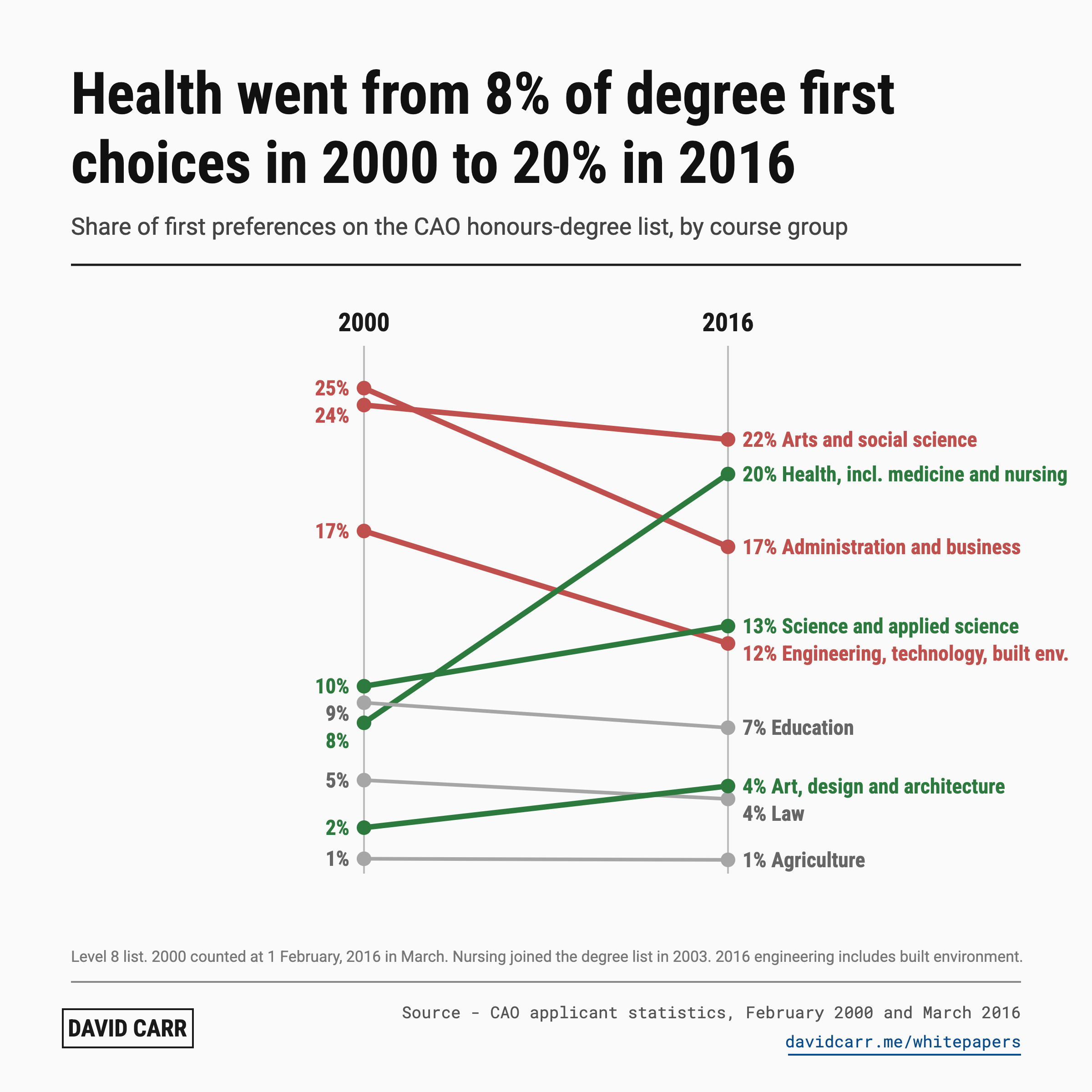
Health went from 8% of degree first choices in 2000 to 20% in 2016
- Health, including medicine and nursing: 3,952 first preferences to 13,258
- Administration and business: 25% to 17%
- Engineering and technology: 17% to 12%
- Science and applied science: 10% to 13%
- Arts and social science: 24% to 22%, still the biggest group
Much of the health rise came when nursing became a degree and joined the CAO degree list, which it did in the 2003 figures. Medicine first preferences also doubled, from 1,618 to 3,246.
CAO applicant statistics, February 2000 and March 2016, honours-degree (Level 8) list. The CAO grouped courses its own way until 2016; from 2017 it switched to international field codes, so this chart stops in 2016.
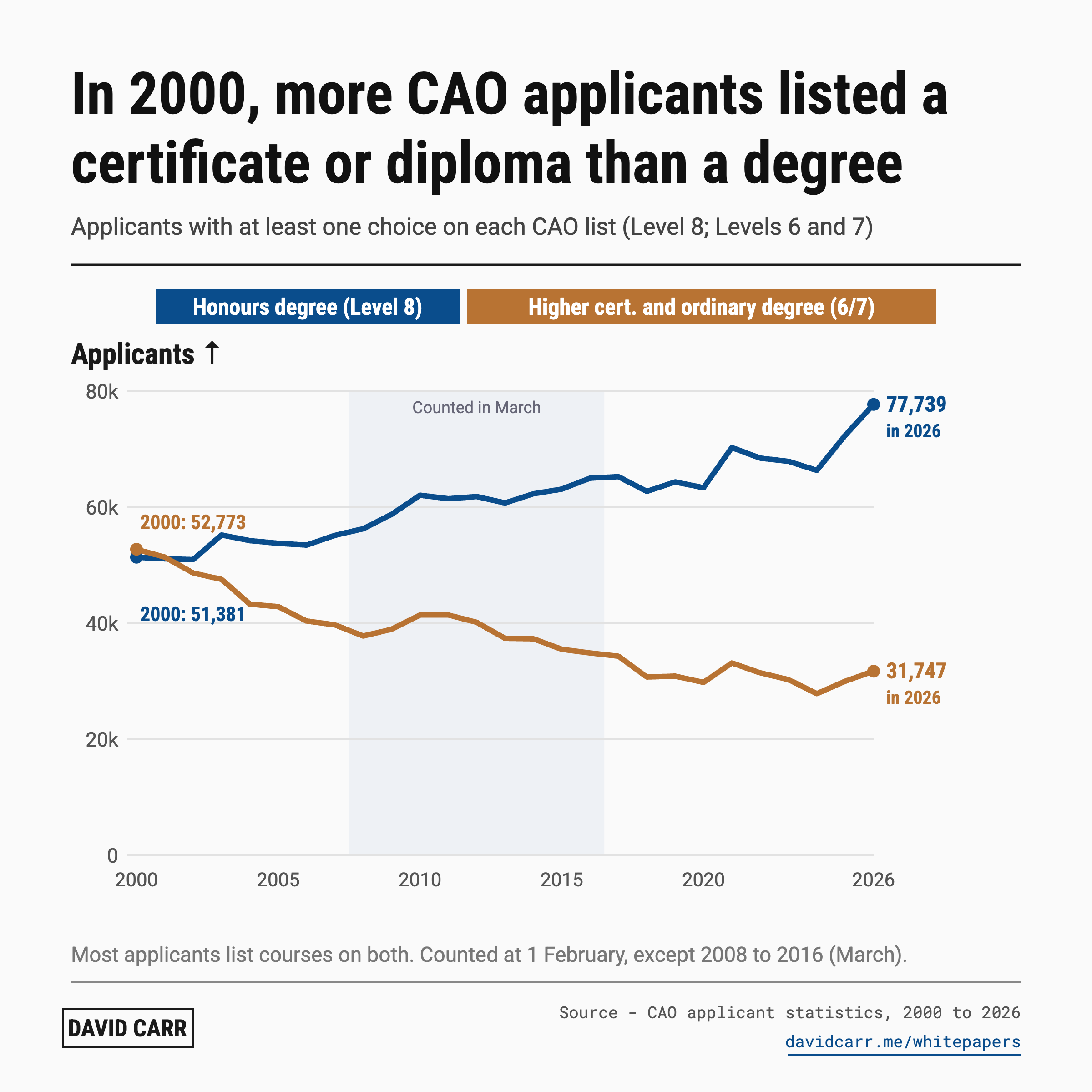
In 2000, more CAO applicants listed a certificate or diploma than a degree
- 2000: 52,773 applicants listed a Level 6 or 7 course; 51,381 listed an honours degree
- 2002 was the first year the degree list was bigger
- 2026: 77,739 on the degree list, 31,747 on the Level 6 and 7 list
- The Level 6 and 7 list was smallest in 2024, at 27,871
Degree applications rose by half in 26 years. Applications for higher certificates and ordinary degrees fell by about two fifths.
CAO applicant statistics. Most applicants list courses on both lists, so the two lines overlap and do not add up to all applicants. Counted at 1 February, except 2008 to 2016, when the CAO reported March figures.
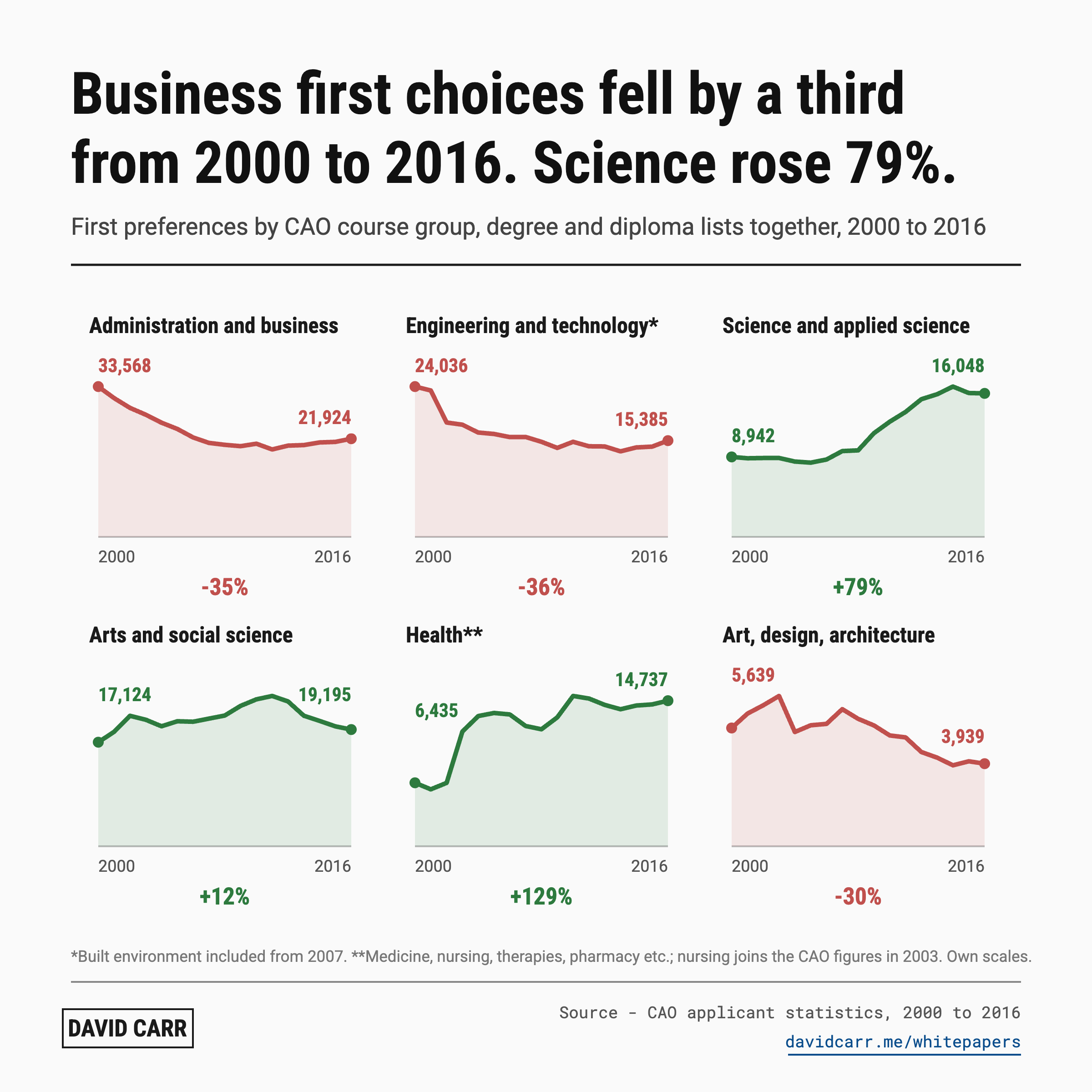
Business first choices fell by a third from 2000 to 2016. Science rose 79%.
- Administration and business: 33,568 to 21,924, with a low of 19,522 in 2011
- Engineering and technology: 24,036 to 15,385; 23,402 in 2001 fell to 18,294 in 2002
- Science and applied science: 8,942 to 16,048, peaking at 16,817 in 2014
- Arts and social science: up 12%, peaking at 24,724 in 2011
Science doubled between 2005 and 2014. Business and engineering fell through the boom years and have only partly come back.
CAO applicant statistics, degree and diploma lists added together. Each panel has its own scale. Health jumps in 2003 when nursing degrees appear in the CAO figures. The CAO moved some engineering courses into a new built-environment group in 2007; that group is counted with engineering here.
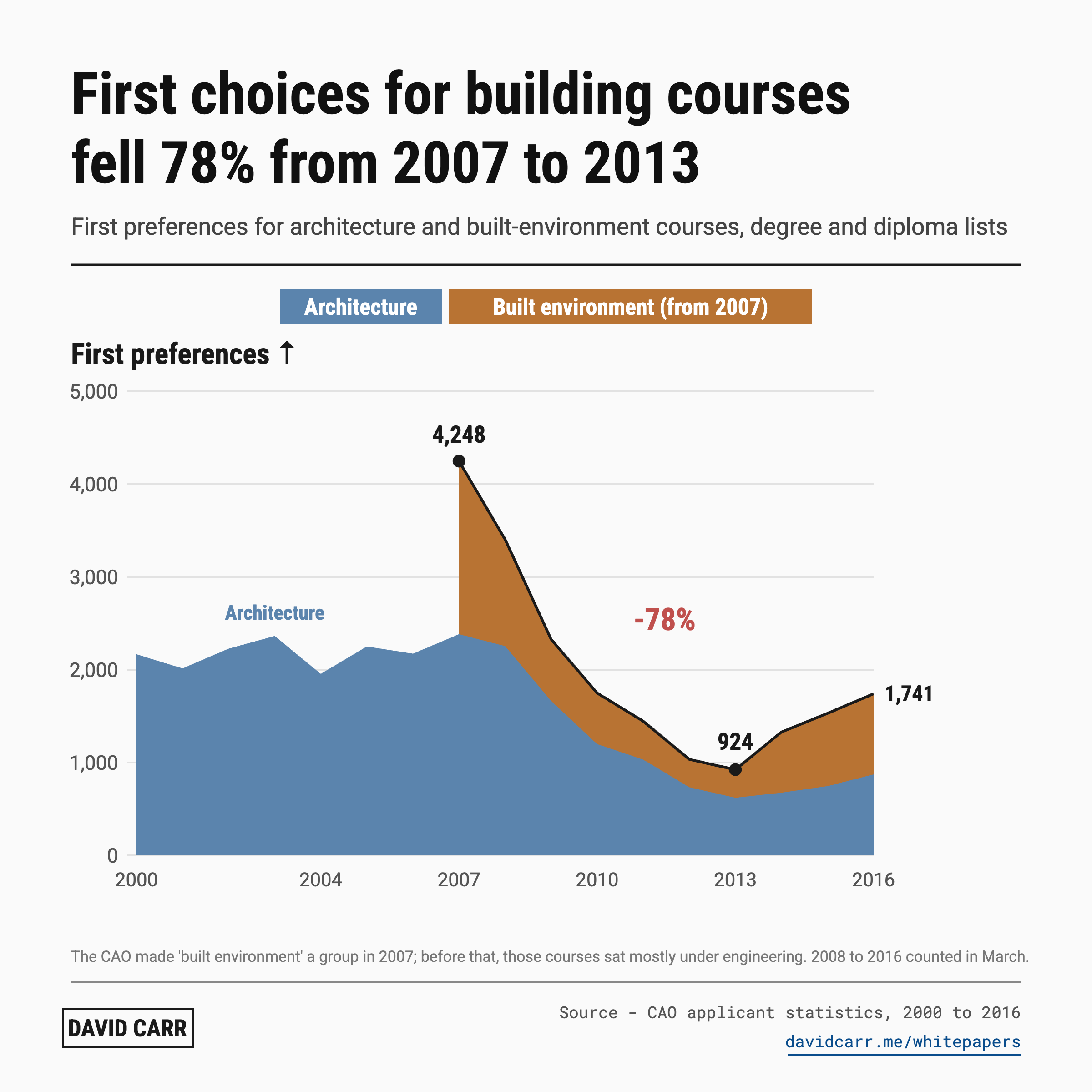
First choices for building courses fell 78% from 2007 to 2013
- Architecture and built environment, both lists: 4,248 first preferences in 2007
- 924 in 2013, the low point
- 1,741 in 2016
- Architecture alone: 2,383 in 2007, 621 in 2013
Demand for building courses moved with the building industry. After 2013 it began to climb again, and it kept climbing after 2017.
CAO applicant statistics. "Built environment" (construction, surveying, property) became its own CAO group in 2007; before that those courses sat mostly under engineering, so the orange band starts in 2007. For 2017 to 2026 on newer field codes, see Irish universities.
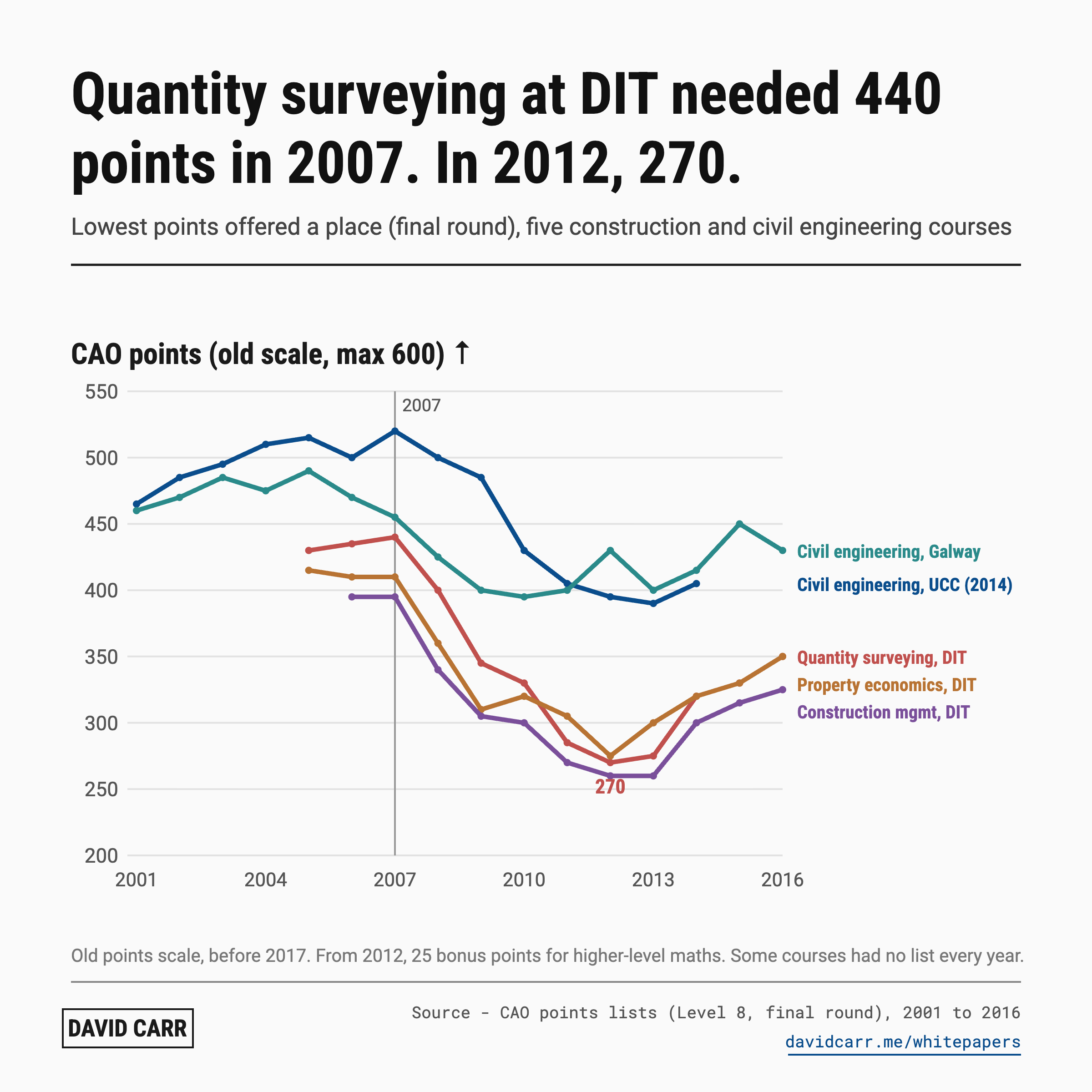
Quantity surveying at DIT needed 440 points in 2007. In 2012, 270.
- Quantity surveying, DIT: 440 in 2007, 270 in 2012, 350 in 2016
- Construction management, DIT: 395 to 260
- Civil engineering, UCC: 520 in 2007, 390 in 2013
- Civil engineering, Galway: 490 in 2005, 395 in 2010
Points follow demand. When fewer people put a course first, the points needed for a place fall, and these courses fell by 95 to 170 points.
CAO points lists, Level 8, final round. Old points scale (maximum 600) used until 2016. DIT is now TU Dublin. The UCC course code ends in 2014.
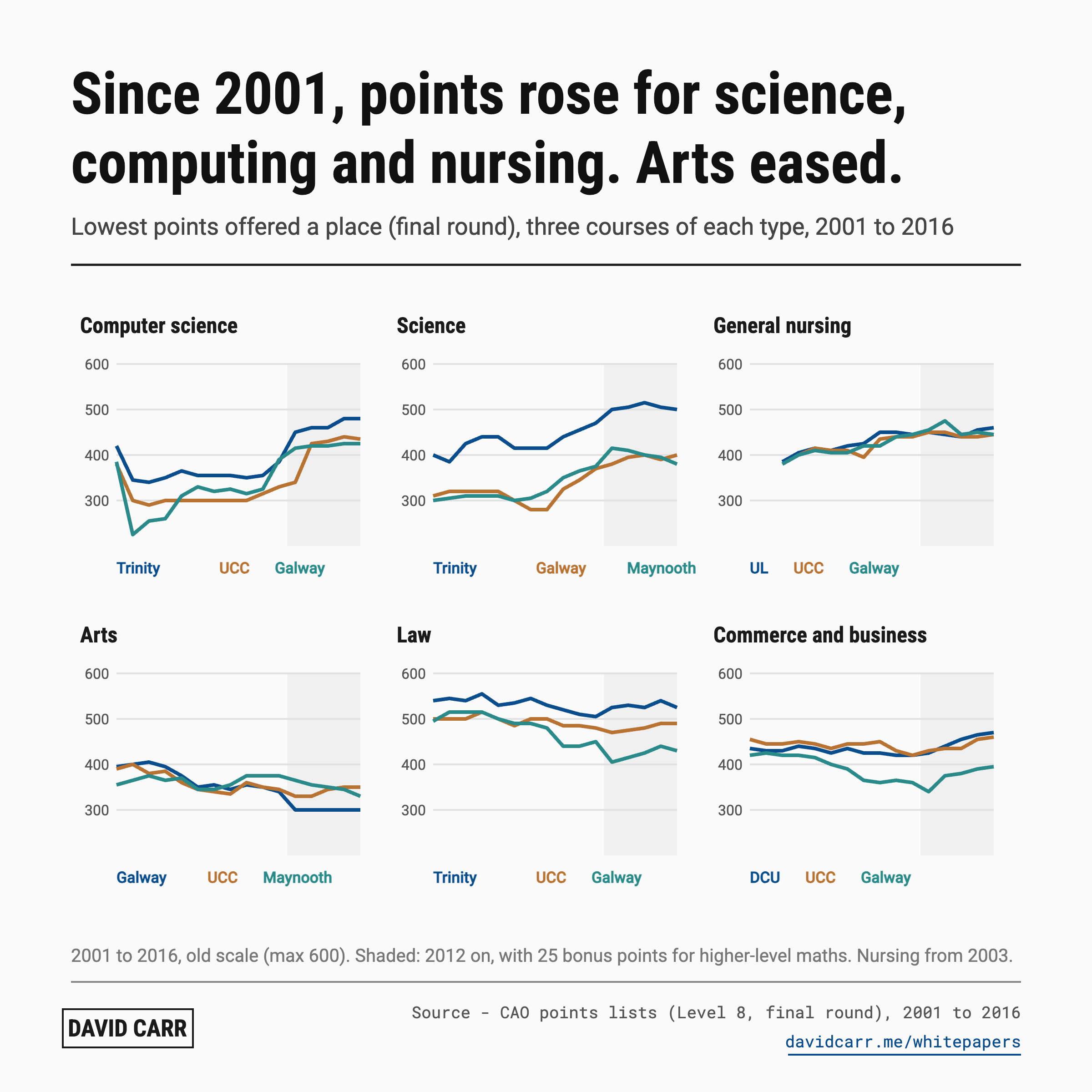
Since 2001, points rose for science, computing and nursing. Arts eased.
- Computer science, Trinity: 420 in 2001, 345 in 2002, 480 in 2016
- Science, Trinity: 400 to 500; Galway 310 to 400; Maynooth 300 to 380
- General nursing, UL: 385 in 2003 to 460 in 2016
- Arts, Galway: 395 to 300; UCC 390 to 350; Maynooth 355 to 330
- Law eased a little; commerce was mixed
Computer science points fell sharply after 2001, then rose well past where they started. From 2012, 25 bonus points for higher-level maths lifted maths-heavy courses, so part of the late rise in science and computing comes from that.
CAO points lists, final round, 2001 to 2016. The same three course codes in each panel every year. Medicine is left out: it added the HPAT test score from 2009, so its numbers changed scale. Maths bonus points: NUI and the CAO.
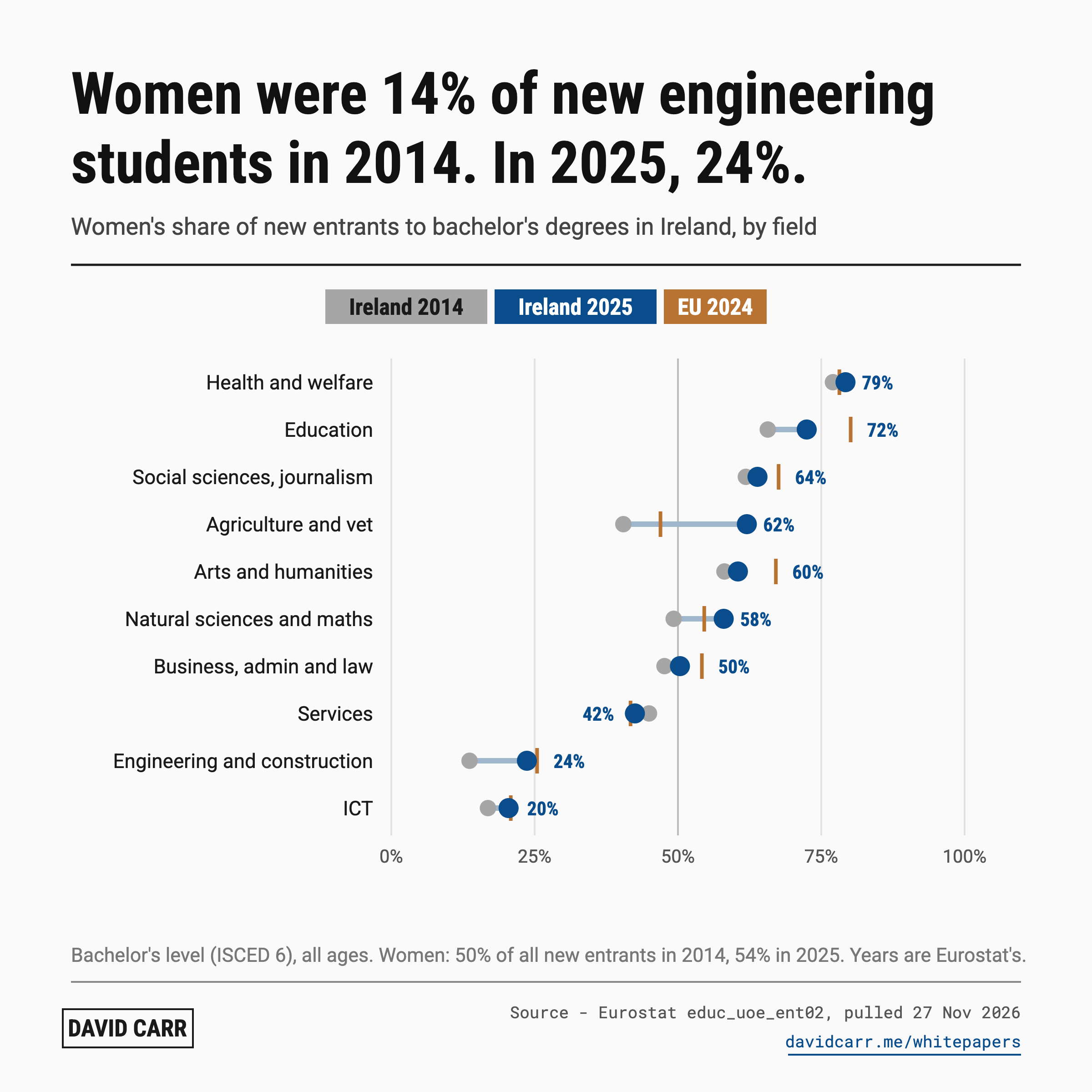
Women were 14% of new engineering students in 2014. In 2025, 24%.
- Engineering and construction: 14% to 24% (EU: 25%)
- Agriculture and vet: 40% to 62%
- Natural sciences and maths: 49% to 58%
- ICT: 17% to 20%
- Health and welfare: 77% to 79%
Women's share rose in nine of ten fields. Engineering is now close to the EU share, and agriculture is well above it.
Eurostat educ_uoe_ent02, new entrants to bachelor's level, Ireland, pulled 27 November 2026. Women were 50% of all new entrants in 2014 and 54% in 2025. 2014 is used as the start because the 2013 figure looks incomplete. Years are as Eurostat labels them.
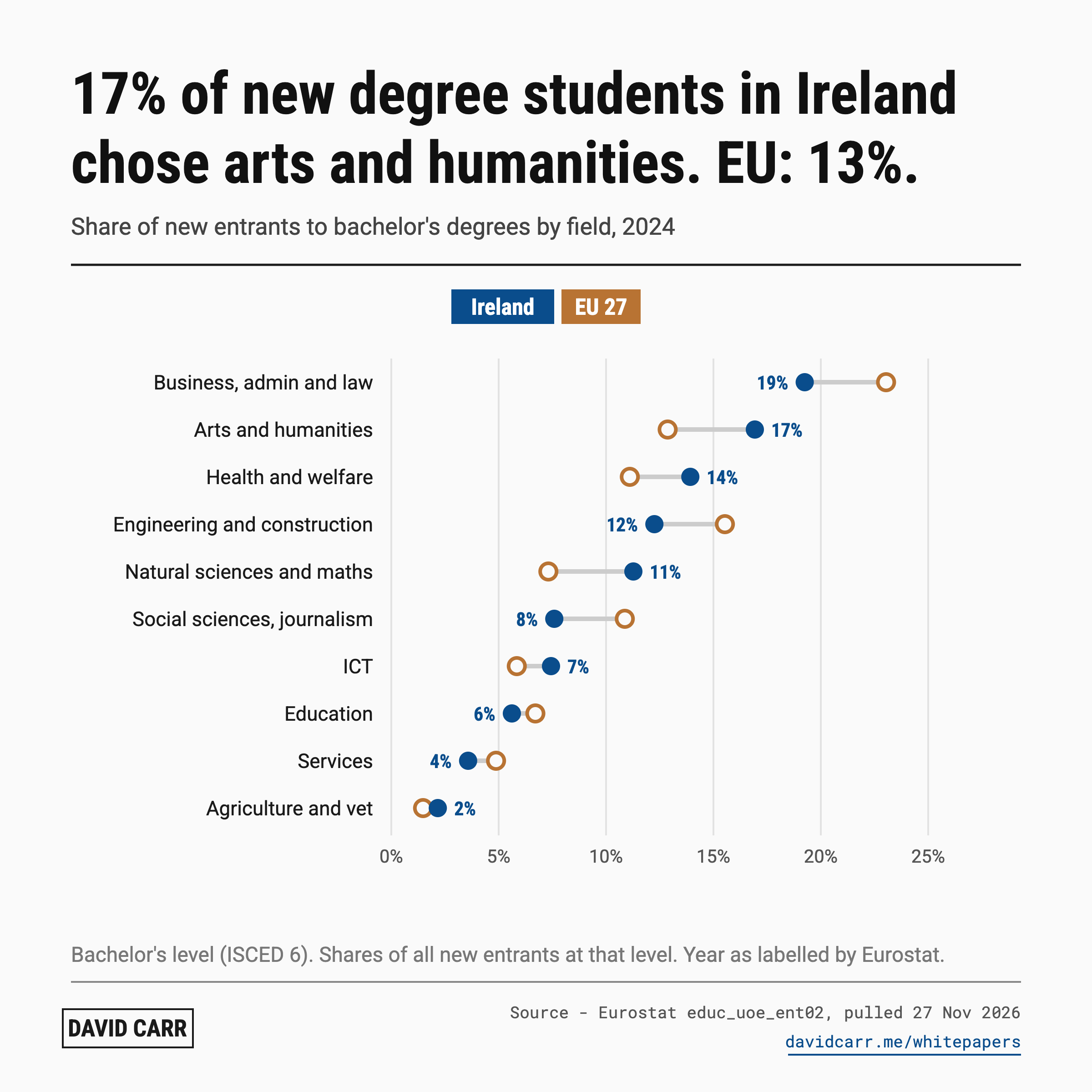
17% of new degree students in Ireland chose arts and humanities. EU: 13%.
- Arts and humanities: Ireland 17%, EU 13%
- Natural sciences and maths: 11% and 7%
- Health and welfare: 14% and 11%
- Business, admin and law: 19% and 23%
- Engineering and construction: 12% and 15%
Ireland leans more towards arts, science, health and ICT than the EU average, and less towards business and engineering.
Eurostat educ_uoe_ent02, new entrants to bachelor's level, 2024, the latest year with an EU total. Shares of all new entrants at that level.
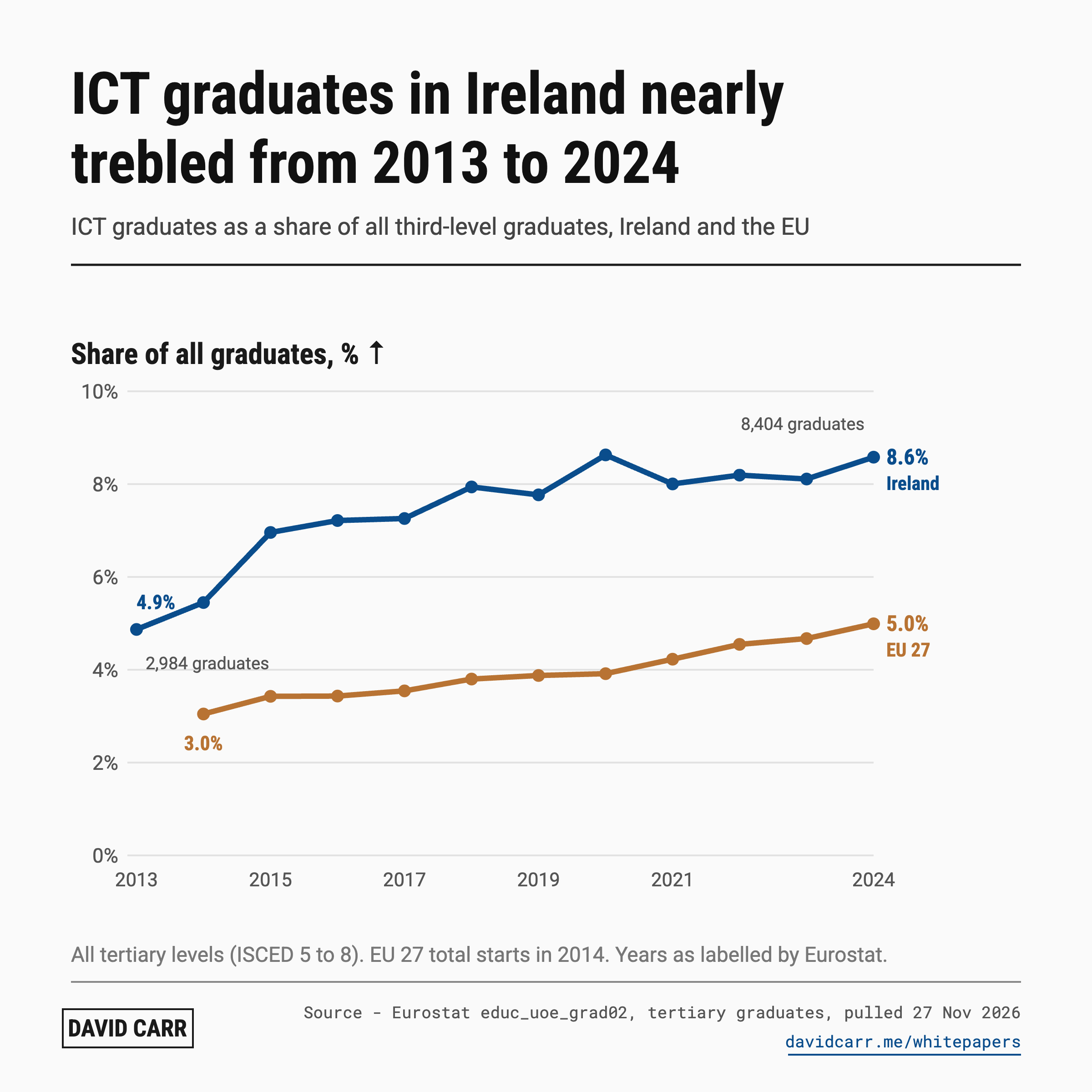
ICT graduates in Ireland nearly trebled from 2013 to 2024
- 2,984 ICT graduates in 2013; 8,404 in 2024
- Share of all graduates: 4.9% to 8.6%
- EU share: 3.0% in 2014, 5.0% in 2024
Computing went from a small field to one of the bigger ones, and Ireland's share stays well above the EU's.
Eurostat educ_uoe_grad02, all third-level graduates (ISCED 5 to 8), pulled 27 November 2026. For what graduates go on to do, see From college to career.
Method, caveats and sources
The short answer. What Ireland chooses to study has shifted a lot since 2000, and it moves with the economy. Health courses went from 8% of honours-degree first choices in 2000 to 20% in 2016, helped by nursing becoming a degree. Business and engineering first choices fell by about a third, and science rose 79%. Building courses lost 78% of their first choices from 2007 to 2013, and their points fell with them: quantity surveying at DIT went from 440 to 270. Points for science, computing and nursing rose over the period; arts points eased. In 2000 more CAO applicants listed a certificate or diploma than a degree; in 2026 degree applicants outnumbered them more than two to one. Women's share of new engineering students rose from 14% to 24%. Compared with the EU, new students in Ireland lean more towards arts, science, health and ICT, and ICT graduates nearly trebled from 2013 to 2024.
Data. CAO applicant statistics reports for 2000 to 2026 (first preferences by CAO course group, 2000 to 2016; totals for each list to 2026), read from the CAO's own PDFs. CAO points lists for 2001 to 2016, the CAO's HTML and PDF files, end-of-season final points. Eurostat tables educ_uoe_ent02 (new entrants by field and sex) and educ_uoe_grad02 (graduates by field), pulled on 27 November 2026. Every figure is my own count or calculation on those files.
Definitions. A first preference is the course an applicant put first on a list. Applicants can list courses on both the honours-degree (Level 8) list and the Level 6 and 7 list, so each list has its own first preferences. Points are the lowest score offered a place in the final round, Leaving Cert only; courses with a test, interview or portfolio are left out of the points charts.
Caveats. The CAO counted applications at 1 February, except 2008 to 2016, when its reports give March figures. Its course groups changed: nursing appears in 2003 and built environment in 2007, and from 2017 it uses international field codes, which is why the course-group charts stop in 2016. The points scale changed in 2017, so points before and after cannot be compared; the 2000 points list is a scanned image and is left out. From 2012, 25 bonus points for higher-level maths raised points for maths-heavy courses. Eurostat fields are broad and include all ages. This page shows what people chose, not how those choices worked out.
Also: The Leaving Cert and CAO points (points since 2017), Irish universities and From college to career.