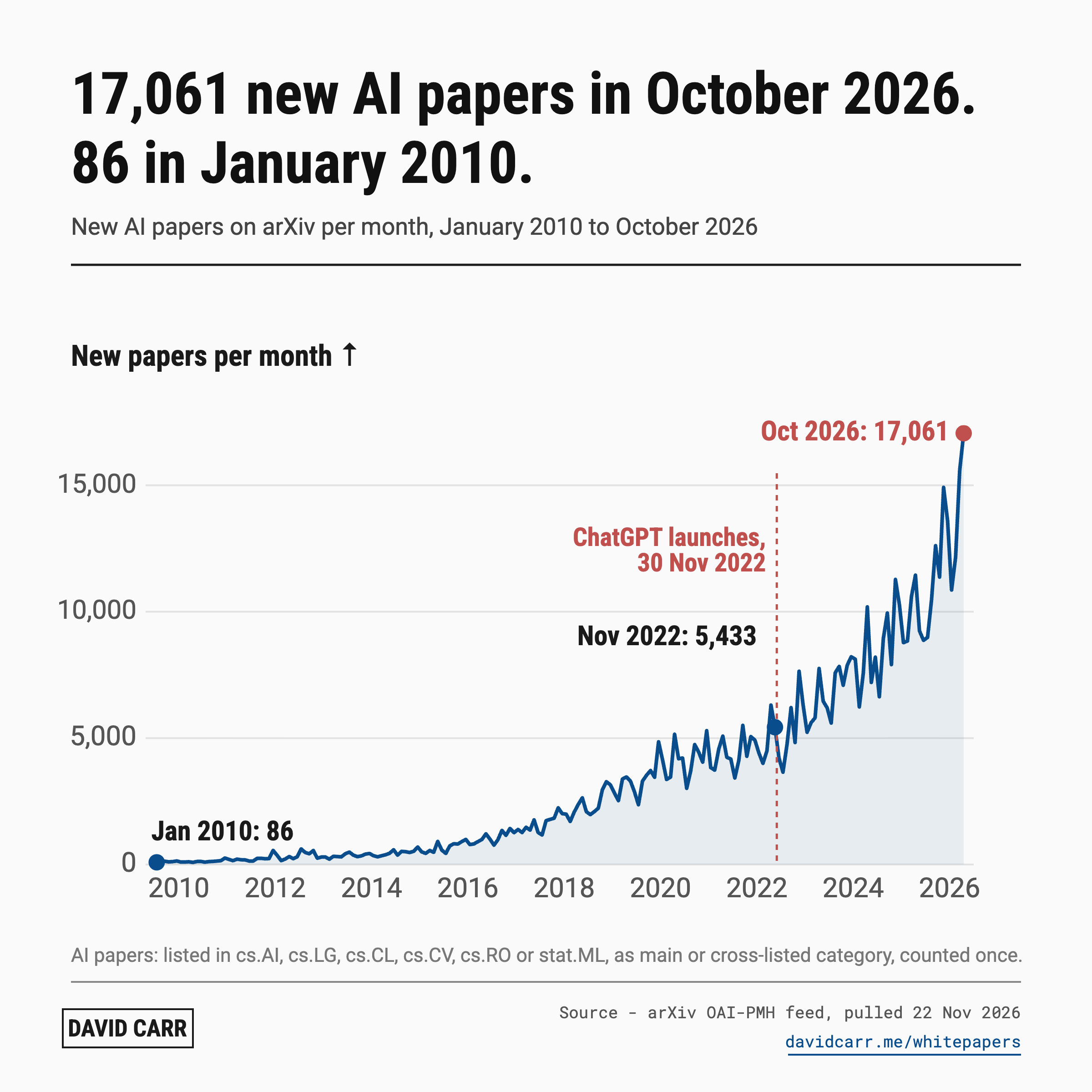
17,061 new AI papers in October 2026. 86 in January 2010.
- January 2010: 86
- January 2015: 371
- January 2020: 2,363
- November 2022, when ChatGPT launched: 5,433
- October 2026: 17,061
October 2026 had about 198 new AI papers for every one in January 2010. The line climbs every year, and it was already steep before ChatGPT.
New papers per month from the arXiv OAI-PMH feed, pulled 22 November 2026. An AI paper is one listed in cs.AI, cs.LG, cs.CL, cs.CV, cs.RO or stat.ML, as its main category or a cross-list, counted once.
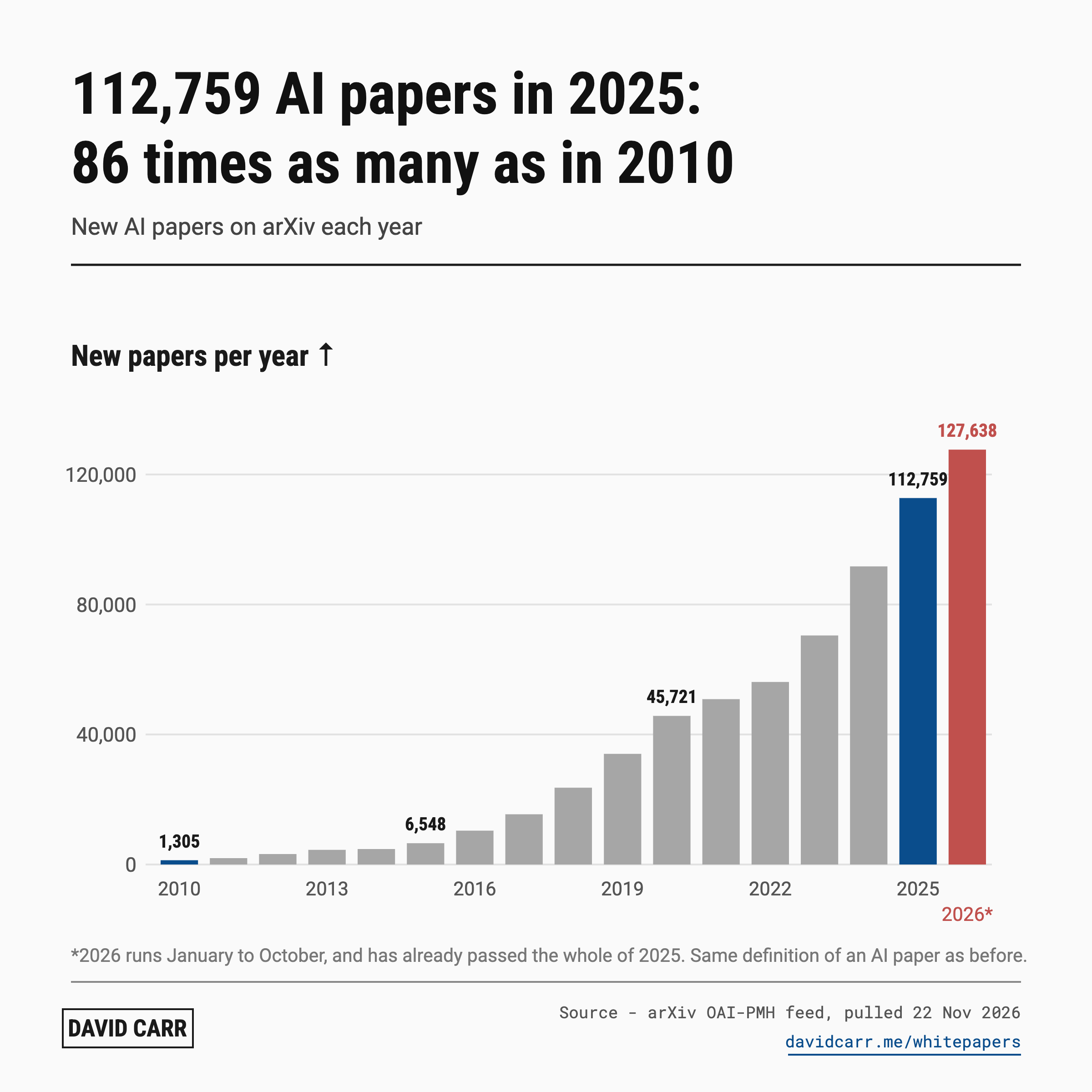
112,759 AI papers in 2025: 86 times as many as in 2010
- 2010: 1,305
- 2015: 6,548
- 2020: 45,721
- 2025: 112,759
- 2026, January to October: 127,638
2026 passed the whole of 2025 before the end of October. January to October 2026 is up 35% on the same months of 2025.
A paper counts in the month its arXiv number was given, which is when it was first submitted.
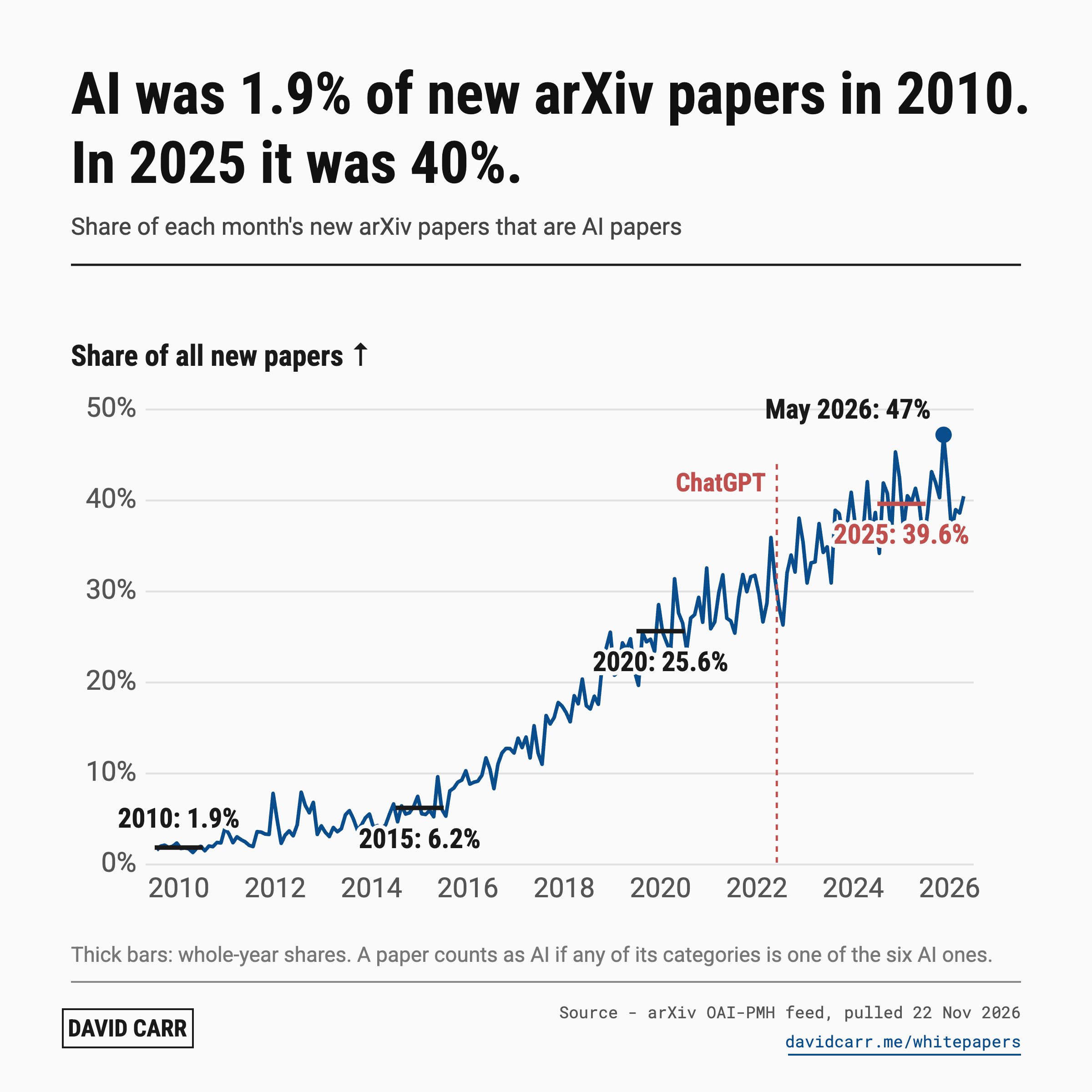
AI was 1.9% of new arXiv papers in 2010. In 2025 it was 40%.
- 2010: 1.9%
- 2015: 6.2%
- 2020: 25.6%
- 2025: 39.6%
- 2026 to October: 40.8%
- Highest month: May 2026, 47%
arXiv also covers physics, maths, biology, economics and more. Two in every five new papers on it are now about AI.
All new arXiv papers in each month, from the same feed. The monthly totals match arXiv's own submission statistics to within 0.2% in every month.
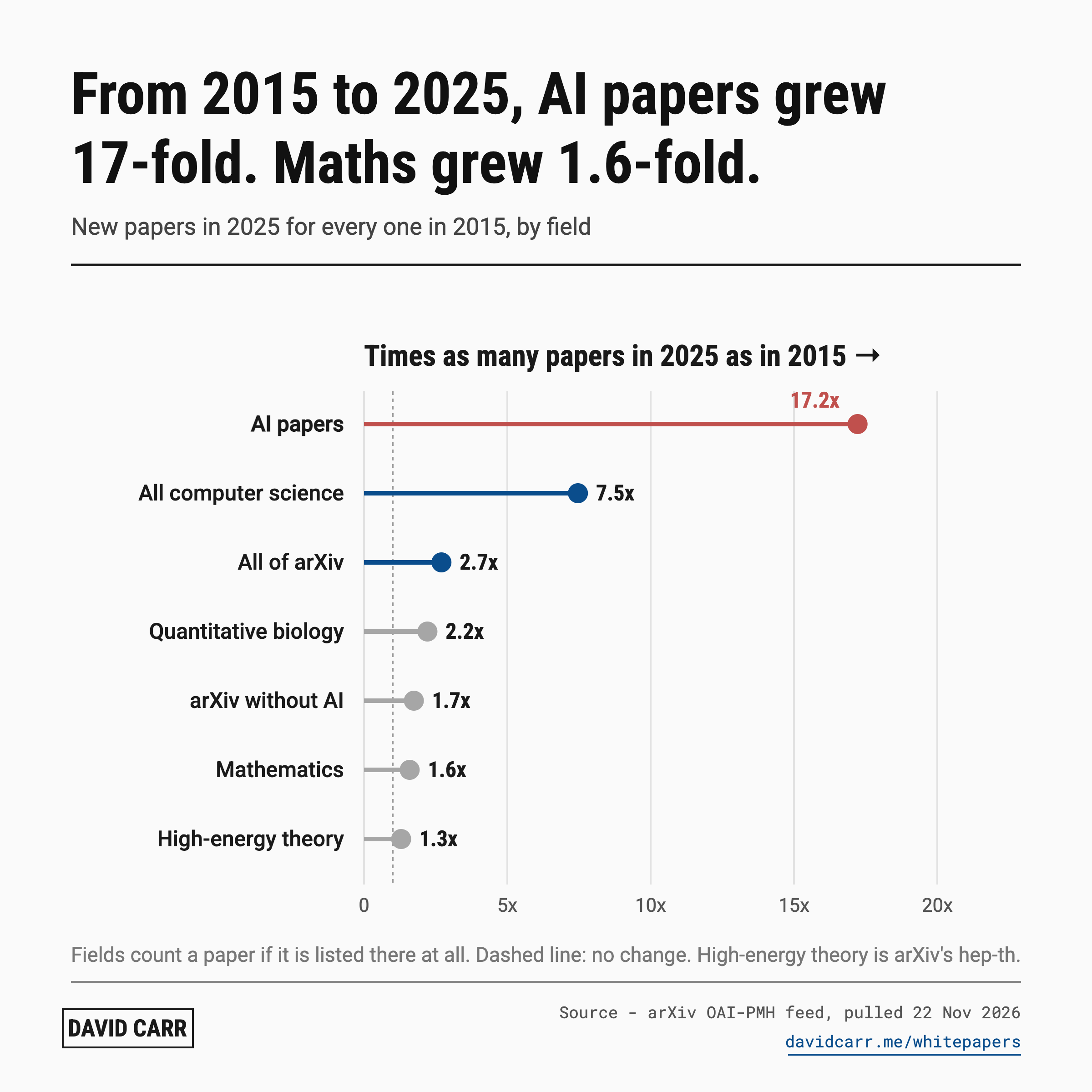
From 2015 to 2025, AI papers grew 17-fold. Maths grew 1.6-fold.
- AI papers: 6,548 to 112,759 (17.2x)
- All computer science: 7.5x
- All of arXiv: 2.7x
- arXiv without AI: 1.7x
- Mathematics: 1.6x
- High-energy theory: 1.3x
- Quantitative biology: 2.2x
Every field here grew. AI grew far faster, and it pulls the computer science and all-arXiv numbers up with it.
A paper counts in a field if any of its categories is in that field, so one paper can count in several.
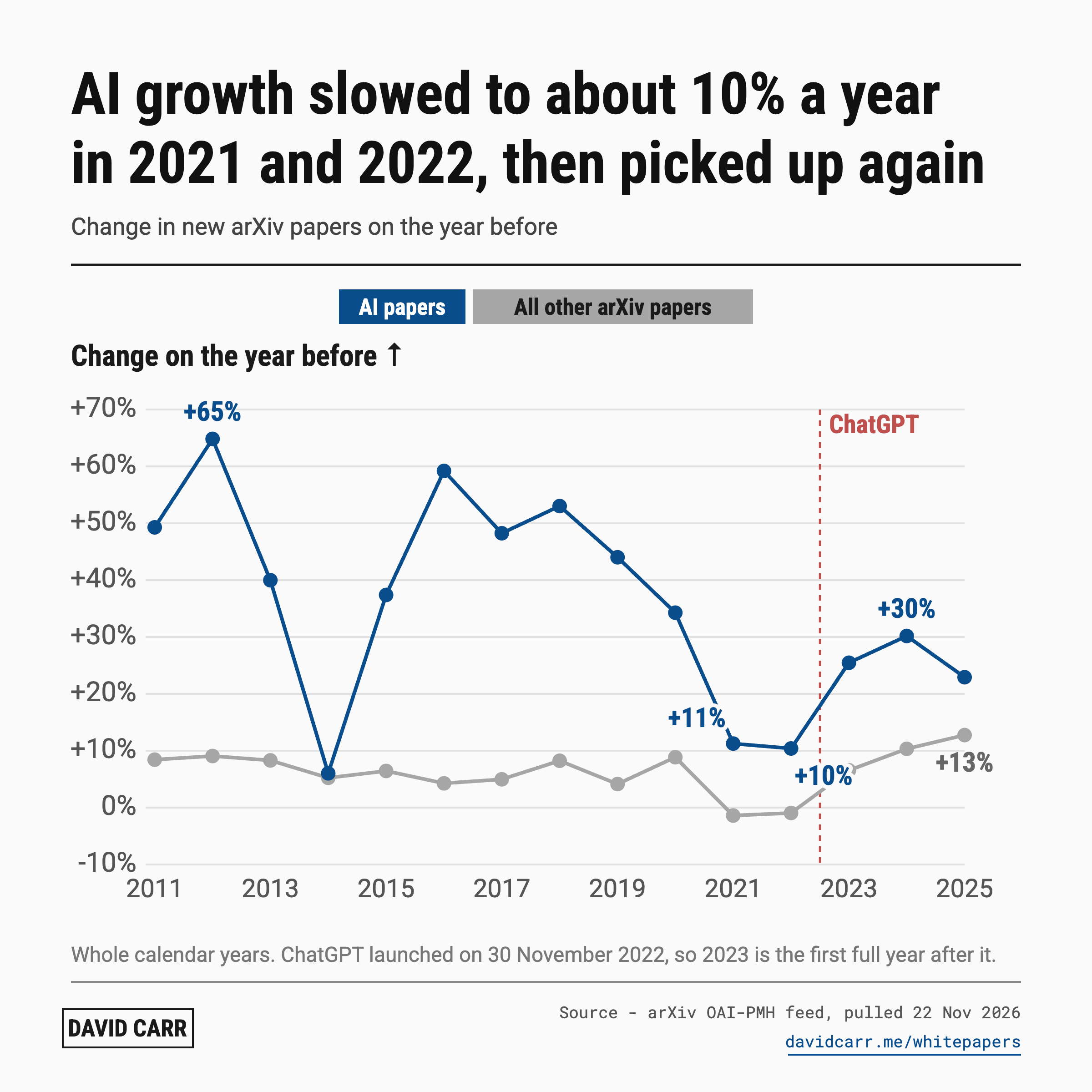
AI growth slowed to about 10% a year in 2021 and 2022, then picked up again
- 2019: +44%
- 2020: +34%
- 2021: +11%
- 2022: +10%
- 2023: +25%
- 2024: +30%
- 2025: +23%
The growth rate had been falling for years before ChatGPT. It more than doubled in 2023 and has stayed above 20% since. The rest of arXiv sped up too, from -1% in 2022 to +13% in 2025.
Whole calendar years against the year before. The data shows timing, not cause: other things changed in the same years.
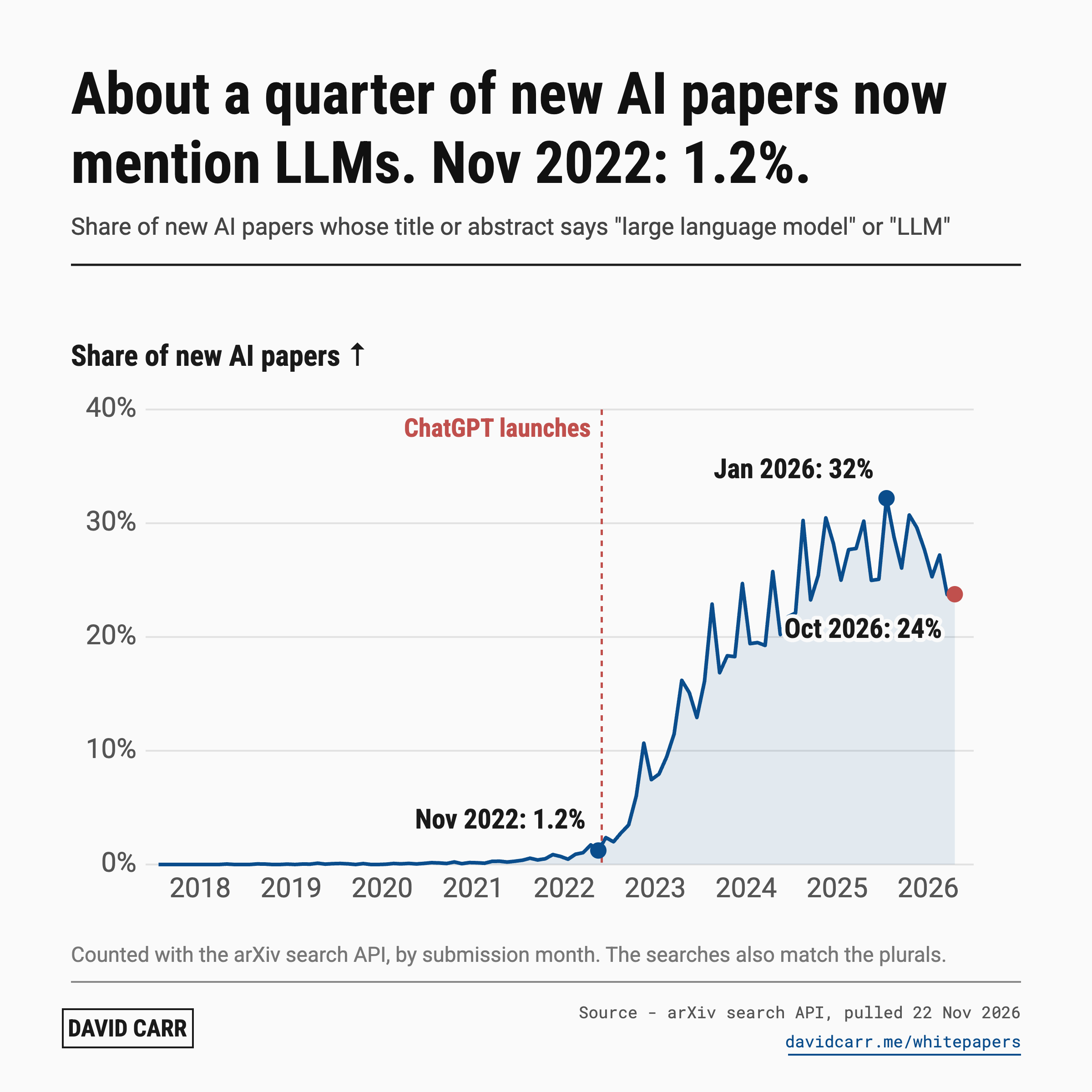
About a quarter of new AI papers mention large language models. 1.2% did in November 2022.
- 2019: 0.0%
- 2022: 1.0%
- 2023: 9.4%
- 2024: 21%
- 2025: 27%
- Highest month: January 2026, 32%
- October 2026: 24%
Before ChatGPT, almost no AI paper used the phrase. By 2025 it was in more than one in four. The share has eased a little since early 2026, while the number of AI papers kept rising.
Share of AI papers whose title or abstract matches "large language model(s)" or "LLM(s)" in the arXiv search API, by submission month.
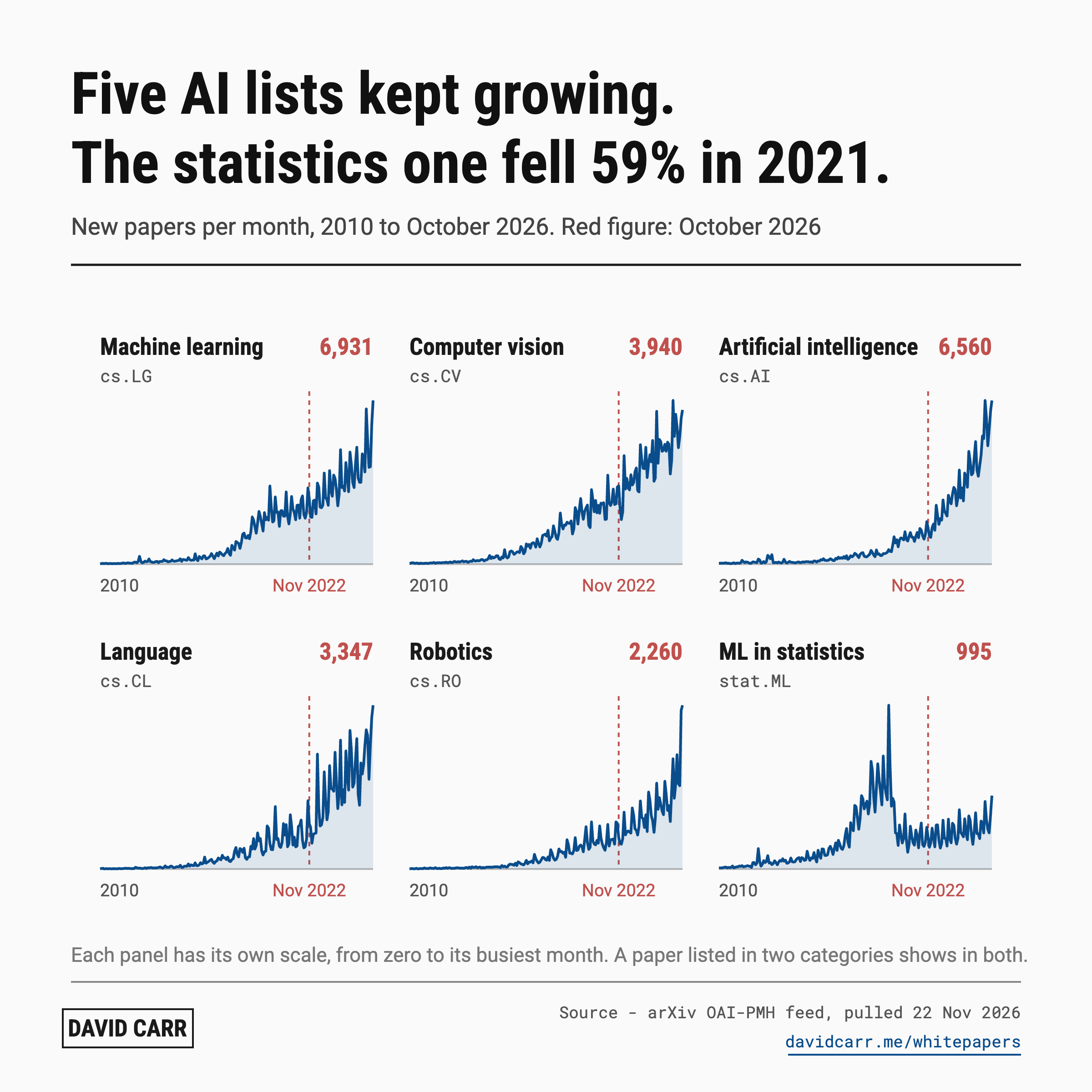
Five AI lists kept growing. The statistics one fell 59% in 2021.
- Machine learning (cs.LG): 6,931 in October 2026
- Artificial intelligence (cs.AI): 6,560 in October 2026
- Computer vision (cs.CV): 3,940 in October 2026
- Language (cs.CL): 3,347 in October 2026
- Robotics (cs.RO): 2,260 in October 2026
- Machine learning in statistics (stat.ML): 995 in October 2026
Machine learning is still the biggest list. stat.ML went from 12,806 papers in 2020 to 5,237 in 2021, and never came back. The data doesn't say why.
Each panel has its own scale. Many papers sit in two or more of these lists.
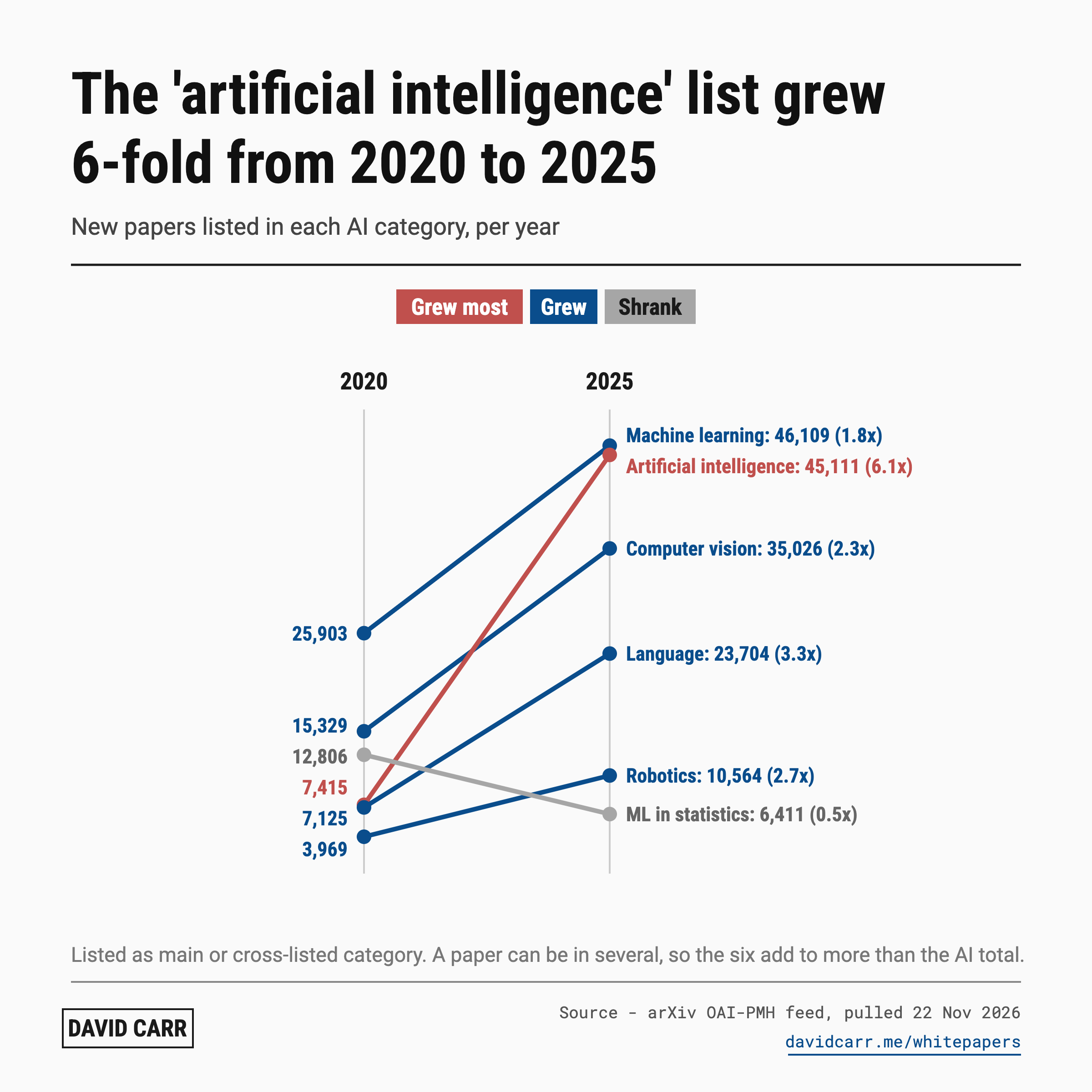
The 'artificial intelligence' list grew 6-fold from 2020 to 2025
- Artificial intelligence (cs.AI): 7,415 to 45,111 (6.1x)
- Language (cs.CL): 7,125 to 23,704 (3.3x)
- Robotics (cs.RO): 3,969 to 10,564 (2.7x)
- Computer vision (cs.CV): 15,329 to 35,026 (2.3x)
- Machine learning (cs.LG): 25,903 to 46,109 (1.8x)
- Machine learning in statistics (stat.ML): 12,806 to 6,411 (0.5x)
cs.AI went from the fourth-biggest list to almost level with machine learning. Language papers more than tripled.
Counts include cross-lists, and authors choose their own categories, so a fast-growing list can partly mean more people tagging it.
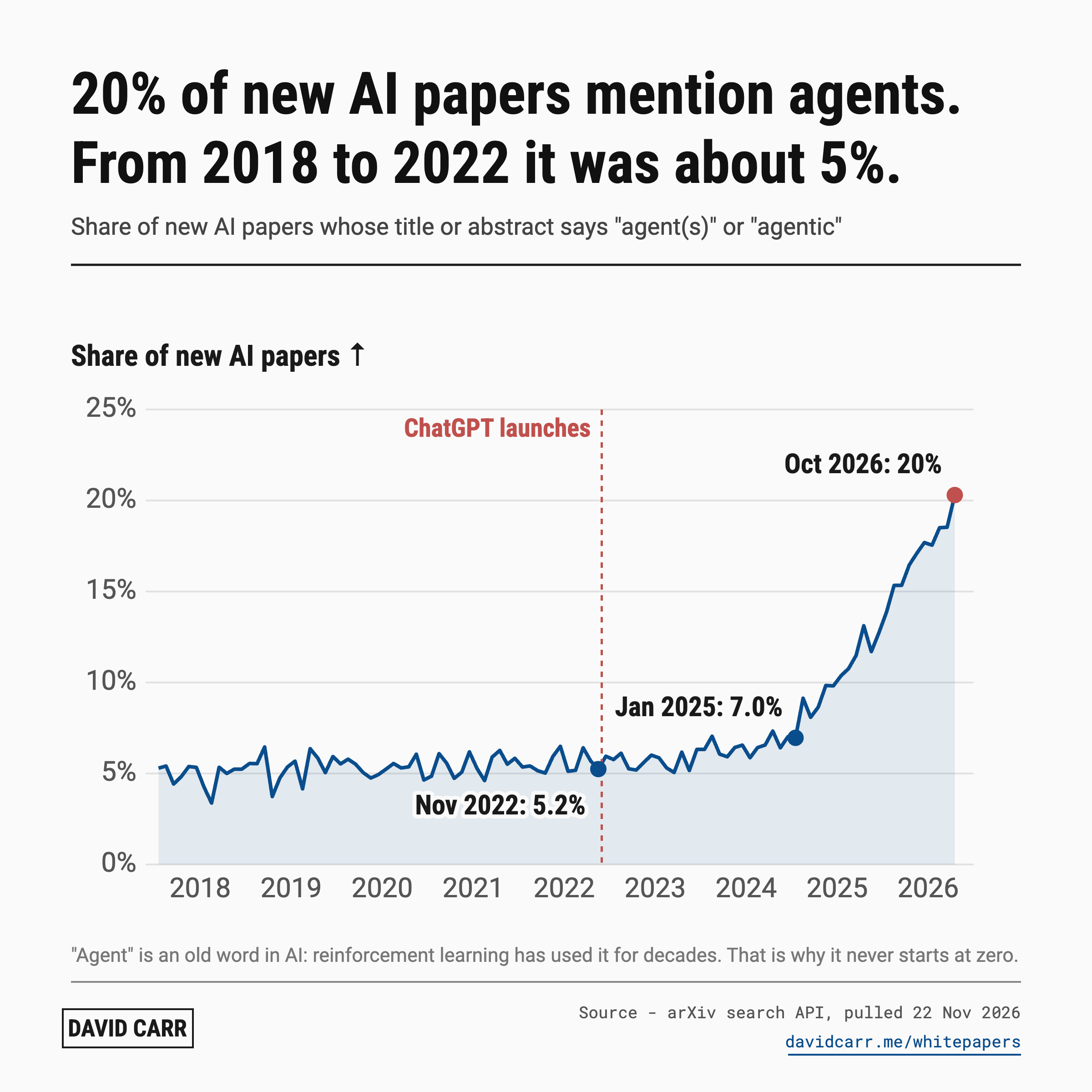
20% of new AI papers now mention agents. From 2018 to 2022 it was about 5%.
- 2019: 5.4%
- 2022: 5.6%
- 2024: 6.5%
- 2025: 10.4%
- January 2025: 7%
- October 2026: 20%
Agents are an old idea in AI, so the line never starts at zero. It sat near 5% for years, began to climb in 2024, and has nearly tripled since January 2025.
Share of AI papers whose title or abstract says "agent", "agents" or "agentic", from the arXiv search API. This includes the older reinforcement-learning sense of the word.
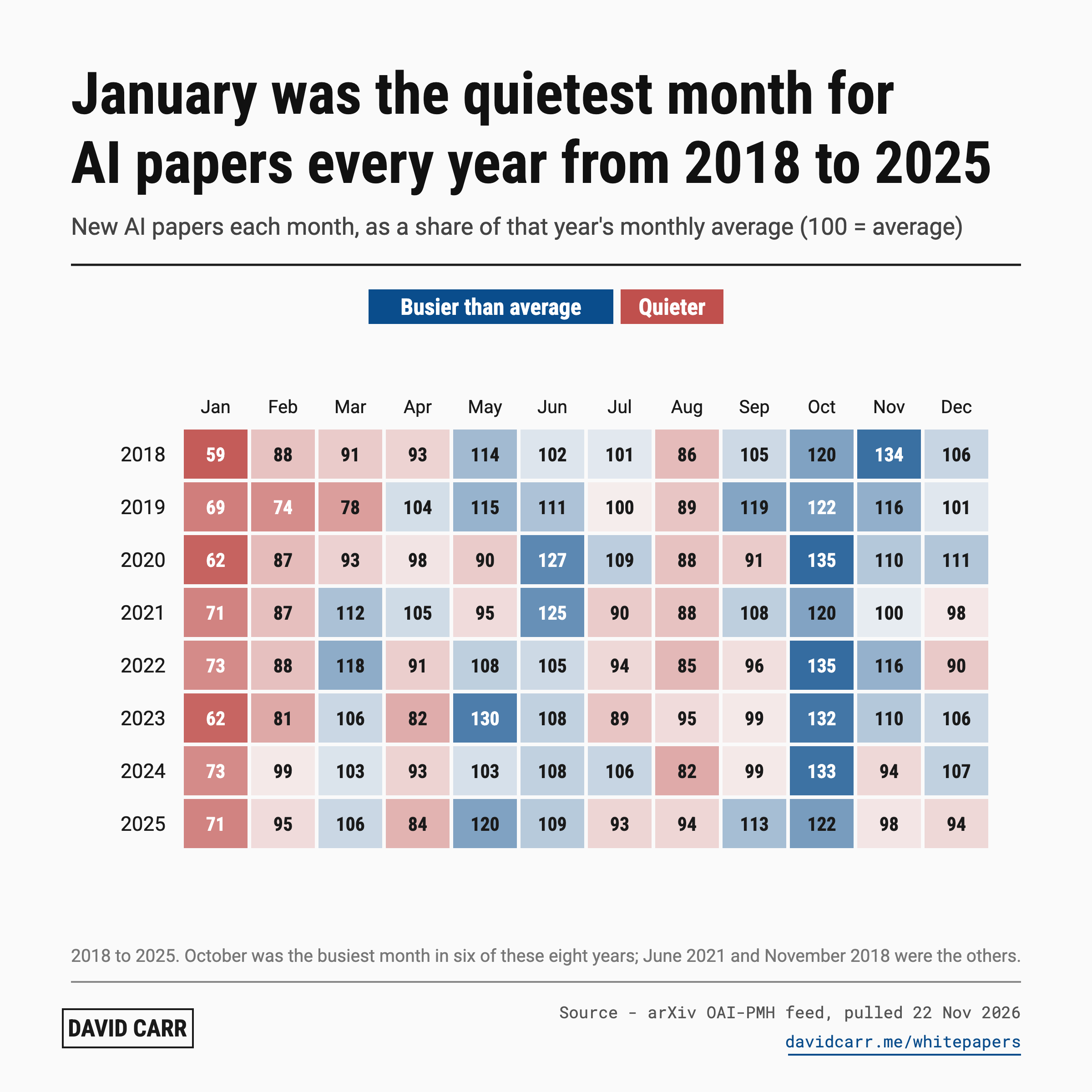
January was the quietest month for AI papers every year from 2018 to 2025
- January: 59 to 73% of the year's monthly average
- October: 120 to 135%, the busiest month in six of the eight years
- The exceptions: November 2018 and June 2021
AI papers come in waves through the year. The rest of arXiv also dips in January, but less: maths runs much closer to flat.
Each cell is that month's AI papers against the average month of the same year, so growth within the year is not removed.
Method, caveats and sources
The short answer. 17,061 new AI papers went up on arXiv in October 2026, against 86 in January 2010. AI was 1.9% of new arXiv papers in 2010 and 40% in 2025. Growth slowed to about 10% a year in 2021 and 2022, then picked up after ChatGPT launched. In October 2026, 24% of new AI papers mentioned large language models and 20% mentioned agents.
Data. arXiv is a free site where researchers post papers, often before journals publish them. Paper counts come from its public arXiv OAI-PMH feed: a list of every paper and the categories it is filed under, pulled on 22 November 2026 (about 3.3 million records, of which 2,655,623 are from January 2010 to October 2026). The monthly totals match arXiv's own monthly submission statistics to within 0.2% in every month, and exactly in most. The large language model and agent counts come from the arXiv search API, one request per month and term, by the date version 1 was submitted.
What counts as an AI paper. An AI paper is one listed in cs.AI, cs.LG, cs.CL, cs.CV, cs.RO or stat.ML, as its main category or a cross-list, counted once. Papers are counted wherever they are listed, not only under their main category. That is why the six lists add to more than the total. Counting main categories only gives 89,613 AI papers in 2025 instead of 112,759, with the same shape over time (5,215 in 2015, 33,968 in 2020).
Months. A paper counts in the month of its arXiv number (2301.xxxxx is January 2023), which is the month it was first submitted. Later versions do not count again. The data runs to the end of October 2026.
Words in abstracts. The search matches whole words in the title and abstract. "LLM" can occasionally mean something else, and "agent" has an older meaning in reinforcement learning, so the agent line never starts at zero. Treat both as rough measures of what papers talk about.
Cause. The data shows what happened and when, not why. More papers is not the same as better research, and this page says nothing about the quality of any paper. September and October 2026 were unusually busy across all of arXiv, maths included, not only AI.
Left out. Which institutions or countries the papers come from: the feed has author names but not reliable affiliations.
Also: What AI costs now and What happened to Stack Overflow after ChatGPT.