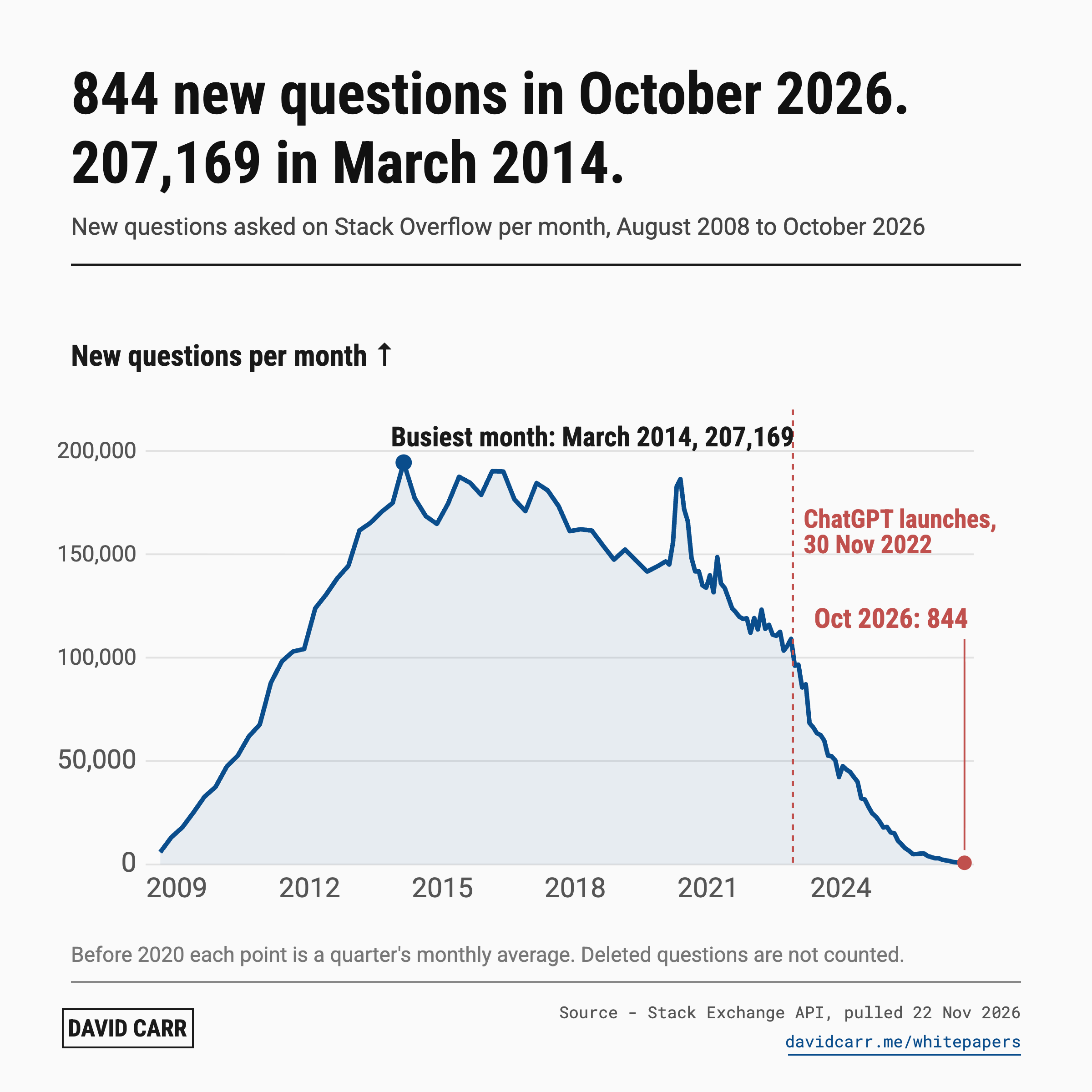
844 new questions in October 2026. 207,169 in March 2014.
- March 2014: 207,169, the busiest month in this data
- May 2020: 186,374
- November 2022, when ChatGPT launched: 109,119
- October 2024: 23,161
- October 2026: 844
October 2026 had about one question for every 245 in March 2014. The line was already sloping down for years before ChatGPT. Then it fell off a cliff.
New questions per month from the Stack Exchange API, pulled 22 November 2026. Before 2020 each point is a quarter's monthly average. Deleted questions are not counted.
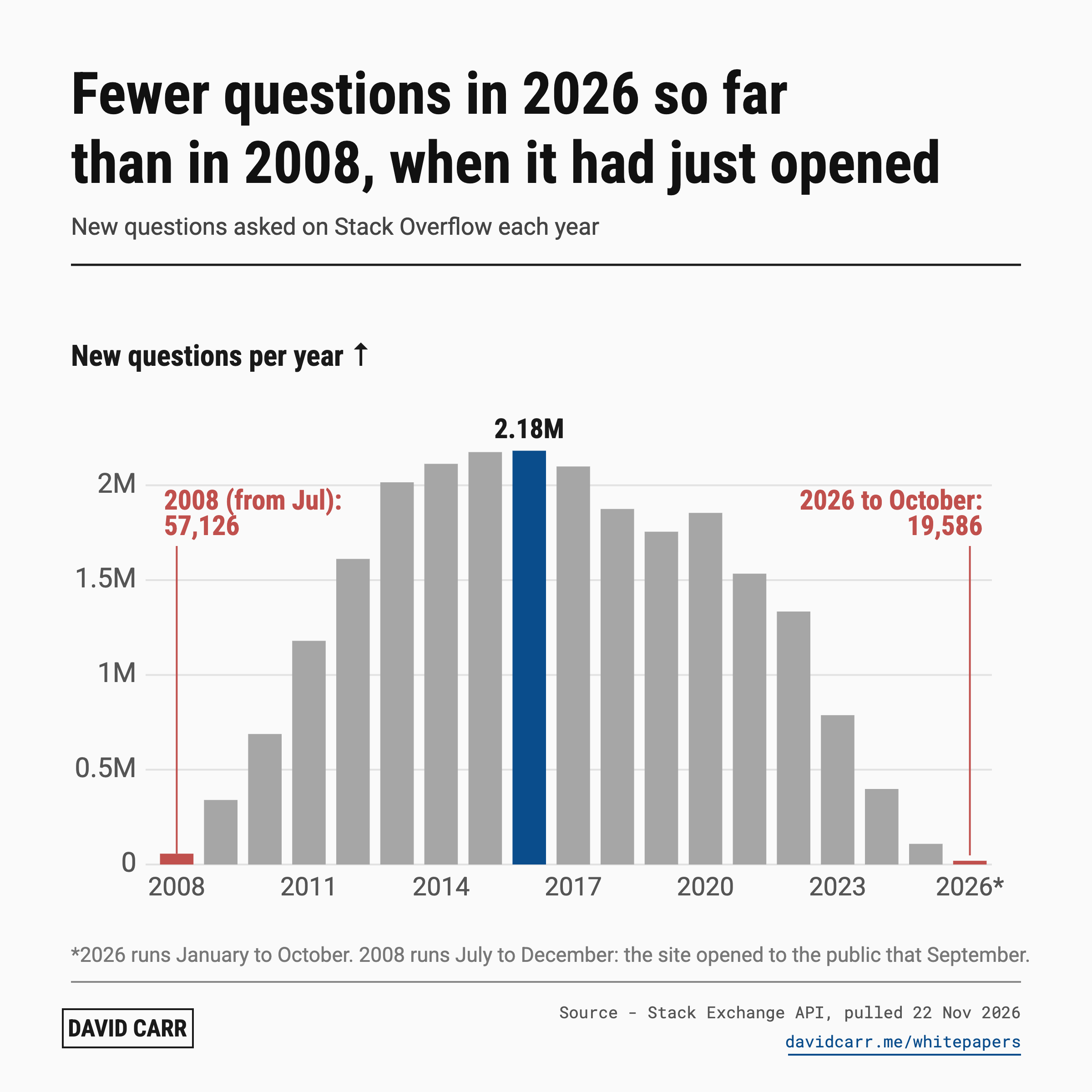
Fewer questions in 2026 so far than in 2008, when it had just opened
- 2008 (July to December): 57,126
- 2016, the busiest year: 2,182,737
- 2022: 1,334,587
- 2024: 398,313
- 2025: 108,919
- 2026 to October: 19,586
2025 had fewer questions than 2009, the site's first full year. 2026 is on course to finish below 2008's half year.
Stack Overflow opened to the public in September 2008; the API has questions from July, when it was in testing.
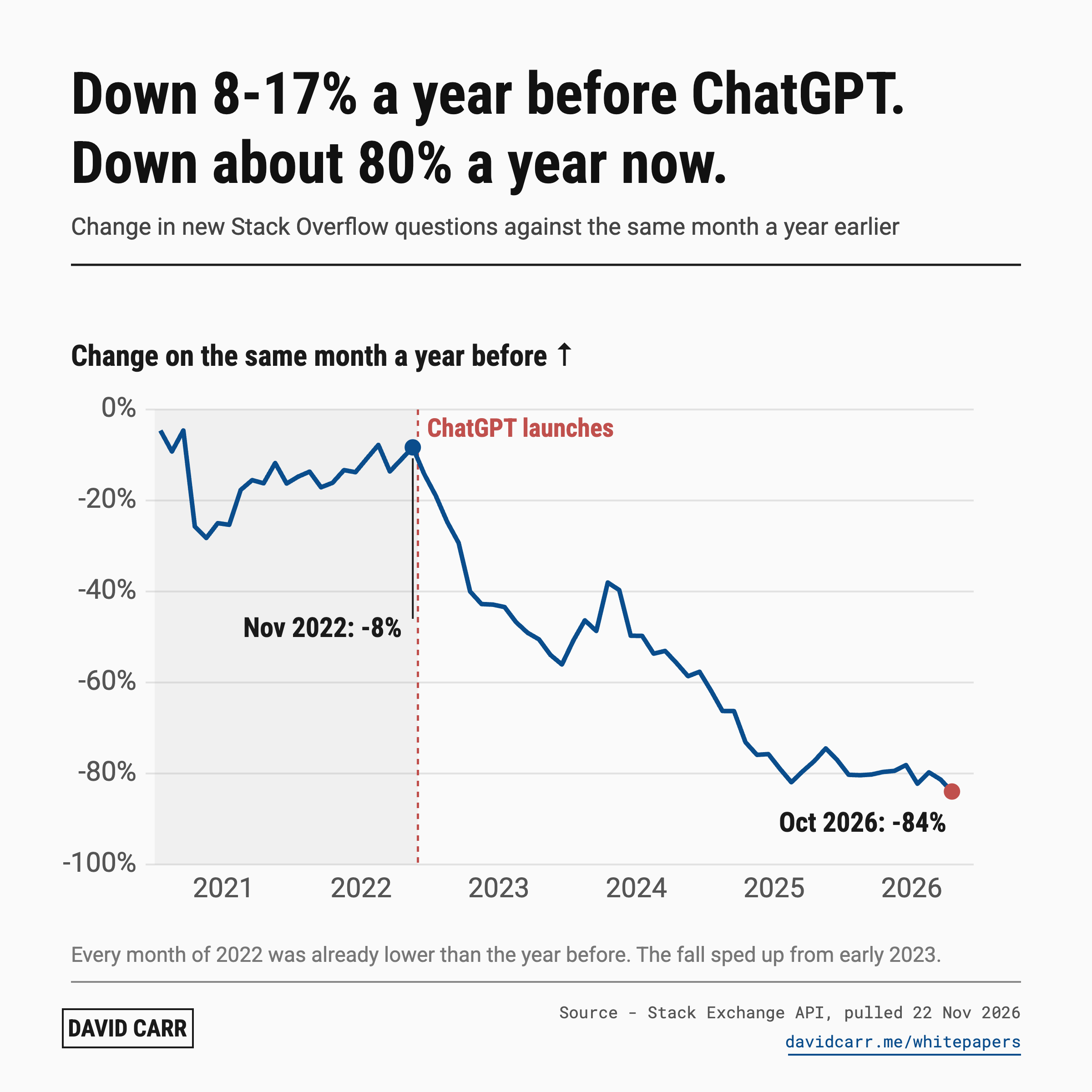
Down 8-17% a year before ChatGPT. Down about 80% a year now.
- Every month of 2022: down 8% to 17% on a year before
- Mid-2023: down 40% to 50%
- Late 2024: down 55% to 59%
- Every month of 2026: down 78% to 84%
The slide had started before ChatGPT. What changed after it launched was the speed.
Each month against the same month a year earlier, so seasons cancel out. The spring 2021 dip is against the busy lockdown months of 2020.
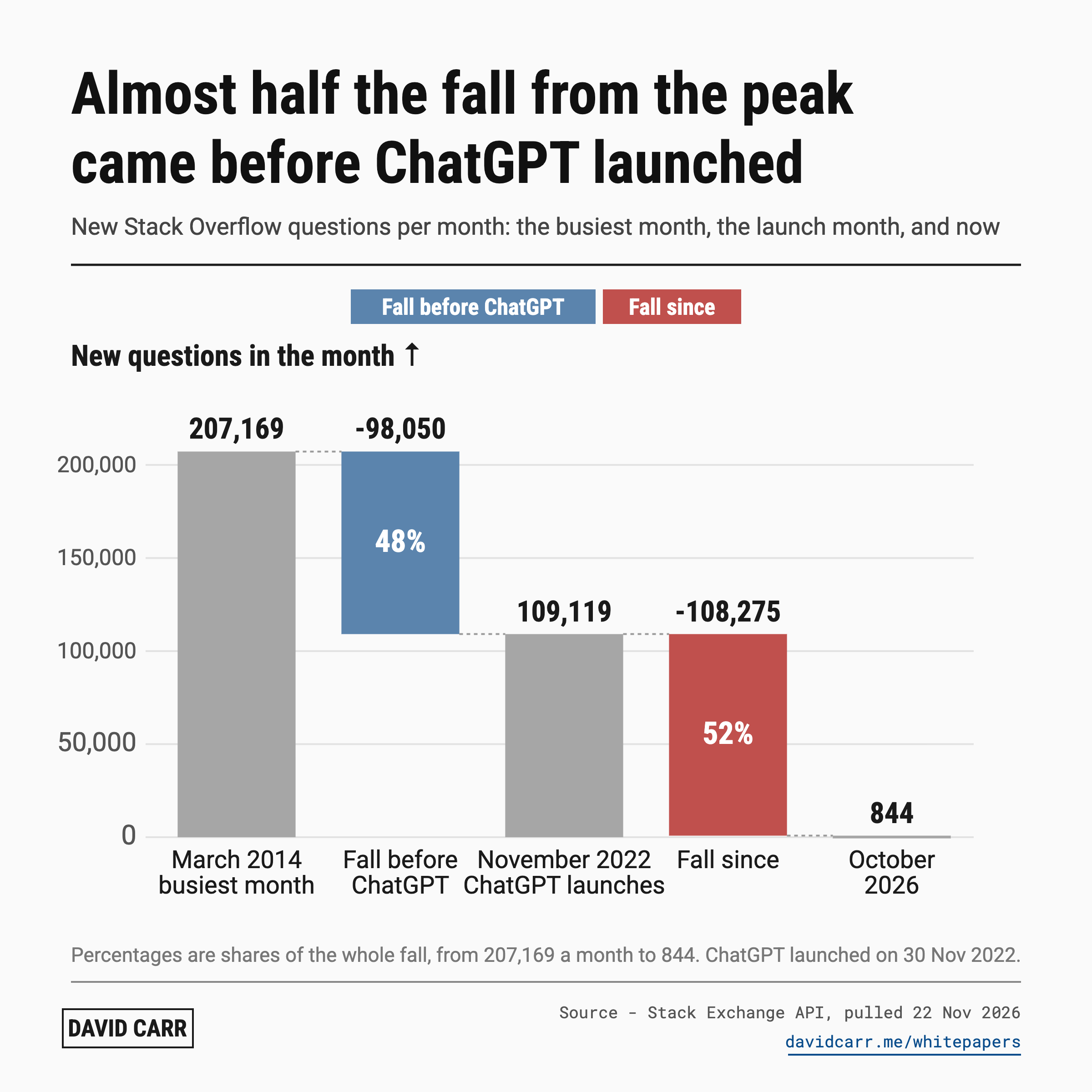
Almost half the fall from the peak came before ChatGPT launched
- March 2014: 207,169 questions
- November 2022: 109,119, down 98,050 (48% of the whole fall)
- October 2026: 844, down a further 108,275 (52%)
Stack Overflow had lost about half its monthly questions over eight years before ChatGPT. It lost the other half in under four.
ChatGPT launched on 30 November 2022, so November 2022 is almost all before it.
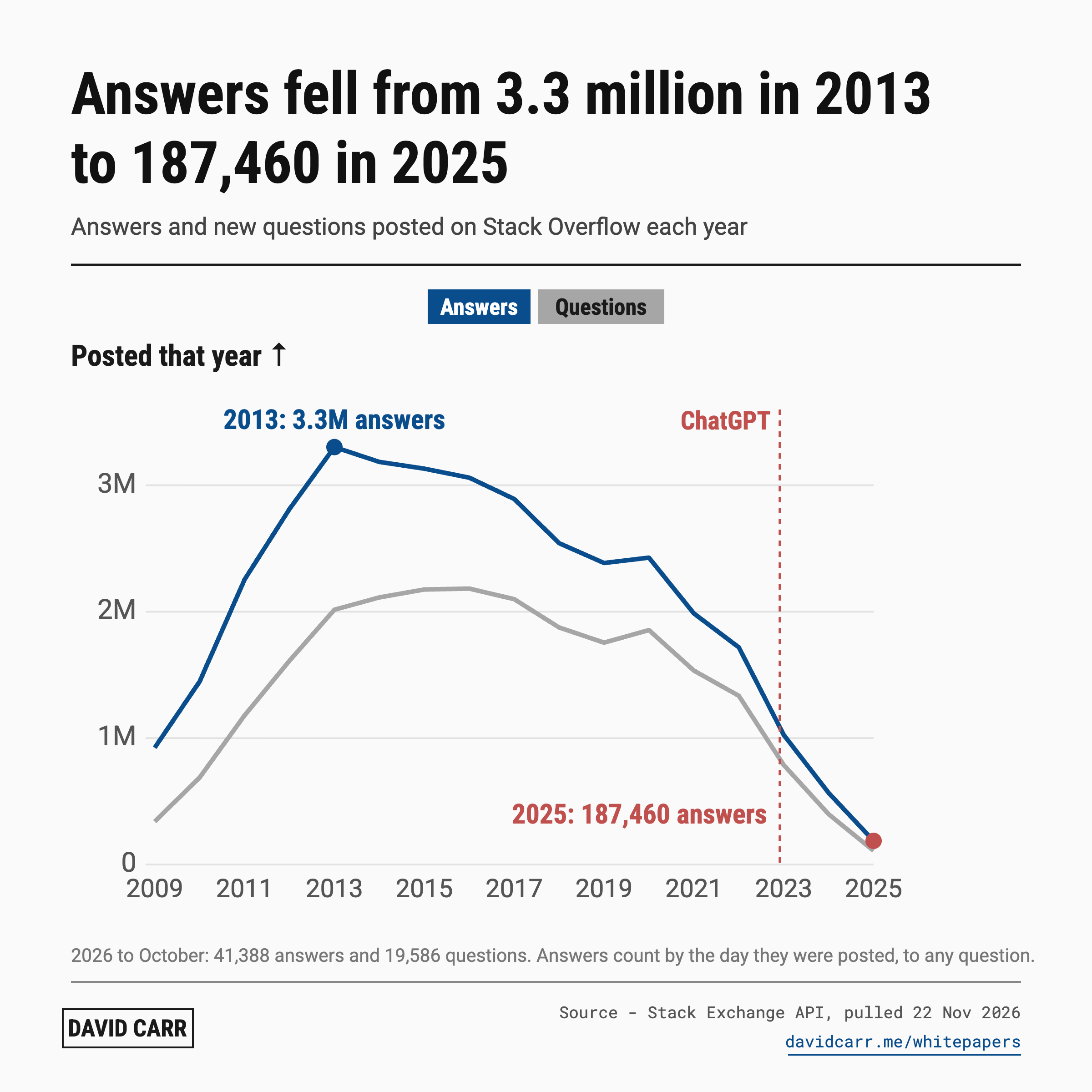
Answers fell from 3.3 million in 2013 to 187,460 in 2025
- 2013: 3,302,568 answers
- 2022: 1,717,917
- 2024: 566,845
- 2025: 187,460
- 2026 to October: 41,388
Answers fell with questions. In 2026 so far there have been about two answers posted for every new question, up from 1.3 in 2022, because some answers still go to older questions.
Answers are counted by the date they were posted, whatever the question's date. Deleted answers are not counted.
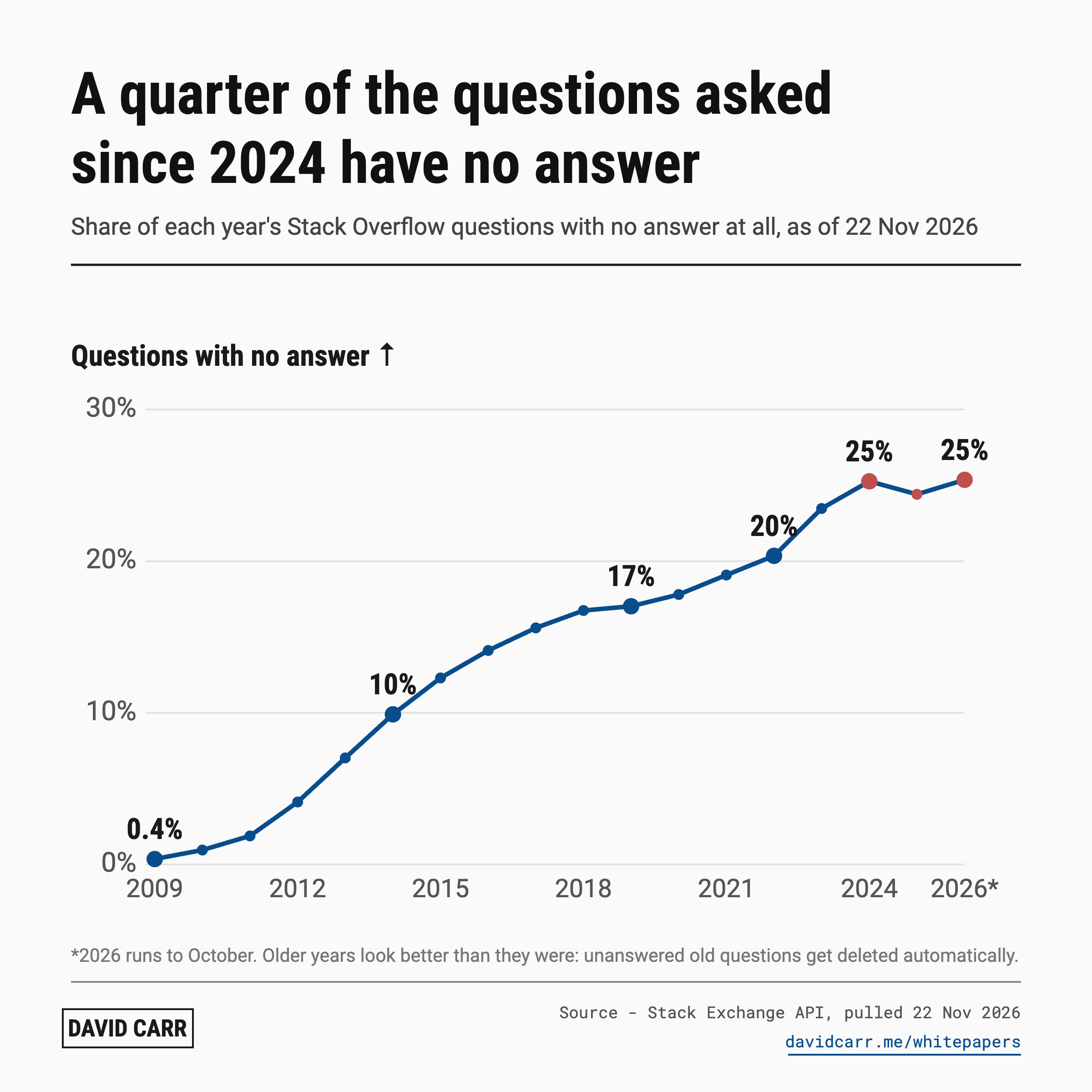
A quarter of the questions asked since 2024 have no answer
- 2009: 0.4%
- 2014: 10%
- 2019: 17%
- 2022: 20%
- 2024: 25%
- 2025: 24%
- 2026 to October: 25%
The share with no answer has crept up for years. It has held around a quarter since 2024, even as the number of questions collapsed.
Older years look better than they were. Stack Overflow automatically deletes many unanswered questions once they are a year old, so they are no longer in the count. Recent questions have also had less time to get an answer.
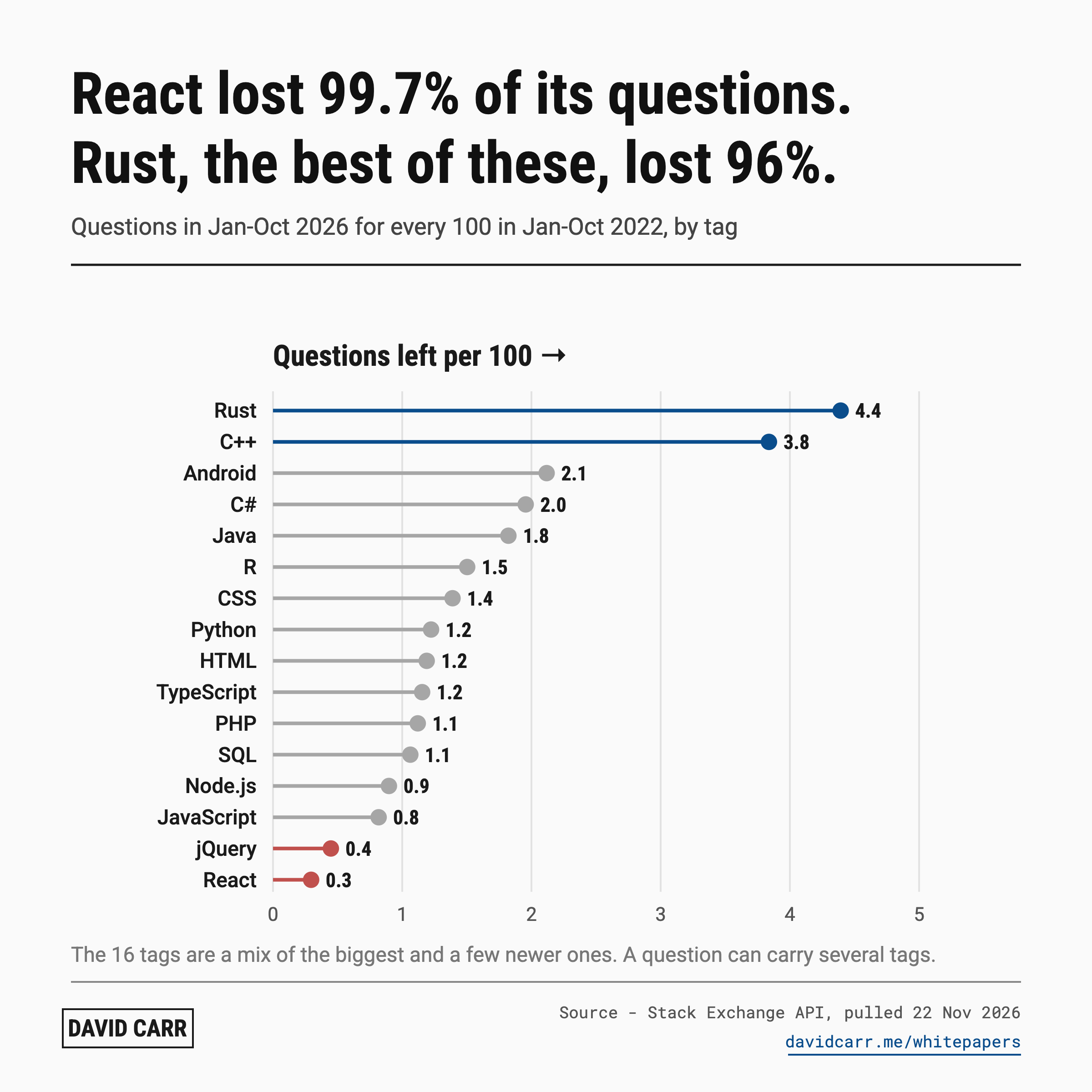
React lost 99.7% of its questions. Rust, the best of these, lost 96%.
- React: 67,175 to 198
- JavaScript: 127,495 to 1,042
- Python: 188,896 to 2,310
- C++: 31,451 to 1,207
- Rust: 6,169 to 271
No tag held up. Of the 16 checked, the web tags (React, jQuery, JavaScript, Node.js) fell furthest. C++ and Rust fell least.
January to October 2022 against January to October 2026, so both are before and after ChatGPT with the same months.
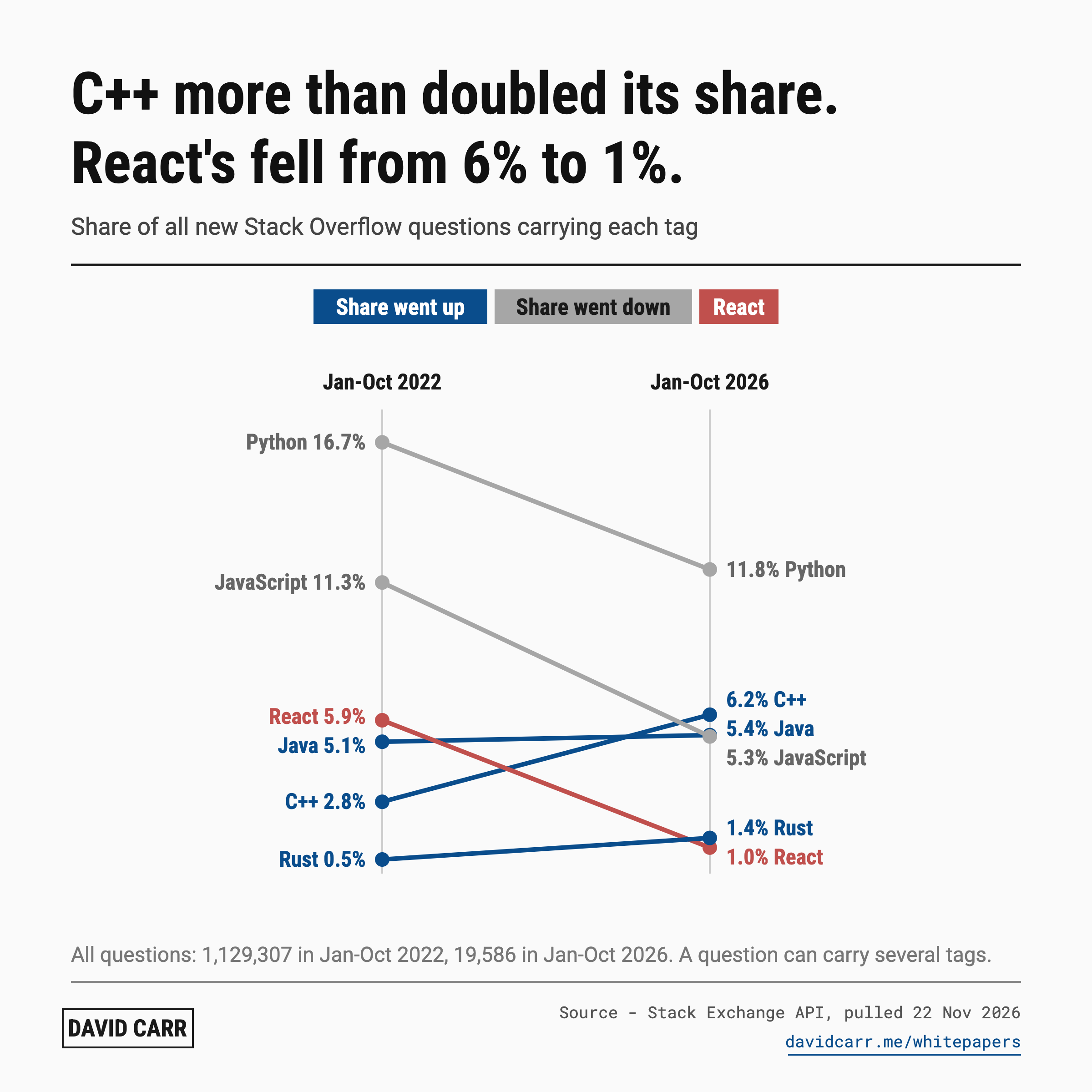
C++ more than doubled its share. React's fell from 6% to 1%.
- Python: 16.7% to 11.8%
- JavaScript: 11.3% to 5.3%
- React: 5.9% to 1.0%
- Java: 5.1% to 5.4%
- C++: 2.8% to 6.2%
- Rust: 0.5% to 1.4%
Python is still the biggest tag. What's left on Stack Overflow leans more towards C++, Java, C# and Rust than it did.
Share of all new questions in each window. C# went from 4.6% to 5.2% and Android from 3.2% to 3.9%. A question can carry several tags, so shares add to more than 100%.
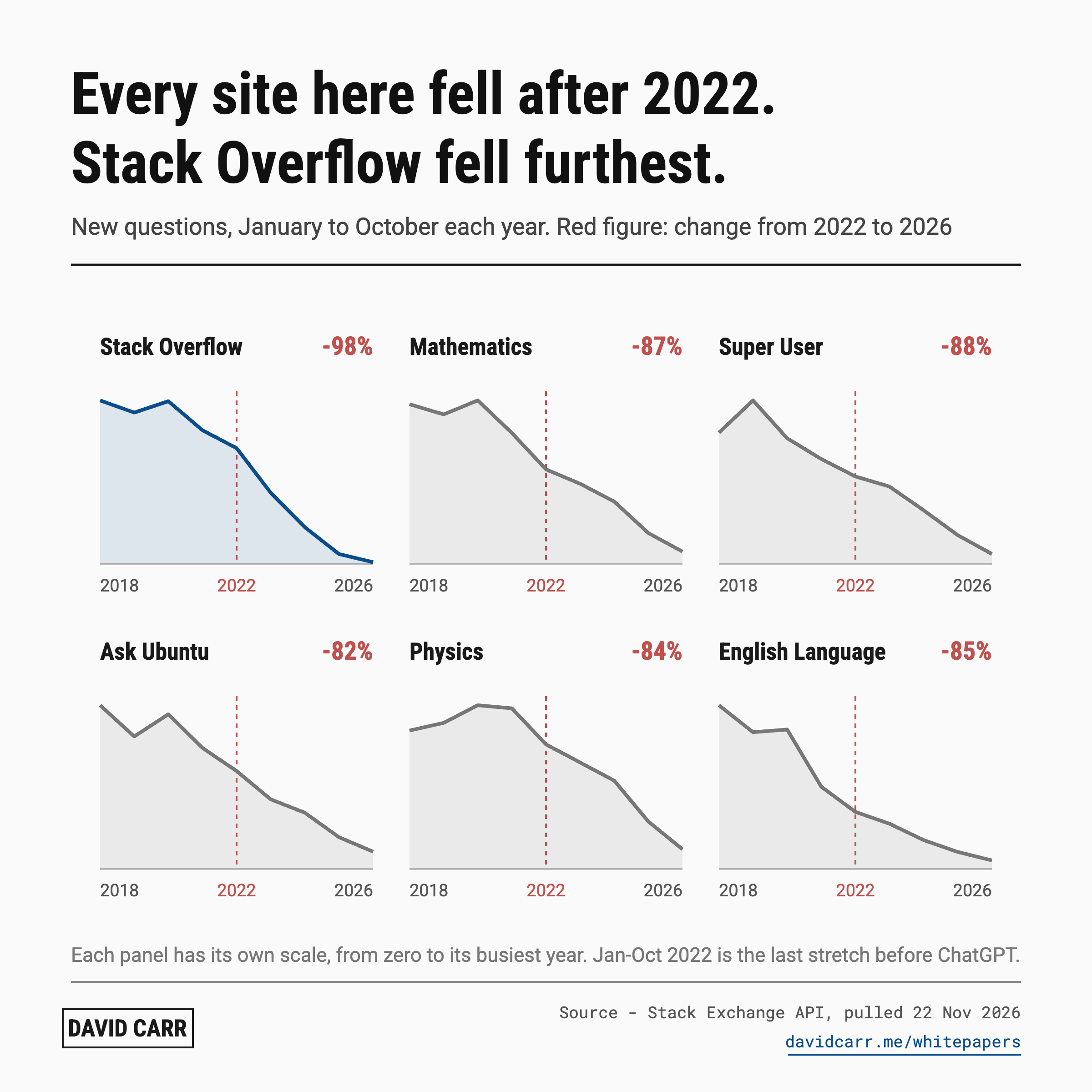
Every site here fell after 2022. Stack Overflow fell furthest.
- Stack Overflow: down 98%
- Super User: down 88%
- Mathematics: down 87%
- English Language: down 85%
- Physics: down 84%
- Ask Ubuntu: down 82%
Sites about maths, physics and English fell almost as hard as the programming ones. So the fall is not only about code.
Five other Stack Exchange sites, January to October each year, 2022 against 2026.
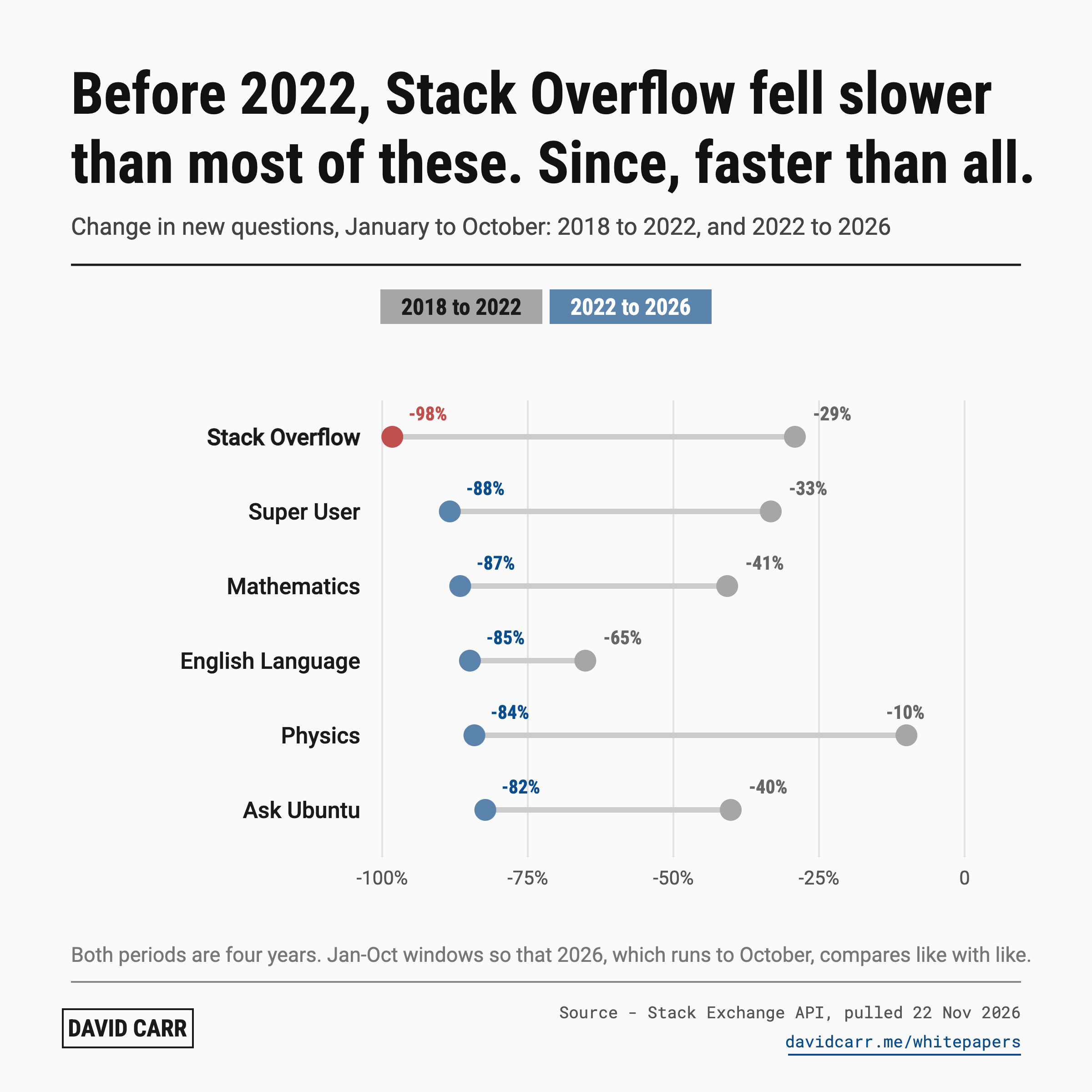
Before 2022, Stack Overflow fell slower than most of these. Since, faster than all.
- Stack Overflow: -29% (2018-22), then -98% (2022-26)
- Mathematics: -41%, then -87%
- English Language: -65%, then -85%
- Physics: -10%, then -84%
Every site was shrinking before ChatGPT launched. Stack Overflow was not the worst case then. It is now.
Both periods are four years, January to October.
Method, caveats and sources
The short answer. Stack Overflow had 844 new questions in October 2026, against 207,169 in March 2014. It was already shrinking, by 8% to 17% a year, before ChatGPT launched on 30 November 2022. Since then the fall has sped up to about 80% a year. Every tag checked lost at least 95% of its questions, and five other Stack Exchange sites fell by 82% to 88%.
Data. Counts from the public Stack Exchange API (version 2.3, no key), pulled on 22 November 2026. Each number is one request for the total number of questions, answers or unanswered questions created between two dates, in UTC. The data runs to the end of October 2026. Every response is saved with the scripts, so each number can be checked.
Deleted posts are not counted. The API only sees questions and answers that still exist. Stack Overflow deletes many old questions, especially unanswered ones, so older months had more questions than shown here. Recent months have had less time to lose any. If anything, that makes the fall look smaller than it was.
Months and quarters. The API allows about 300 requests a day without a key. So the line before 2020 uses quarters, shown as a monthly average, and every month from 2020. To find the busiest month, single months were pulled for the seven busiest quarters: March 2014 was the highest. A month in another quarter could only beat it if the other two months in that quarter were unusually quiet.
Cause. The data shows what happened after ChatGPT launched, not why. ChatGPT is the obvious suspect for the speed-up, but other AI coding tools arrived in the same years, and the numbers were falling before any of them. Other Stack Exchange sites, on subjects far from code, fell too.
Tags and sites. 16 tags and five other sites, chosen by me, compared over January to October of each year so that 2026 compares like with like. A question can carry several tags.
Left out. New accounts. The API counts them, but they behave oddly: 5.8 million in 2024, more than in any year before, while questions fell by half. The data doesn't say why, so they are not charted.
Also: How much of Y Combinator is AI, OpenAI and Installed vs used.