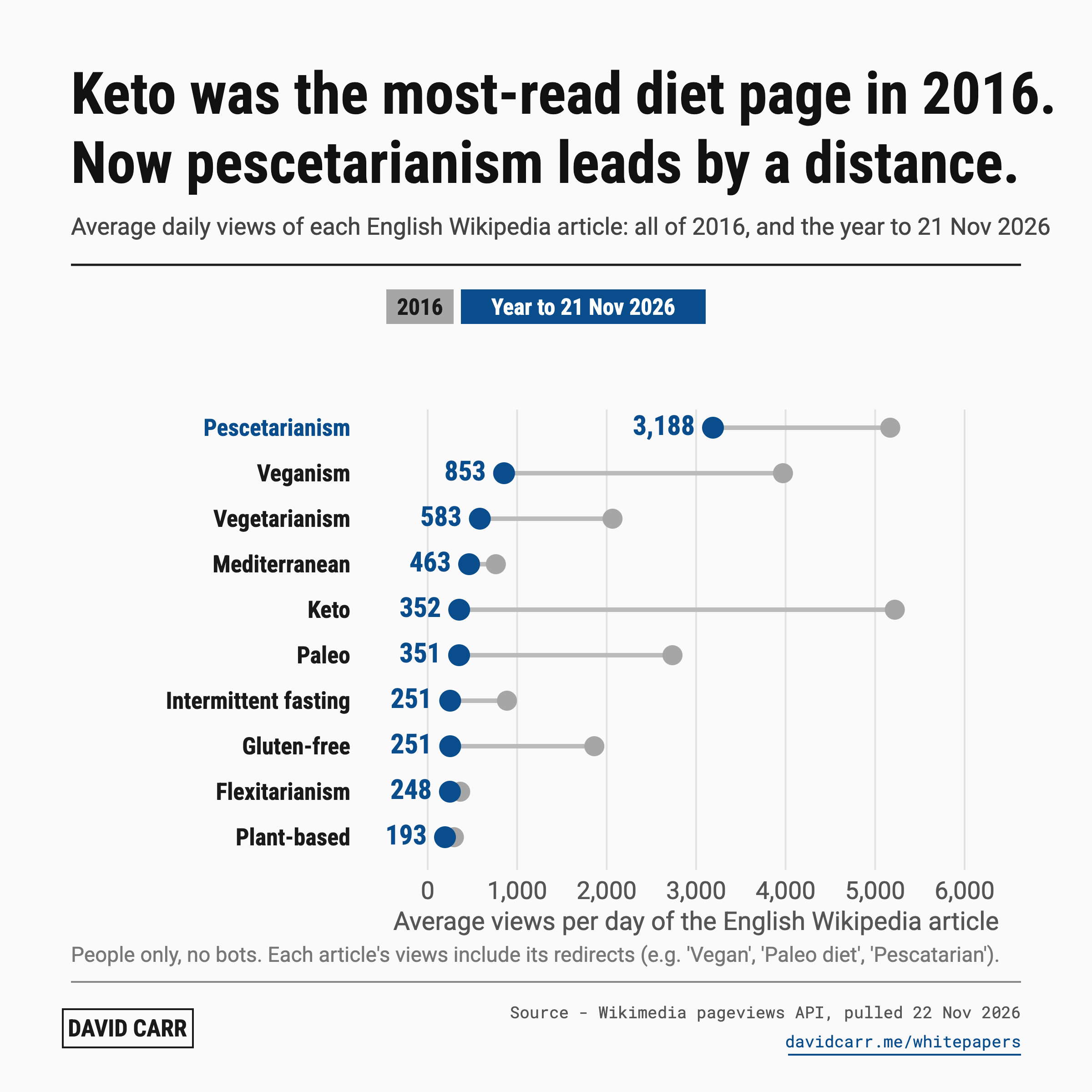
Keto was the most-read diet page in 2016. Now pescetarianism leads by a distance.
- 2016: keto 5,220 views a day, pescetarianism 5,170, veganism 3,971
- Year to 21 Nov 2026: pescetarianism 3,188, veganism 853, vegetarianism 583
- Keto now: 352 a day
Pescetarianism now draws 3.7 times the views of the next diet page. It fell too, just far less than the rest.
Average daily views of each English Wikipedia article, people only, from the Wikimedia pageviews API. Each article includes its redirects, such as "Vegan" and "Pescatarian".
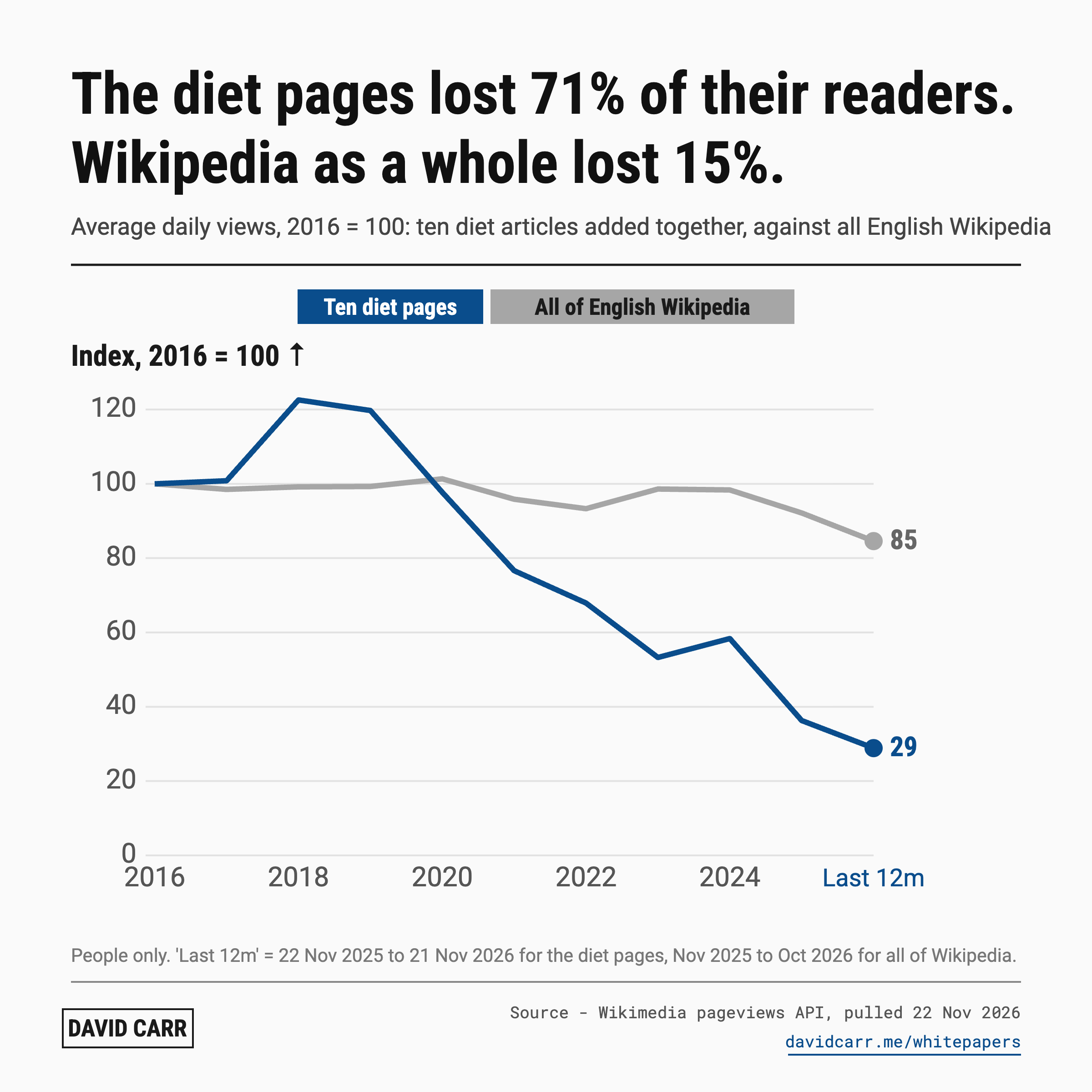
The diet pages lost 71% of their readers. Wikipedia as a whole lost 15%.
- Ten diet pages together: highest in 2018, 23% above 2016
- Year to 21 Nov 2026: 29% of their 2016 level
- All of English Wikipedia: 85% of its 2016 level
Wikipedia has fewer readers than it had, but these pages lost far more than the site did. Fewer people are reading about diets on Wikipedia.
That says nothing on its own about how many people follow any diet. People may now find the same answers in search results, apps or chatbots.
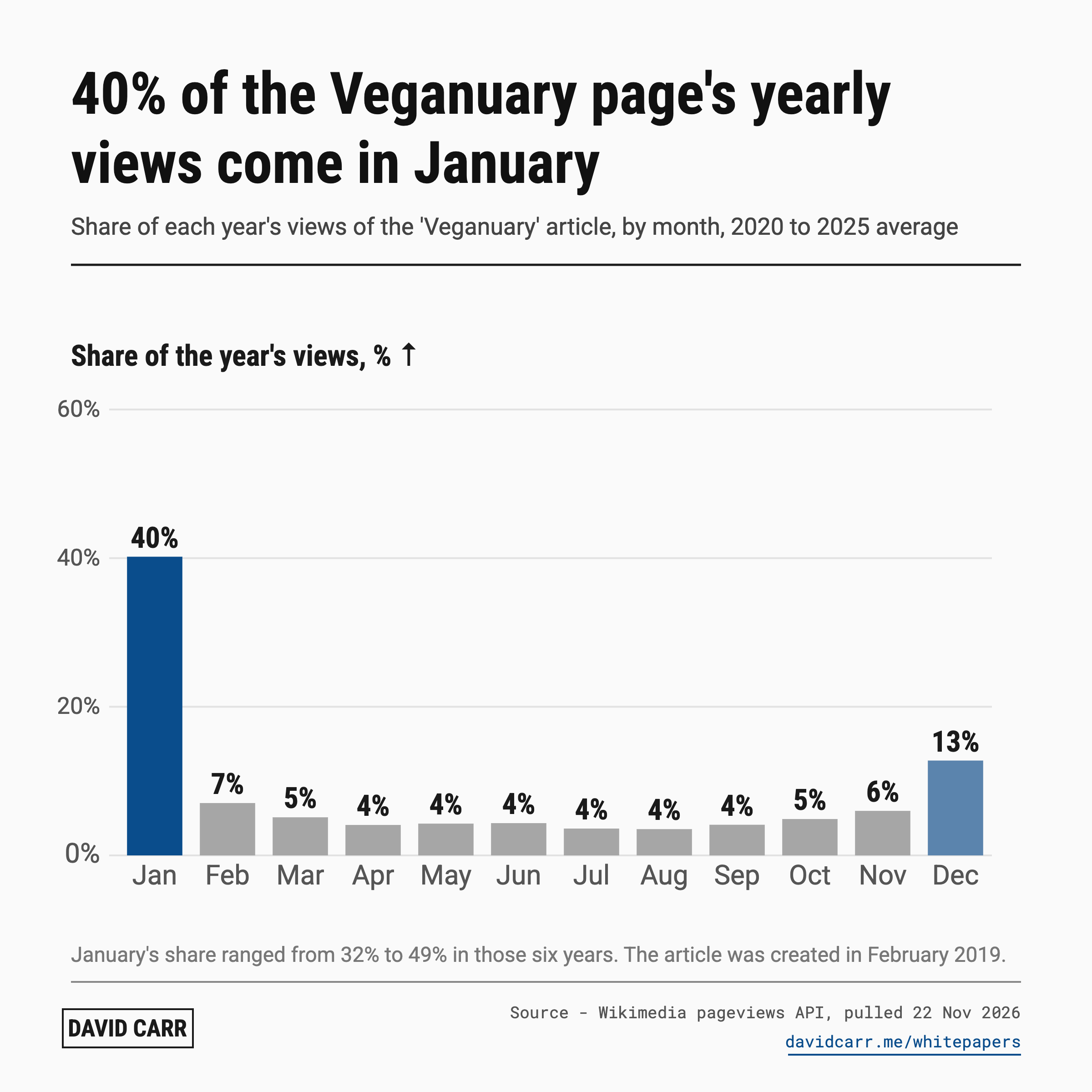
40% of the Veganuary page's yearly views come in January
- January: 40% on average, 2020 to 2025
- Between 32% and 49% in any one year
- December: 13%, the run-up
The rest of the year is quiet: 7% or less a month.
Monthly views of the Veganuary article. It was created in February 2019, so 2019 is left out.
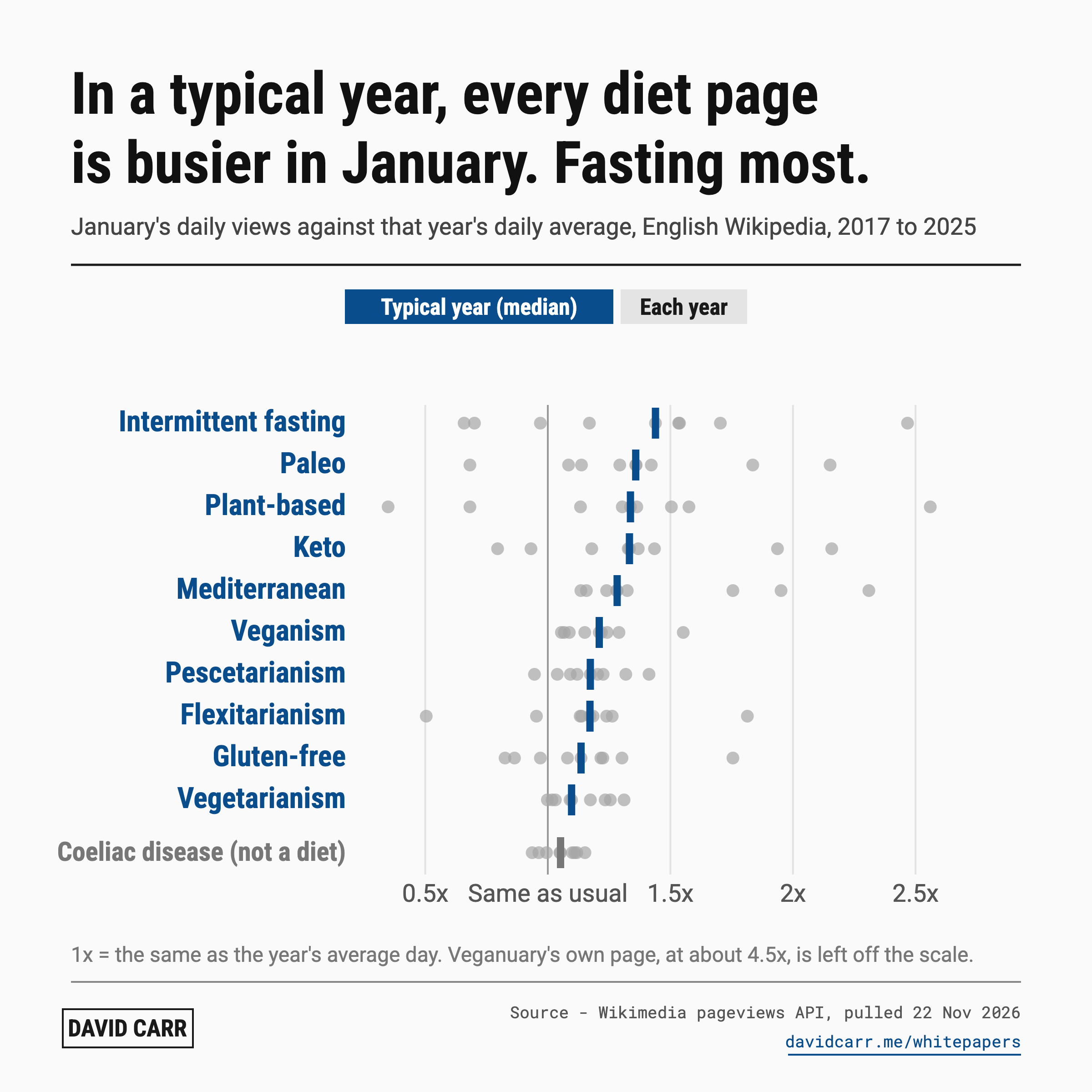
In a typical year, every diet page is busier in January. Fasting most.
- Intermittent fasting: 44% above its yearly average day
- Paleo: 36%, plant-based: 34%, keto: 33%
- Veganism: 21%, vegetarianism: 10%
- Coeliac disease, for comparison: 5%
The New Year bump is real for every one of the ten diets, though not in every year. The Veganuary page itself runs at about 4.5 times its average in January.
January's views per day against that year's views per day, 2017 to 2025. The bar is the median year; the dots are each year.
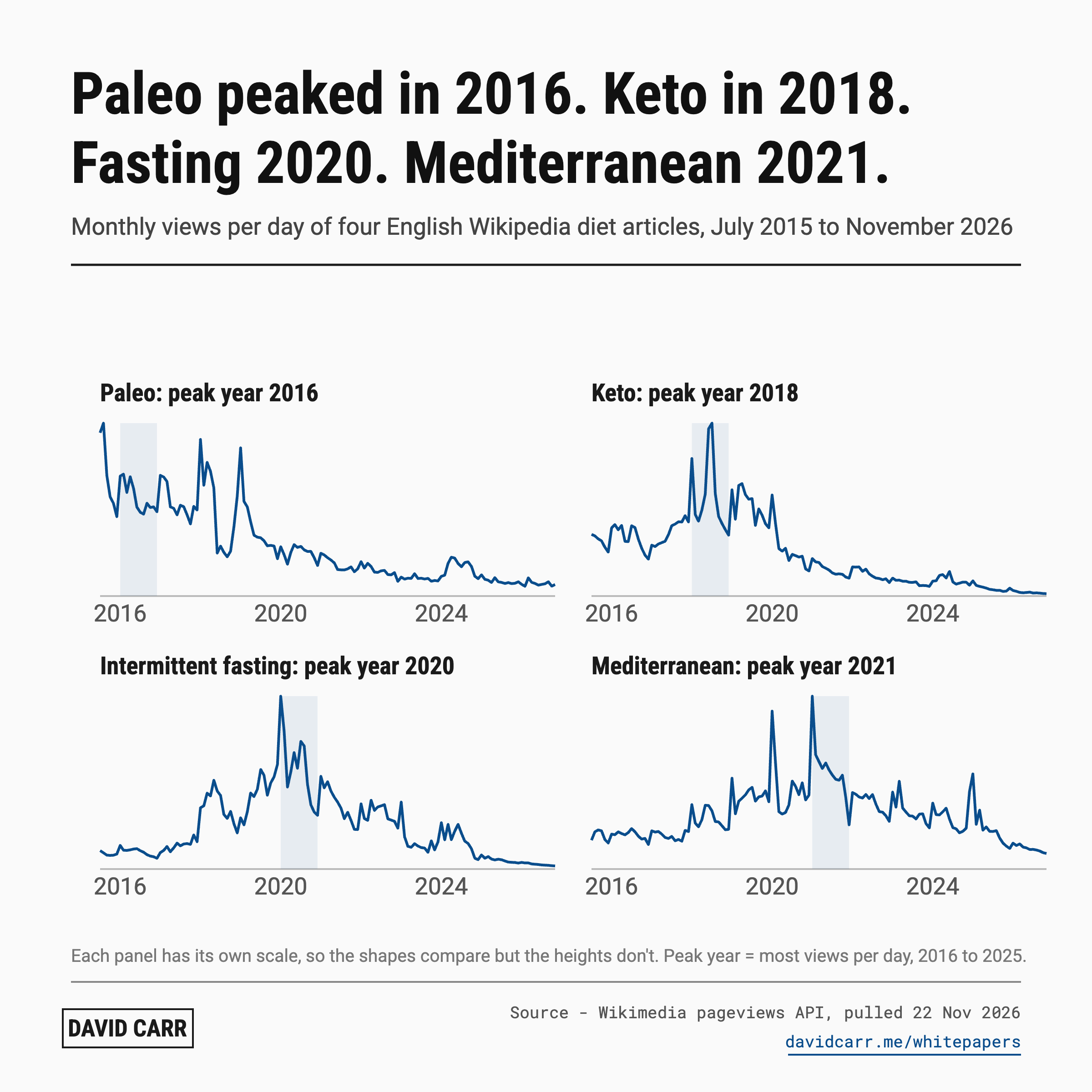
Paleo peaked in 2016. Keto in 2018. Fasting 2020. Mediterranean 2021.
- Paleo: busiest year 2016
- Keto: 2018
- Intermittent fasting: 2020
- Mediterranean: 2021
Each had its moment, one after another, and each page is now well below its peak.
Busiest year = most views per day, 2016 to 2025. Paleo's data starts in July 2015 and it was already high then.
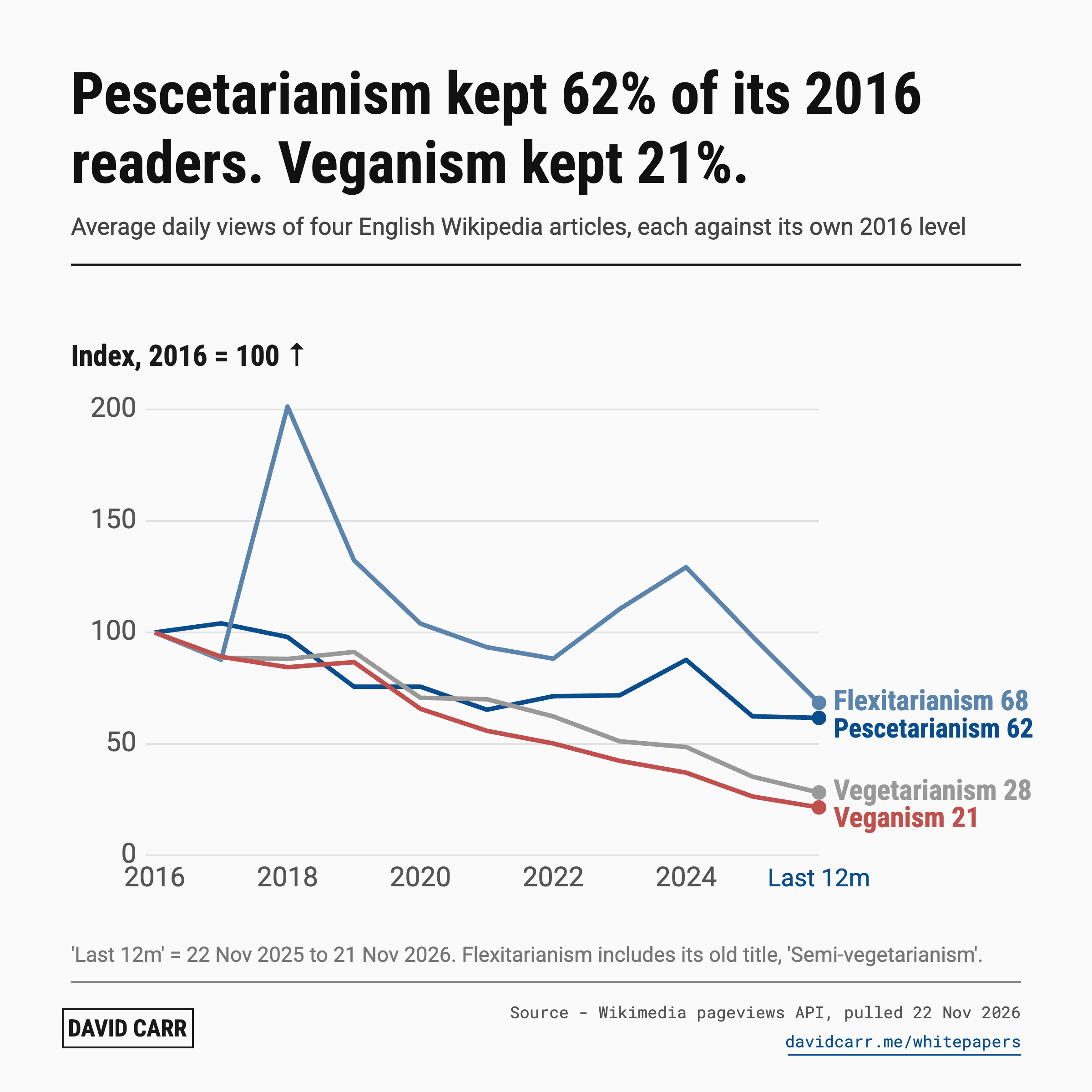
Pescetarianism kept 62% of its 2016 readers. Veganism kept 21%.
- Flexitarianism: 68%
- Pescetarianism: 62%
- Vegetarianism: 28%
- Veganism: 21%
Veganism's busiest year on this page was 2016. The pages for in-between diets held their readers best.
Year to 21 Nov 2026 against 2016, views per day. Flexitarianism includes its old title, Semi-vegetarianism.
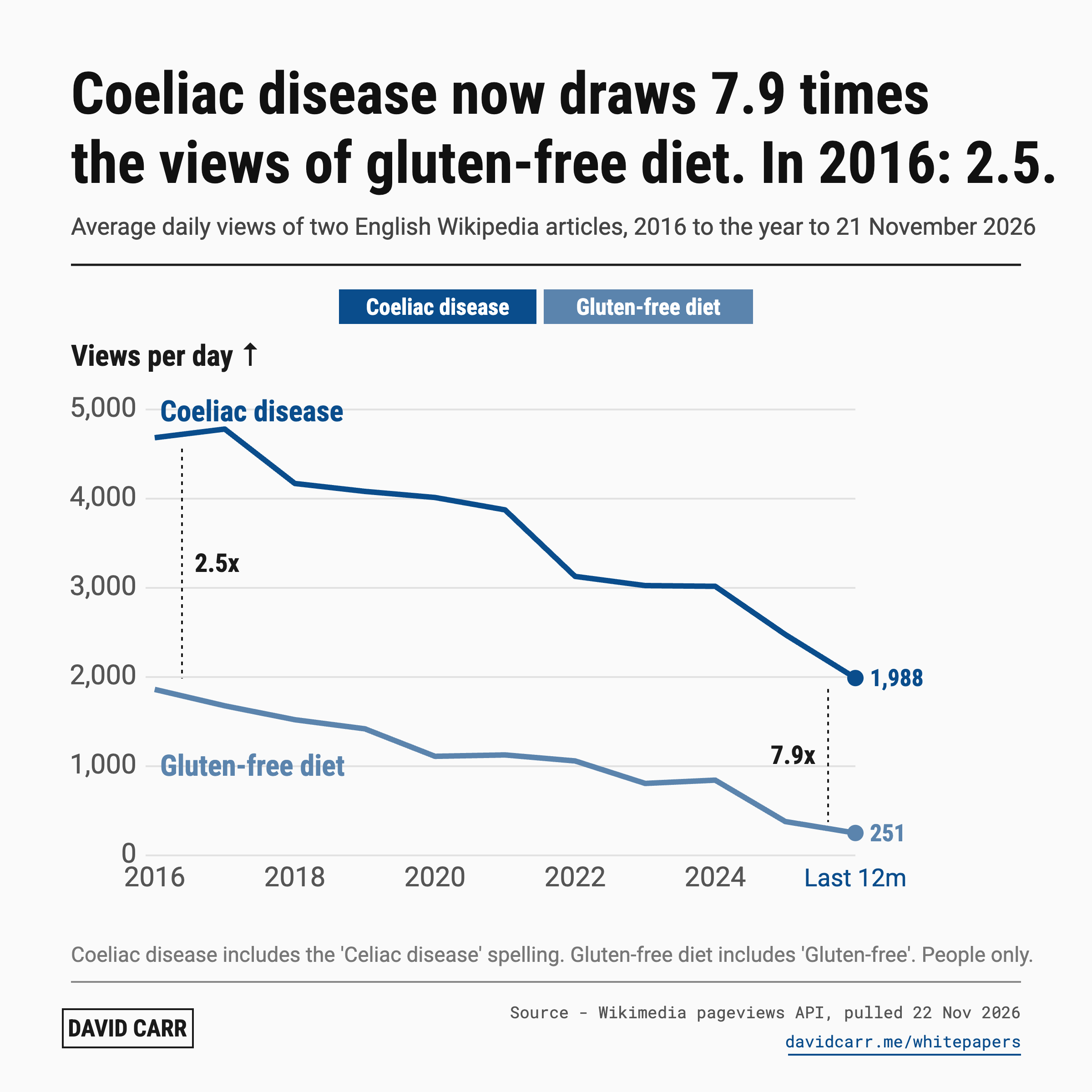
Coeliac disease now draws 7.9 times the views of gluten-free diet. In 2016: 2.5.
- Coeliac disease: 4,684 a day in 2016, 1,988 now
- Gluten-free diet: 1,862 a day in 2016, 251 now
Both fell. The page about the diet fell much faster than the page about the condition.
Both spellings counted: "Coeliac disease" and "Celiac disease". Gluten-free diet includes "Gluten-free".
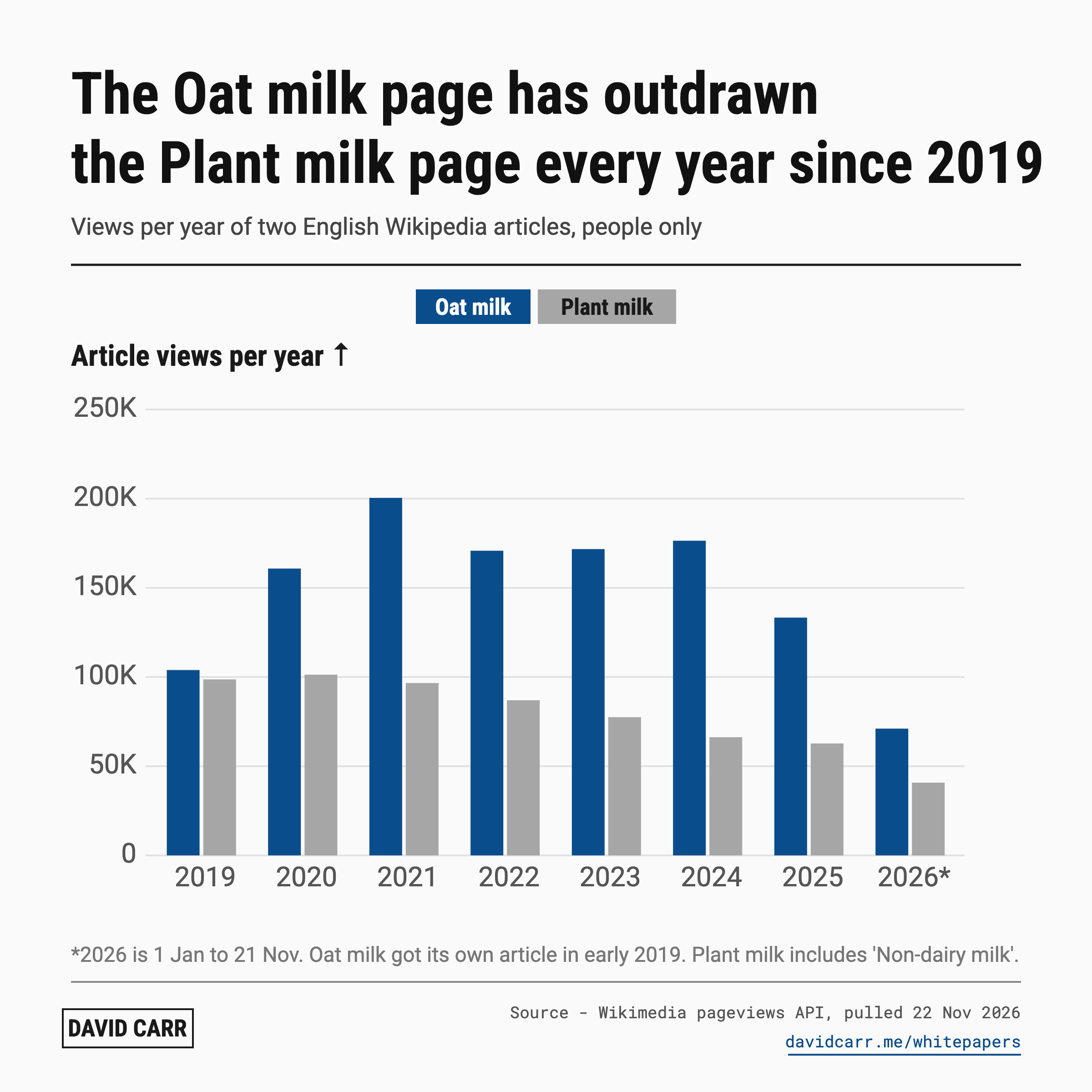
The Oat milk page has outdrawn the Plant milk page every year since 2019
- 2019: 103,911 views against 98,682
- 2026 to 21 Nov: 71,086 against 40,837
One kind of plant milk gets more readers than the page about all of them.
Oat milk got its own article in early 2019. Plant milk includes "Non-dairy milk".
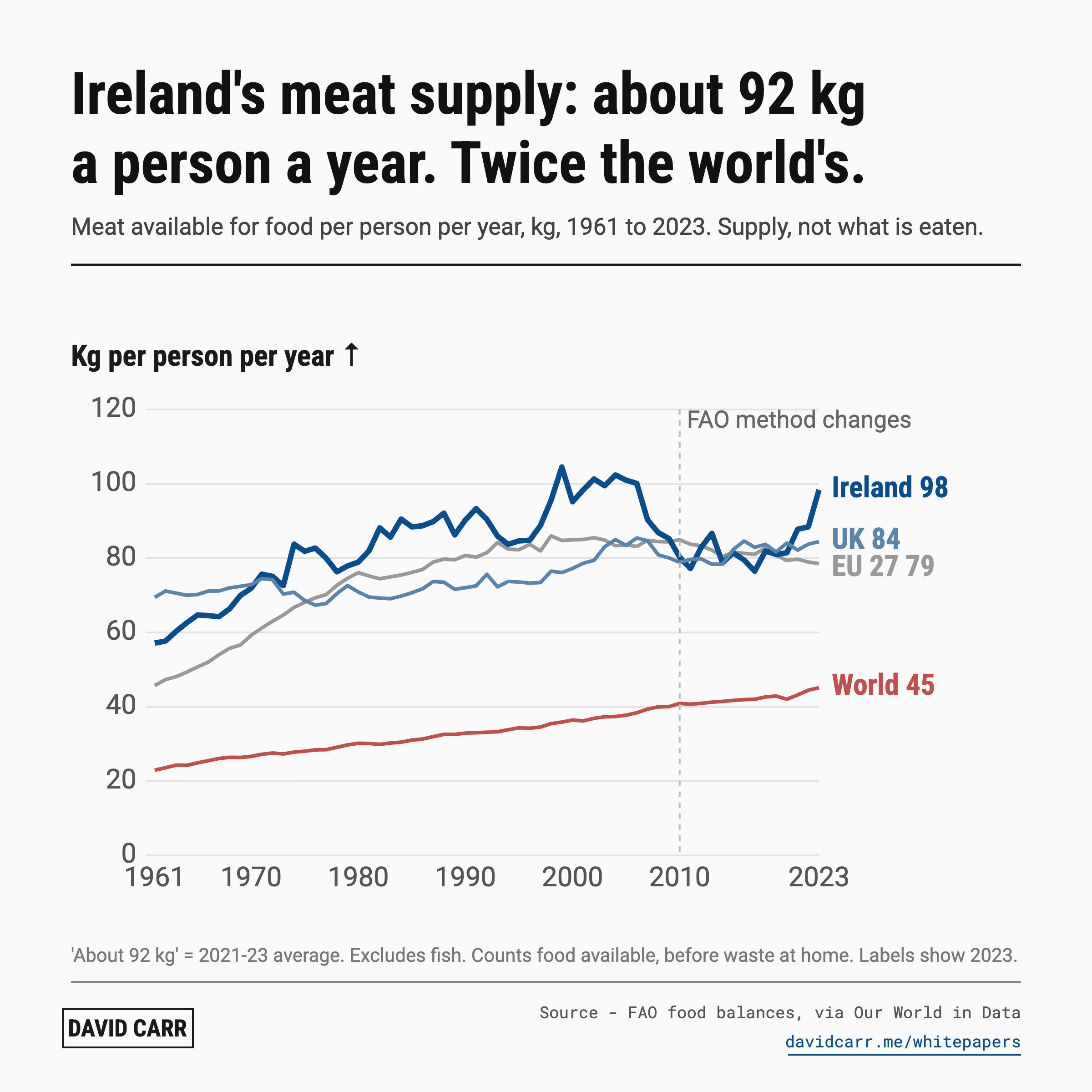
Ireland's meat supply: about 92 kg a person a year. Twice the world's.
- Ireland, 2021-23 average: 92 kg
- UK: 83 kg
- EU 27: 79 kg
- World: 44 kg
- Ireland, 1961-63: 58 kg
Ireland has been well above the world average since the data begins in 1961. Its own figure rose to a high of 105 kg in 1999.
FAO food balances via Our World in Data. This is meat available for food, before waste at home, not a measure of what people eat. Fish is not included. Ireland's yearly figure moves around a lot, so the headline uses a three-year average.
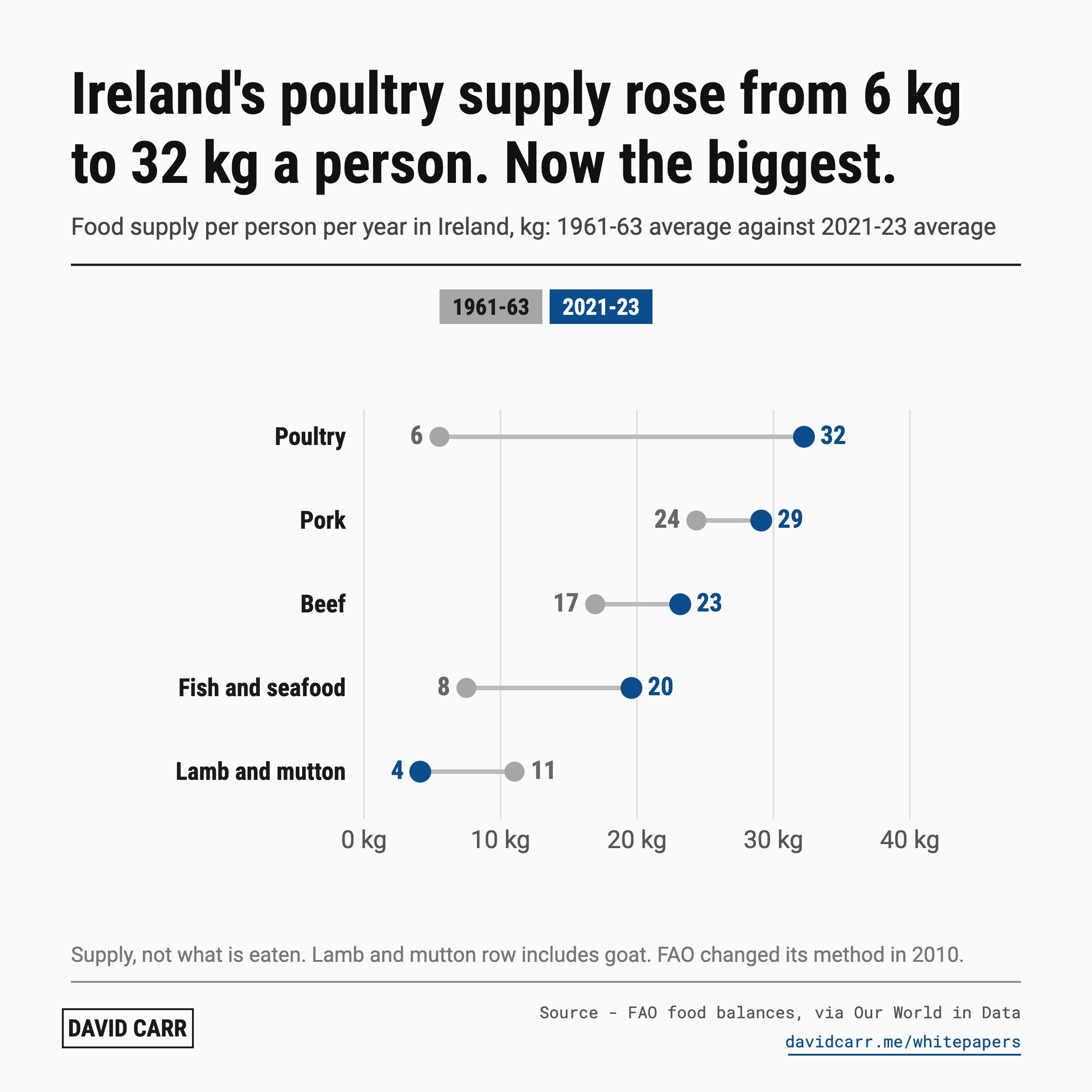
Ireland's poultry supply rose from 6 kg to 32 kg a person. Now the biggest.
- Poultry: 6 kg to 32 kg
- Pork: 24 kg to 29 kg
- Beef: 17 kg to 23 kg
- Fish and seafood: 8 kg to 20 kg
- Lamb and mutton: 11 kg to 4 kg
In the early 1960s poultry was the smallest of the four meats. Now it is the largest.
Three-year averages, 1961-63 and 2021-23, from FAO food balances via Our World in Data. Supply, not what is eaten.
Method, caveats and sources
The short answer. Pescetarianism is now the most-read diet page on English Wikipedia, well ahead of veganism; in 2016 keto just led it. Every diet page is busier in January, and Veganuary's page gets 40% of its year then. Paleo, keto, intermittent fasting and the Mediterranean diet each had a peak year, one after another. Readers of diet pages fell far faster than readers of Wikipedia as a whole. In Ireland, meat supply is about 92 kg a person a year, twice the world average, and poultry has gone from smallest to largest.
What Wikipedia shows, and what it doesn't. Page views show interest: people looking something up. They don't show what anyone buys, cooks or eats, and they say nothing about how many people follow a diet. English Wikipedia is read all over the world, so these are not Irish figures. Someone may look up a diet because they are curious, sceptical, or cooking for a friend.
Wikipedia data. Daily human views (no bots, as Wikimedia classifies them) of English Wikipedia articles from the Wikimedia pageviews API, 1 July 2015 to 21 November 2026, pulled 22 November 2026. Views of a redirect are counted under the redirect, so each topic adds up its article and its main redirects or old titles: for example Veganism + Vegan, Coeliac disease + Celiac disease, Flexitarianism + Semi-vegetarianism. "Now" means the 365 days to 21 November 2026. The all-Wikipedia line uses Wikimedia's monthly total for English Wikipedia, people only.
Meat data. FAO food balance sheets, as published by Our World in Data, 1961 to 2023. It measures food available per person, not what is eaten: it doesn't take off food wasted at home. FAO changed its method in 2010, and Ireland's yearly numbers jump about, so the page uses three-year averages.
Left out. Nothing here is health advice, and no diet is better or worse for having more readers.
Also: What Christmas dinner costs in Ireland and When the Christmas films come back.