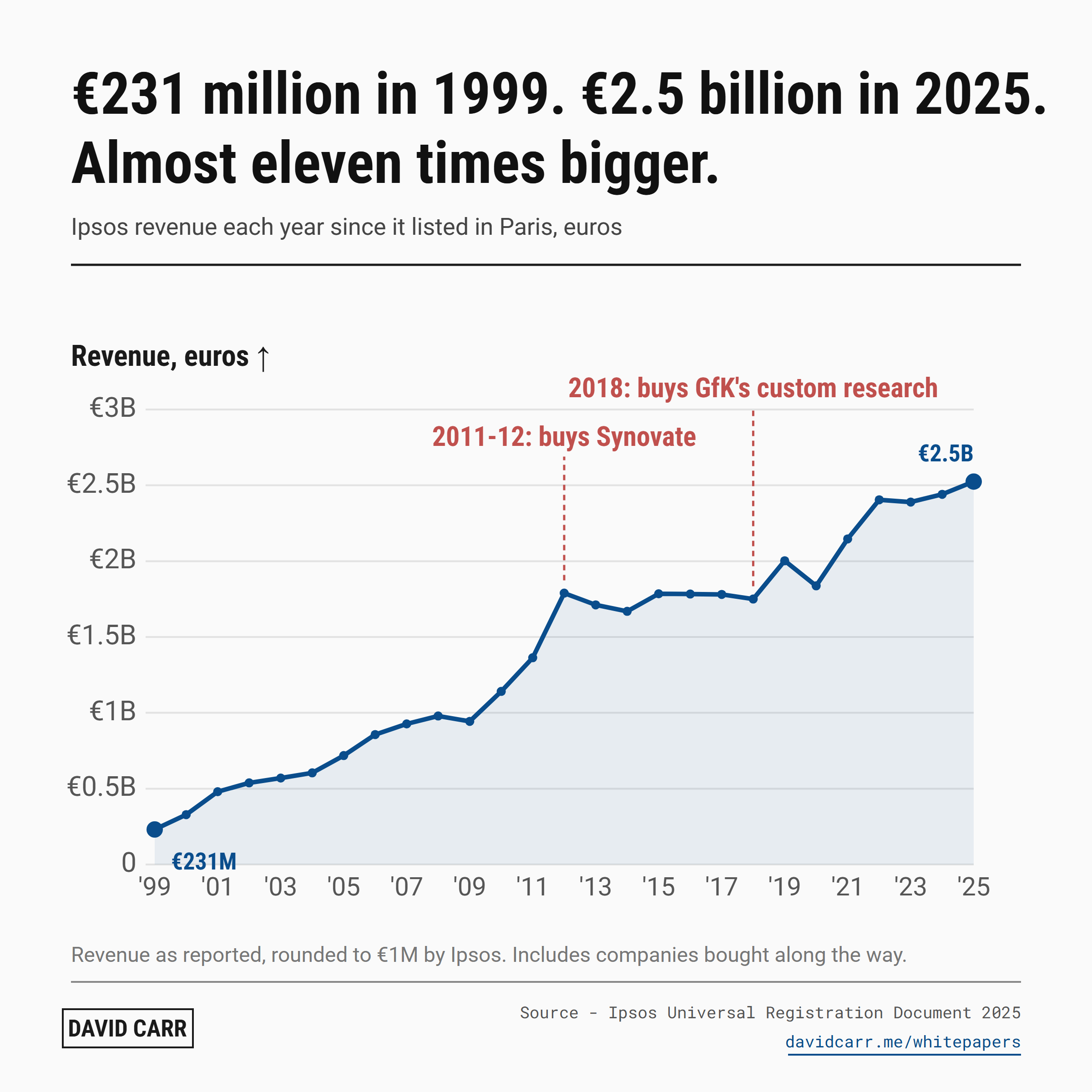
€231 million in 1999. €2.5 billion in 2025. Almost eleven times bigger.
- 1999: €231 million
- 2008: €979 million
- 2012: €1.79 billion, after buying Synovate
- 2019: €2.0 billion
- 2025: €2.52 billion
Two big deals show up as steps: Synovate in 2011-12 and GfK's custom research arm in 2018. Revenue dipped twice, in 2009 and 2020.
From the revenue history in Ipsos's 2025 Universal Registration Document, rounded to €1M by Ipsos.
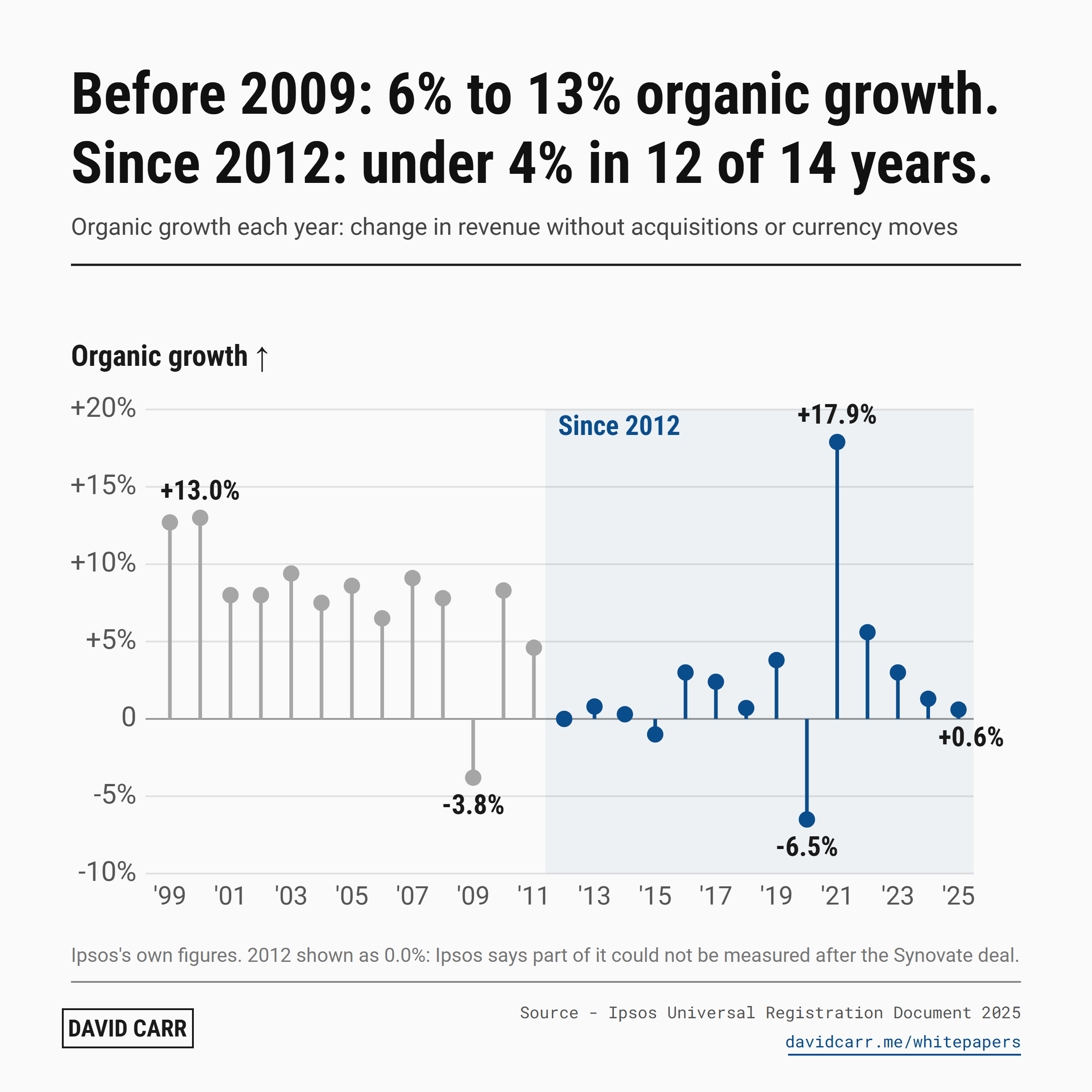
Before 2009: 6% to 13% organic growth. Since 2012: under 4% in 12 of 14 years.
- 2000: +13.0%, the fastest
- 2009: -3.8%
- 2020: -6.5%
- 2021: +17.9%
- 2025: +0.6%
Organic growth strips out acquisitions and currency moves. The 2021 jump was a rebound after 2020.
Ipsos could not measure part of 2012 organic growth after the Synovate deal, so it shows 0.0% for that year.
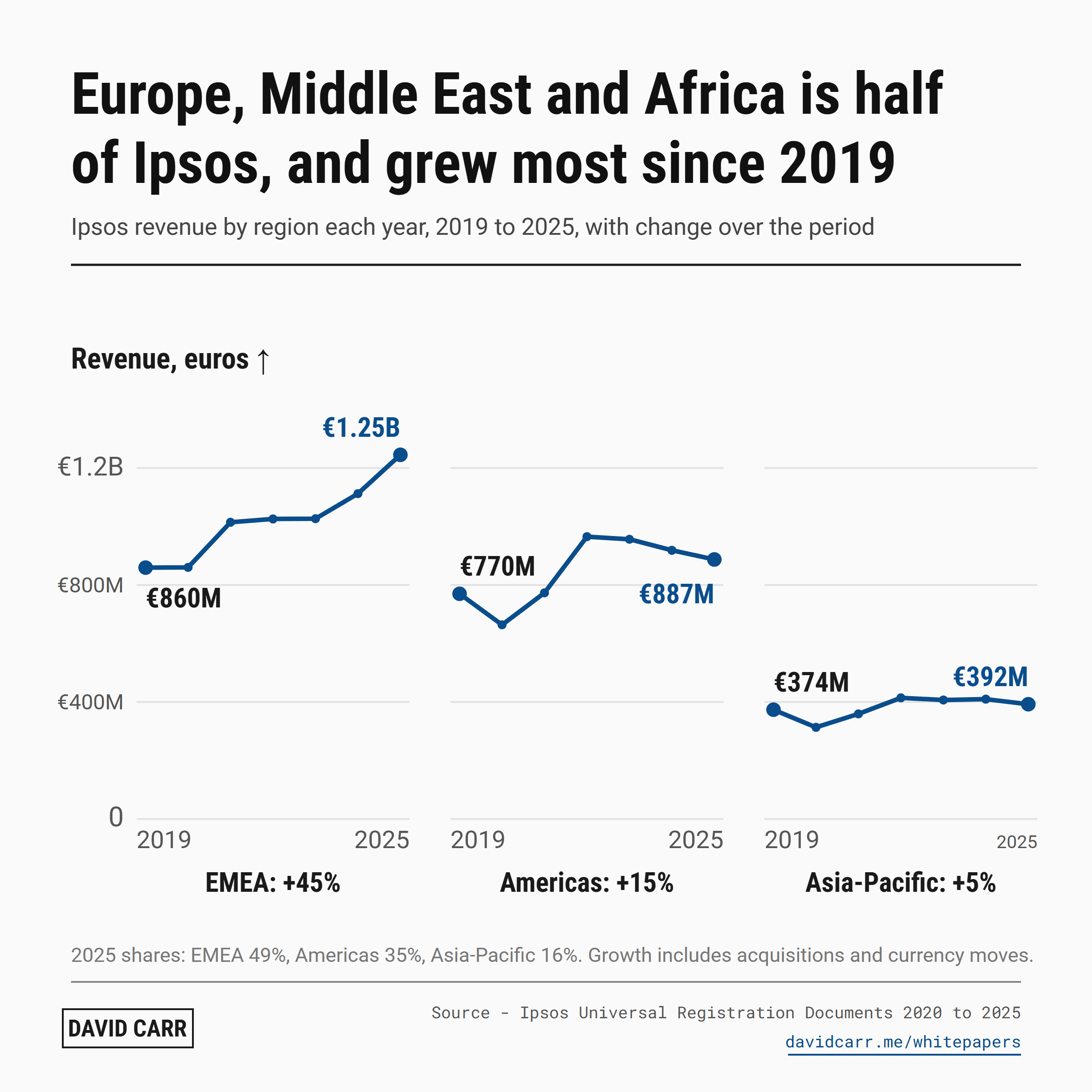
Europe, Middle East and Africa is half of Ipsos, and grew most since 2019
- EMEA: €860M to €1.25B, +45%
- Americas: €770M to €887M, +15%
- Asia-Pacific: €374M to €392M, +5%
EMEA was 49% of revenue in 2025. Much of its recent growth came from buying The BVA Family and infas.
Regional revenue from the 2020 to 2025 registration documents. Totals include acquisitions and currency moves.
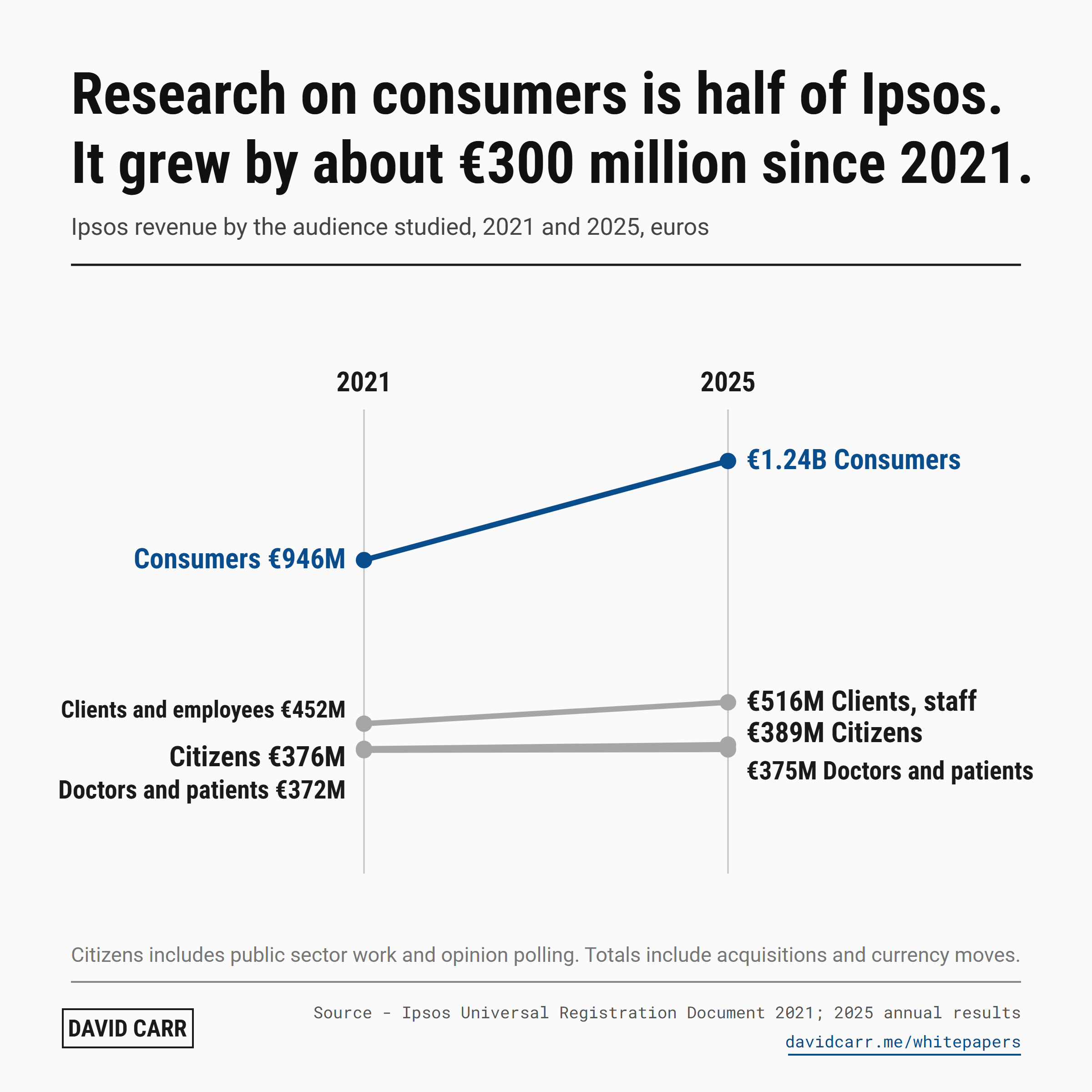
Research on consumers is half of Ipsos. It grew by about €300 million since 2021.
- Consumers: €946M to €1.24B
- Clients and employees: €452M to €516M
- Citizens: €376M to €389M
- Doctors and patients: €372M to €375M
Ipsos groups its work by who is being studied. Opinion polling sits inside Citizens, alongside public sector research.
2021 from the 2021 registration document, 2025 from the 2025 annual results.
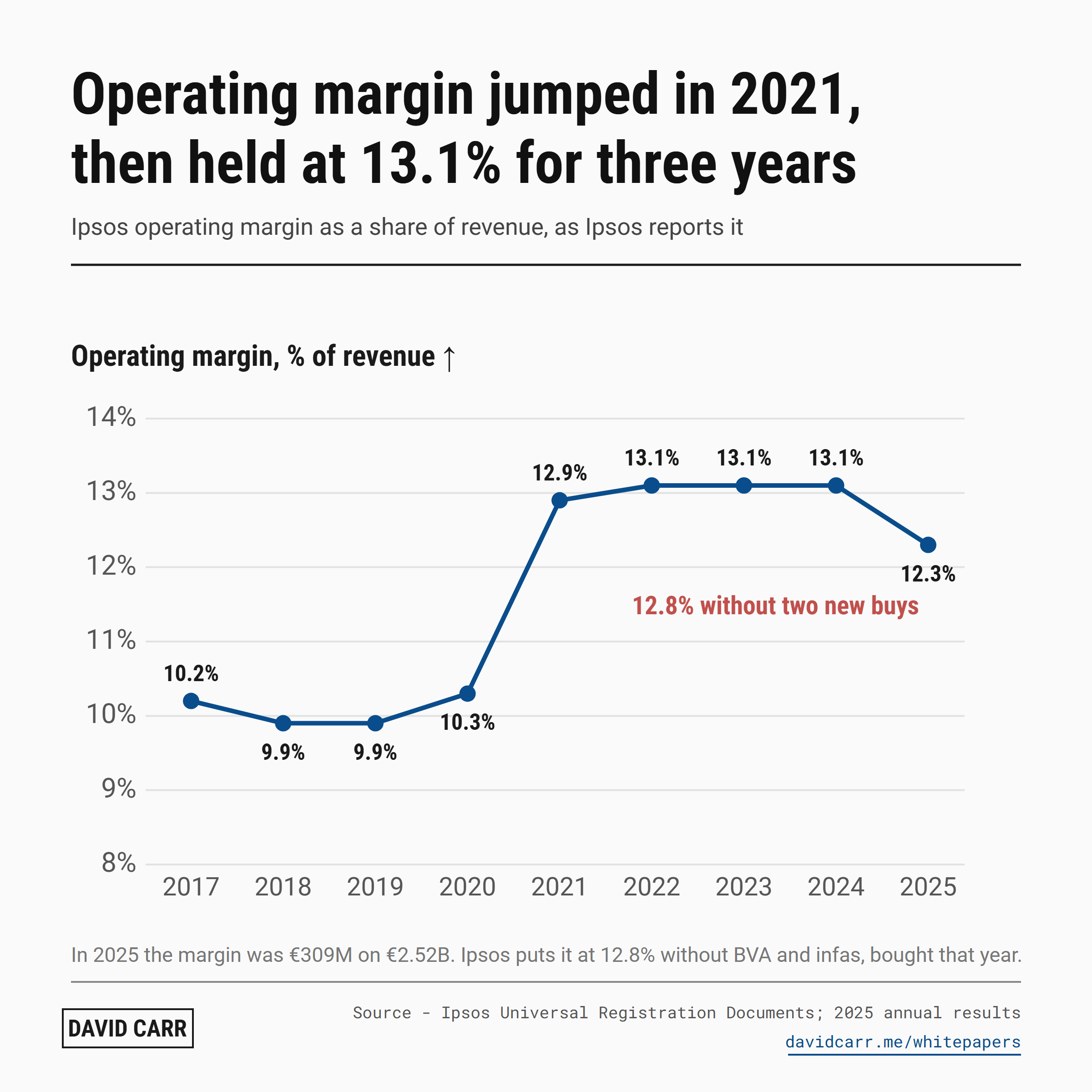
Operating margin jumped in 2021, then held at 13.1% for three years
- 2017 to 2020: 9.9% to 10.3%
- 2021: 12.9%
- 2022 to 2024: 13.1%
- 2025: 12.3%, or 12.8% without BVA and infas
Operating margin was €309 million on €2.52 billion of revenue in 2025.
Operating margin as Ipsos reports it, from its registration documents and the 2025 results.
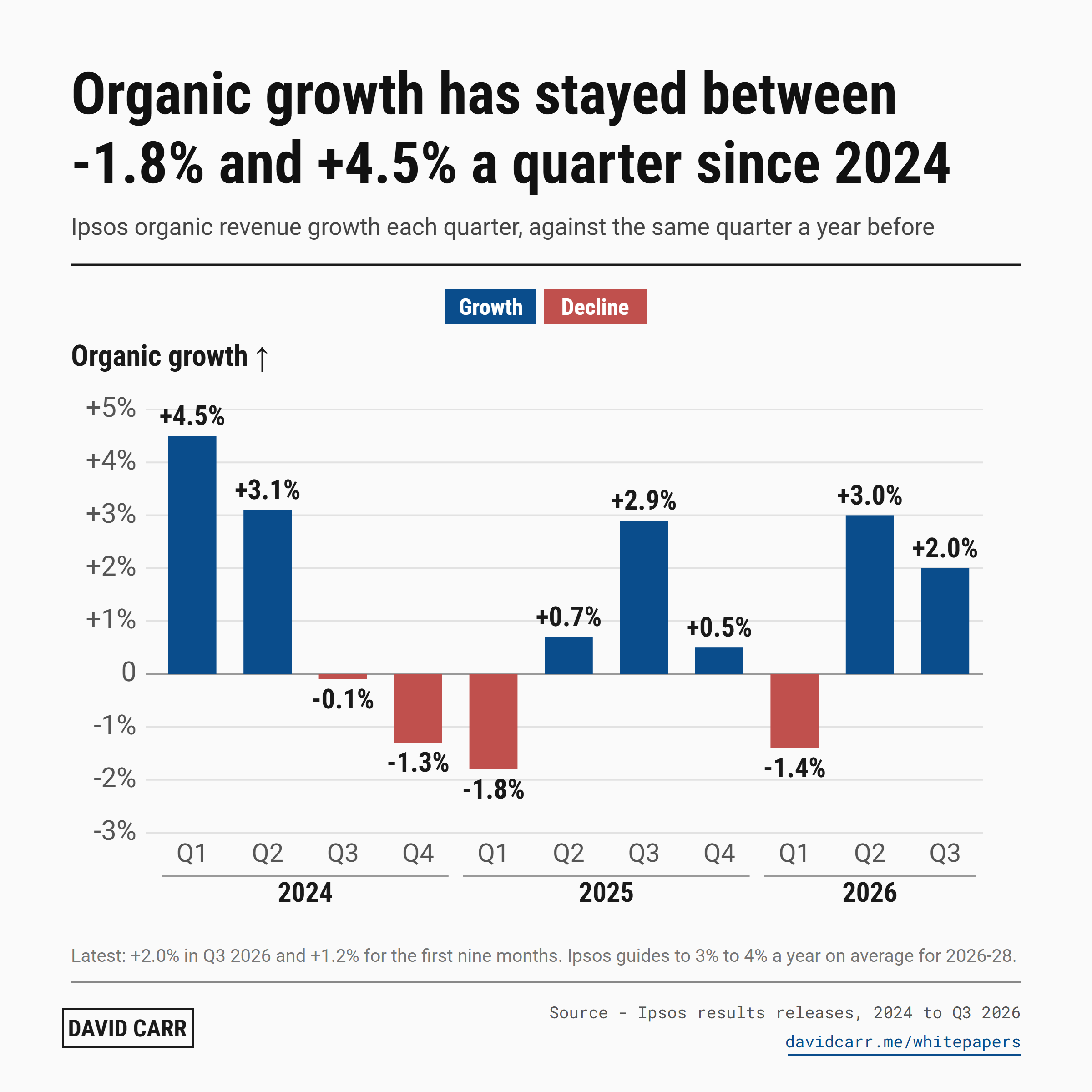
Organic growth has stayed between -1.8% and +4.5% a quarter since 2024
- Q1 2024: +4.5%
- Q1 2025: -1.8%
- Q3 2025: +2.9%
- Q2 2026: +3.0%
- Q3 2026: +2.0%
For the first nine months of 2026, organic growth was 1.2%. Ipsos aims for 3% to 4% a year on average over 2026 to 2028.
From the 2024 and 2025 annual results and the Q3 2026 release of 23 October 2026.
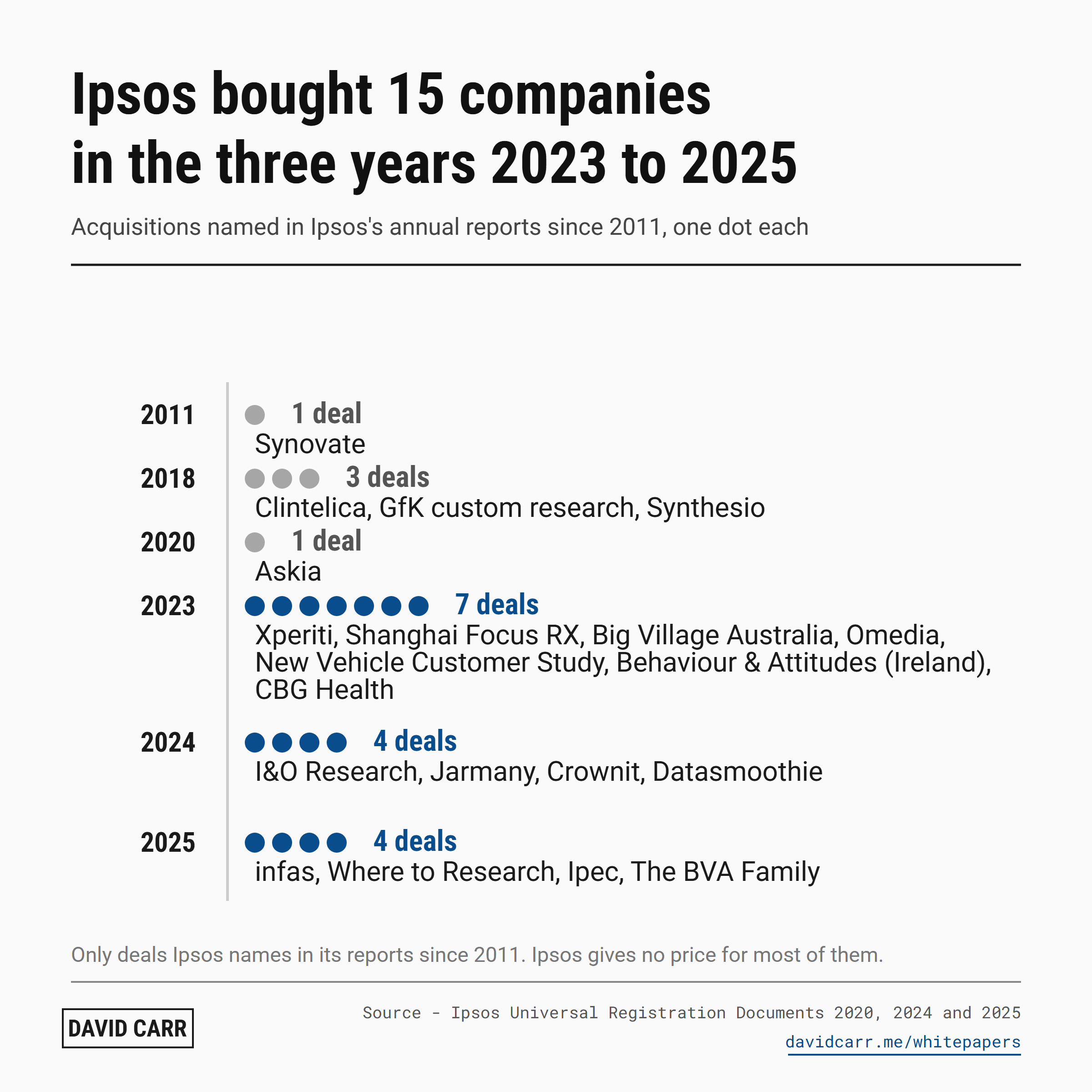
Ipsos bought 15 companies in the three years 2023 to 2025
- 2011: Synovate, its biggest deal ever
- 2018: GfK's custom research divisions, Synthesio, Clintelica
- 2023: seven deals, including Behaviour & Attitudes in Ireland
- 2024: four deals
- 2025: four, including The BVA Family
Many recent buys are local specialists: public sector research in Germany, Australia and the Netherlands, healthcare research in China and New Zealand.
Deals as listed in Ipsos's 2024 and 2025 registration documents. Ipsos gives no price for most of them.
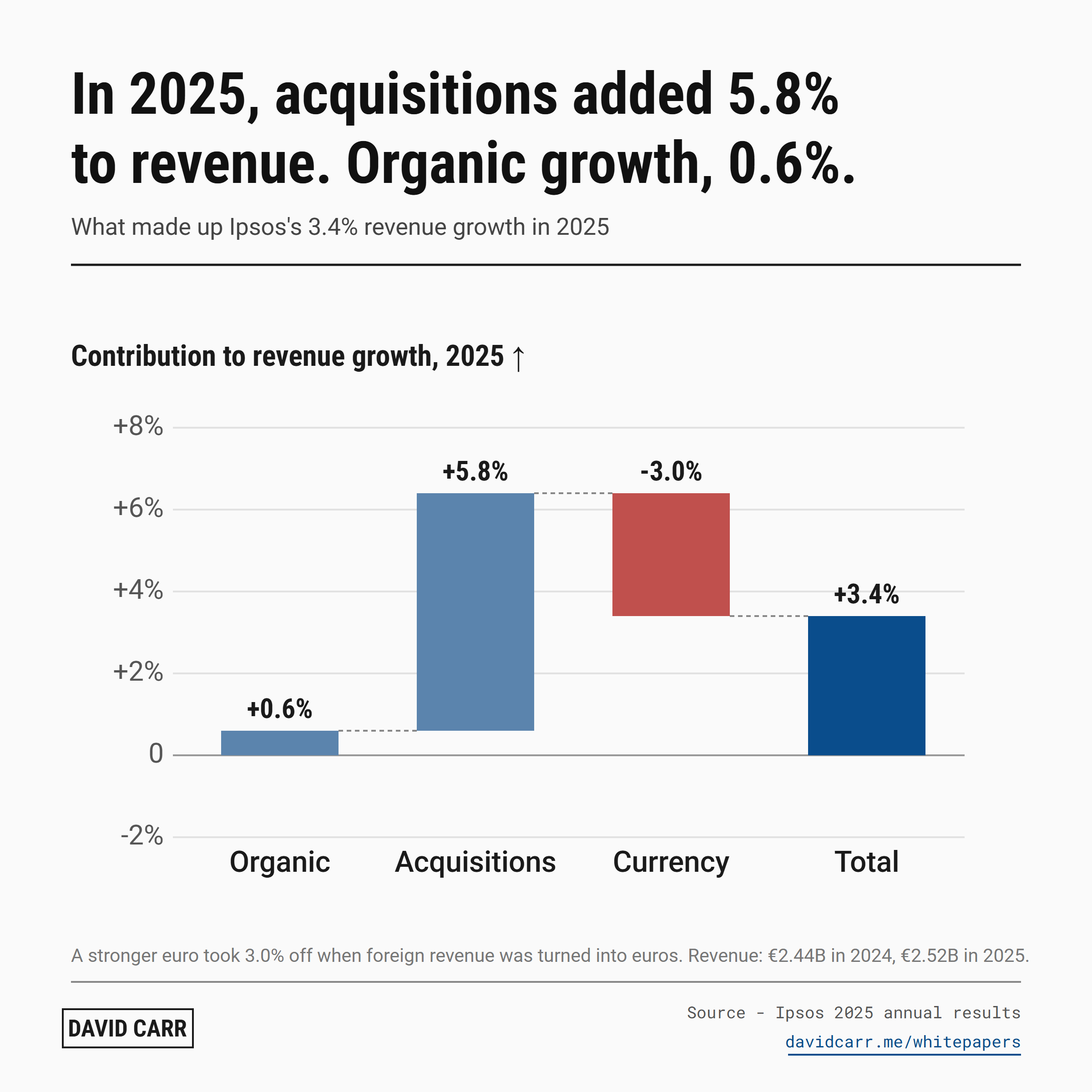
In 2025, acquisitions added 5.8% to revenue. Organic growth, 0.6%.
- Organic: +0.6%
- Acquisitions: +5.8%
- Currency: -3.0%
- Total: +3.4%
A stronger euro shrinks revenue earned in other currencies when Ipsos reports it in euros.
The split is Ipsos's own, from the 2025 annual results.
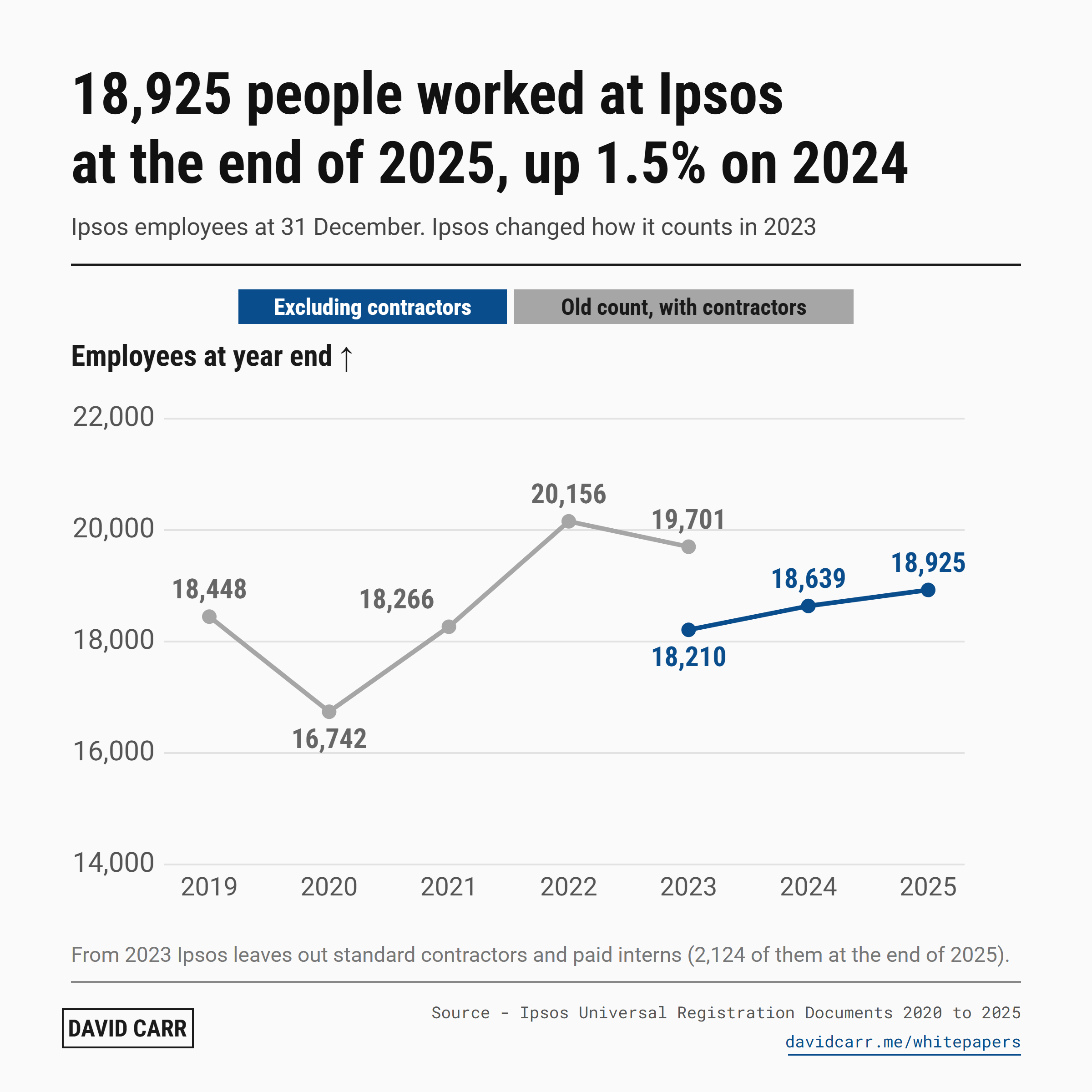
18,925 people worked at Ipsos at the end of 2025, up 1.5% on 2024
- 2022: 20,156, old count
- 2023: 19,701 old count, 18,210 new count
- 2024: 18,639
- 2025: 18,925
From 2023 Ipsos stopped counting standard contractors and paid interns. There were 2,124 of them at the end of 2025.
Year-end headcount from the registration documents, 2020 to 2025.
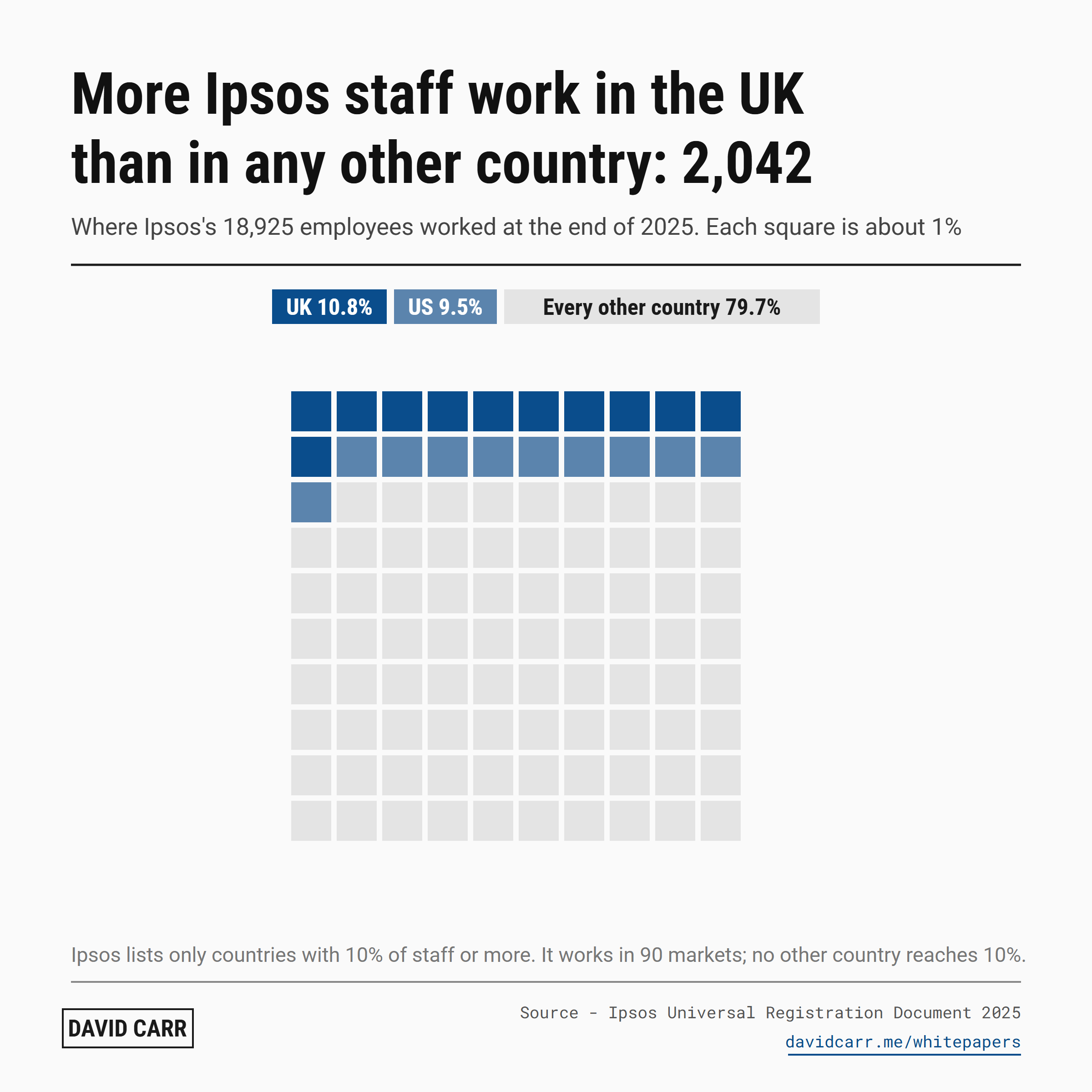
More Ipsos staff work in the UK than in any other country: 2,042
- UK: 2,042, 10.8%
- US: 1,804, 9.5%
- Every other country: 15,079, 79.7%
Ipsos works in 90 markets. Outside the UK, no single country has 10% of its staff. Women are 60% of the workforce.
From the workforce tables in the 2025 registration document, which name only countries with 10% of staff or more.
Method, caveats and sources
The short answer. Ipsos made €2.52 billion in 2025, almost eleven times its revenue when it listed in 1999. Half comes from Europe, the Middle East and Africa, and half from research on consumers. It keeps about 12% to 13% of revenue as operating margin. Organic growth has been low single digits in most recent years, and acquisitions did most of the work in 2025.
Sources. Every figure comes from Ipsos itself: its Universal Registration Documents for 2020, 2021, 2024 and 2025, its 2024 and 2025 annual results, and its Q3 2026 release. Read on 25 November 2026. All in euros.
Organic growth. Ipsos's own measure: revenue growth with acquisitions, disposals and currency moves taken out. Totals elsewhere on the page include all three.
Headcount. Ipsos changed its definition in 2023 to leave out standard contractors and paid interns. Both counts are shown for that year and not joined into one line.
Polling. Opinion polling appears here only as part of the Citizens line of business. No poll results are used.
Also: Stripe, S&P Global and FactSet.