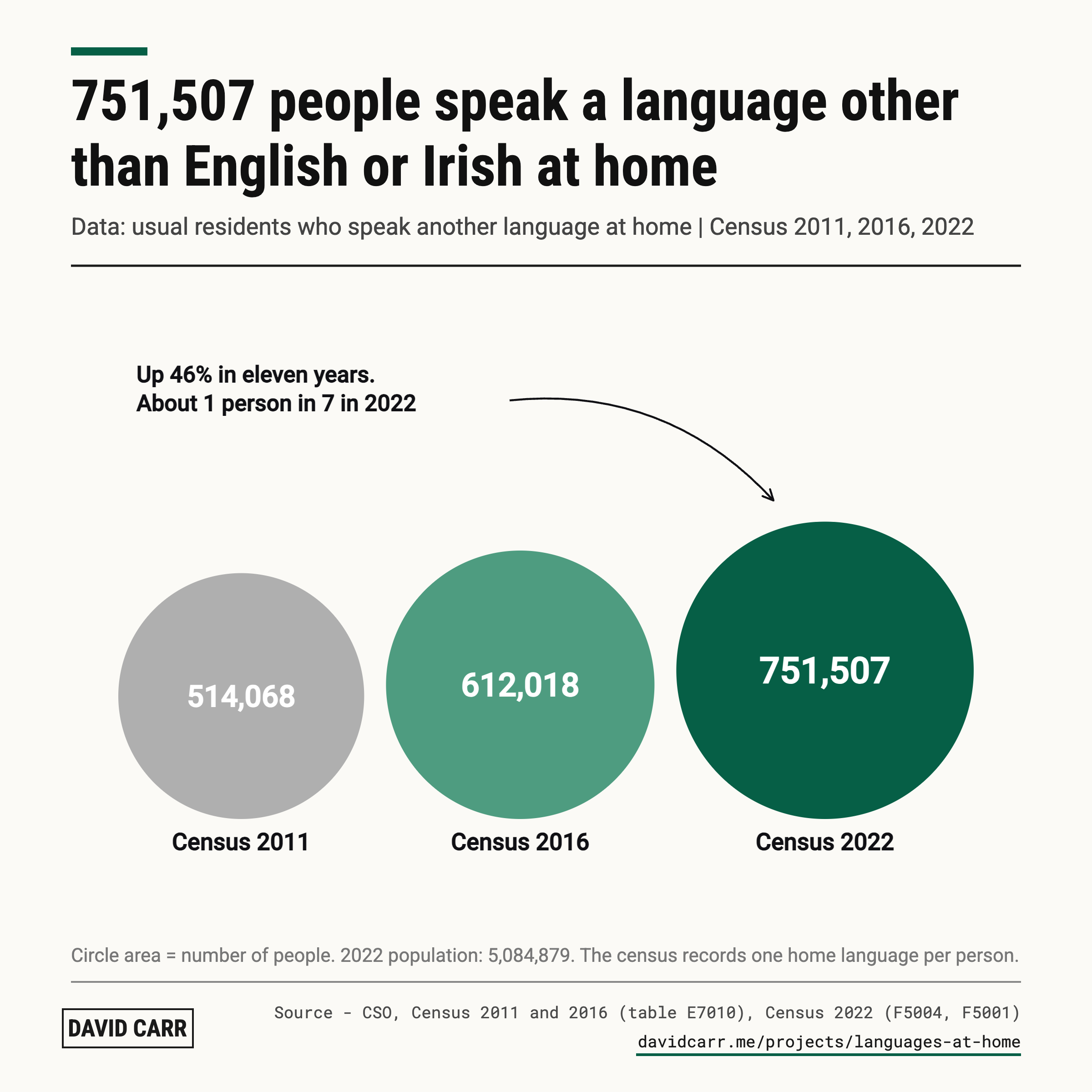
751,507 people speak a language other than English or Irish at home
- Census 2011: 514,068
- Census 2016: 612,018
- Census 2022: 751,507
- About 1 in 7 of the 5.08 million people counted in 2022
The number rose by 46% in eleven years. The census asks one question: do you speak a language other than English or Irish at home, and if so, which one.
CSO tables E7010 (2011 and 2016) and F5004 (2022). Population from F5001. Usual residents present on census night.
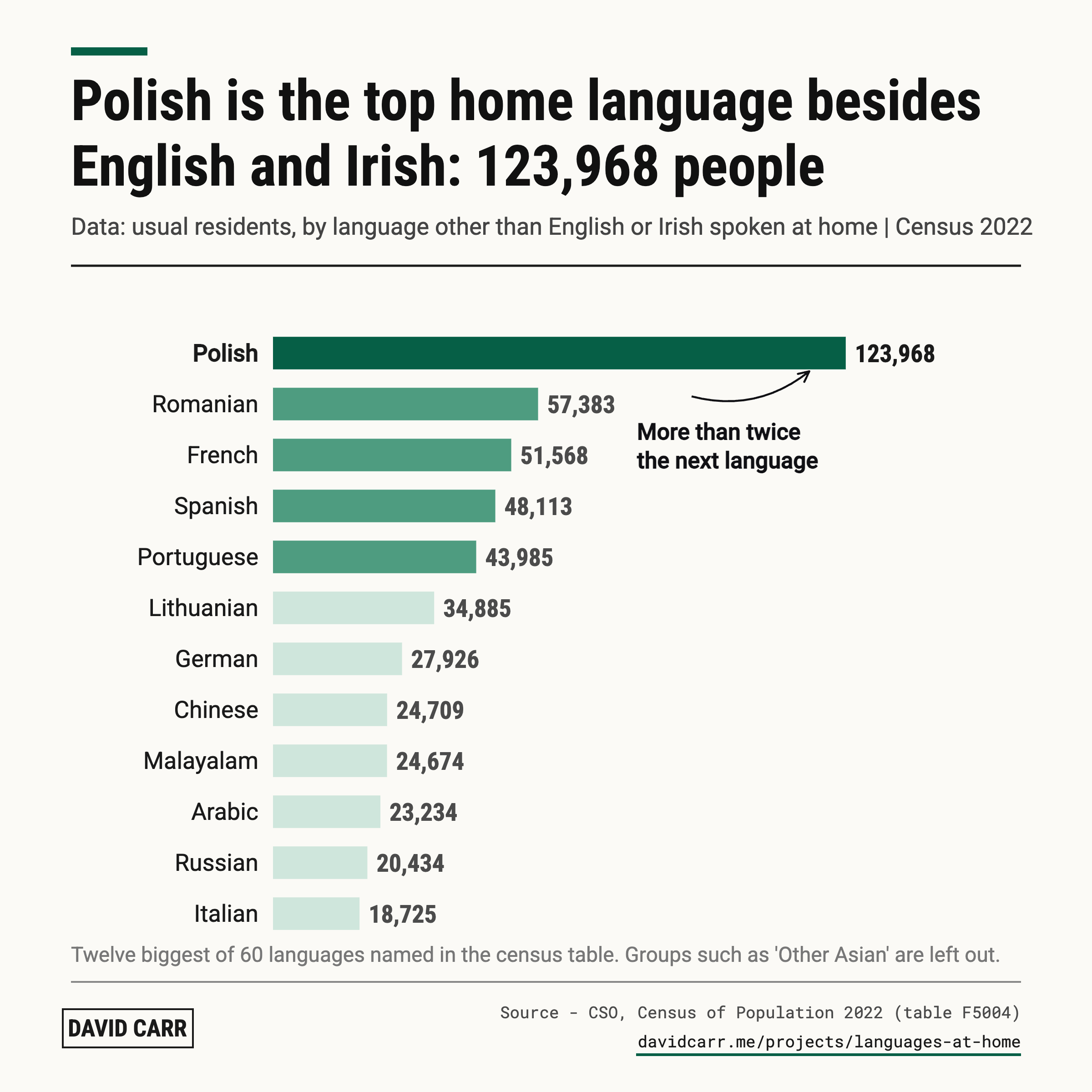
Polish is the top home language besides English and Irish: 123,968 people
- Polish: 123,968
- Romanian: 57,383
- French: 51,568
- Spanish: 48,113
- Portuguese: 43,985
Polish is more than twice the size of the next language. The census table names 60 languages. Irish Sign Language is in it too, with 3,578 people.
CSO table F5004, Census 2022. Groups such as "Other Asian" are left out of the ranking.
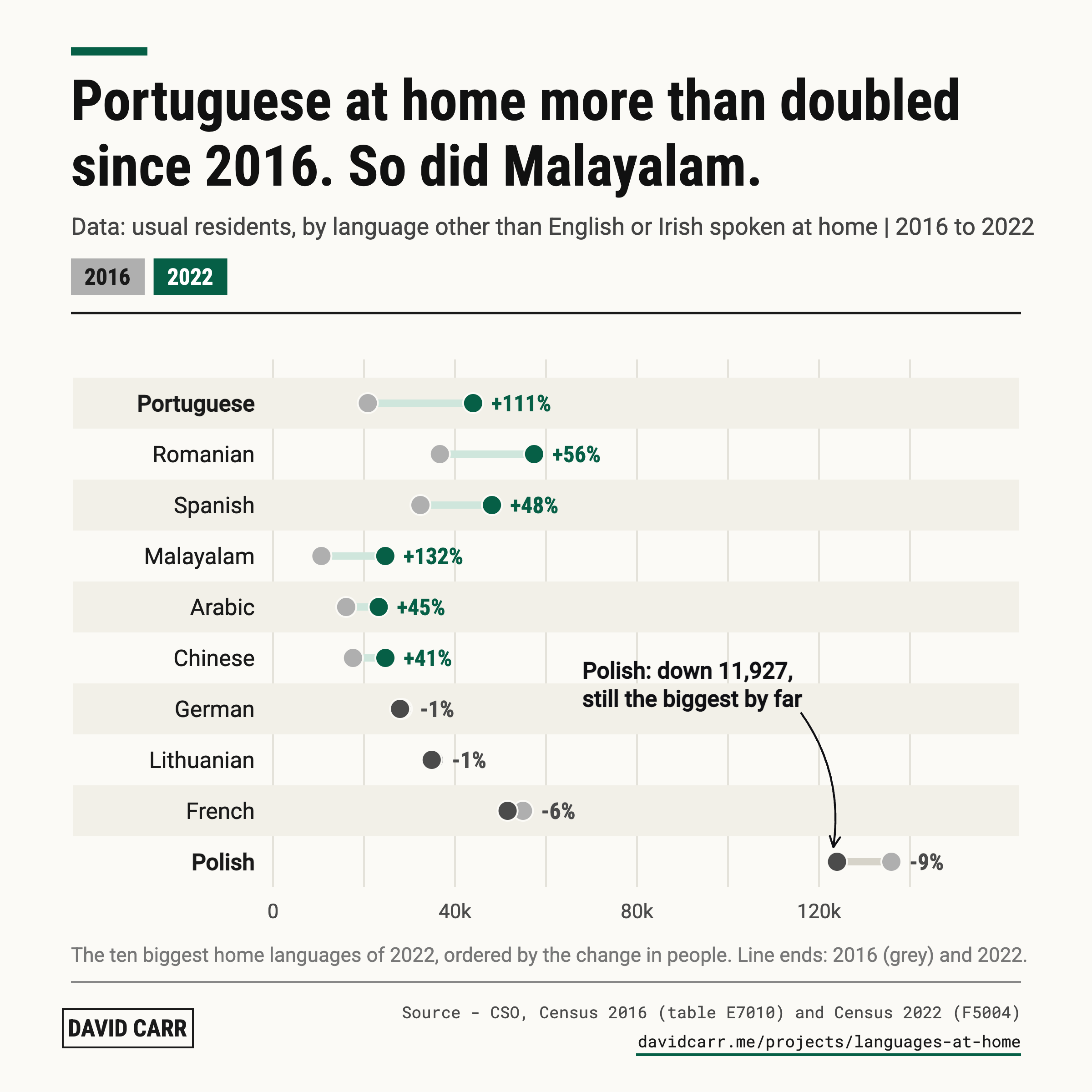
Portuguese at home more than doubled since 2016. So did Malayalam.
- Portuguese: 20,833 to 43,985 (+111%)
- Malayalam: 10,642 to 24,674 (+132%)
- Romanian: 36,683 to 57,383 (+56%)
- Polish: 135,895 to 123,968 (-9%)
Six of the ten biggest home languages grew by 40% or more in six years. Polish, French, Lithuanian and German were flat or slightly down.
CSO tables E7010 (2016) and F5004 (2022). The same language names are used in both.
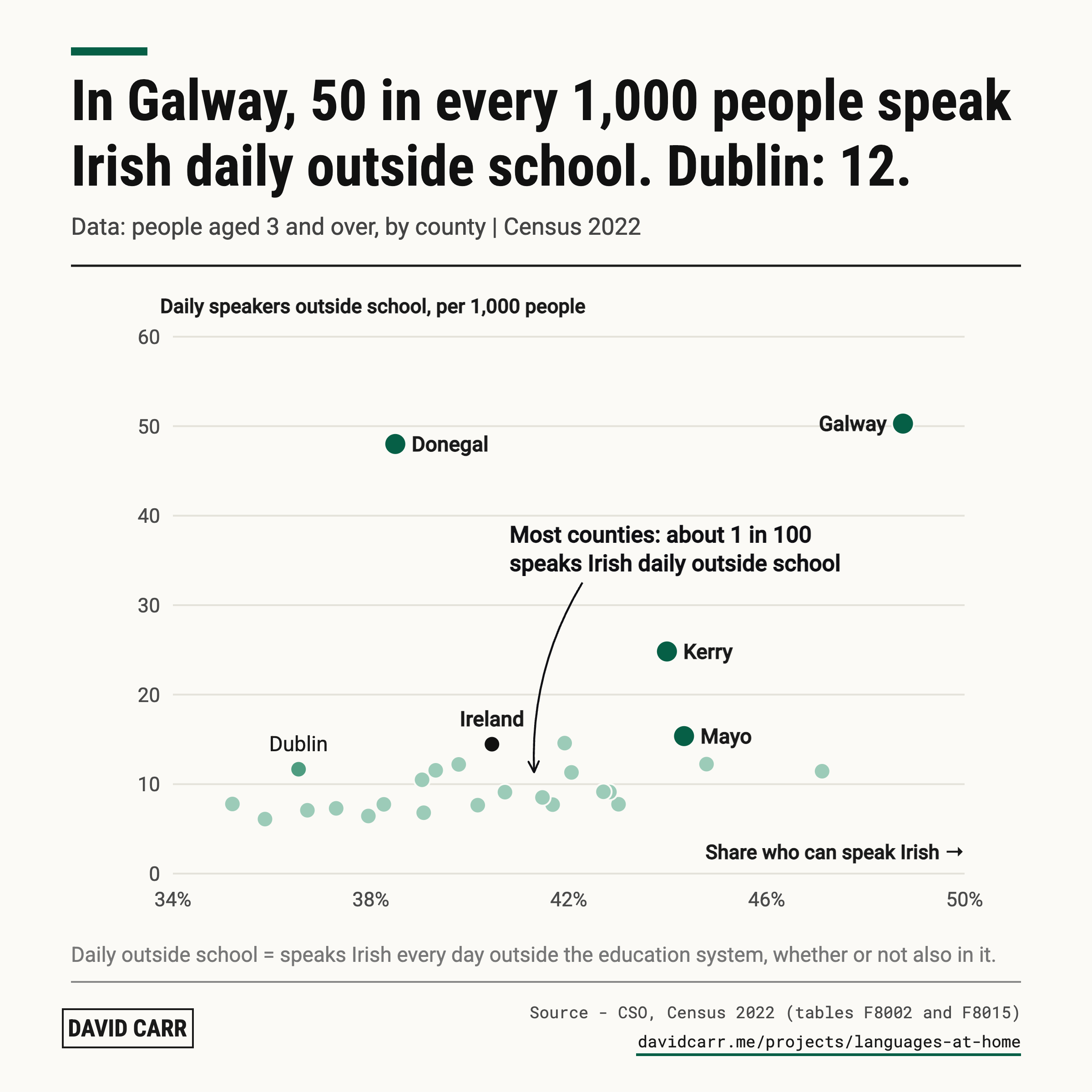
In Galway, 50 in every 1,000 people speak Irish daily outside school. Dublin: 12.
- Galway: 50.3 per 1,000
- Donegal: 48.0
- Kerry: 24.8
- Mayo: 15.4
- Ireland: 14.5
In most counties about four in ten people say they can speak Irish, but only about one in a hundred speaks it every day outside school. Galway and Donegal stand apart.
CSO tables F8002 (ability, people aged 3 and over) and F8015 (frequency, by local authority, added up to counties). More on Irish, the Gaeltacht and age in Who speaks Irish.
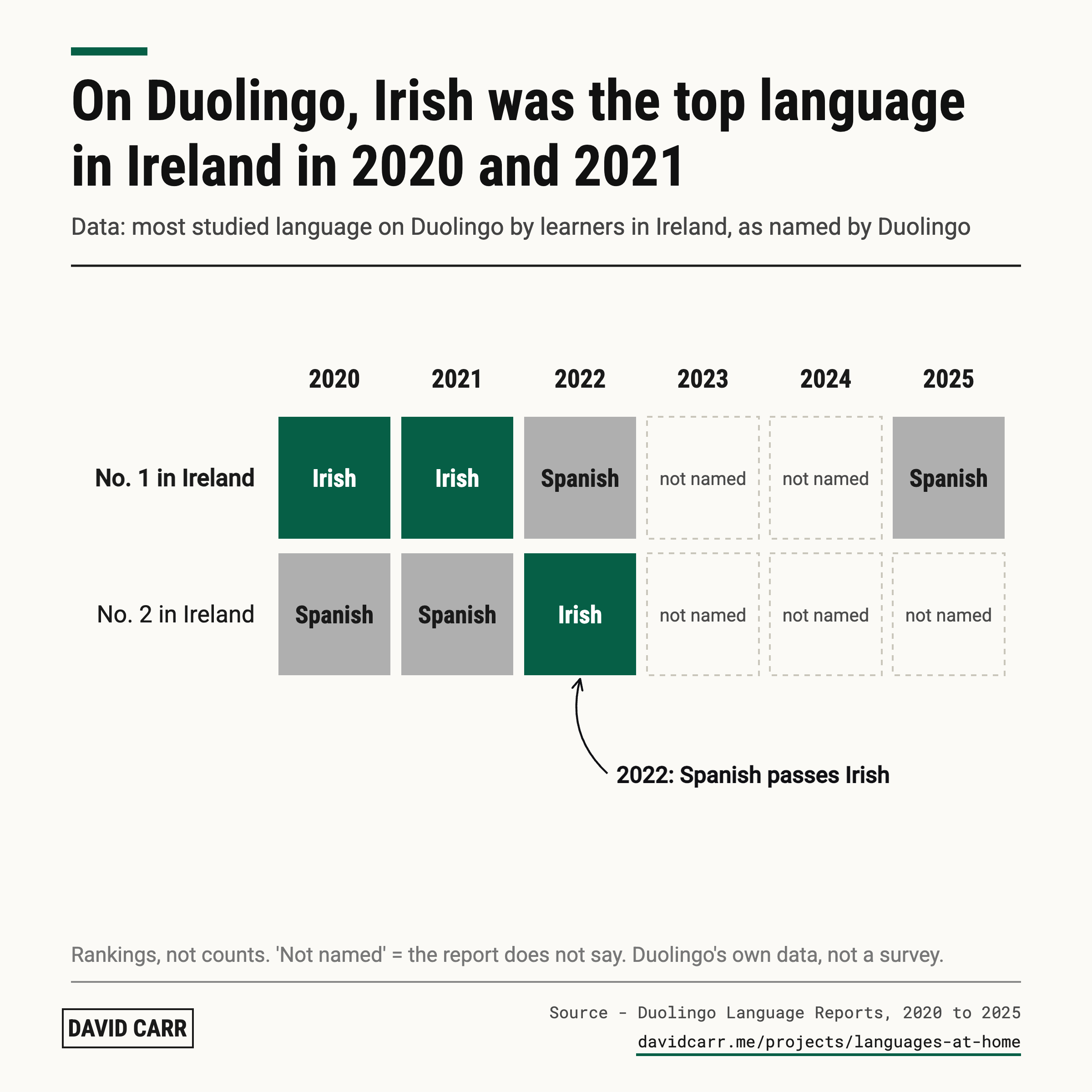
On Duolingo, Irish was the top language in Ireland in 2020 and 2021
- 2020: Irish first, grew 42% against Spanish's 10%
- 2021: Irish first for the second year
- 2022: Spanish first, Irish second
- 2025: Spanish first
In December 2020 Duolingo said over a million people were learning Irish on the app every week (RTÉ). In 2016, 23% of Irish learners on the app were in Ireland, and more than half were in the US (RTÉ). Each report since 2022 says Irish is the second language in one country, without naming it.
Duolingo Language Reports for 2020, 2021, 2022 and 2025. Duolingo's own rankings; it does not publish counts by country. More in The daily habit, in numbers.
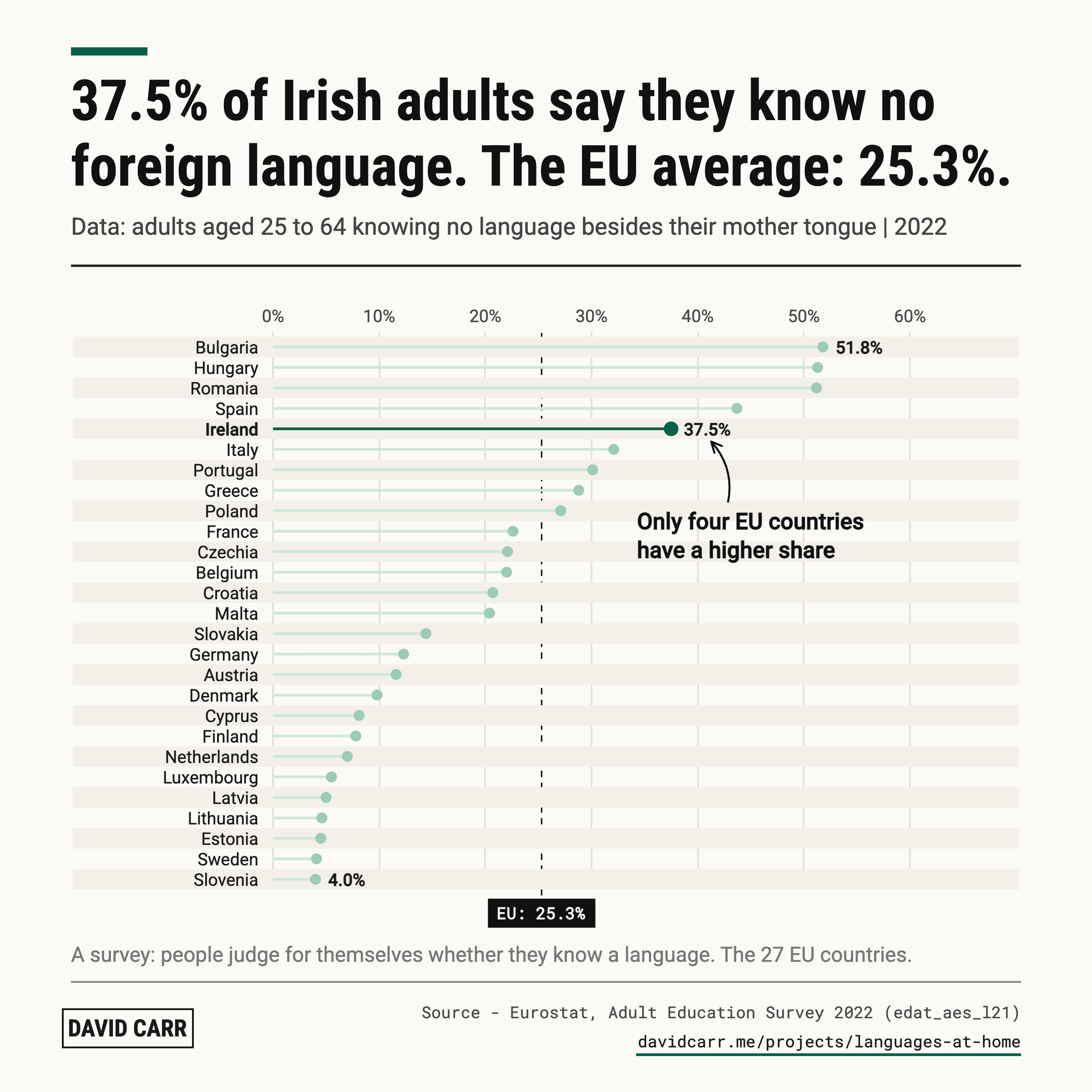
37.5% of Irish adults say they know no foreign language. The EU average: 25.3%.
- Bulgaria: 51.8%, the highest
- Spain: 43.7%
- Ireland: 37.5%, fifth highest of 27
- EU: 25.3%
- Slovenia: 4.0%, the lowest
The share in Ireland has fallen, from 72.7% in 2011 and 49.2% in 2016, though Eurostat warns that countries can apply the question in their own way.
Eurostat Adult Education Survey, table edat_aes_l21, adults aged 25 to 64. Foreign language = any language besides the mother tongue (Eurostat). Whether Irish counts is not stated.
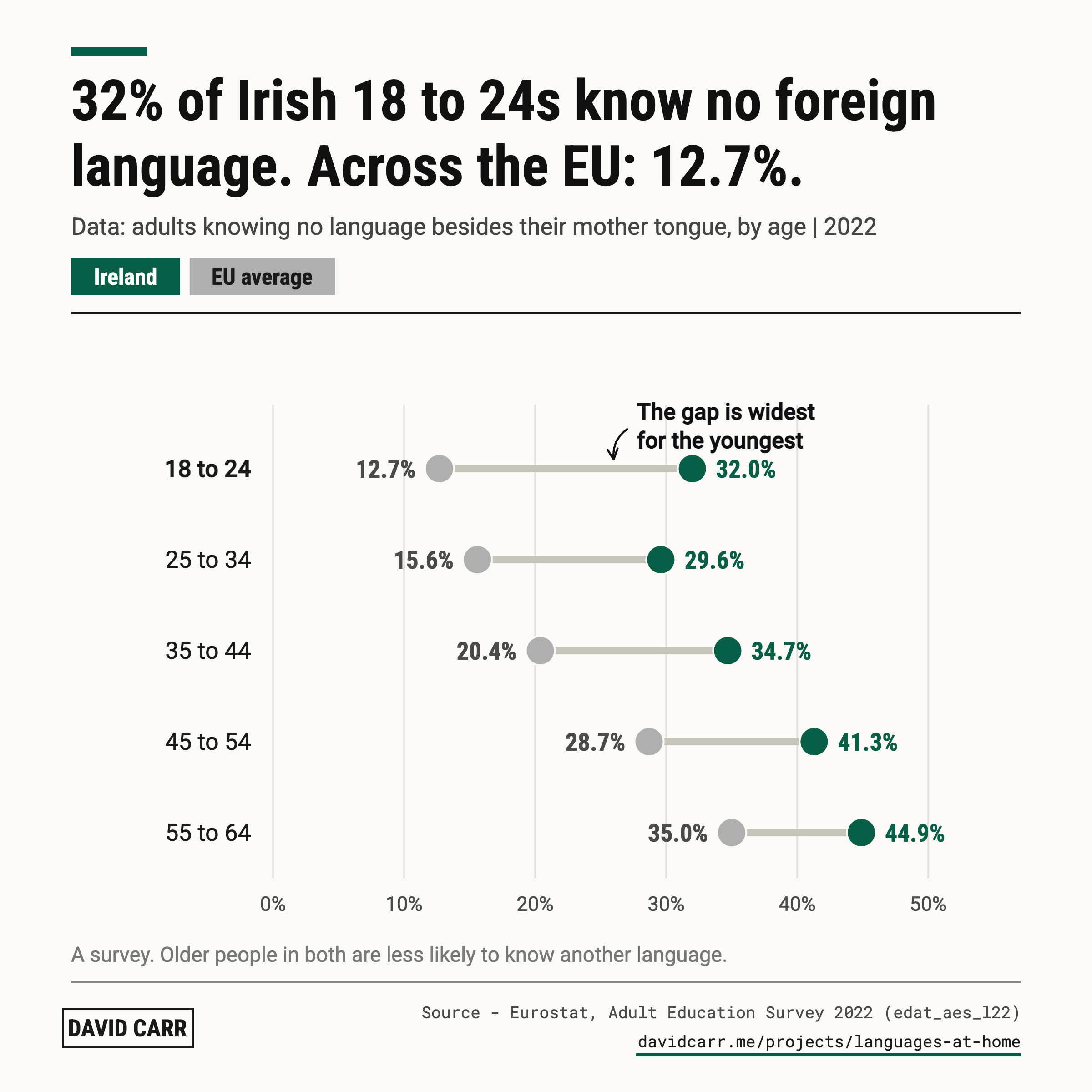
32% of Irish 18 to 24s know no foreign language. Across the EU: 12.7%.
- 18 to 24: Ireland 32.0%, EU 12.7%
- 25 to 34: 29.6% and 15.6%
- 45 to 54: 41.3% and 28.7%
- 55 to 64: 44.9% and 35.0%
In both, younger adults are more likely to know another language. In Ireland the gap to the EU is biggest for the youngest group. 5.7% of Irish 18 to 24s know three or more languages, against 16.0% across the EU.
Eurostat Adult Education Survey 2022, table edat_aes_l22. A survey.
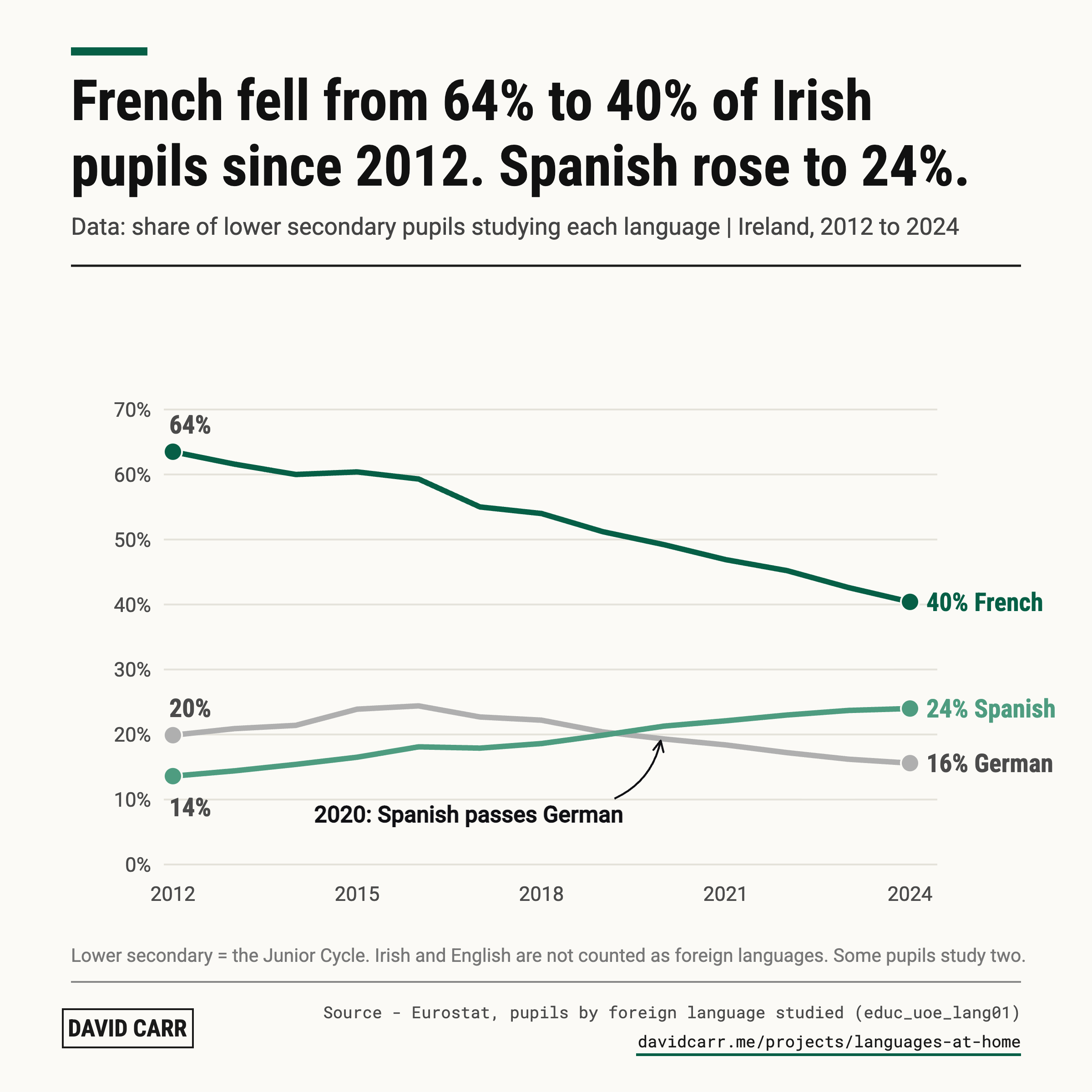
French fell from 64% to 40% of Irish pupils since 2012. Spanish rose to 24%.
- French: 63.5% to 40.4%
- Spanish: 13.6% to 24.0%
- German: 19.9% to 15.6%
- Spanish passed German in 2020
French is still the most studied foreign language in the Junior Cycle. The share of lower secondary pupils studying no foreign language rose from 10.5% in 2013 to 25.2% in 2024. The EU figure was 1.8%.
Eurostat tables educ_uoe_lang01 and educ_uoe_lang02. Irish and English are not counted as foreign languages.
Method, caveats and sources
The short answer. About one person in seven in Ireland speaks a language other than English or Irish at home, most often Polish. Irish is known by four in ten people but spoken daily outside school by about one in seventy, most of them in Galway and Donegal. Irish adults are less likely than most Europeans to know a foreign language, and fewer pupils study one than a decade ago.
Census. CSO PxStat tables F5004, E7010, F5001, F8002 and F8015, pulled 29 November 2026. Home languages are counted for usual residents present on census night. Irish ability is for people aged 3 and over; shares exclude those who did not answer (6.9% in 2022). County figures for daily Irish add up the CSO's local authority areas.
Surveys. The Eurostat Adult Education Survey (2011, 2016, 2022) asks people which languages they know besides their mother tongue. Answers are self-judged, and countries apply the question in slightly different ways, so the fall in Ireland from 2011 to 2022 is shown in the text only.
Schools. Eurostat's UOE education data, 2012 to 2024, lower secondary level (the Junior Cycle in Ireland).
Duolingo. Rankings from Duolingo's own yearly language reports. They are company publications, not surveys, and give no counts by country.
Also: Who speaks Irish, Where Ireland is growing, The jobs Ireland does now, The daily habit, in numbers and, for programming languages, Which programming languages last?