Four climbs, as the newsletters' own pages stated them.
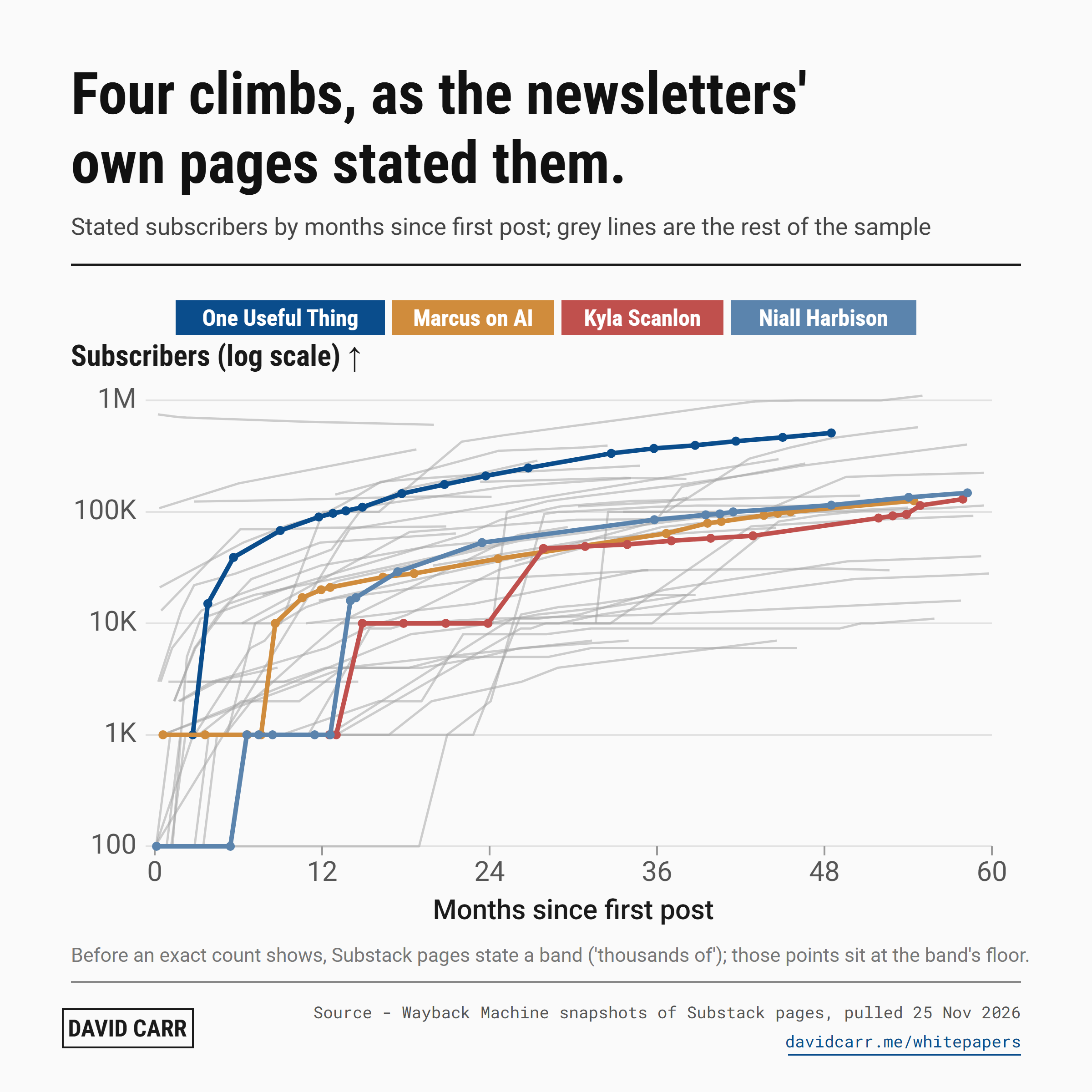
- One Useful Thing: past 10,000 within four months of its first post, past 100,000 at about 13 months
- Marcus on AI and Niall Harbison: past 10,000 inside about 14 months, past 100,000 in three to four years
- Kyla Scanlon: a long flat stretch at the 10,000 band, then a jump in the third year
- 44 more newsletters from the same sample in grey
On a log scale, every tenfold step is the same height. Most lines rise steeply at first and then flatten: the count keeps growing, but each step up takes longer.
Counts are what each page stated when the Wayback Machine visited, rounded by Substack. Before a page showed an exact count it showed a band, plotted at the band's floor, which is why some lines run flat along 1K or 10K.
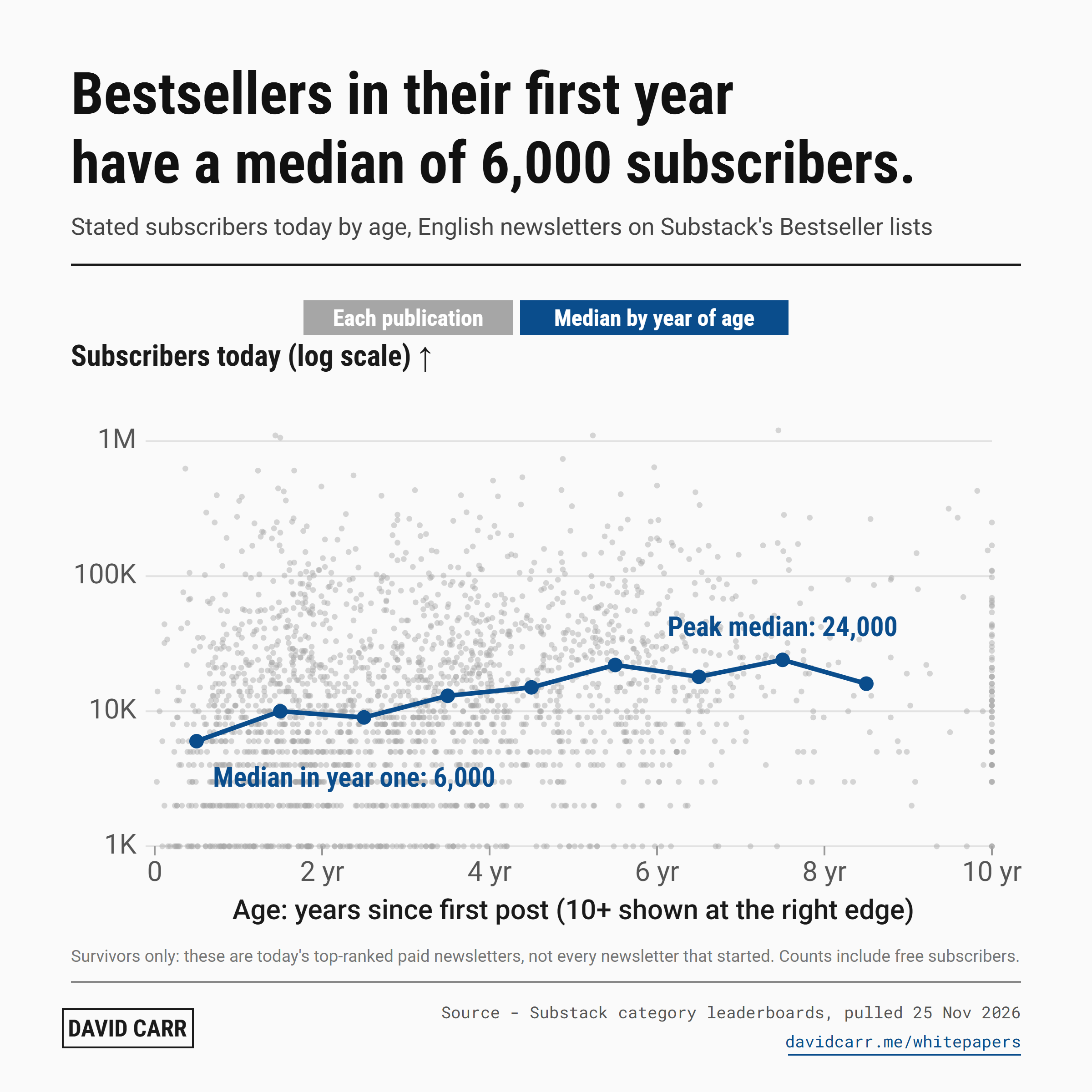
Bestsellers in their first year have a median of 6,000 subscribers.
- 2,268 English newsletters on Substack's category Bestseller lists with a stated count today
- Median in year 1: 6,000 (n = 236)
- Median in year 3: 9,000 (n = 380)
- Median in year 5: 15,000 (n = 262)
- Highest median for any year of age: 24,000
This is today's snapshot, not a growth curve: older newsletters are bigger, partly because they have had longer and partly because the ones that stayed small or stopped are not on the lists. It sets the scale for everything else on the page.
Survivors only. Free subscribers included. Counts are Substack's rounded 'Over N subscribers'.
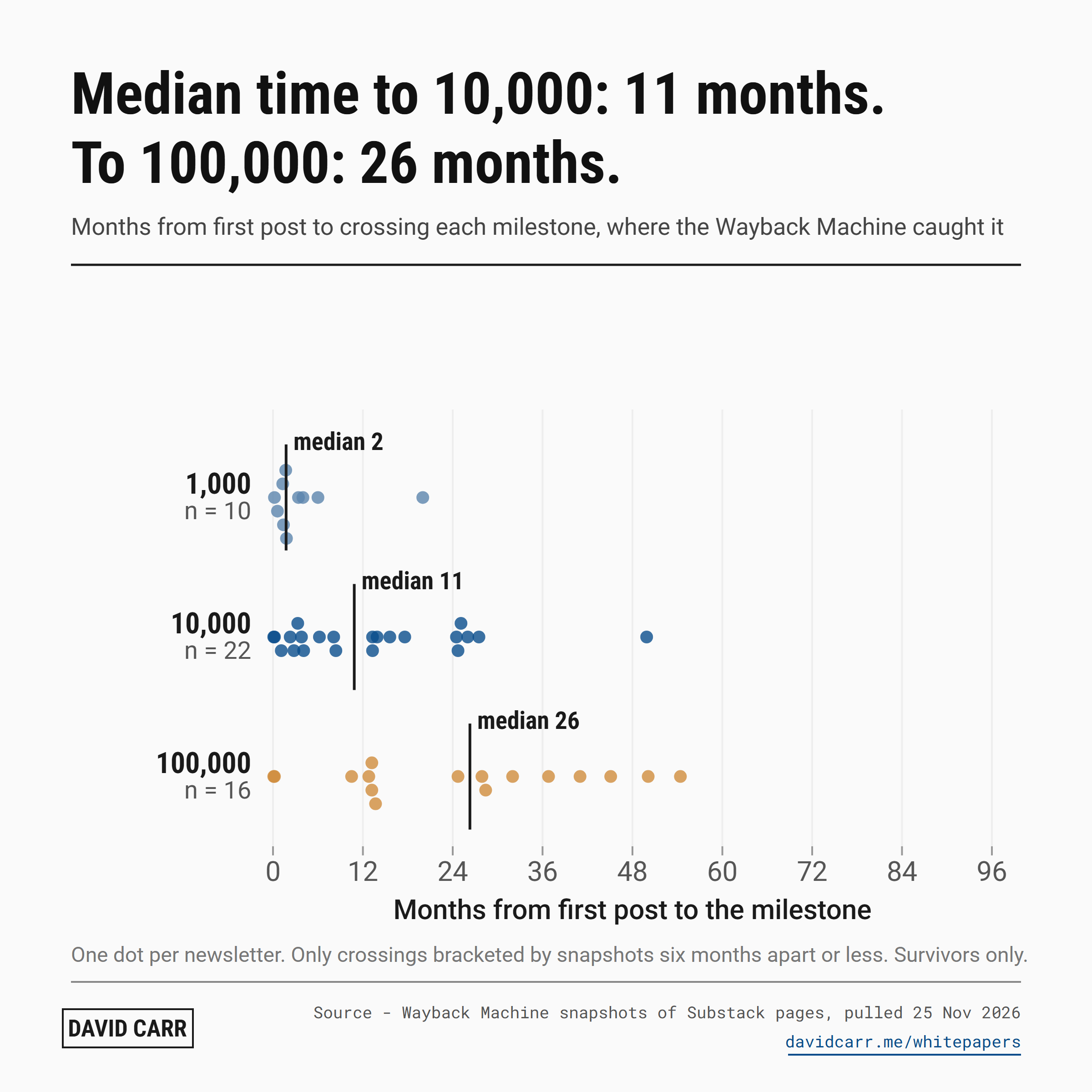
Median time to 10,000: 11 months. To 100,000: 26 months.
- To 1,000: median 2 months (n = 10)
- To 10,000: median 11 months (n = 22)
- To 100,000: median 26 months (n = 16)
The 1,000 row is fast because of who can be in it: only newsletters that launched after late 2021 and are on a Bestseller list now. A slow starter from that period may not be on a list yet.
Small samples. Only crossings bracketed by snapshots six months apart or less are counted, at the midpoint.
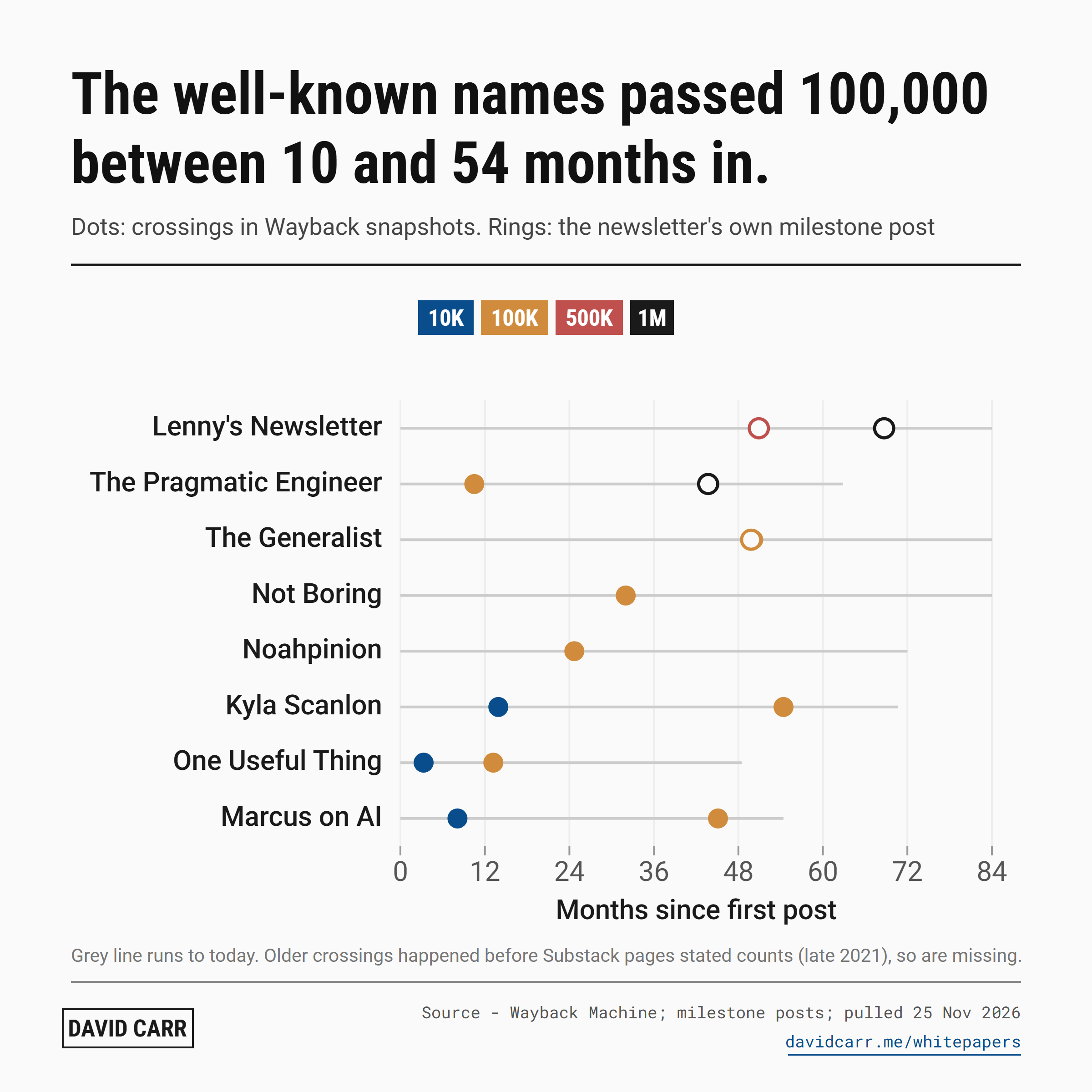
The well-known names passed 100,000 between 10 and 54 months in.
- Lenny's Newsletter: 500,000 at about 51 months, 1,000,000 at about 69
- The Pragmatic Engineer: 100,000 at about 10 months (snapshots), "more than one million readers" at about 44
- The Generalist: "One Hundred Thousand" at about 50 months
- Not Boring, Noahpinion, Kyla Scanlon, One Useful Thing and Marcus on AI: 100,000 at 13 to 54 months (snapshots)
Most took years, not months, to pass 100,000. The Pragmatic Engineer and One Useful Thing were the quick exceptions.
Milestone posts are published when the writer chooses, so they can come after the crossing. Earlier milestones for the older newsletters were passed before Substack pages stated counts.
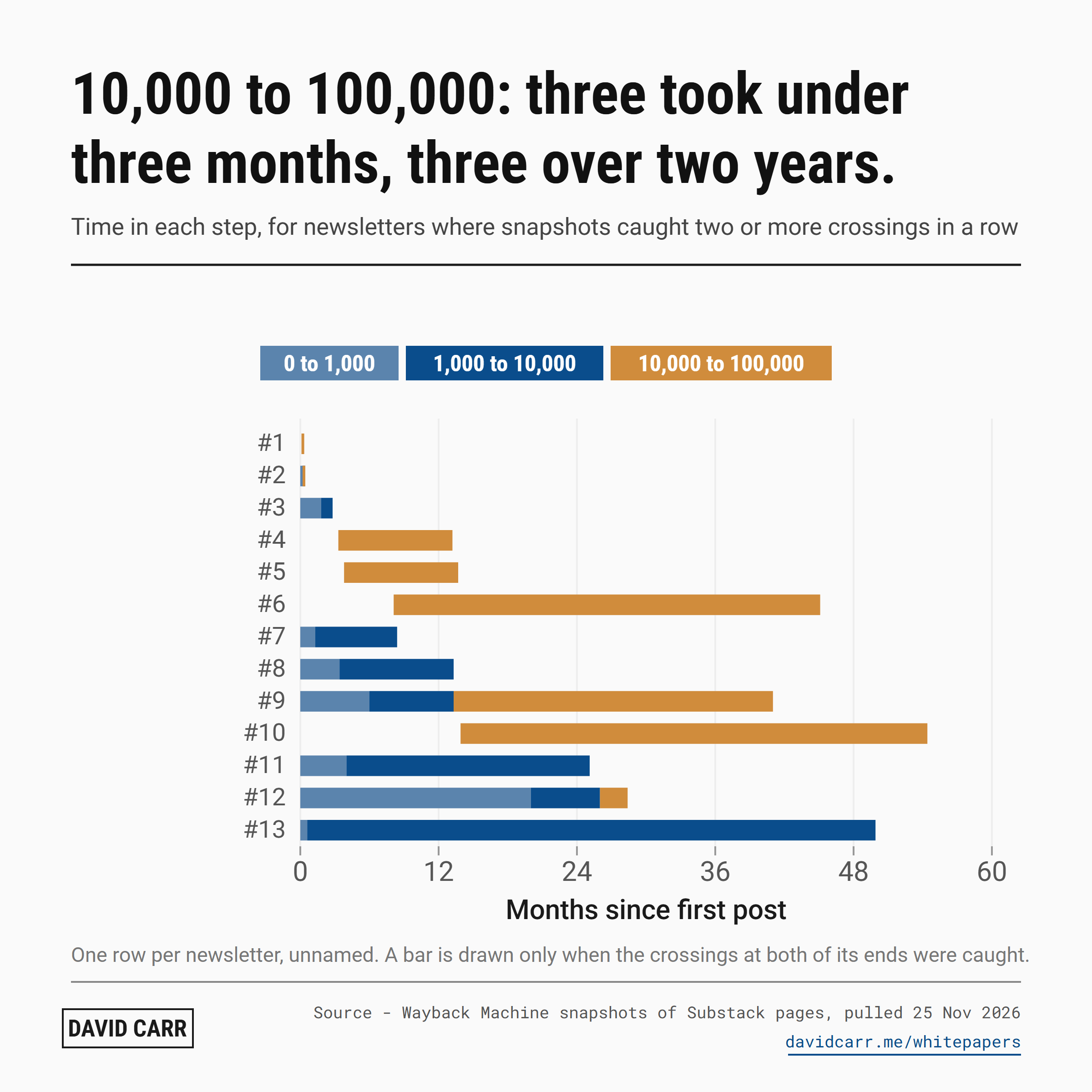
10,000 to 100,000: three took under three months, three over two years.
- 13 newsletters had two or more crossings caught by snapshots
- Light blue: 0 to 1,000. Navy: 1,000 to 10,000. Orange: 10,000 to 100,000
- Rows without a first segment: the snapshots did not catch the earlier crossing
The spread is wide at every step. Some newsletters went from 10,000 to 100,000 in weeks; others spent more than three years on it.
Newsletters are not named here because most of them are small and personal.
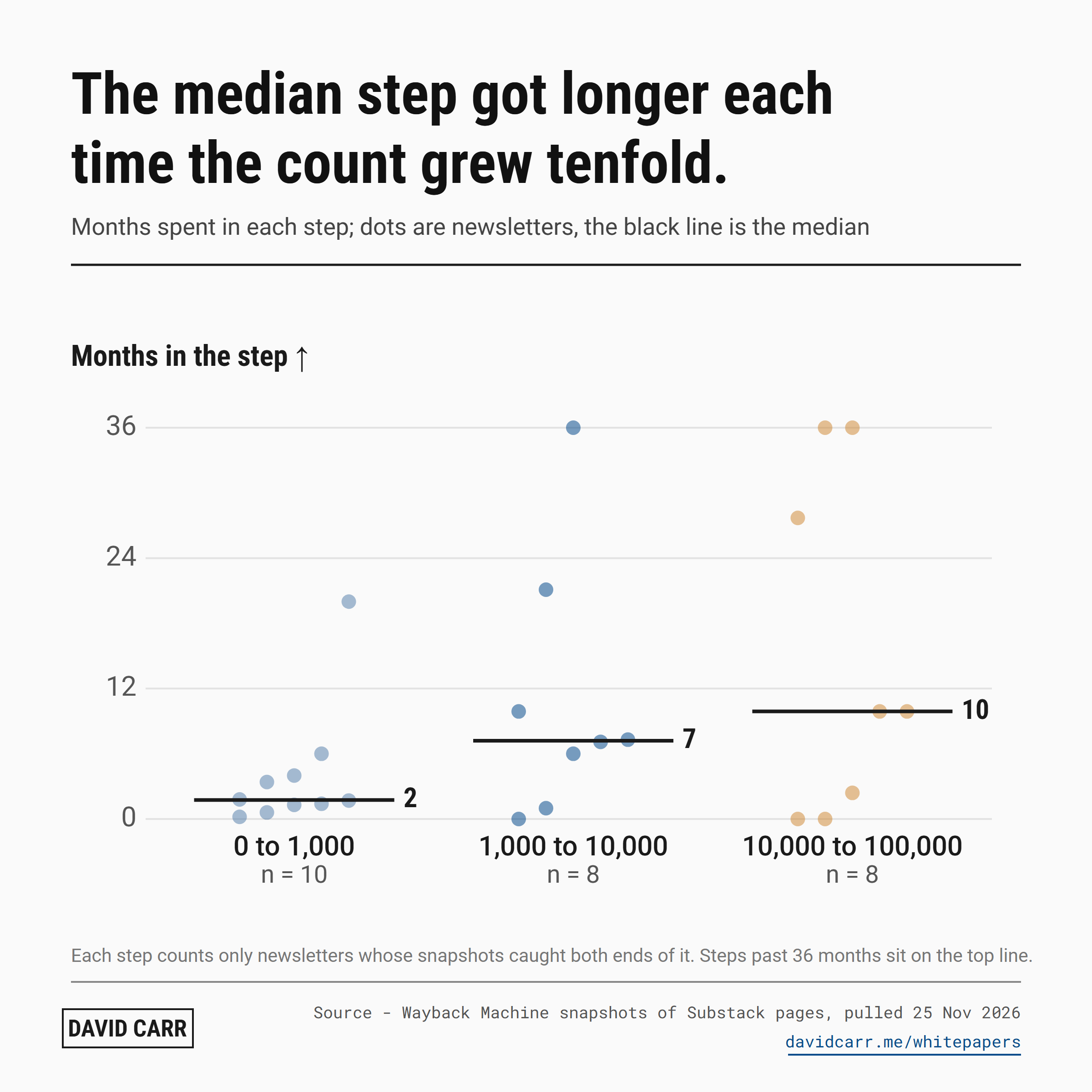
The median step got longer each time the count grew tenfold.
- 0 to 1,000: median 2 months (n = 10)
- 1,000 to 10,000: median 7 months (n = 8)
- 10,000 to 100,000: median 10 months (n = 8)
Each step adds ten times as many readers as the one before, so the same rate of growth takes the same time per step. A longer step means growth slowed in percentage terms, even while more readers arrived each month.
Very small samples; read as a direction, not a rule.
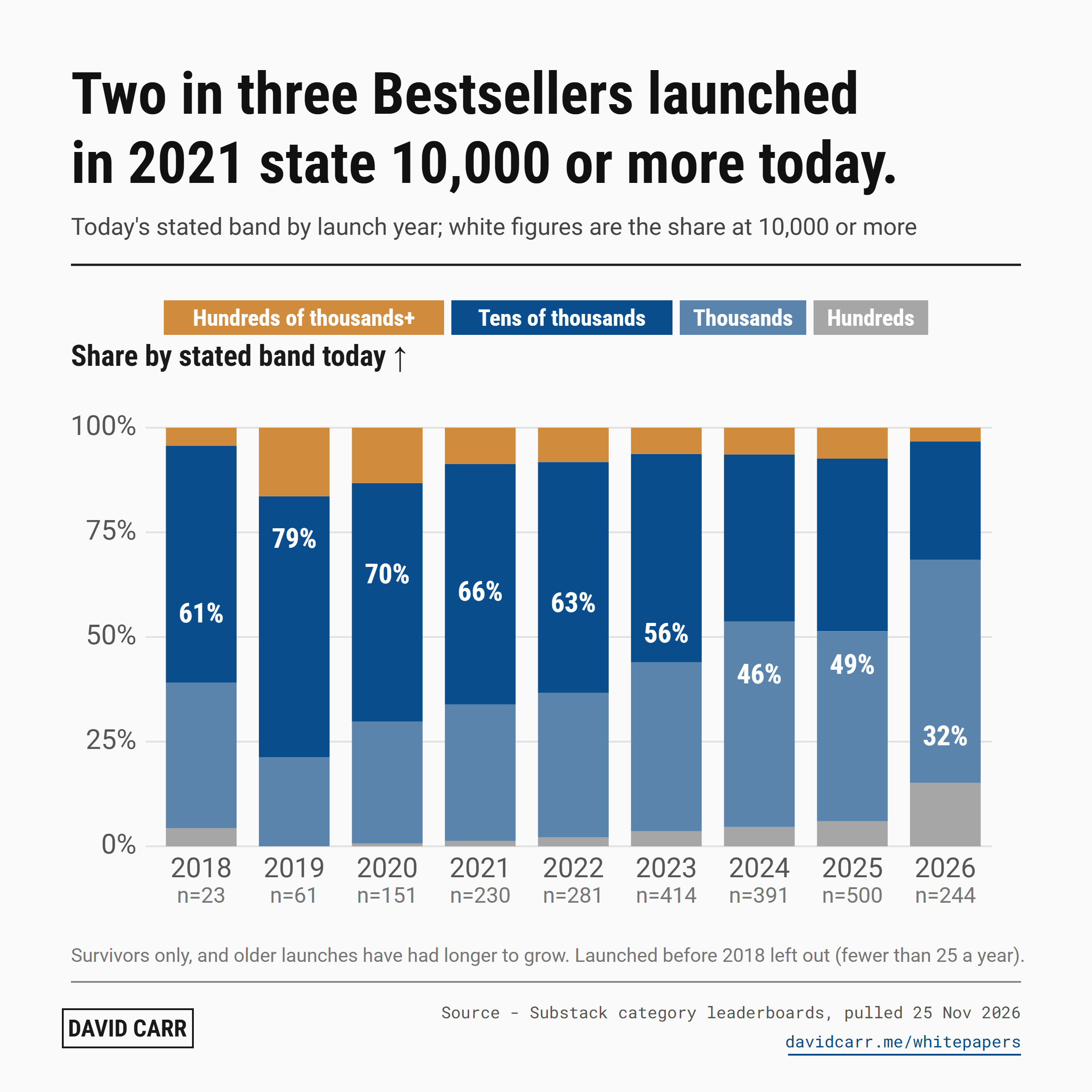
Two in three Bestsellers launched in 2021 state 10,000 or more today.
- Launched 2019: 79% state 10,000 or more (n = 61)
- Launched 2021: 66% (n = 230)
- Launched 2023: 56% (n = 414)
- Launched 2025: 49% (n = 500)
- Launched 2026: 32% (n = 244)
Newer launches have had less time, so a lower share is expected. What stands out is how many under-two-year-old newsletters already sit at 10,000 or more.
Survivors only. Bands are Substack's own wording.
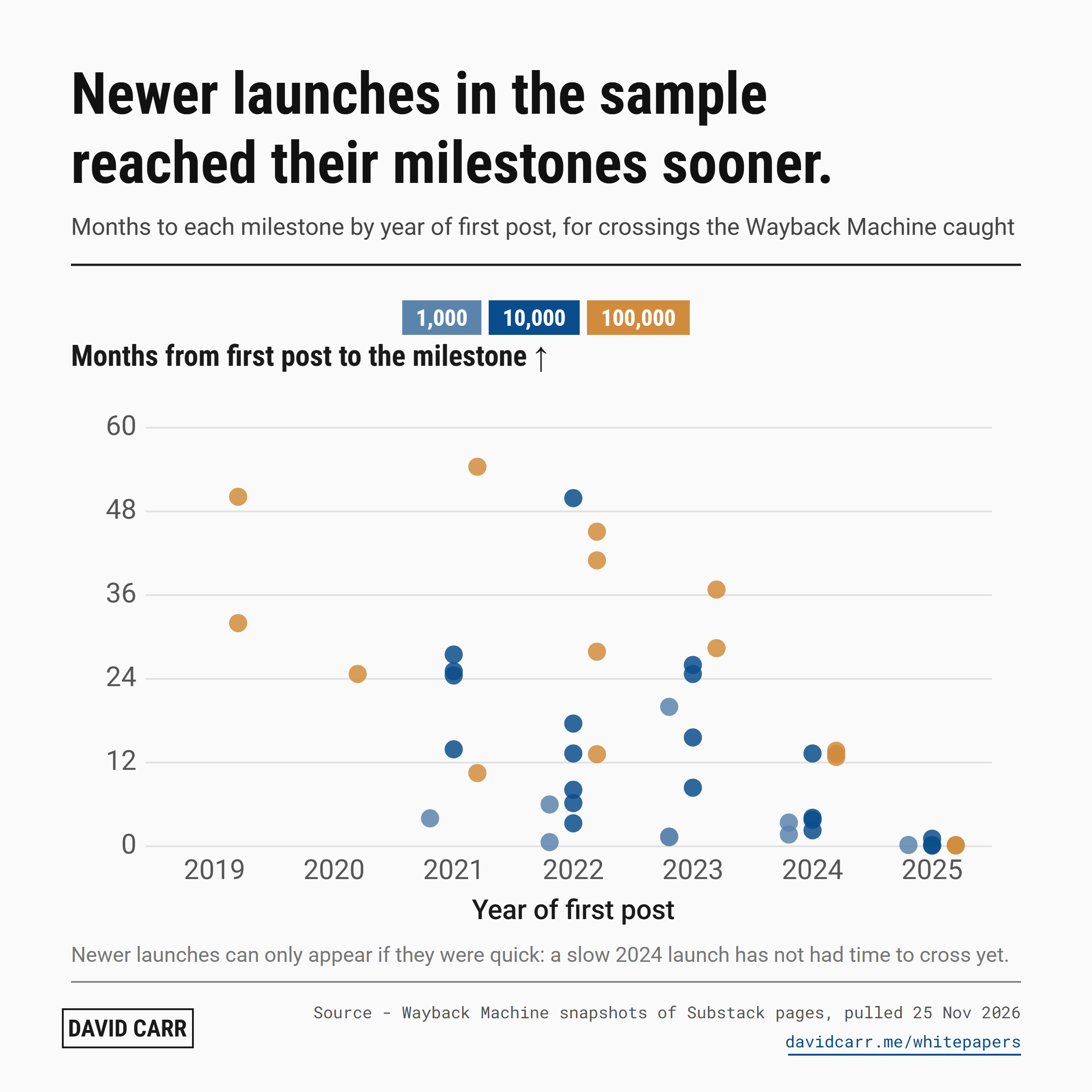
Newer launches in the sample reached their milestones sooner.
- One dot per newsletter and milestone, coloured by milestone
- Years with no dots had no crossing the snapshots could date
Read with care: a newsletter launched in 2024 can only be here if it crossed quickly, because it has not had time to cross slowly. This chart shows the pattern exists in the sample, not that growth has sped up.
Small sample, and the selection runs in the direction of the finding.
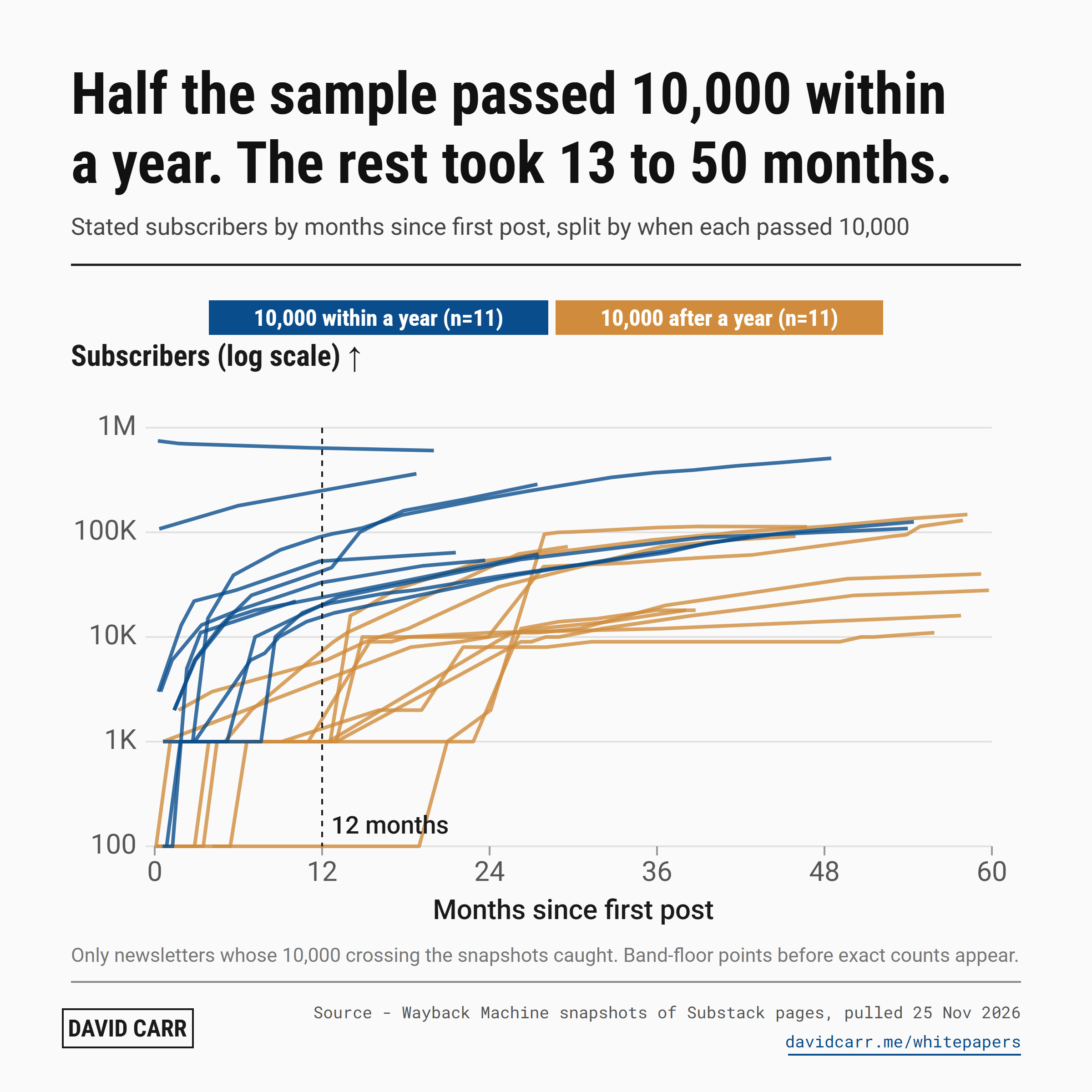
Half the sample passed 10,000 within a year. The rest took 13 to 50 months.
- Passed 10,000 within 12 months: 11 newsletters
- Passed 10,000 after 12 months: 11 newsletters
- Both groups are on today's Bestseller lists
The names here are neutral on purpose: in this sample, a slow first year was as common as a fast one among newsletters that went on to do well.
Only newsletters whose 10,000 crossing the snapshots caught.
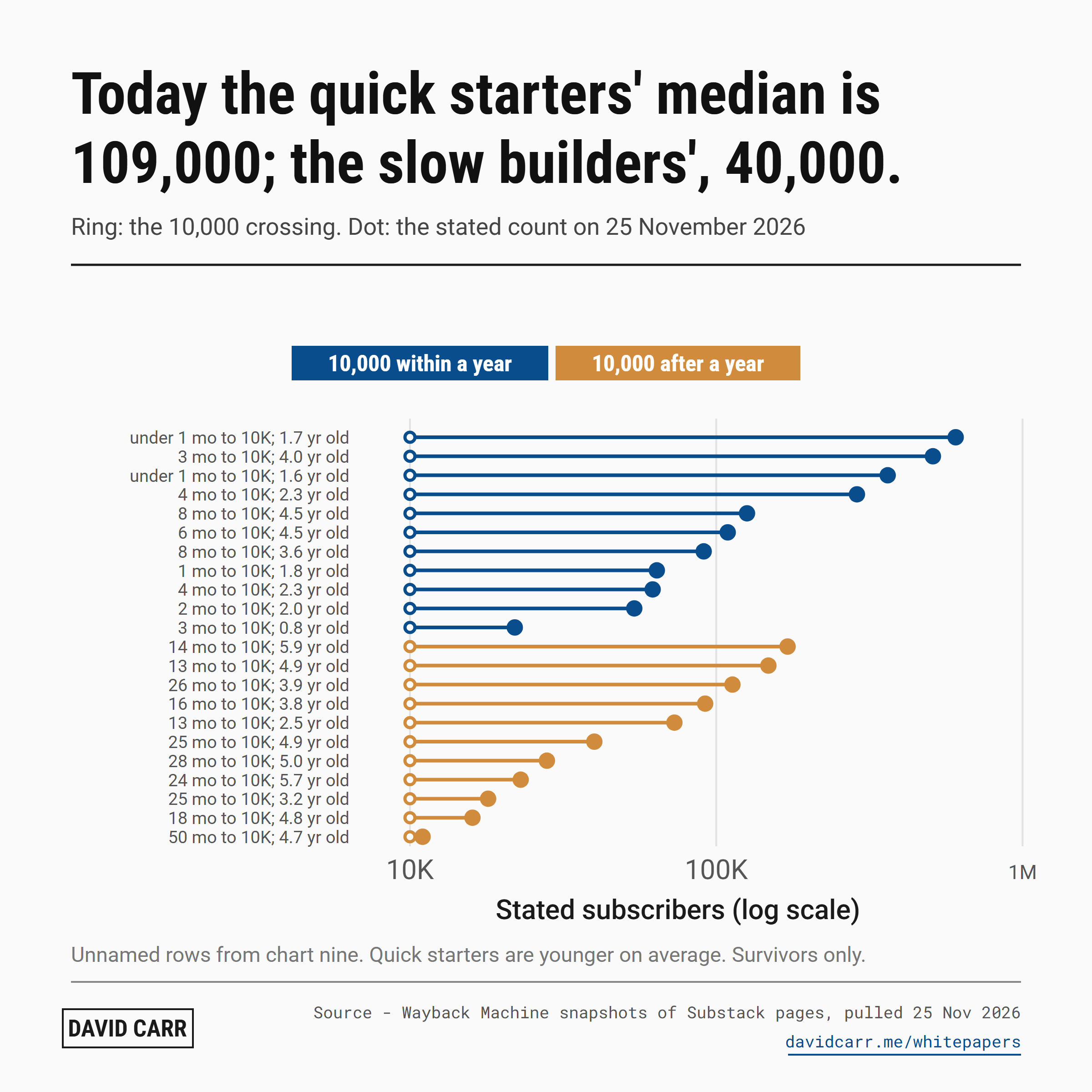
Today the quick starters' median is 109,000; the slow builders', 40,000.
- Passed 10,000 within a year: median 109,000 subscribers today (n = 11)
- Passed 10,000 after a year: median 40,000 today (n = 11)
- Every one of the 22 has grown past its 10,000 crossing
The quick starters are bigger today, and younger. A fast first year was a good sign in this sample, but the slow builders also kept growing.
Survivors only. Ages differ, so a younger newsletter has had less time to grow.
Method, caveats and sources
The short answer. Among newsletters that are on Substack's Bestseller lists today, the median time from first post to 10,000 subscribers was about 11 months, and to 100,000 about 26 months. The first 1,000 came fast for the recent launches the snapshots could see. Each tenfold step took longer than the last at the median (2, then 7, then 10 months). The samples are small and every number here is from survivors.
Read this first: the caveats. (1) Survivors only. Every newsletter here is on a Bestseller list today. The many that stalled or stopped are invisible, so every time here is faster than a typical newsletter's. (2) Rounded, self-reported counts. Substack rounds ("Over 12,000 subscribers") and writers choose what to say. (3) Free subscribers included. These are all subscribers, not paying ones. (4) Wayback gaps. The Wayback Machine visits pages irregularly; a crossing is only dated when snapshots either side of it are six months apart or less. (5) Milestone posts are self-selected. Writers post about milestones they are proud of, when they choose to.
The sample. Substack's public category leaderboards, pulled 25 November 2026: 4,553 publications across 28 categories. Political, news, international and climate categories were left out on purpose. The charts use English-language publications on a Bestseller (paid) list.
Method one: Wayback Machine snapshots. For each newsletter, the Wayback Machine's CDX API listed one snapshot a month of its home page (Substack and custom domain), from October 2021, when Substack pages began to state counts. Snapshots were fetched raw, at no more than one request a second, and cached. Each page's stated count was read: Substack's own "Over 12,000 subscribers" or band ("Thousands of subscribers"), or the writer's own "Join 12,000+ subscribers". Each crossing of 1,000, 10,000 and 100,000 was then narrowed down by fetching the months between. Crossings dated: 10 at 1,000, 22 at 10,000, 16 at 100,000. The fetch is slow (the archive answers a few requests a minute), so the sample is the 62 newsletters reached in the time available: ten named newsletters first, then a fixed random order of recent launches.
Method two: milestone posts. Each newsletter's public archive (its own JSON feed of every post) was searched for titles and subtitles that name a round count of subscribers or readers: 100, 1,000, 10,000, 100,000, 500,000 or a million. Every match was read by hand; most were not milestones (a survey with "3,000 responses", a song called "100,000"). Kept: 4 posts, from Lenny's Newsletter (500,000 and 1,000,000), The Pragmatic Engineer (one million readers) and The Generalist (100,000). Months to the milestone are counted from the first post to the milestone post. Archives searched: 88 publications (ten named first, then a fixed random order of Bestseller-list newsletters), as many as the time available allowed.
Start date. Substack's own first-post date for each publication. A few newsletters imported older posts from another platform, so their clock starts before they moved to Substack.
Also: From zero to an audience, Lenny's Newsletter, Substack and Newsletter cadence.