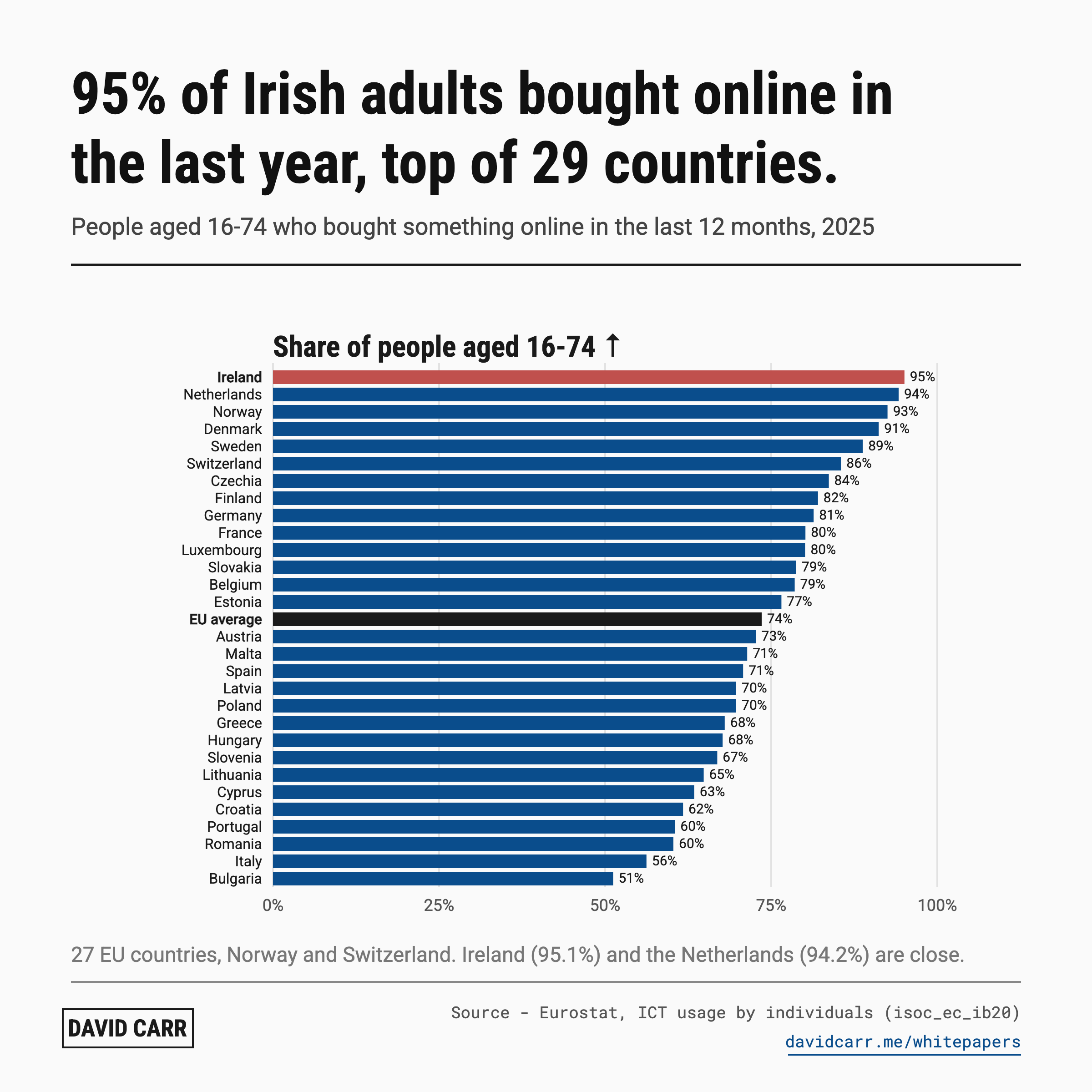
95% of Irish adults bought something online in the past year, the top of 29 countries.
- Ireland 95%, Netherlands 94%, Norway 93%, Denmark 91%, Sweden 89%
- EU average 74%
- All 29 countries are above 50%
Ireland and the Netherlands are within a point of each other, so think of them as joint top.
Eurostat survey on ICT usage in households and by individuals, 2025 (isoc_ec_ib20). People aged 16 to 74 whose last online purchase was in the past 12 months.
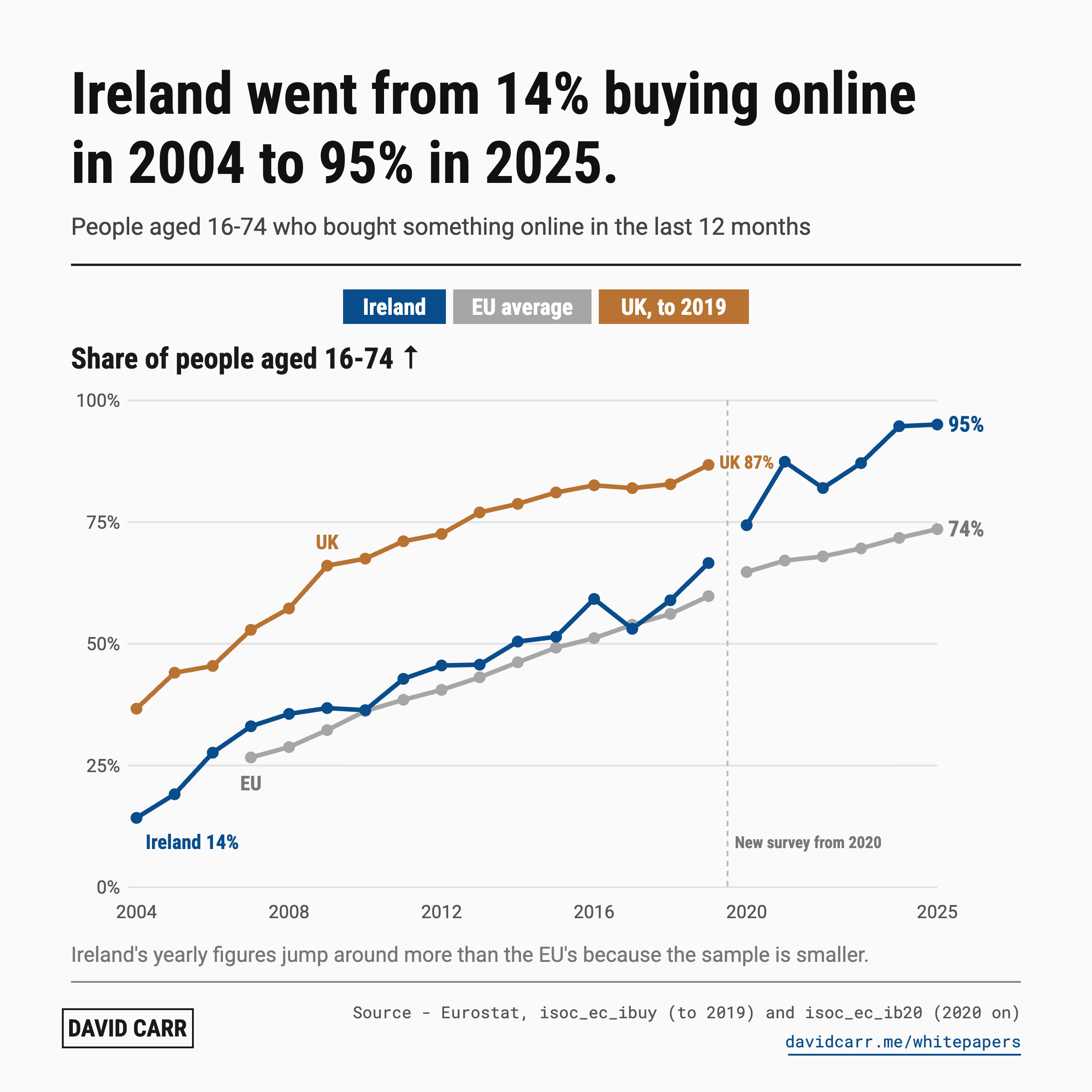
Ireland went from 14% buying online in 2004 to 95% in 2025.
- Ireland was above the EU average in most years from 2007
- 2019: Ireland 67%, EU 60%, UK 87% (the UK’s last year in the survey)
- 2025: Ireland 95%, EU 74%
The big jump in Ireland came from 2019 to 2021, the years of the pandemic.
The survey changed in 2020 (new dataset, isoc_ec_ib20), so the line is broken there. Ireland’s sample is smaller than the EU’s, so its line is bumpier.
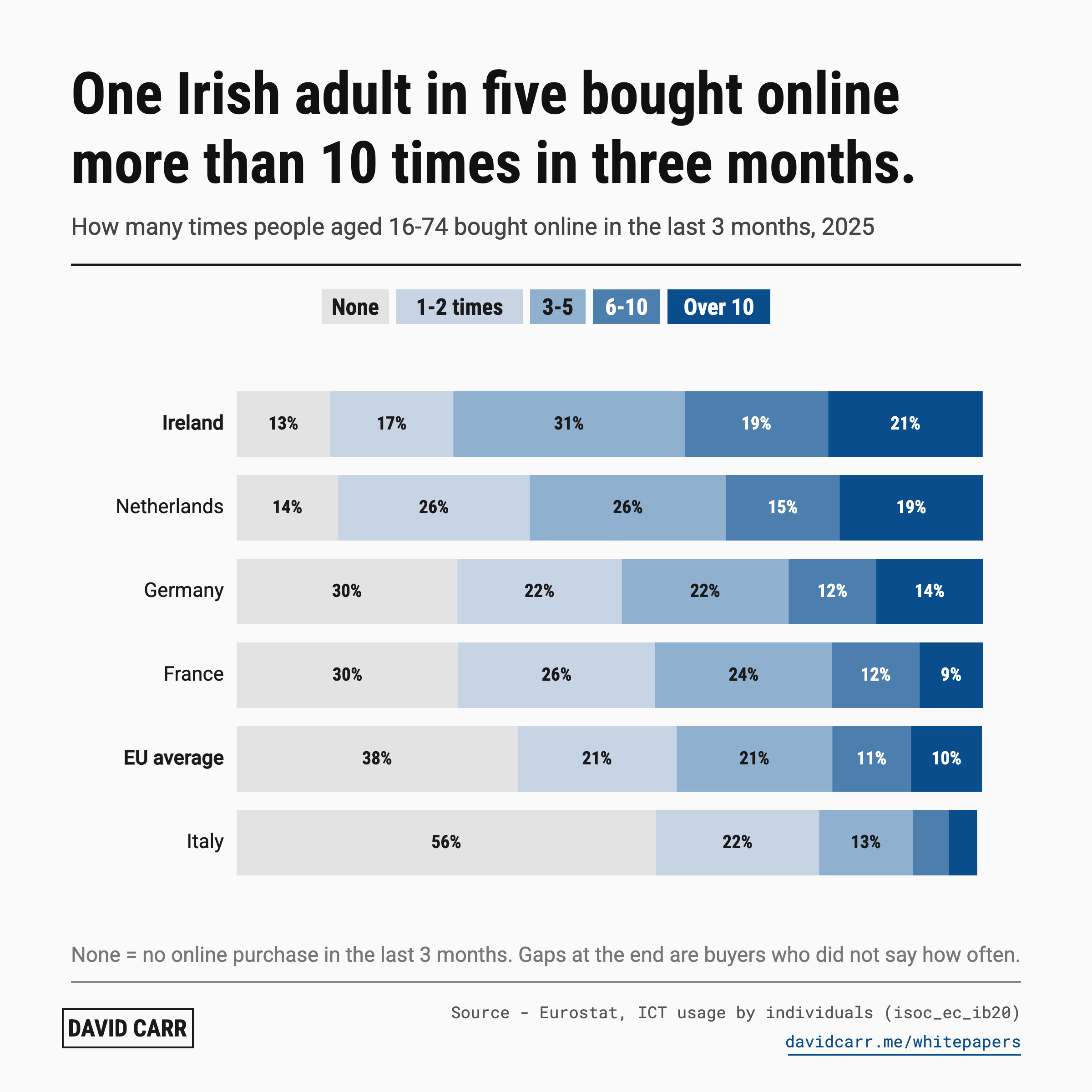
One Irish adult in five bought online more than 10 times in three months.
- Ireland: 21% more than 10 times, 19% 6 to 10 times, 31% 3 to 5 times
- EU average: 10% more than 10 times; 38% bought nothing online in the three months
- Netherlands: 19% more than 10 times
Irish people are not just more likely to buy online. They do it more often.
2025, people aged 16-74. The question asks about the three months before the survey.
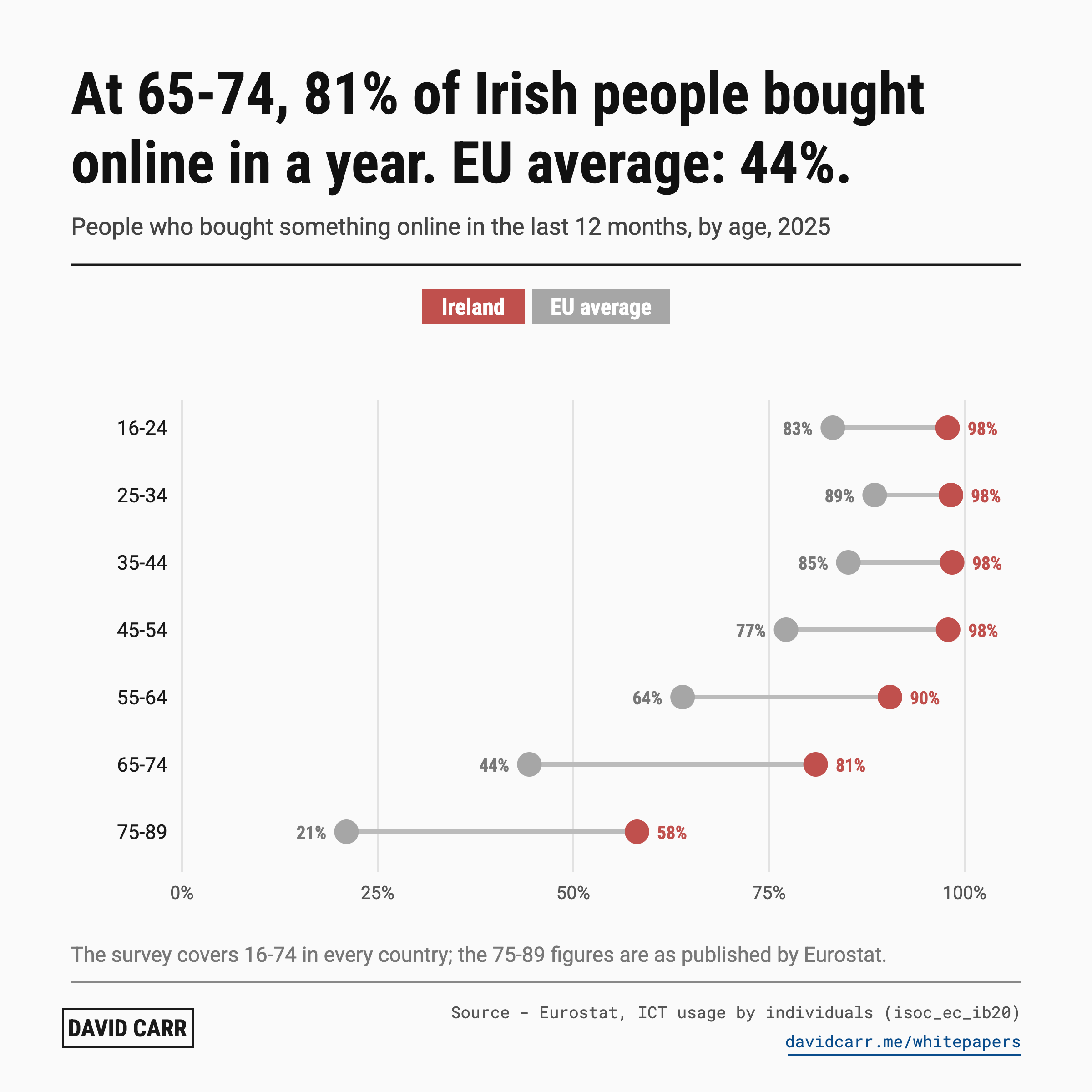
At 65-74, 81% of Irish people bought online in a year. EU average: 44%.
- Ireland: 98% from 16 to 54, then 90% at 55-64, 81% at 65-74 and 58% at 75-89
- EU average: 89% at 25-34, falling to 44% at 65-74 and 21% at 75-89
- The gap between Ireland and the EU is widest for the oldest groups
Online shopping in Ireland reaches much further up the age range than in most of Europe.
2025, last 12 months. The survey’s standard range is 16 to 74; the 75-89 figures are as Eurostat publishes them.
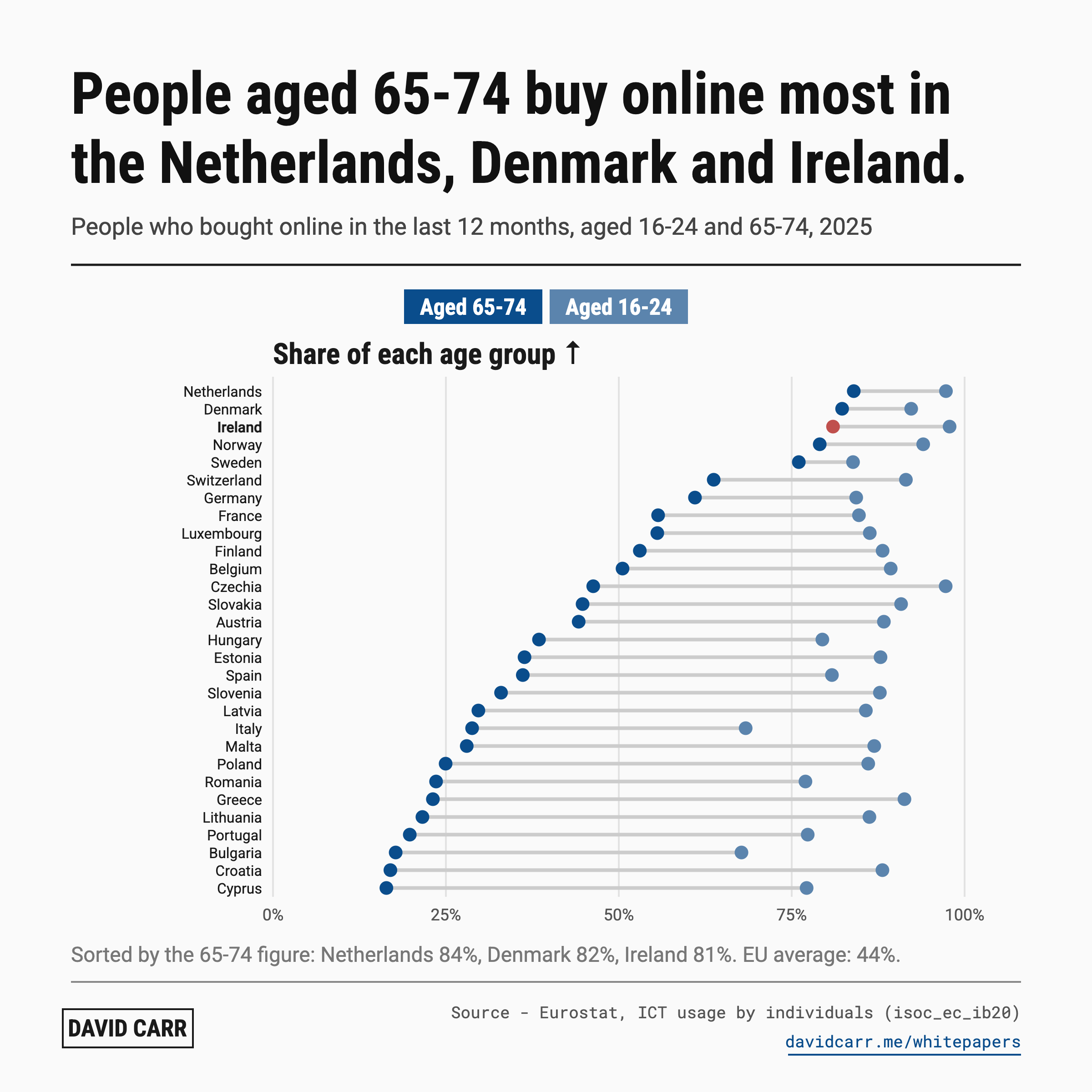
People aged 65-74 buy online most in the Netherlands, Denmark and Ireland.
- Aged 65-74: Netherlands 84%, Denmark 82%, Ireland 81%, Norway 79%, Sweden 76%
- Among 16-24s the range is much narrower, mostly 77% to 98%
- Smallest gap between young and old: Sweden, 8 points; Ireland, 17
Young people buy online almost everywhere. Where countries differ is the older generation.
2025, last 12 months, 27 EU countries, Norway and Switzerland.
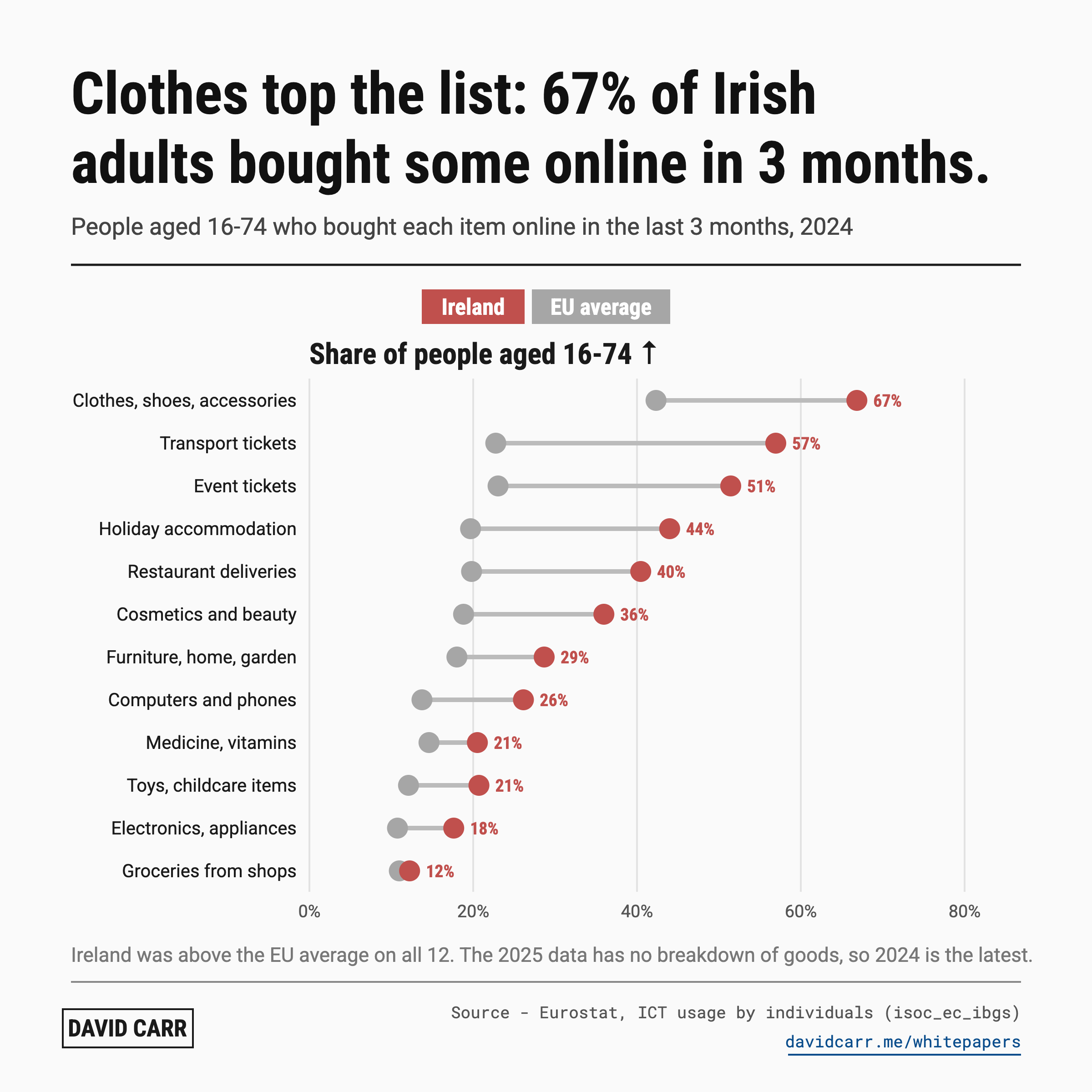
Clothes top the list: 67% of Irish adults bought some online in three months.
- Then transport tickets 57%, event tickets 51%, holiday accommodation 44%, restaurant deliveries 40%
- EU averages: clothes 42%, event tickets 23%, restaurant deliveries 20%
- Groceries from shops: Ireland 12%, EU 11%, the closest of the 12
Ireland is above the EU average on every item. The gap is biggest for tickets and travel.
Eurostat, isoc_ec_ibgs, 2024: the latest year with a breakdown of goods. Share of all people aged 16-74, not just online buyers.
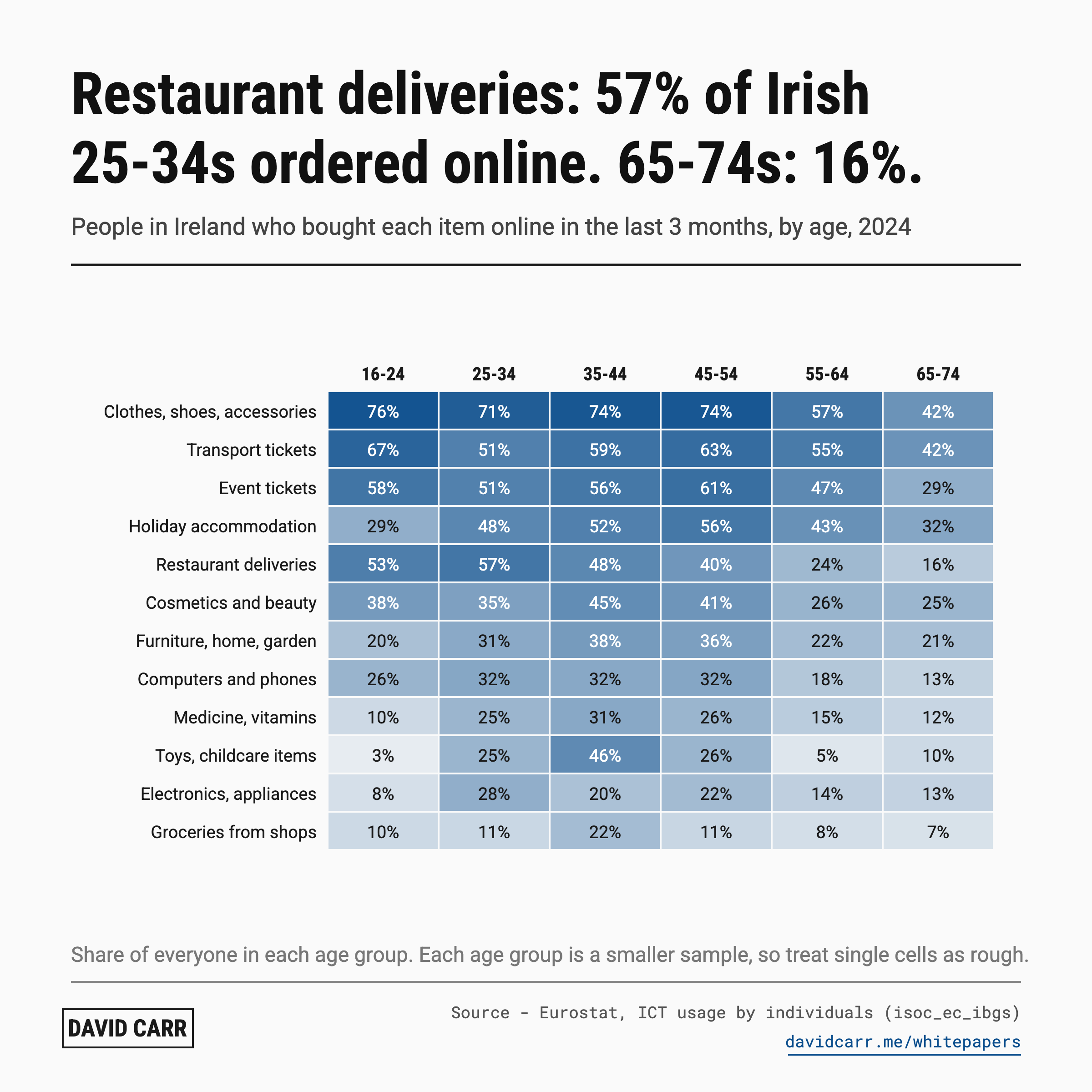
Restaurant deliveries: 57% of Irish 25-34s ordered online. 65-74s: 16%.
- Clothes: 71% to 76% of every age group from 16 to 54
- Toys and childcare items peak at 35-44: 46%
- Holiday accommodation peaks at 45-54: 56%
Clothes are bought online at every age. Food deliveries are the youngest habit and holidays the most middle-aged.
Ireland, 2024, last three months. Each age group is a smaller sample, so read single cells as rough.
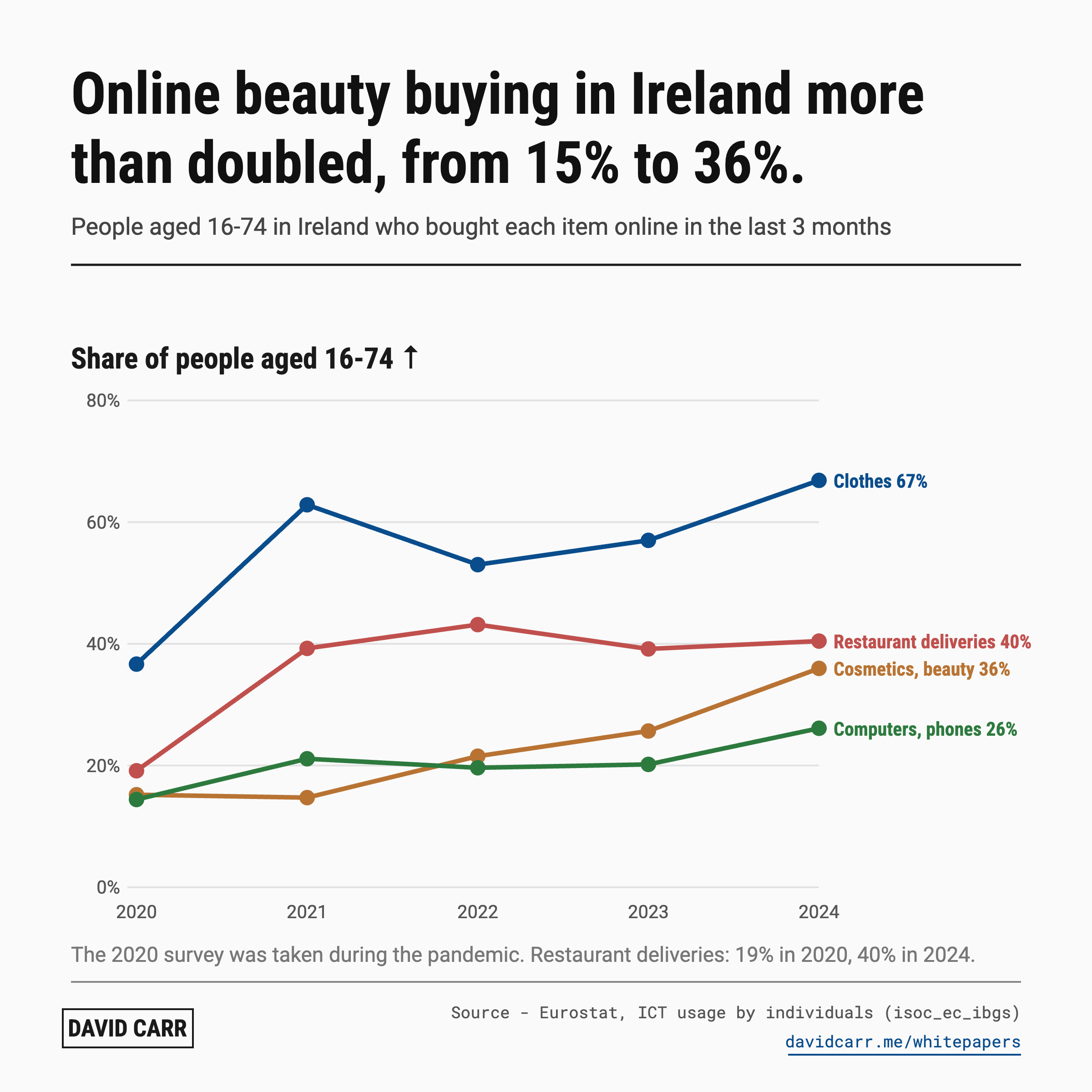
Online beauty buying in Ireland more than doubled, from 15% in 2020 to 36% in 2024.
- Clothes: 37% in 2020, 67% in 2024
- Restaurant deliveries: 19% in 2020, about 40% each year since 2021
- Computers and phones: 14% to 26%
Most of the jump in clothes and deliveries came in 2021. Beauty kept climbing after that.
The 2020 survey was taken during the pandemic, so it may not be a typical starting year.
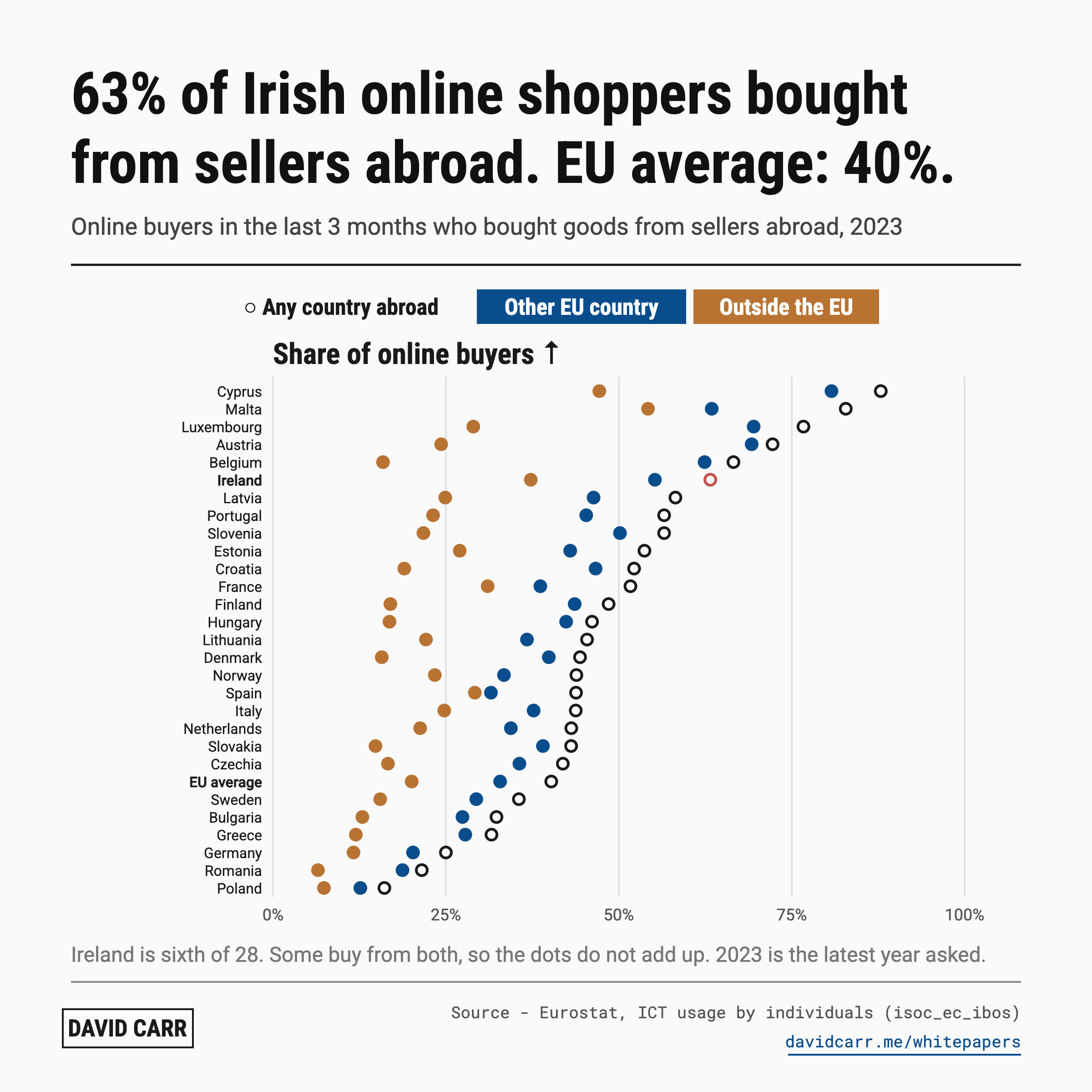
63% of Irish online shoppers bought goods from sellers abroad in 2023. EU average: 40%.
- Ireland: 55% from other EU countries, 37% from outside the EU, 74% from Irish sellers
- Top: Cyprus 88%, Malta 83%, Luxembourg 77%, Austria 72%, Belgium 67%, then Ireland
- Germany 25%, Poland 16%
Ireland is sixth of 28 countries. In Germany and Poland, most online buying stays with home sellers.
Eurostat, isoc_ec_ibos, 2023, the latest year asked. Share of people who bought online in the last three months. Many buy from more than one place.
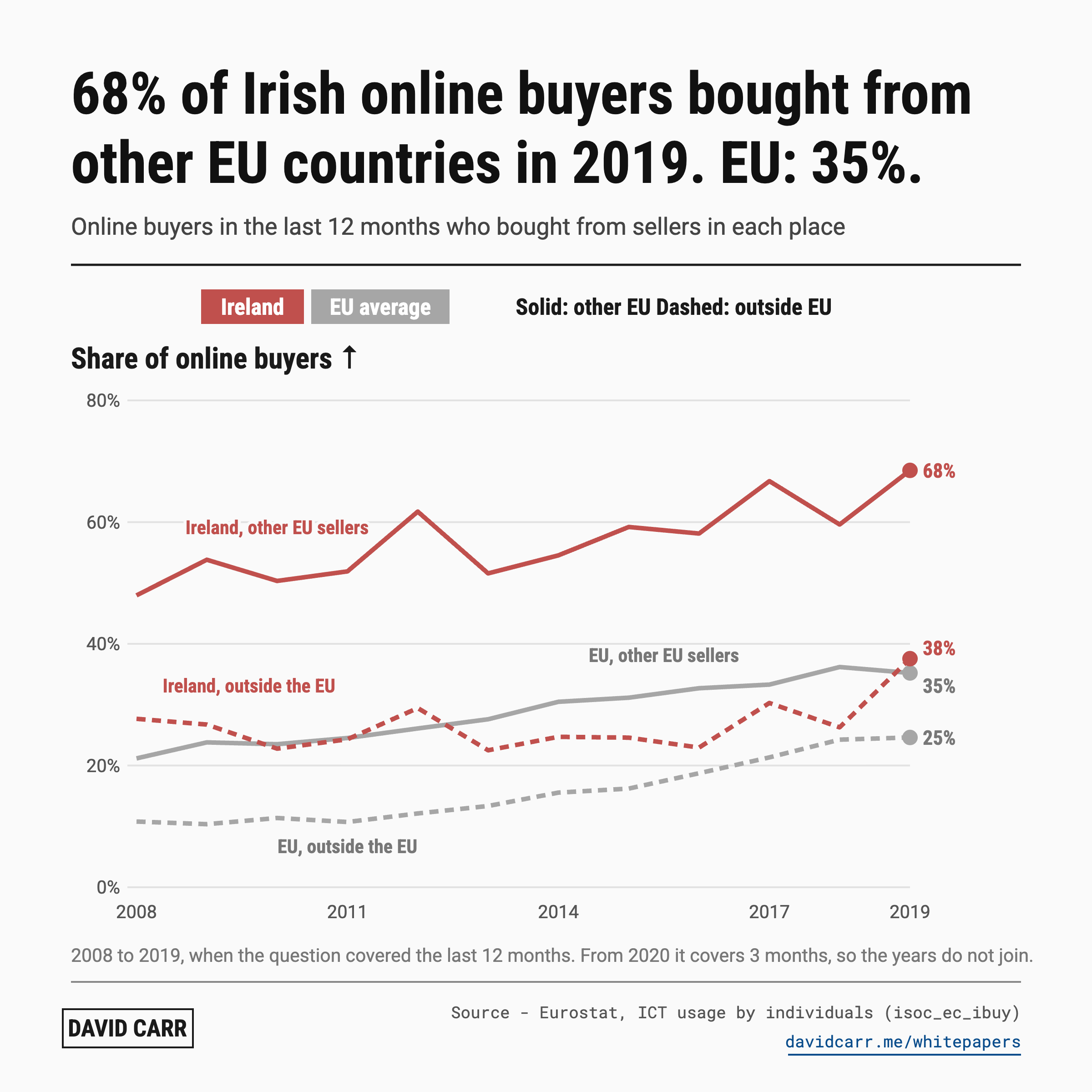
In 2019, 68% of Irish online buyers bought from other EU countries. EU: 35%.
- 2008: Ireland 48%, EU 21%
- From outside the EU, 2019: Ireland 38%, EU 25%
- Ireland was well above the EU average in every year from 2008 to 2019
Buying from abroad is not new for Irish shoppers. It was common long before the big online years.
2008 to 2019, when the question covered the last 12 months (isoc_ec_ibuy). From 2020 it covers three months, so the two periods are shown apart.
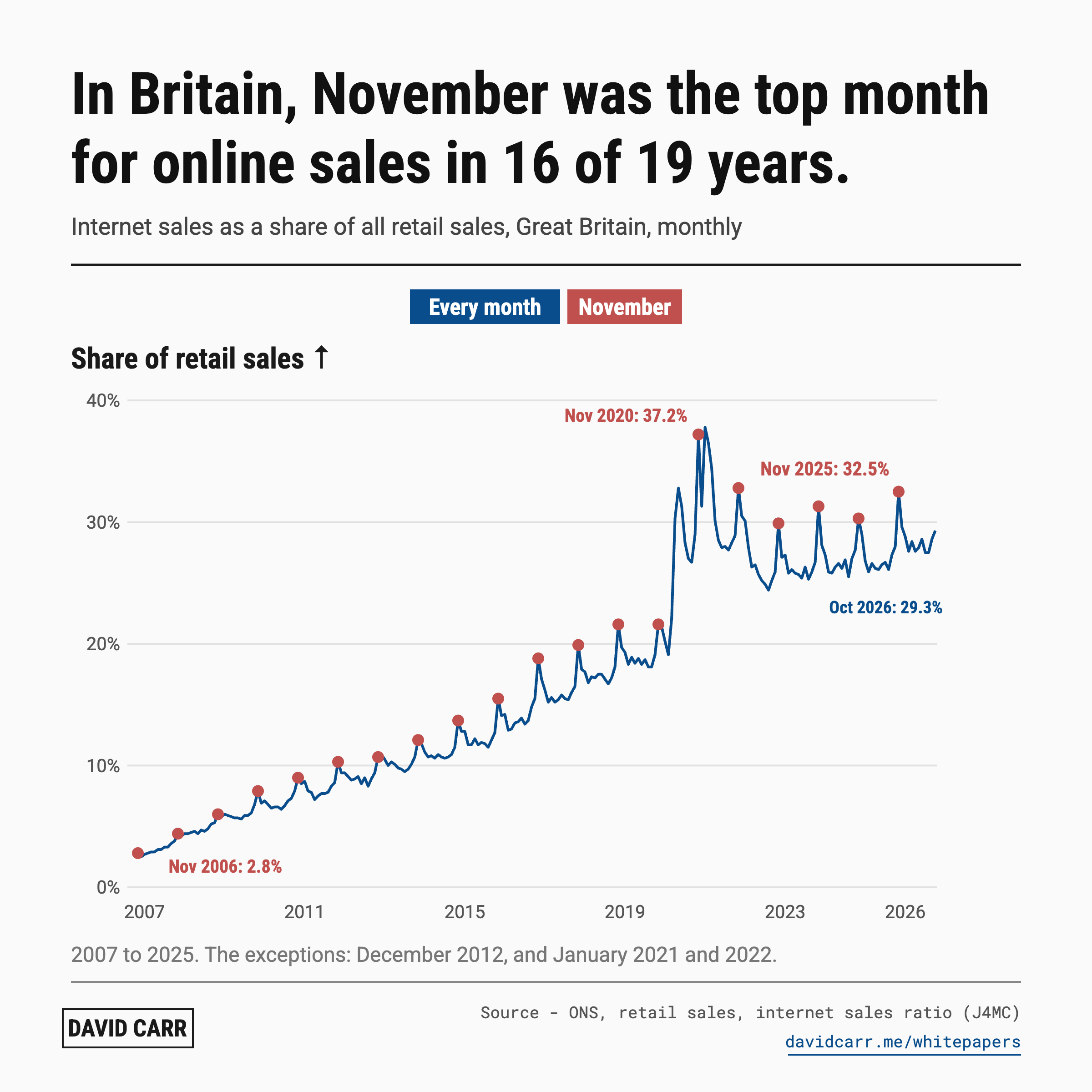
In Britain, November was the top month for online sales in 16 of 19 years.
- Internet share of retail sales: 2.8% in November 2006, 32.5% in November 2025
- The peak month on record: January 2021, 37.8%, when shops were shut
- October 2026: 29.3%
November, the month of Black Friday, is the online peak almost every year.
ONS retail sales, series J4MC, internet sales as a share of all retail sales, Great Britain, monthly, as published.
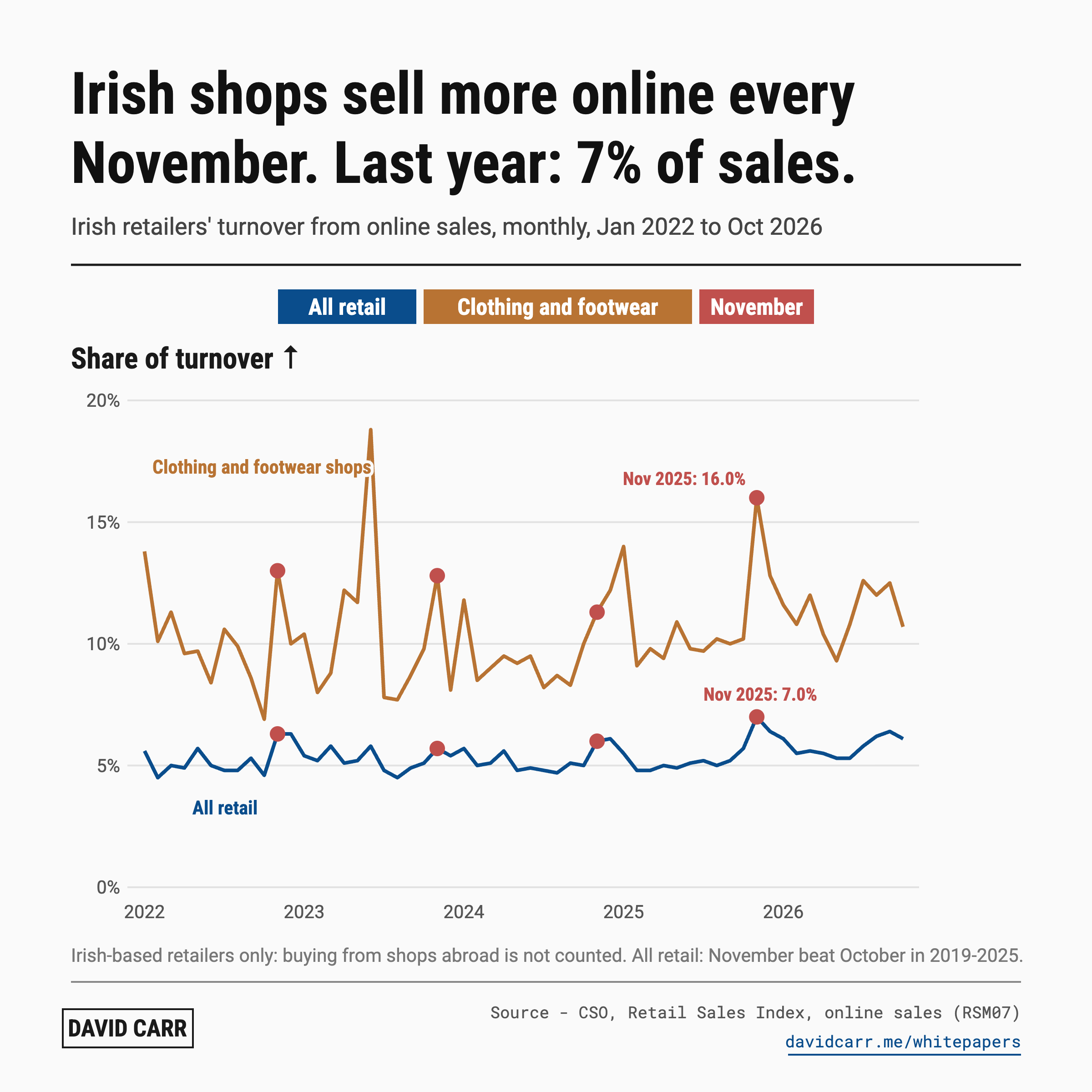
Irish shops sell more online every November. Last year: 7% of sales, the highest since 2021.
- All retail: November beat October in every year from 2019 to 2025
- November 2025: 7.0% of turnover online; clothing and footwear shops 16.0%
- October 2026: 6.1%
Irish retailers’ own online sales are small next to the 95% of adults who buy online. Much of that buying goes to sellers based abroad, which this measure leaves out.
CSO Retail Sales Index, table RSM07: online sales as a share of turnover, domestic retailers only. 2020 and 2021 are left off the chart because lockdown months reached 15% for all retail and 67% for clothing.
Method, caveats and sources
The short answer. Almost everyone in Ireland. In 2025, 95% of Irish adults aged 16 to 74 bought something online in the past year, the highest of 29 European countries, against an EU average of 74%. One in five bought online more than 10 times in three months. Older people in Ireland buy online far more than the European average: 81% at 65-74, against 44%. Clothes are the most common online buy, then travel and event tickets and restaurant deliveries. Irish online shoppers buy from sellers abroad much more than most Europeans. And November is the peak month: in Britain it was the top month for online sales in 16 of the last 19 years, and in Ireland shops’ online share rises every November.
Eurostat. The Eurostat survey on ICT usage in households and by individuals, run by national statistics offices each year (the CSO in Ireland). Datasets: isoc_ec_ibuy (2002 to 2019), isoc_ec_ib20 (2020 to 2025), isoc_ec_ibgs (what people bought, 2020 to 2025; item detail to 2024) and isoc_ec_ibos (origin of sellers, 2020 to 2023). Pulled 27 November 2026. Shares are of all people aged 16 to 74 unless the chart says otherwise. EU average = the EU27 (2020) aggregate. The UK took part until 2019.
Retail sales. CSO Retail Sales Index table RSM07 (online sales as a share of turnover, monthly, December 2018 to October 2026, updated 27 November 2026) and ONS series J4MC (internet sales as a share of all retail sales, Great Britain, monthly, November 2006 to October 2026).
Caveats. The survey is a sample, and Ireland’s is much smaller than the EU’s, so Irish yearly figures move around more; single age-group figures are rougher still. The survey changed in 2020 and the cross-border question moved from a 12-month to a 3-month window, so those series are shown separately. The 2020 survey was taken during the pandemic. The CSO measure covers retailers based in Ireland only, so it says nothing about Irish shoppers buying from abroad. The ONS and CSO measures are not the same, so compare their shape rather than their level.
Also: Black Friday: big day or myth? and How Ireland shops for Christmas