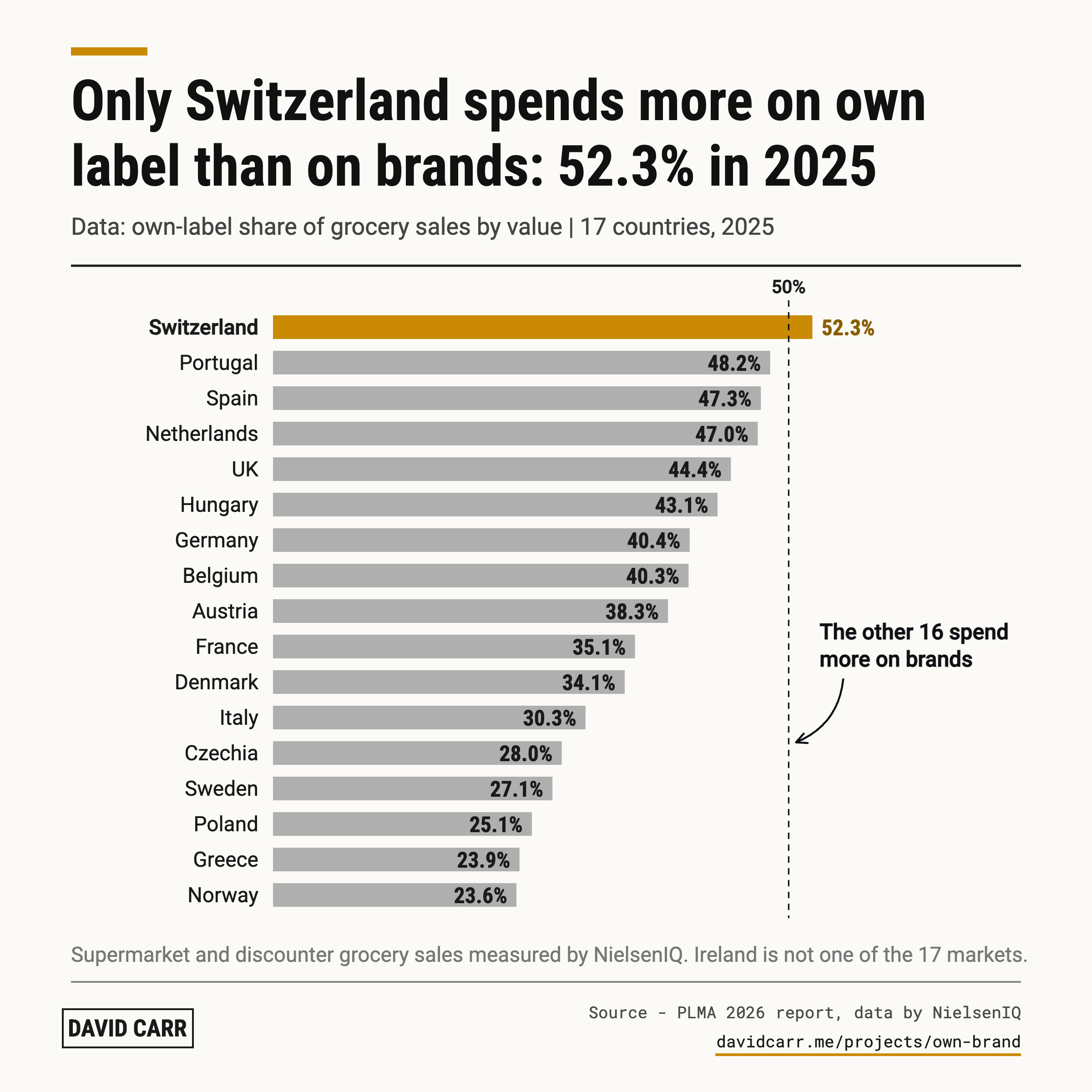
Only Switzerland spends more on own label than on brands: 52.3% in 2025
- Switzerland: 52.3%
- Portugal: 48.2%
- Spain: 47.3%
- UK: 44.4%
- Germany: 40.4%
- Italy: 30.3%
- Norway: 23.6%
Across the 17 countries, shoppers spent €387bn on own label in 2025, 38.8% of €1,000bn in grocery sales (PLMA 2026 report). Brands still lead everywhere except Switzerland.
NielsenIQ till data for PLMA, full year 2025. Ireland is not one of the 17 markets; Irish figures below come from Kantar’s shopper panel.
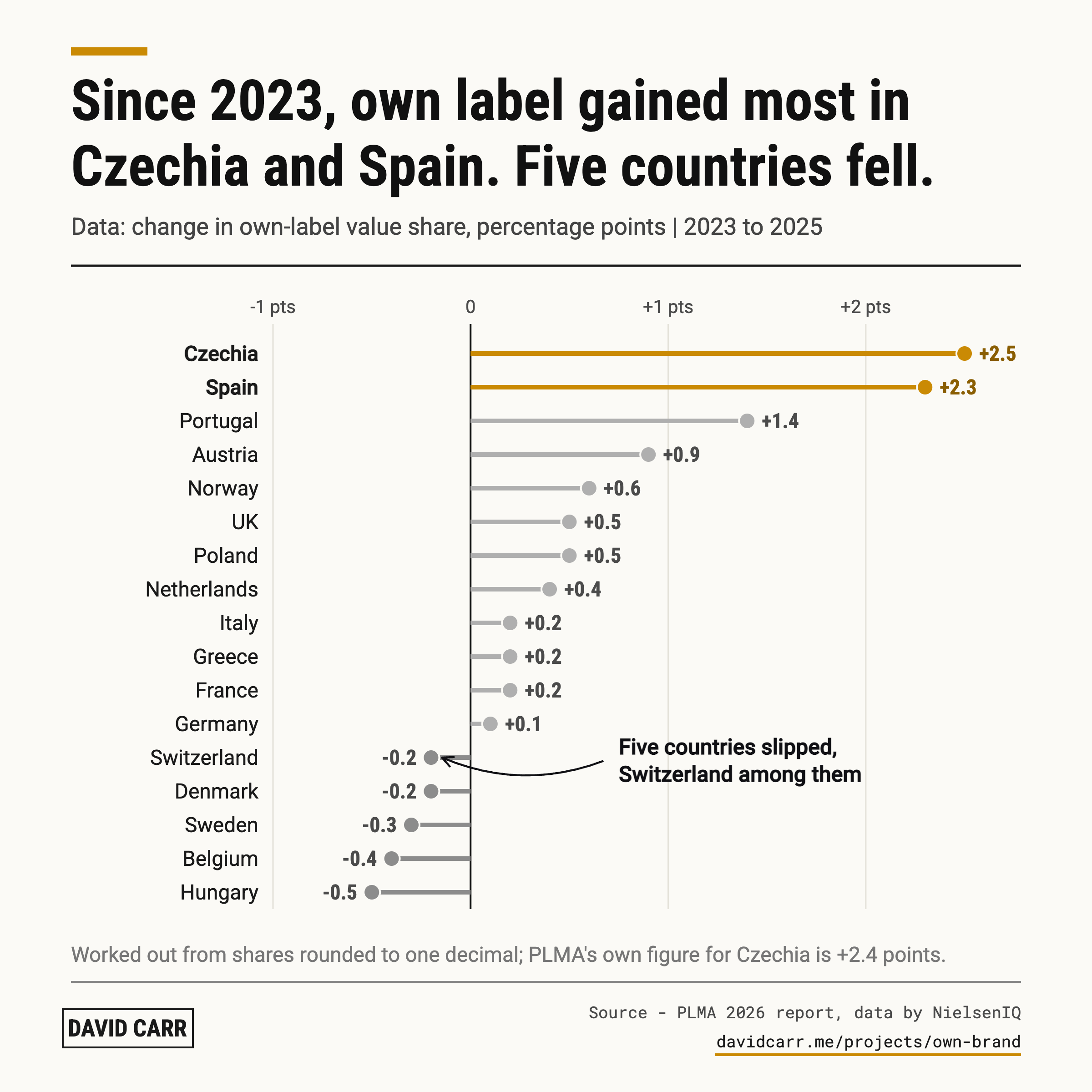
Since 2023, own label gained most in Czechia and Spain. Five countries fell.
- Czechia: +2.5 points (PLMA says +2.4)
- Spain: +2.3
- Portugal: +1.4
- UK: +0.5
- Switzerland: −0.2
- Hungary: −0.5
In Spain, own-label sales rose 7% in 2025 against 2.4% for brands. PLMA notes that Aldi left Denmark in November 2023, one reason it gives for Denmark’s small fall (PLMA).
My sums from the shares in the PLMA 2026 report, table on page 10, rounded to one decimal.
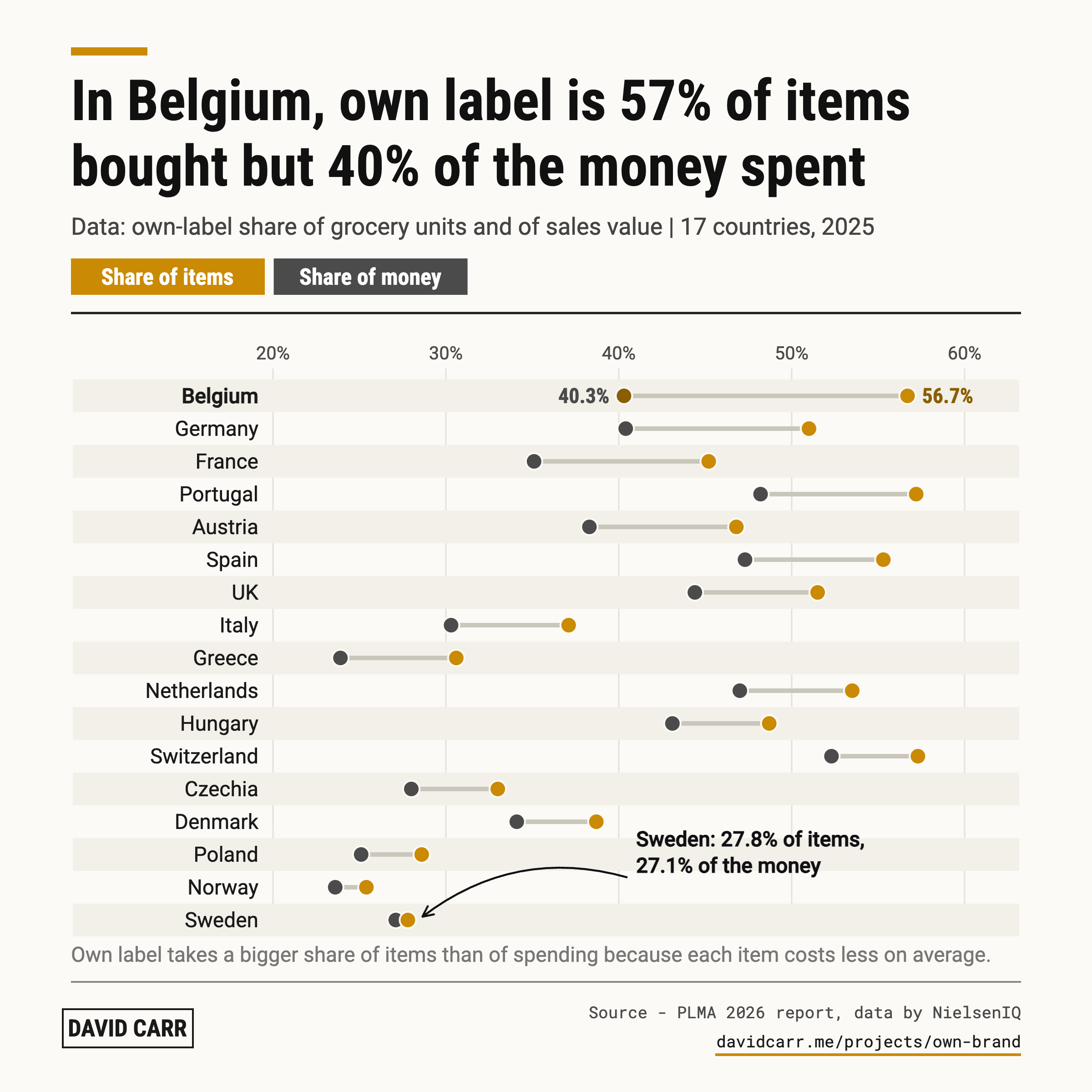
In Belgium, own label is 57% of items bought but 40% of the money spent
- Belgium: 56.7% of items, 40.3% of money
- Germany: 51.0% and 40.4%
- UK: 51.5% and 44.4%
- Sweden: 27.8% and 27.1%
In seven countries own label is more than half of the items in the basket. In none except Switzerland is it more than half of the spending. The gap is a rough measure of how much cheaper each own-label item is.
Unit and value shares, full year 2025, from the PLMA 2026 report.
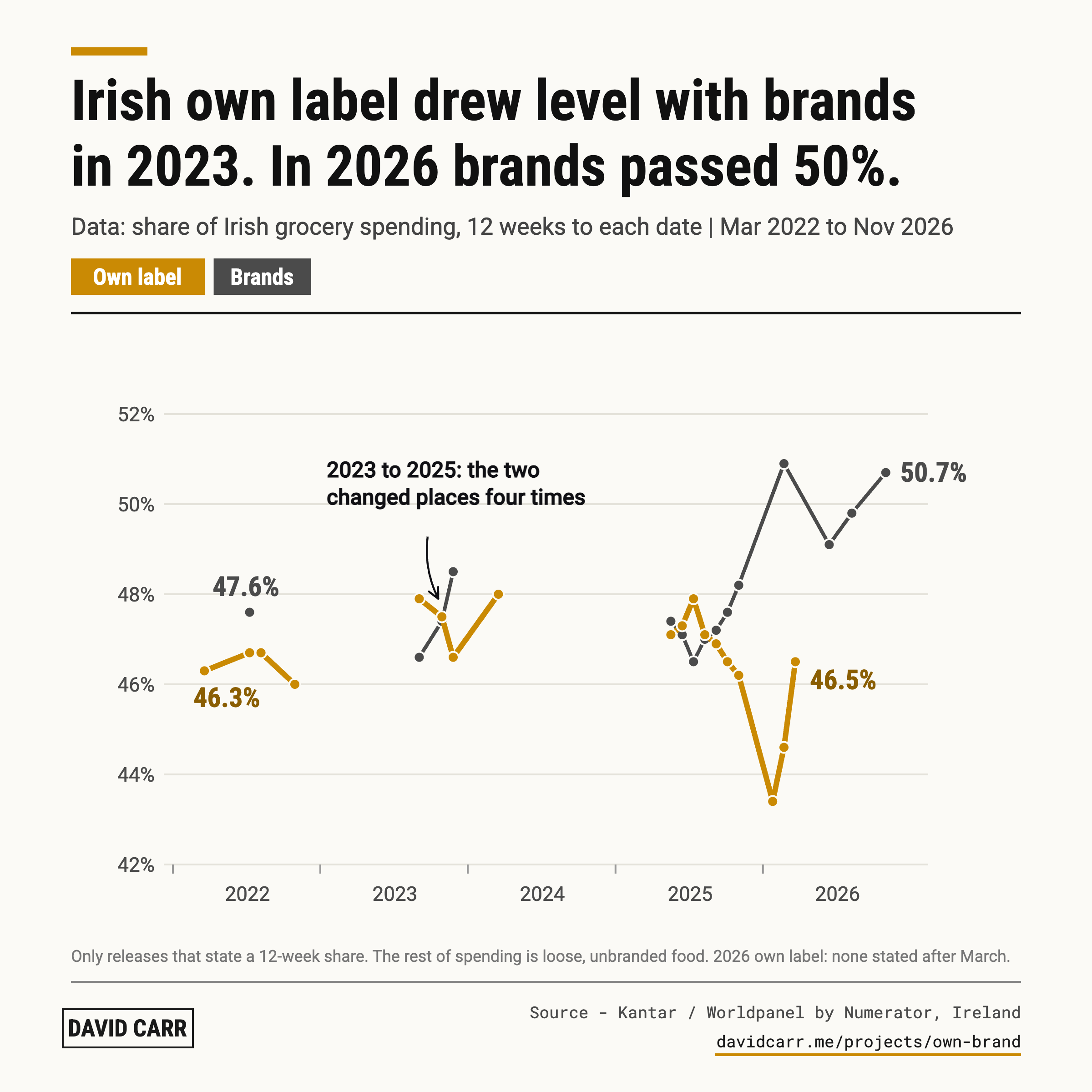
Irish own label drew level with brands in 2023. In 2026 brands passed 50%.
- 12 weeks to 10 Jul 2022: own label 46.7%, brands 47.6%
- 4 weeks to 14 May 2023: both 47.3%, which Kantar called the first time level
- 12 weeks to 3 Sep 2023: own label 47.9%, brands 46.6%
- 12 weeks to 17 Mar 2024: own label 48%
- 12 weeks to 1 Nov 2026: brands 50.7%
Kantar’s May 2023 release said own label and brands each held 47.3%, “the first time that we see branded and own label on equal terms” (Kantar). By November 2026 brands held 50.7% (ESM). Own-label share dips each Christmas and January.
Kantar, now Worldpanel by Numerator, monthly Ireland releases: Jul 2022, Sep 2023, Mar 2024, Jul 2025, Mar 2026, Nov 2026. Only 12-week shares are drawn. Since April 2026 the releases give only the brand share.
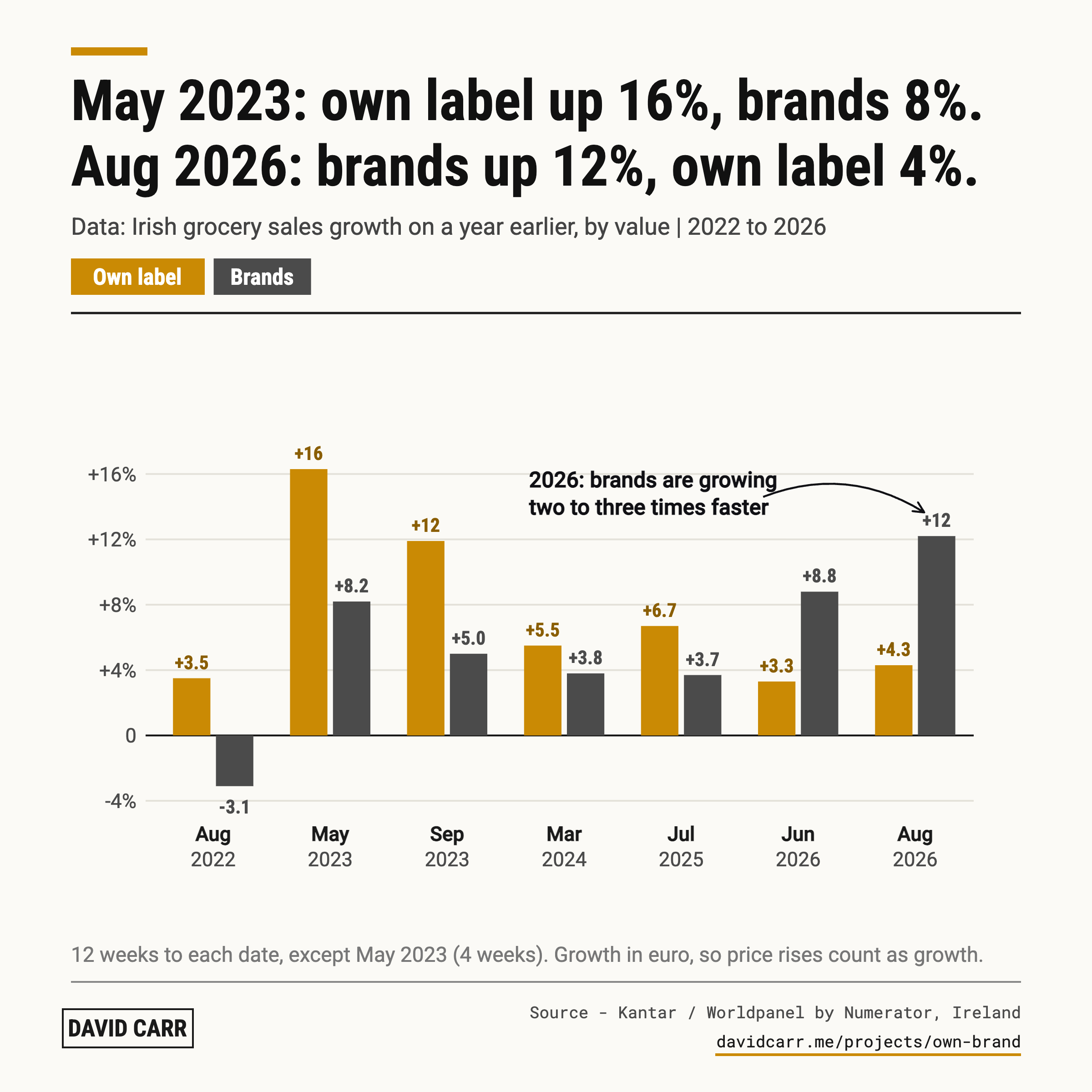
May 2023: own label up 16%, brands 8%. Aug 2026: brands up 12%, own label 4%.
- Aug 2022: own label +3.5%, brands −3.1%
- May 2023: +16.3% and +8.2%
- Sep 2023: +11.9% and +5.0%
- Jul 2025: +6.7% and +3.7%
- Aug 2026: +4.3% and +12.2%
From 2022 to mid-2025 own label grew faster than brands in almost every release. In 2026 that flipped: brands have grown two to three times as fast since April. Both are in euro, so higher prices count as growth.
Kantar Ireland: Aug 2022, May 2023, Sep 2023, Mar 2024, Jul 2025, Jun 2026, Aug 2026.
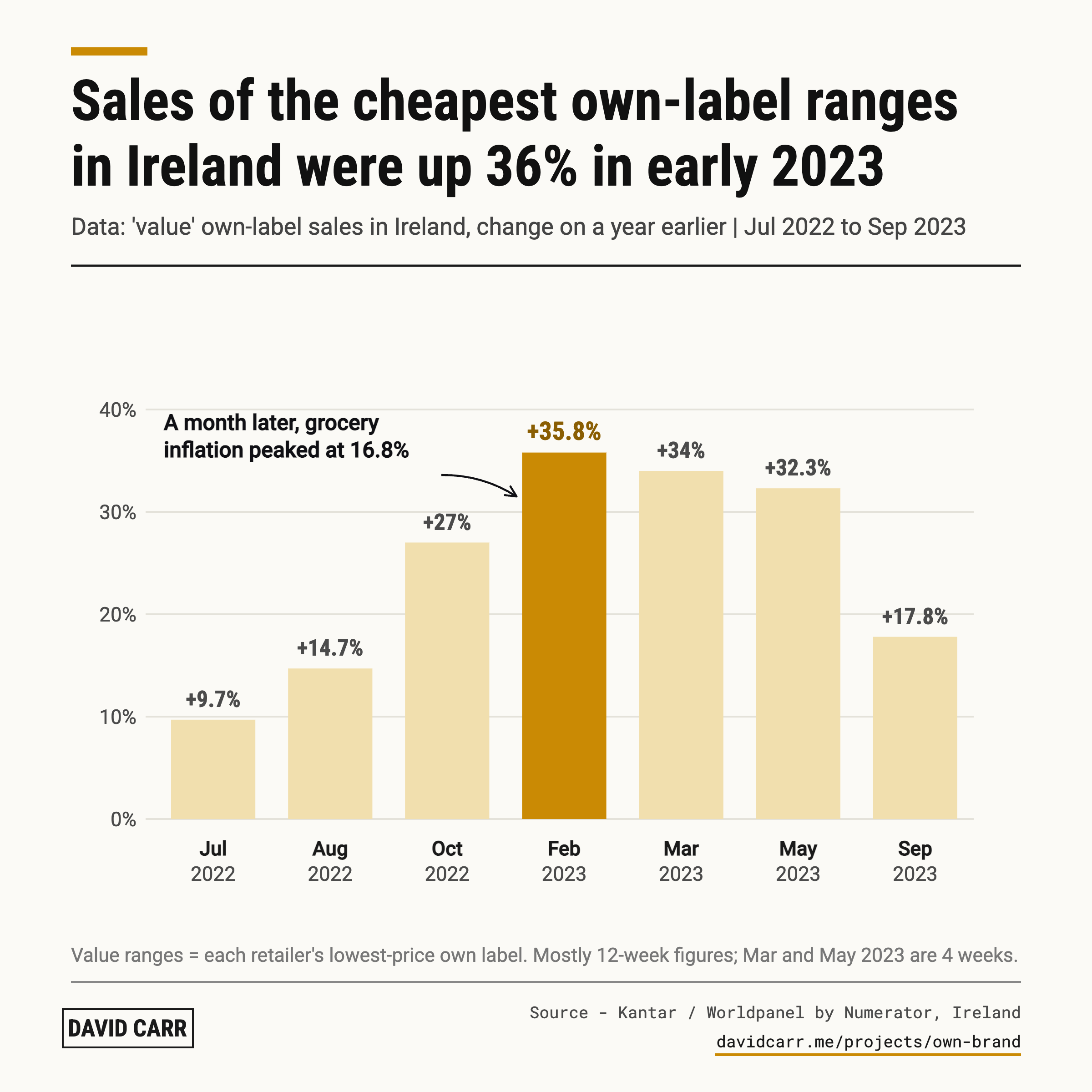
Sales of the cheapest own-label ranges in Ireland were up 36% in early 2023
- Jul 2022: +9.7%
- Oct 2022: +27%
- Feb 2023: +35.8%
- May 2023: +32.3%
- Sep 2023: +17.8%
These are the lowest-price lines each supermarket sells under its own name. Grocery inflation peaked at 16.8% in the 12 weeks to 19 March 2023 (Irish Times). In Britain, Kantar put value own-label growth at 42% in late 2022 (Kantar GB). From late 2023 Kantar switched to reporting premium own label, which grew 10% to 16% a year through 2024 to 2026.
Kantar Ireland: Jul 2022, Aug 2022, Oct 2022, Feb 2023, Mar 2023, May 2023, Sep 2023.
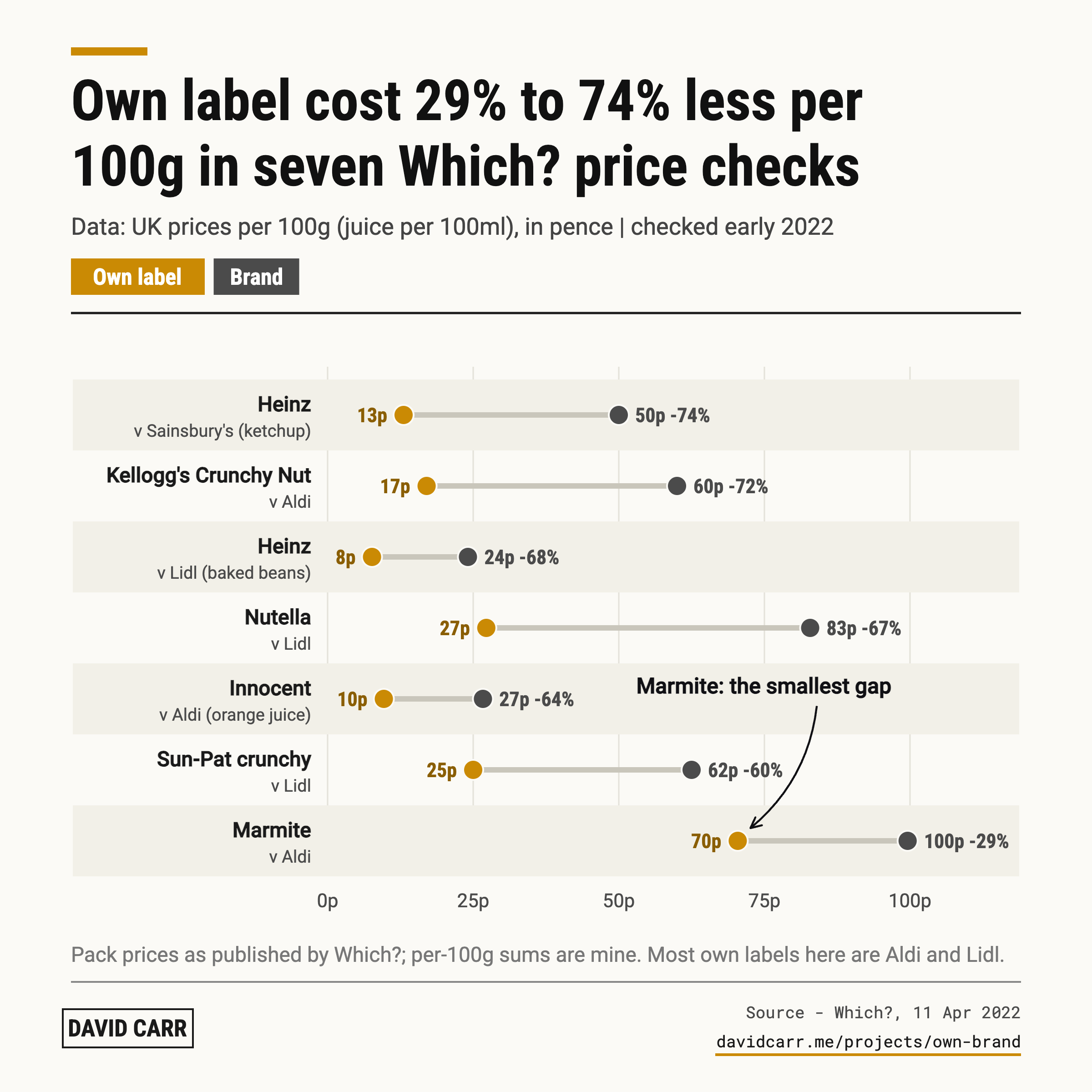
Own label cost 29% to 74% less per 100g in seven Which? price checks
- Heinz ketchup 50p v Sainsbury’s 13p per 100g
- Kellogg’s Crunchy Nut 60p v Aldi 17p
- Nutella 83p v Lidl 27p
- Marmite 100p v Aldi 70p
The gap is widest on staples like ketchup, cereal and beans. These are UK prices from early 2022; the gap moves as prices change. Heinz beans were £1 a tin in this check and £1.40 in Which?’s September 2024 test.
Pack prices from Which?, 11 April 2022, “correct at the time of testing”. Per-100g sums are mine. Brand prices: retailer not stated.
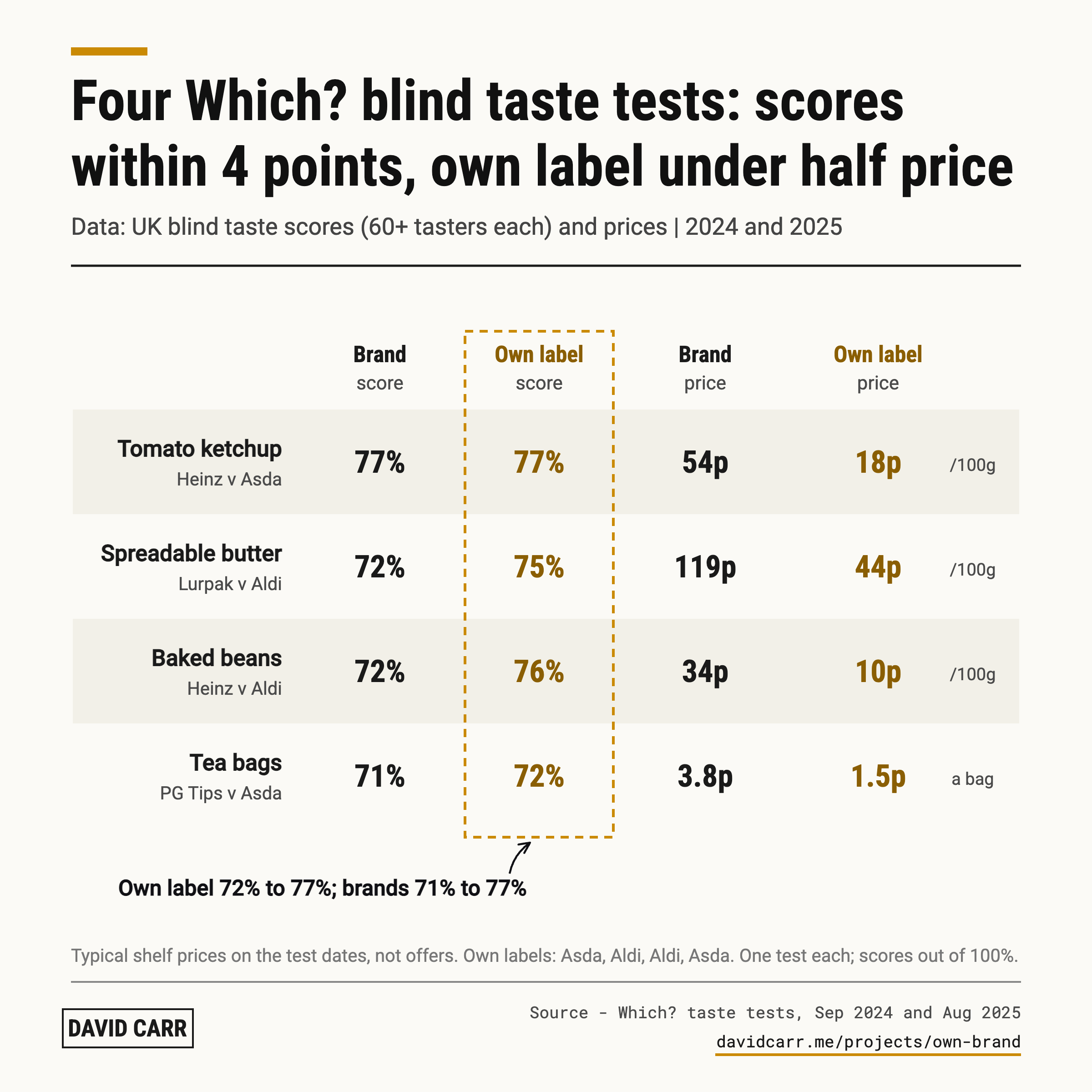
Four Which? blind taste tests: scores within 4 points, own label under half price
- Ketchup: Heinz 77%, Asda 77%; 54p v 18p per 100g
- Spreadable butter: Lurpak 72%, Aldi 75%; £1.19 v 44p
- Baked beans: Heinz 72%, Aldi 76%; 34p v 10p
- Tea: PG Tips 71%, Asda 72%; 3.8p v 1.5p a bag
Scores are averages from panels of 60 to 79 people tasting blind. Brands came first in other Which? tests, such as instant coffee in 2022. One test each, so treat these as examples, not a rule.
Which?: ketchup and butter, 28 Aug 2025; beans, 27 Sep 2024; tea, 6 Sep 2024. Typical prices, not offers.
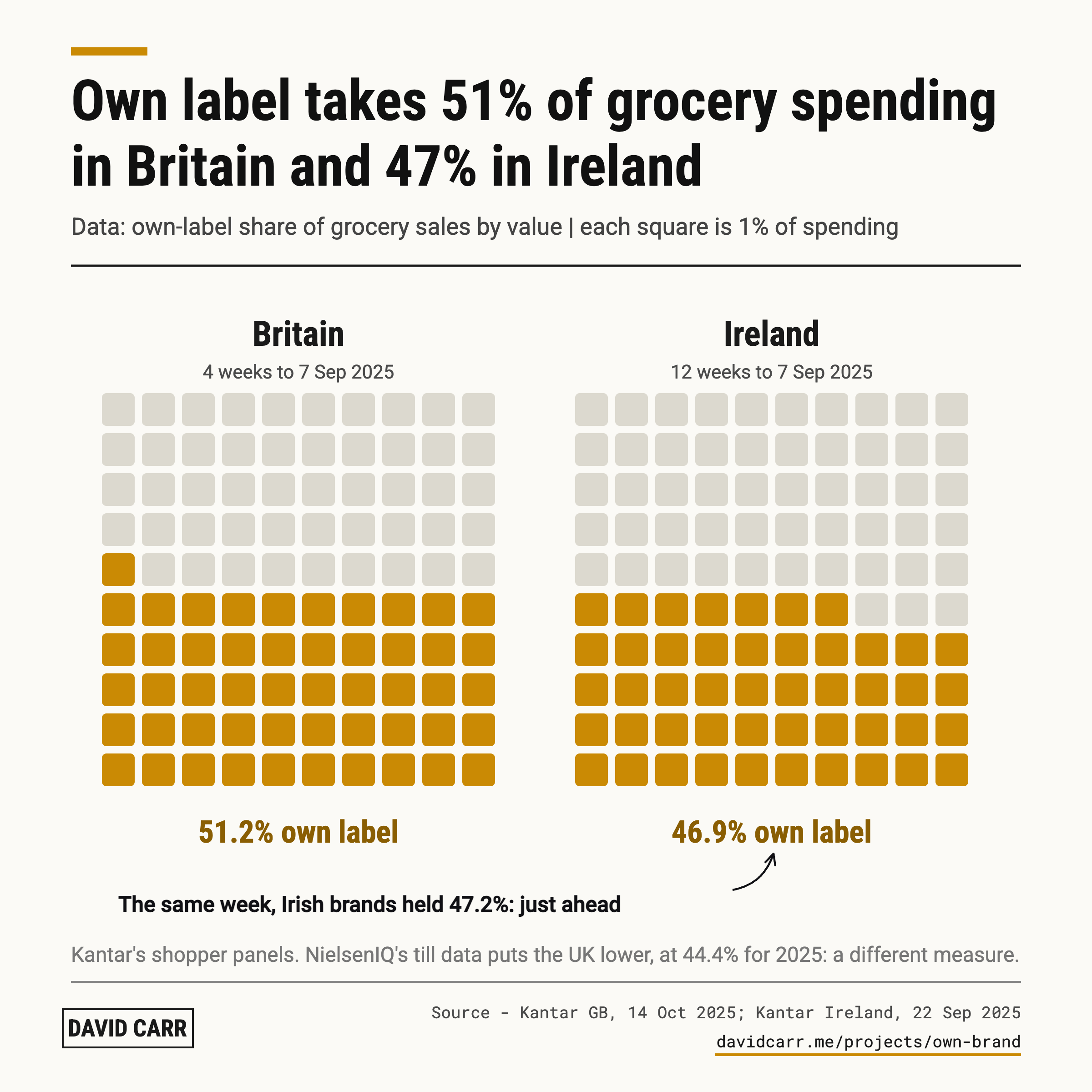
Own label takes 51% of grocery spending in Britain and 47% in Ireland
- Britain, 4 weeks to 7 Sep 2025: 51.2% (50.9% a year before)
- Ireland, 12 weeks to 7 Sep 2025: 46.9%, brands 47.2%
- Britain’s record: about 52%, in January 2025 and January 2026
Kantar’s GB panel first passed 51.6% in August 2022, “the biggest share we’ve ever recorded” (Kantar GB). Lidl and Aldi’s rise in both markets is on Who Ireland buys its groceries from.
Kantar GB, 14 Oct 2025; Kantar Ireland, 22 Sep 2025. NielsenIQ’s UK figure (44.4% for 2025) measures something different and is lower.
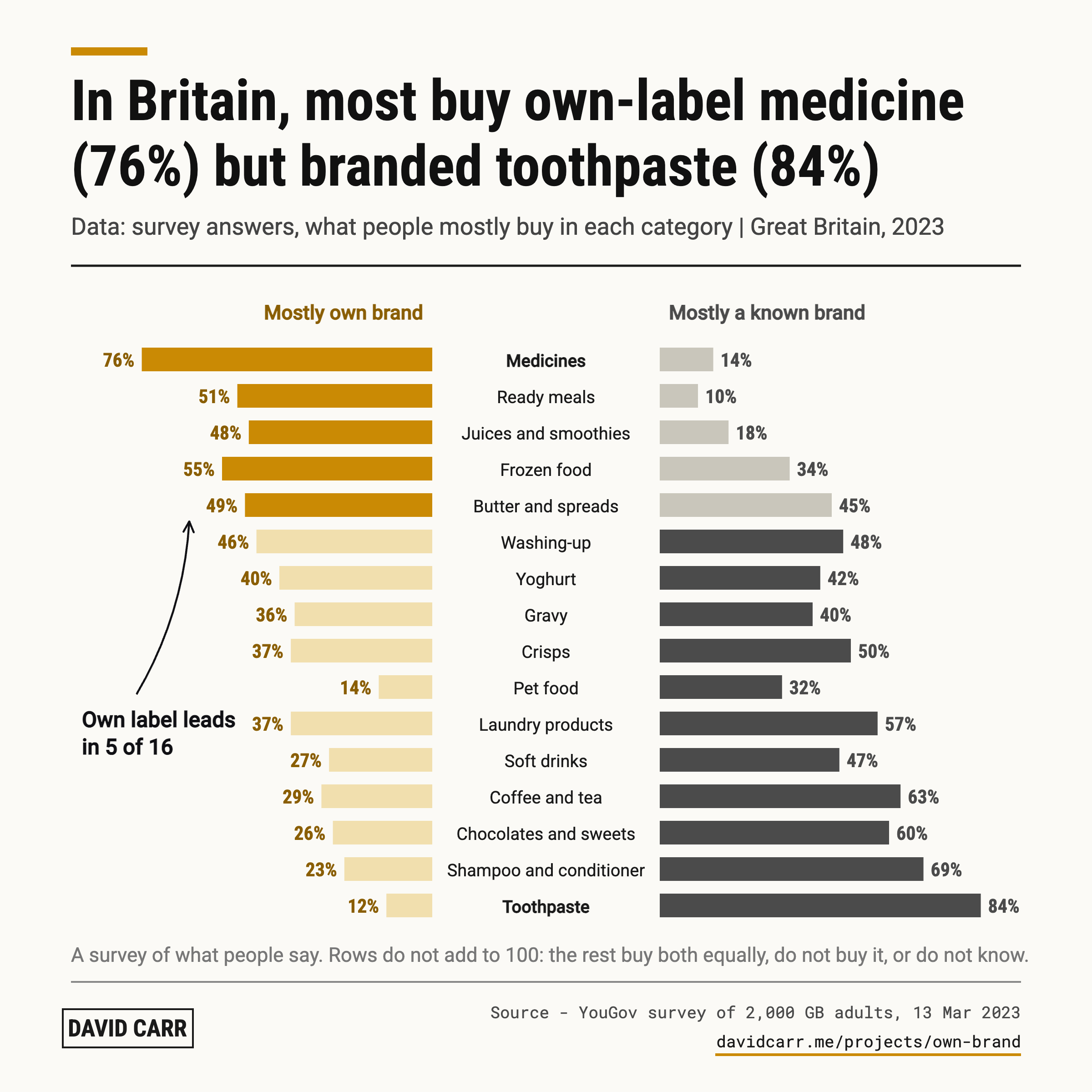
In Britain, most buy own-label medicine (76%) but branded toothpaste (84%)
- Medicines: 76% mostly own brand, 14% known brand
- Frozen food: 55% and 34%
- Crisps: 37% and 50%
- Coffee and tea: 29% and 63%
- Toothpaste: 12% and 84%
Own label leads in five of 16 categories: medicines, ready meals, juices, frozen food and butter. Brands lead most on toothpaste, shampoo, coffee and chocolate. Overall, 34% said they mostly buy own brand and 29% mostly brands.
A survey: YouGov, 2,000 GB adults, 13 March 2023. No Irish survey with category detail was found.
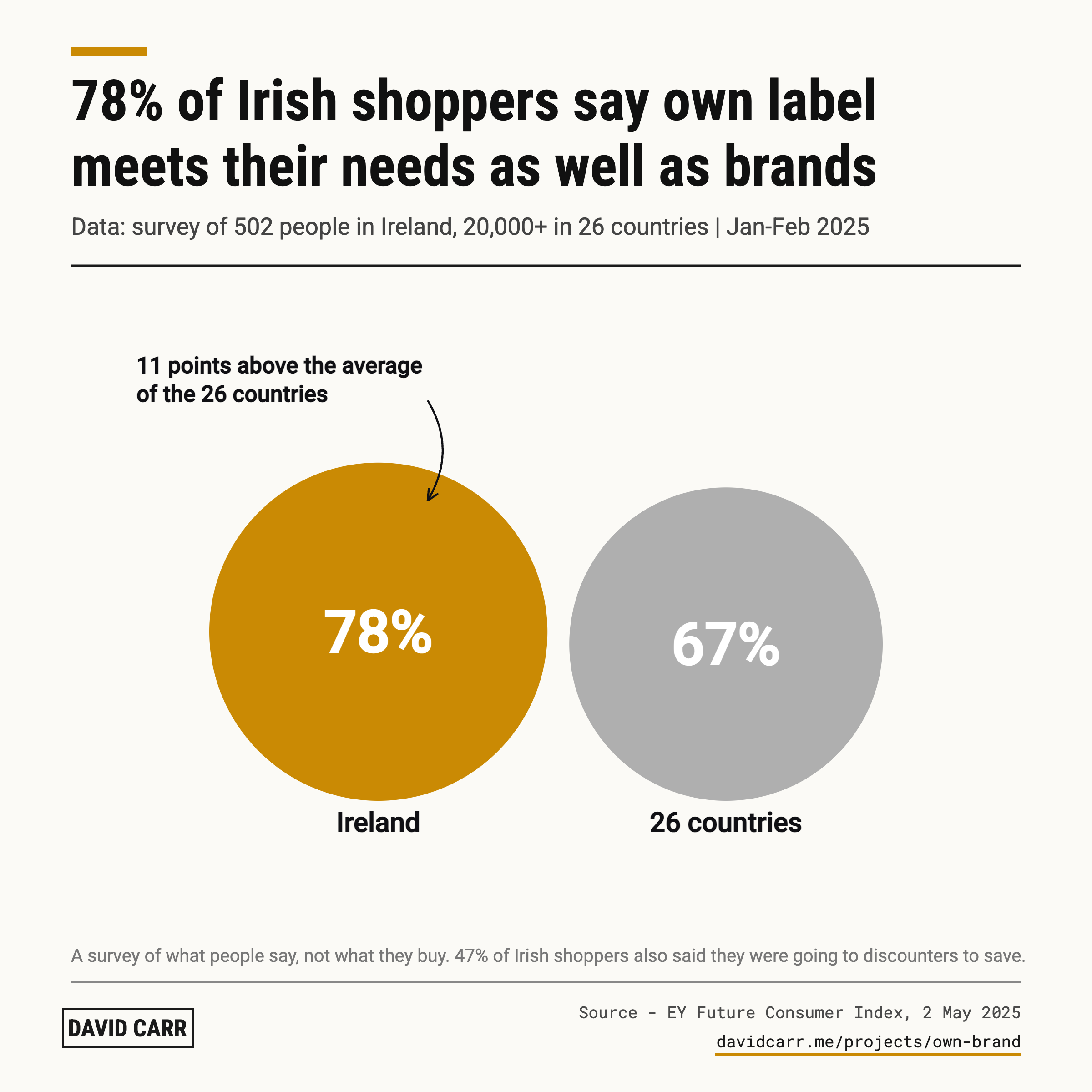
78% of Irish shoppers say own label meets their needs as well as brands
- Ireland: 78%
- 26-country average: 67%
- Irish shoppers heading to discounters to save: 47%
Irish shoppers were among the most open to own label in EY’s survey. It is what people say, not what they buy: Kantar’s till-roll panel shows brands taking slightly more Irish grocery money in 2026.
A survey: EY Future Consumer Index, published 2 May 2025, 502 people in Ireland, January and February 2025.
Method, caveats and sources
The short answer. Across 17 European countries, own label took 38.8% of grocery spending in 2025; only Switzerland is above half. In Ireland, own label drew level with brands in 2023 as prices rose, and the cheapest own-label ranges grew by about a third. In 2026 brands are growing faster again and hold just over half. In UK price checks, own label cost 29% to 74% less per 100g, and in four blind taste tests it scored within four points of the brand.
Europe. PLMA International’s 2026 report, “A Mosaic of Markets”, with NielsenIQ data for 17 countries, 2023 to 2025. Ireland is not covered. Older PLMA yearbooks used a different method, so no earlier years are shown.
Ireland. Kantar (renamed Worldpanel by Numerator in 2026) publishes Irish grocery shares every four weeks. Most releases give own label and brand shares for the latest 12 weeks; some give only one. I used only the figures a release states, and only 12-week shares on the line chart. Own label and brands do not add to 100%: the rest is loose, unbranded food.
Britain. Kantar GB releases. Kantar’s shopper panel puts own label higher (about 51%) than NielsenIQ’s till data (44.4%), because they measure different shops and products. The two are not mixed on one chart.
Prices and taste. Which? price checks and blind taste tests, each dated. Prices are UK pounds, taken from Which?, not from supermarket websites. Most own labels compared are from Aldi and Lidl, so part of the gap is the shop as well as the label. No source used here says any own-label product is the same as a brand.
Surveys. YouGov (Britain, 2023) and EY (Ireland, 2025) are surveys of what people say.
Every figure, with its date and link, is kept with the page’s working files.
Also: Who Ireland buys its groceries from, What Ireland costs, The cost of living in Ireland since 1922, The world’s most valuable brands and How Ireland shops for Christmas.