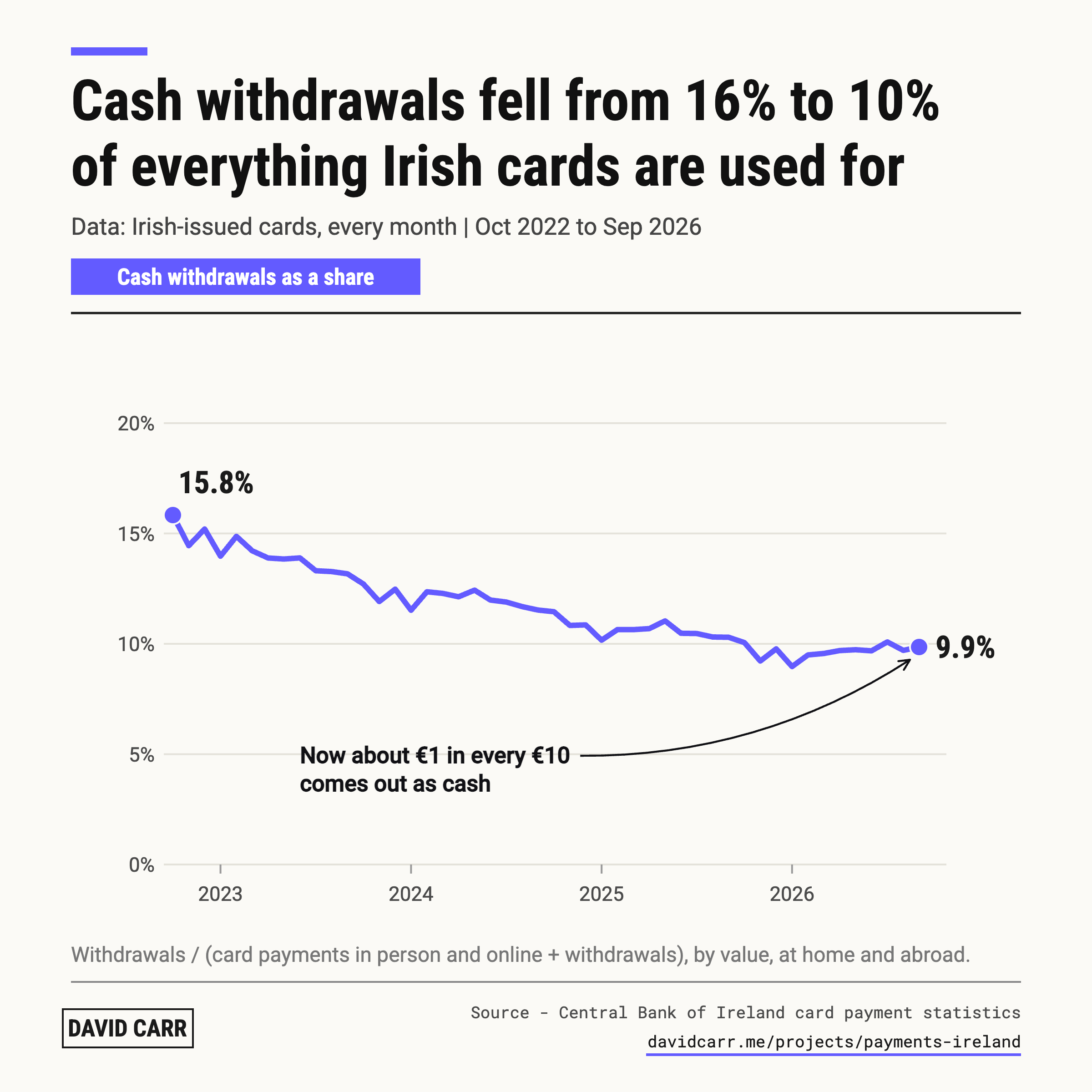
Cash withdrawals fell from 16% to 10% of everything Irish cards are used for
- October 2022: 15.8%
- September 2026: 9.9%
- Lowest month: 9.0%, January 2026
For every euro taken out in cash, Irish cards now pay about nine euro to shops, websites and services. The BPFI puts it another way: in 2025, €2.46 was spent by tapping for every €1 withdrawn, up from €1.70 in 2023 (RTÉ). Withdrawals fell 7.1% in 2025, to 82.2 million.
My sum from the Central Bank's monthly card statistics: ATM and cashback withdrawals divided by card payments plus withdrawals, by value. The Central Bank's own version, on a slightly different base, goes from 17.5% to 11.0% (Behind the Data, Sept 2026).
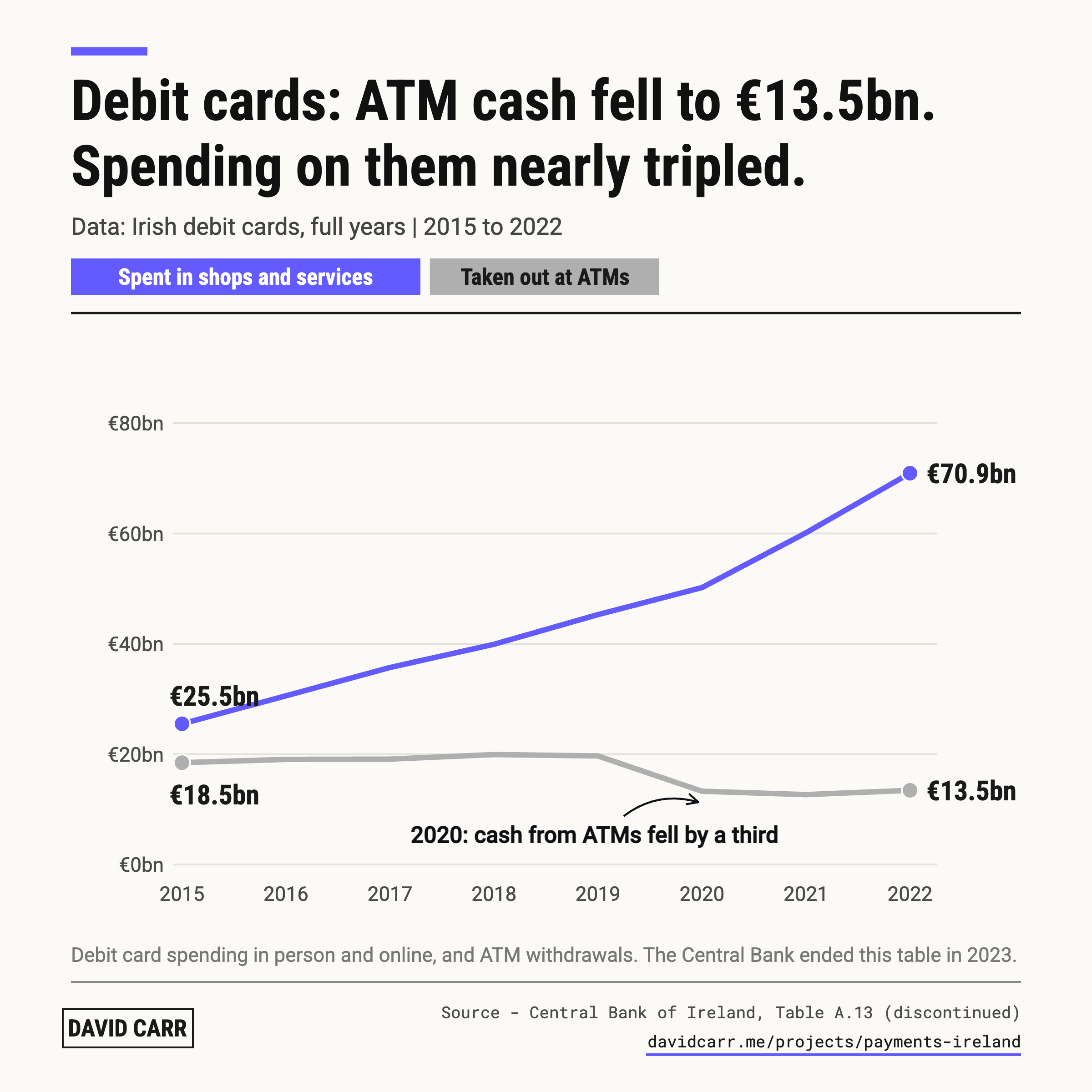
Debit cards: ATM cash fell to €13.5bn. Spending on them nearly tripled.
- 2015: €18.5bn from ATMs, €25.5bn spent
- 2019: €19.7bn from ATMs, €45.3bn spent
- 2020: €13.3bn from ATMs, down a third
- 2022: €13.5bn from ATMs, €70.9bn spent
Cash from ATMs was flat for five years, then fell by a third in 2020 and did not come back. Spending on debit cards grew every year, in person and online.
From the Central Bank's Table A.13, discontinued in 2023, on its card statistics page. Irish debit cards only, full years.
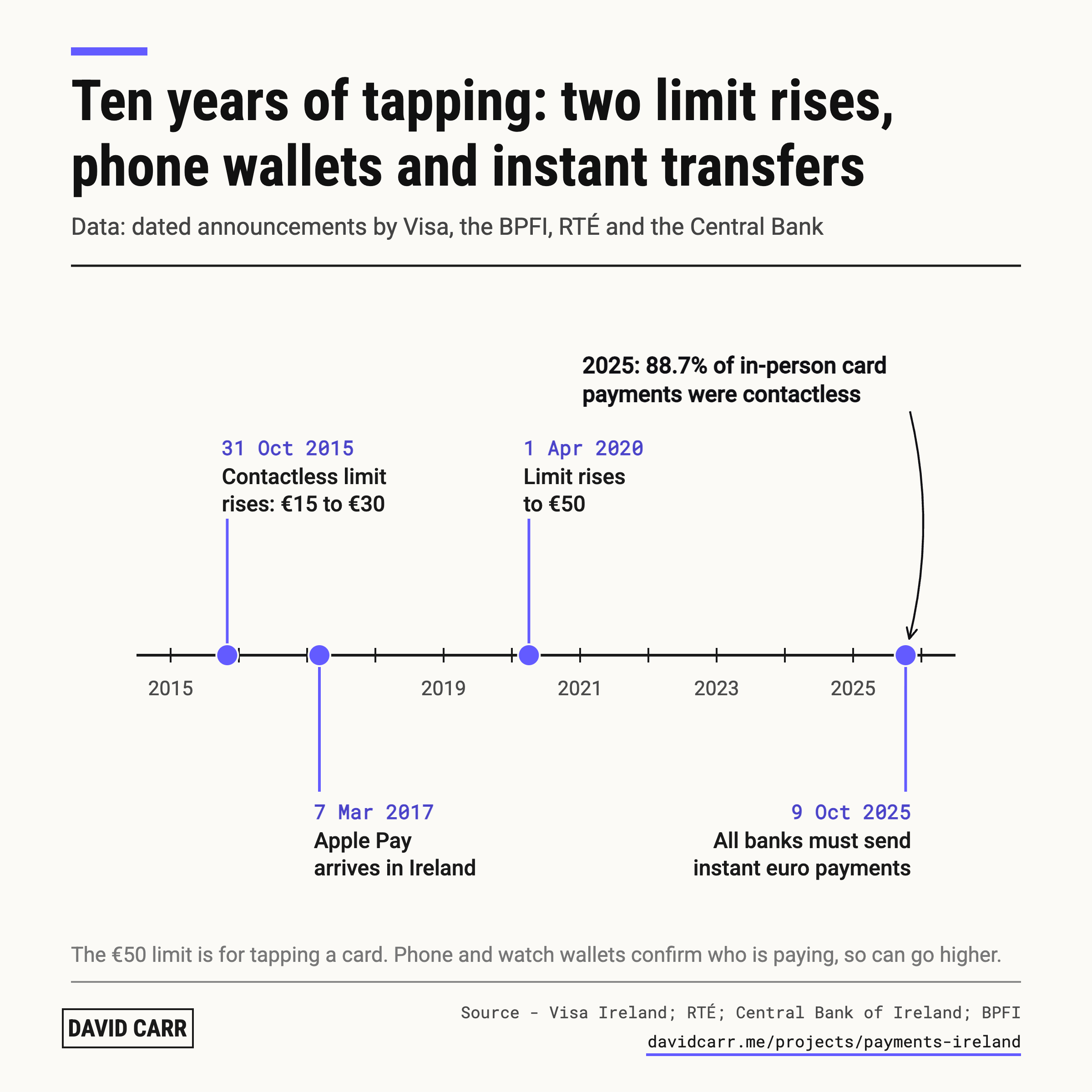
Ten years of tapping: two limit rises, phone wallets and instant transfers
- 31 October 2015: contactless limit rises from €15 to €30
- 7 March 2017: Apple Pay arrives in Ireland
- 1 April 2020: limit rises to €50
- 9 October 2025: all banks must send instant euro payments
In 2025, 88.7% of in-person card payments were contactless: 298 per person, 159 of them by phone or watch (BPFI Payments Monitor, Feb 2026). Since October 2025, an instant transfer can cost no more than a standard one, and banks check the payee's name first (Central Bank).
Dates from Visa Ireland, RTÉ (Apple Pay) and RTÉ (€50 limit). The €50 limit applies to cards; phone wallets check who is paying, so they can go higher.
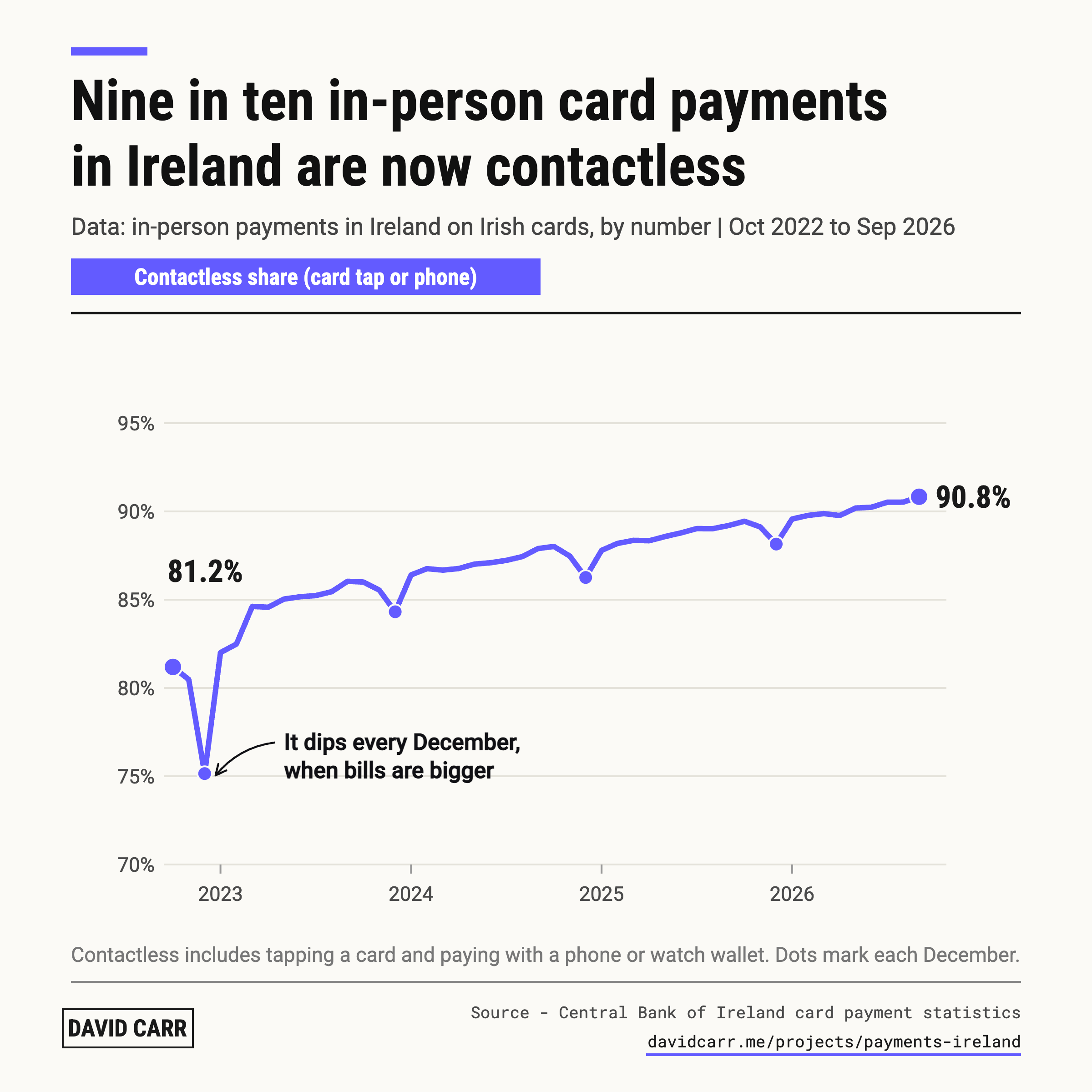
Nine in ten in-person card payments in Ireland are now contactless
- October 2022: 81.2%
- December 2022: 75.1%
- December 2025: 88.2%
- September 2026: 90.8%
The share drops every December, when bills are bigger and a tapped card only covers up to €50. The dip has been smaller since 2022, as more people pay by phone, where the limit does not apply in the same way.
By number of payments, Irish cards in Ireland. From the monthly card statistics, Table 2.
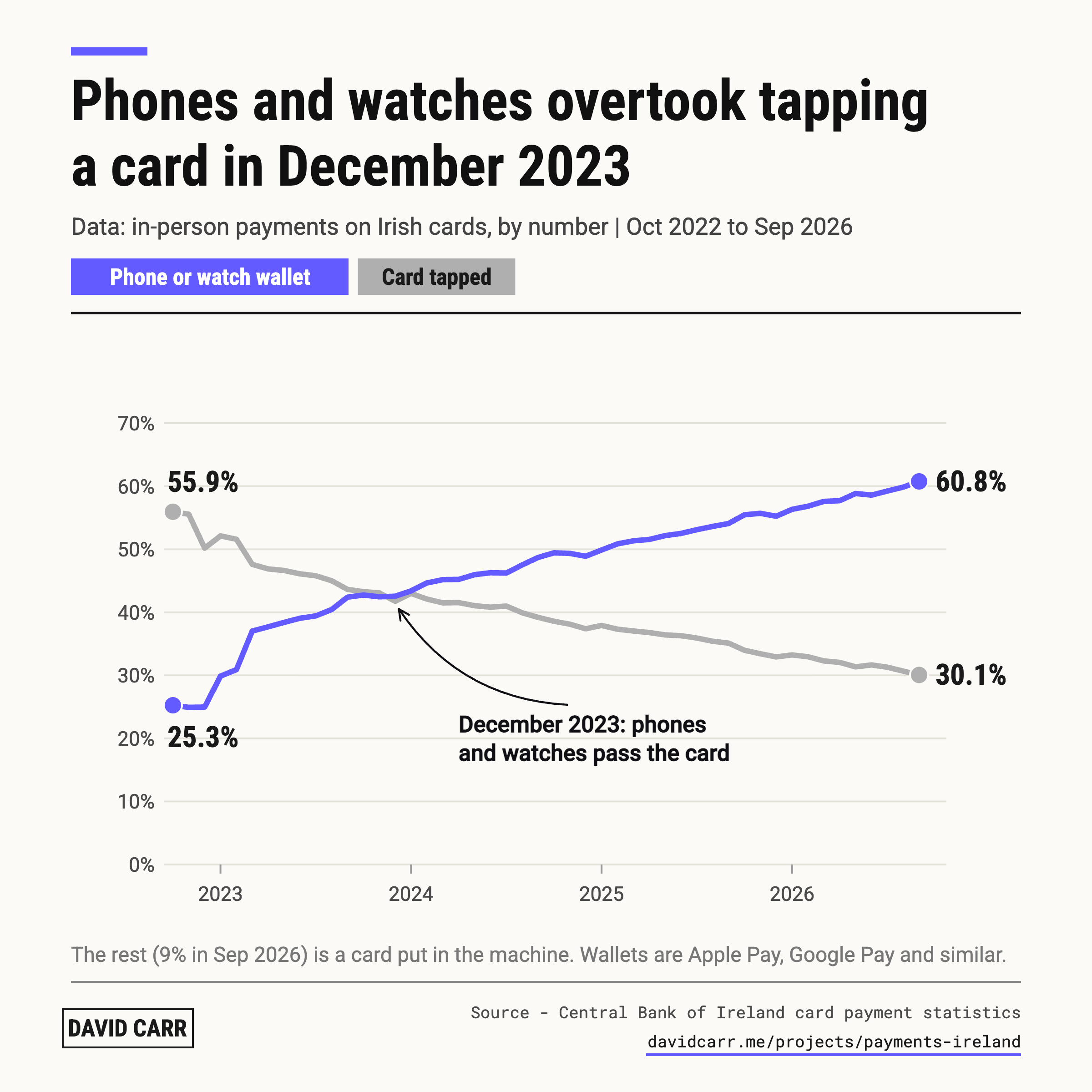
Phones and watches overtook tapping a card in December 2023
- October 2022: phone 25.3%, card tap 55.9%
- December 2023: phone 42.6%, card tap 41.8%
- September 2026: phone 60.8%, card tap 30.1%
Paying with a phone is now twice as common as tapping a card. Two in every three contactless payments are by phone or watch.
Share of all in-person payments, by number. Mobile wallet and contactless series from the monthly card statistics. The rest are cards put in the machine.
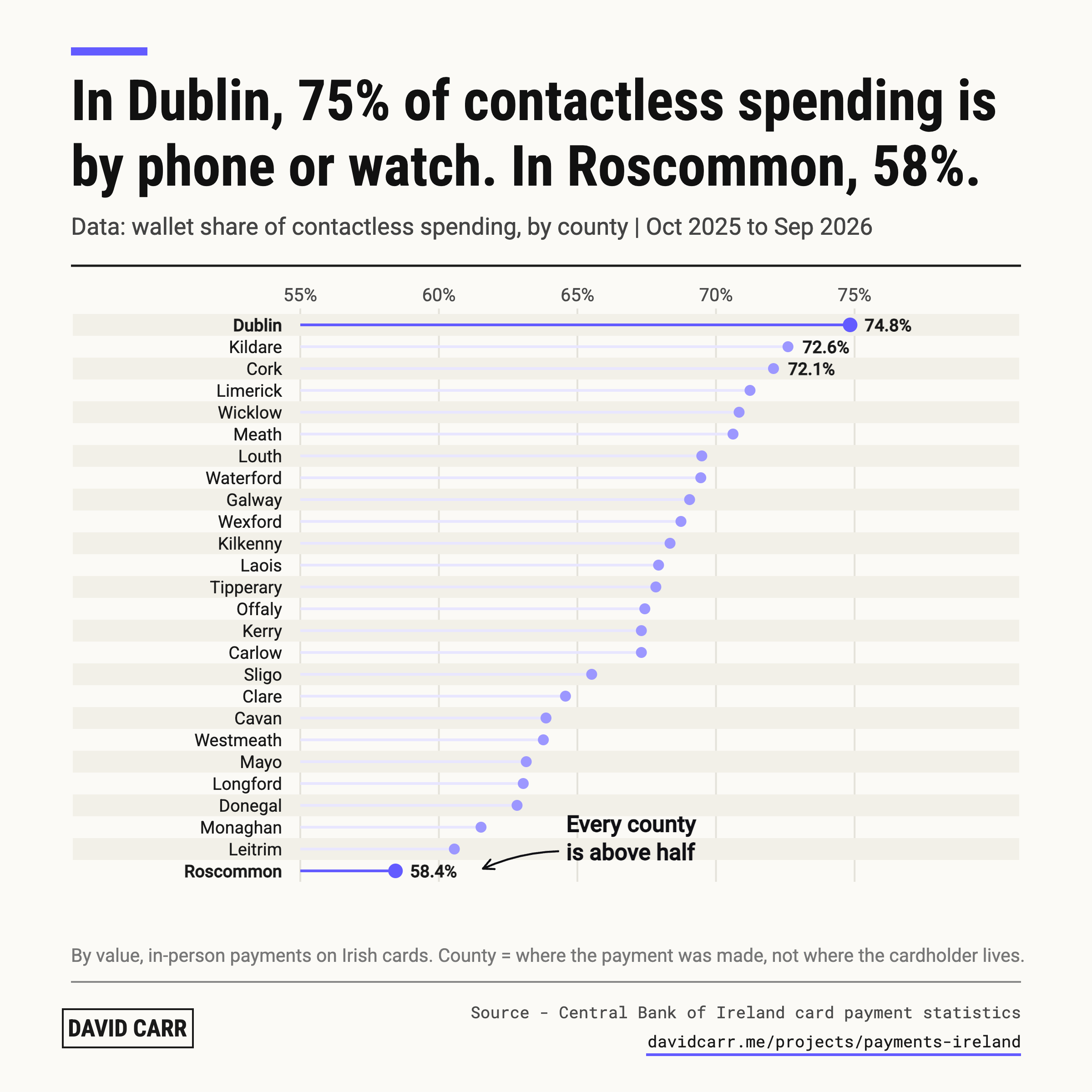
In Dublin, 75% of contactless spending is by phone or watch. In Roscommon, 58%.
- Dublin: 74.8%
- Kildare: 72.6%
- Cork: 72.1%
- Leitrim: 60.6%
- Roscommon: 58.4%
Every county is above half. The Central Bank found the share is higher where more people are aged 15 to 34 and incomes are higher (Behind the Data).
By value, twelve months to September 2026, from Table 3 of the monthly card statistics. My sums match the Central Bank's for the year to June 2026: Dublin 73.4%, Roscommon 56.9%.
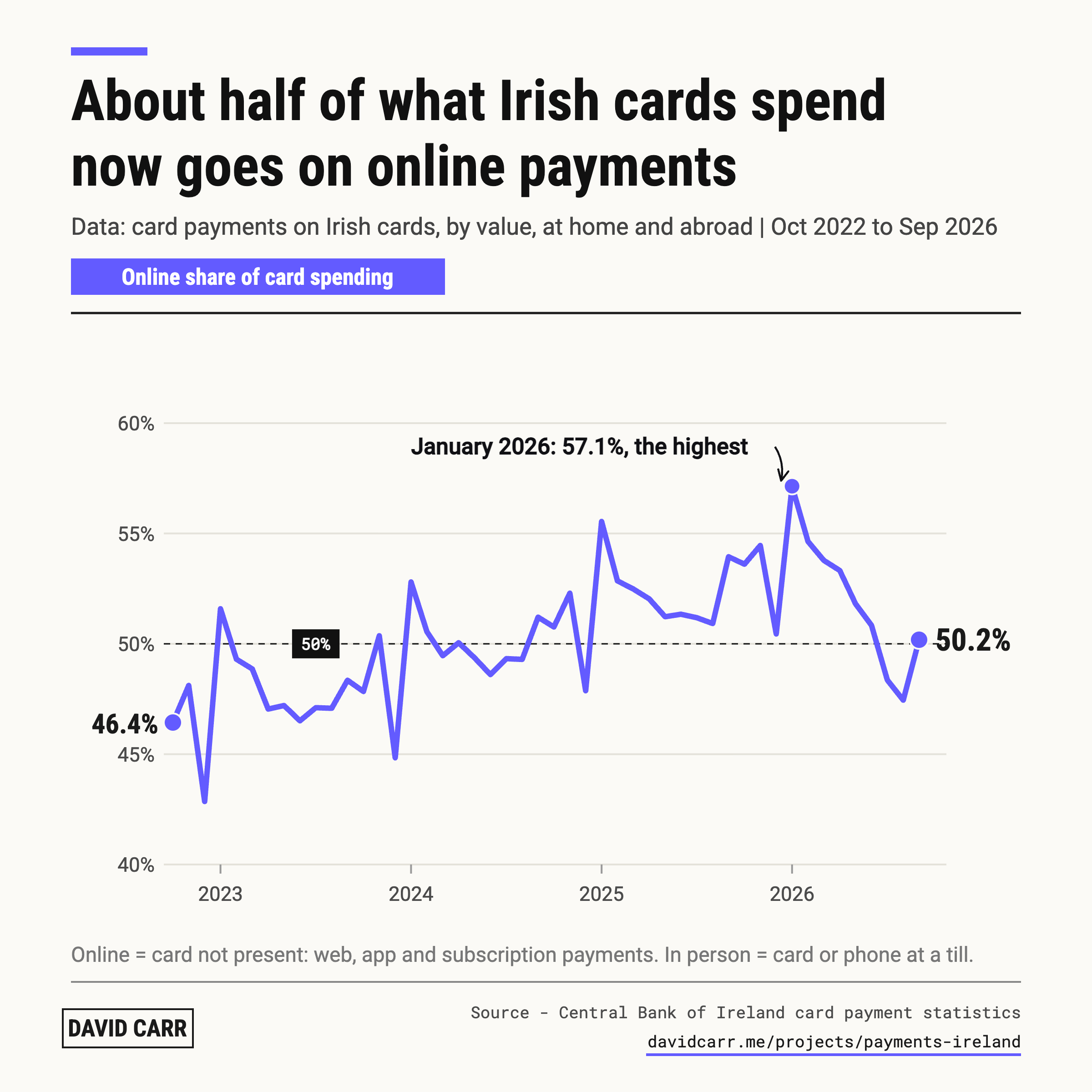
About half of what Irish cards spend now goes on online payments
- October 2022: 46.4%
- January 2026: 57.1%, the highest
- September 2026: 50.2%
Online payments are bigger and fewer. In September 2026 the average online card payment was €67.80. In person it was €25.60. So online is about a quarter of card payments by number but half by value.
Online means card not present: websites, apps, subscriptions and bills, at home and abroad. From the monthly card statistics.
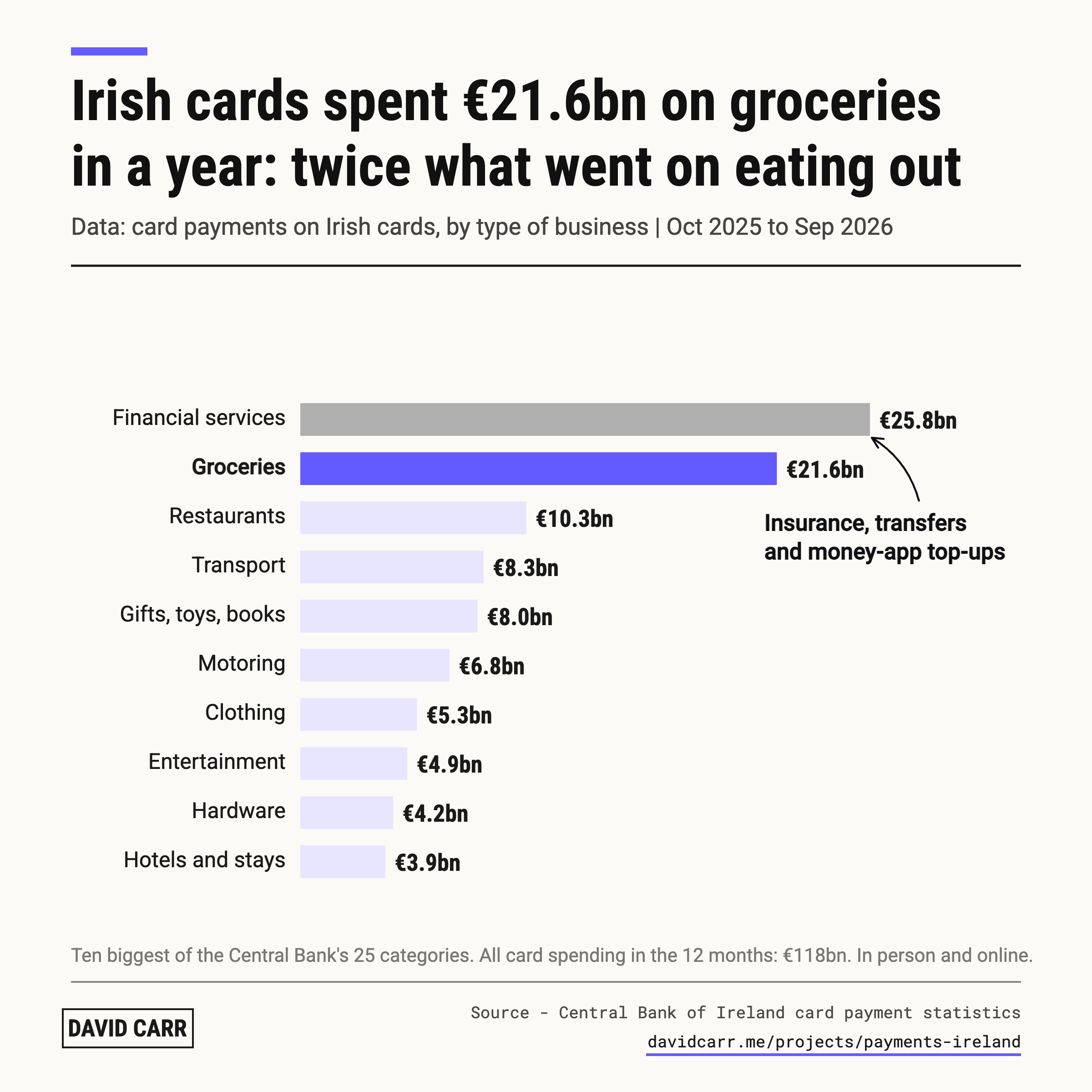
Irish cards spent €21.6bn on groceries in a year: twice what went on eating out
- Financial services: €25.8bn
- Groceries: €21.6bn
- Restaurants: €10.3bn
- Transport: €8.3bn
- Gifts, toys and books: €8.0bn
Financial services is the Central Bank's label for insurance, money transfers and topping up money apps with a card. Of what people buy, groceries come first.
Twelve months to September 2026, in person and online, from Table 4 of the monthly card statistics. Categories follow card scheme merchant codes, mapped by the Central Bank.
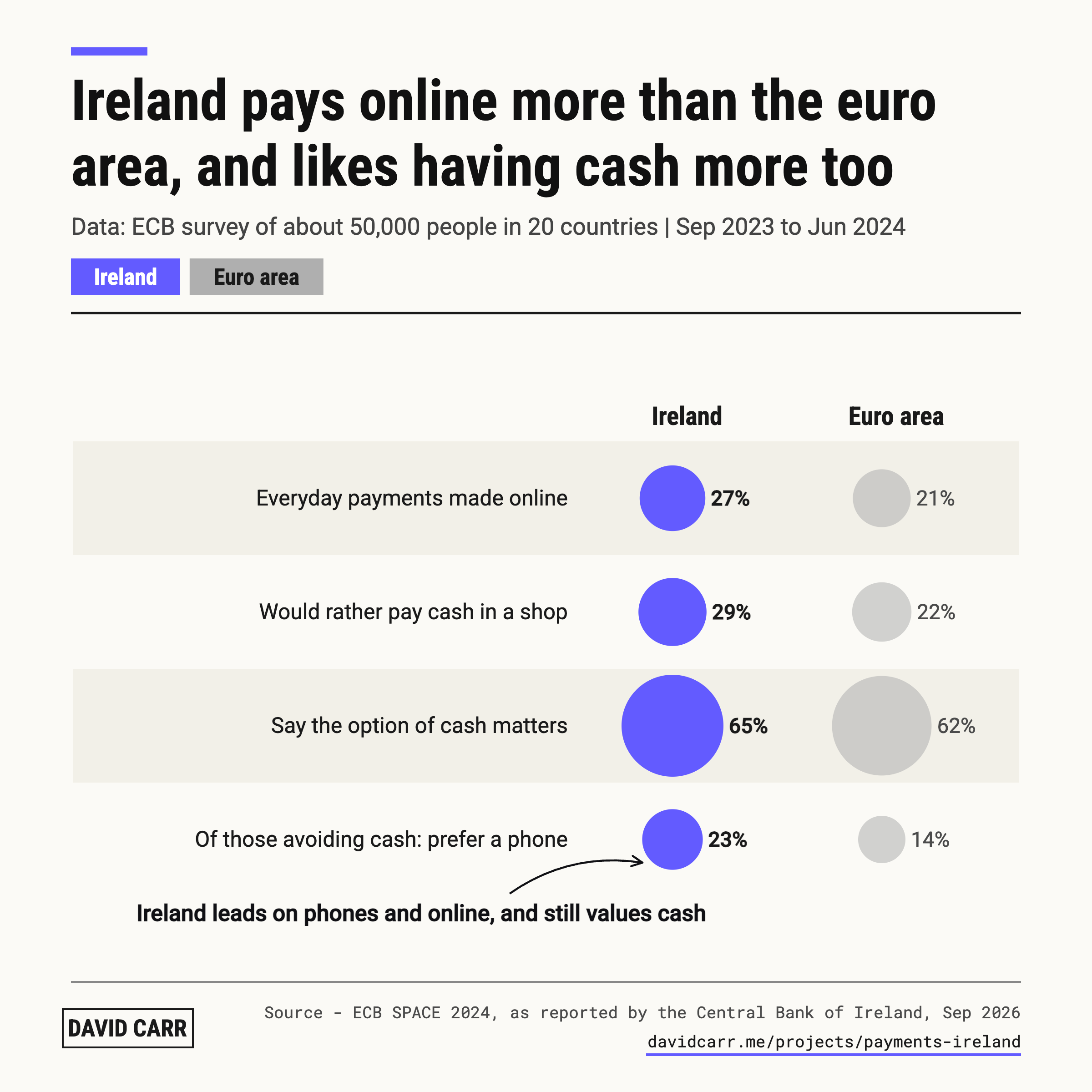
Ireland pays online more than the euro area, and likes having cash more too
- Everyday payments made online: Ireland 27%, euro area 21%
- Would rather pay cash in a shop: 29% and 22%
- Say the option of cash matters: 65% and 62%
- Of those avoiding cash, prefer a phone: 23% and 14%
Ireland is one of three euro countries, with the Netherlands and Finland, where phones make up more than a tenth of in-shop payments (ECB SPACE 2024). The euro-area average is 6%.
ECB survey of about 50,000 people, September 2023 to June 2024. Irish figures as reported by the Central Bank of Ireland.
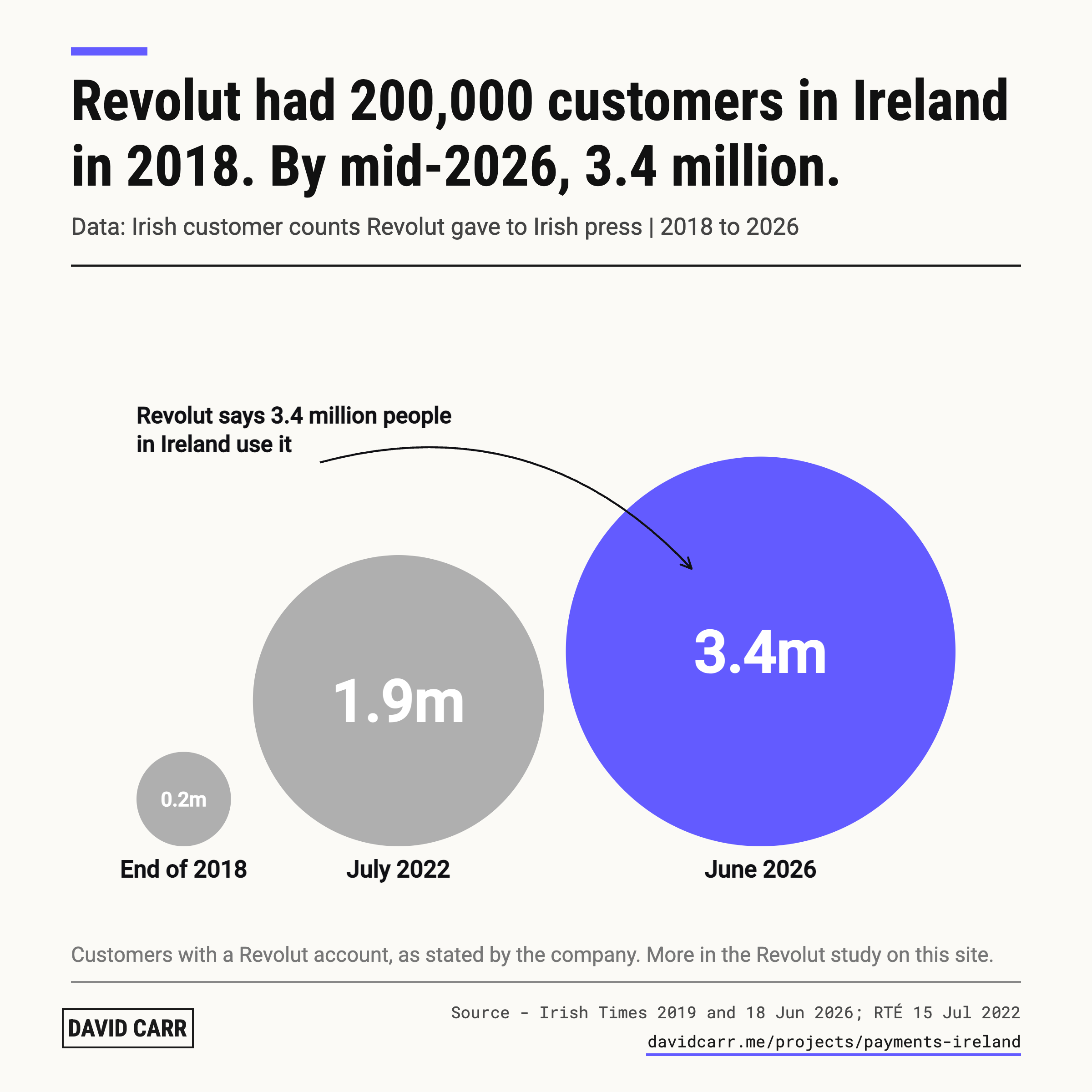
Revolut had 200,000 customers in Ireland in 2018. By mid-2026, 3.4 million.
- End of 2018: 200,000
- July 2022: 1.9 million
- End of 2025: 3.3 million
- June 2026: 3.4 million
Revolut is the newest big name in Irish payments. Its count is people with an account, not people who use it every day; Revolut says 86% use the app each month (Irish Examiner, 14 September 2026).
Figures Revolut gave to the Irish Times, RTÉ and the Irish Times. More in the Revolut study.
Method, caveats and sources
The short answer. Cash withdrawals are now about a tenth of what Irish cards are used for. Nine in ten in-person payments are contactless, and phones overtook tapping a card in December 2023. About half of card spending by value is online. Ireland pays online more than the euro area, yet says it values cash a little more too.
Card data. The Central Bank of Ireland's Monthly Card Payment Statistics, October 2022 to September 2026, pulled 28 November 2026. They cover cards issued in Ireland, at home and abroad. The Central Bank widened the reporting base in March 2023, so the first months are not quite like for like. Longer-run figures for 2015 to 2022 come from its discontinued Table A.13. All shares are my sums, and the code is kept with the page's working files.
What cards miss. Cash spent is not counted, only cash taken out. Bank transfers, instant payments and direct debits are outside the card data.
Survey data. Ireland against the euro area comes from the ECB's SPACE 2024 survey, as reported by the Central Bank. Survey answers are what people say, not what they do.
Other sources. BPFI Payments Monitor (February 2026), Bank of Ireland's December card spending (ATM cash now 13% of monthly spending, about 30% before Covid), and dated press releases for the timeline.
Stripe, the subject of this series, was started by two brothers from Limerick.
Also: Stripe, Revolut, How Ireland shops for Christmas and Who shops online.