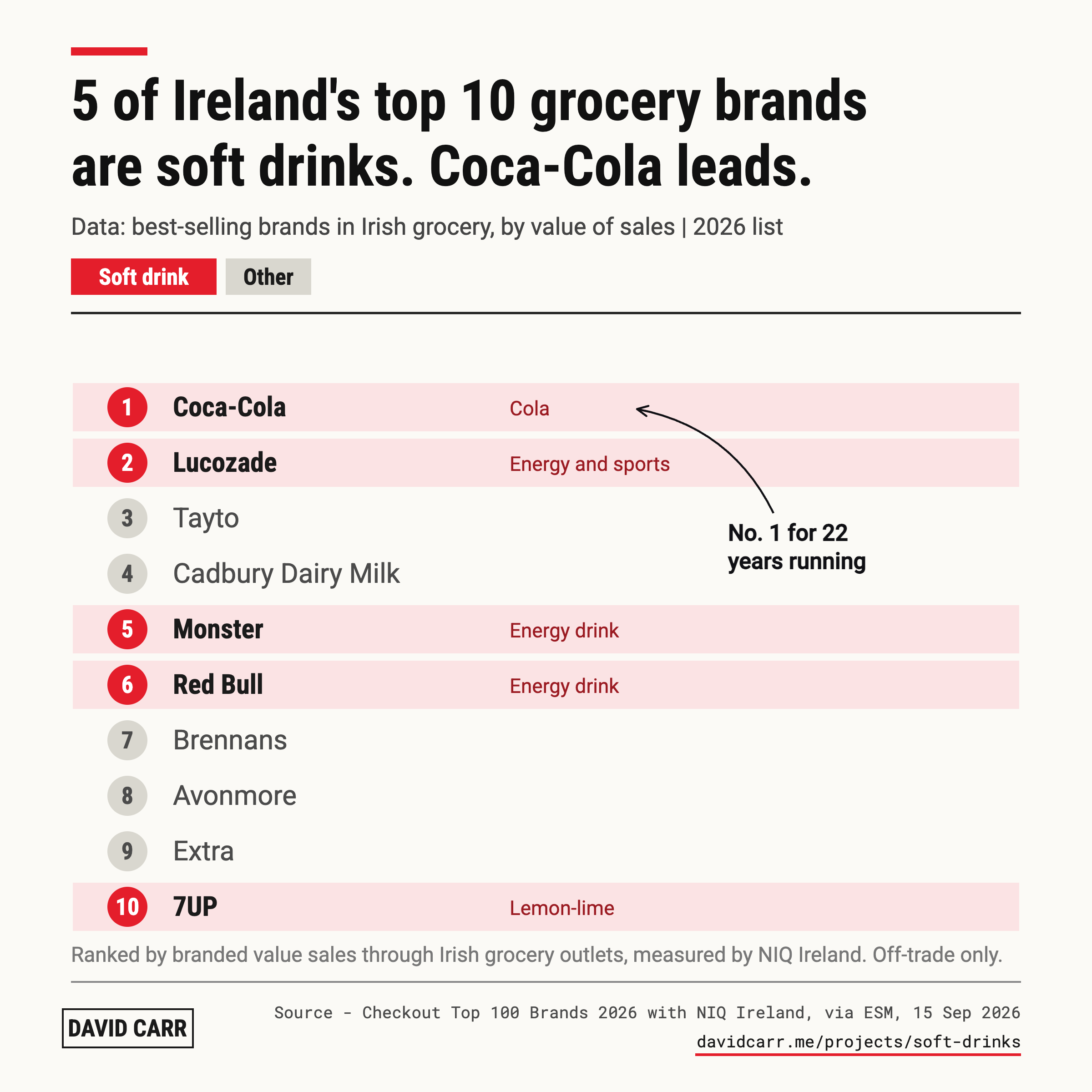
5 of Ireland's top 10 grocery brands are soft drinks. Coca-Cola leads.
- 1 Coca-Cola, 2 Lucozade
- 5 Monster, 6 Red Bull
- 10 7UP
- Also: Ballygowan 12th, Deep RiverRock 21st
Coca-Cola has been No. 1 for 22 years running. Two energy drinks, Monster and Red Bull, now sit inside the top six. The list ranks brands by the value of sales through Irish shops (Checkout Top 100 Brands 2026, via ESM).
Checkout magazine with NIQ Ireland, September 2026. The 2025 list had Monster 5th and Red Bull 7th (RTÉ). The full 100 is not published openly, so Club, Fanta, Pepsi and Sprite are not shown.
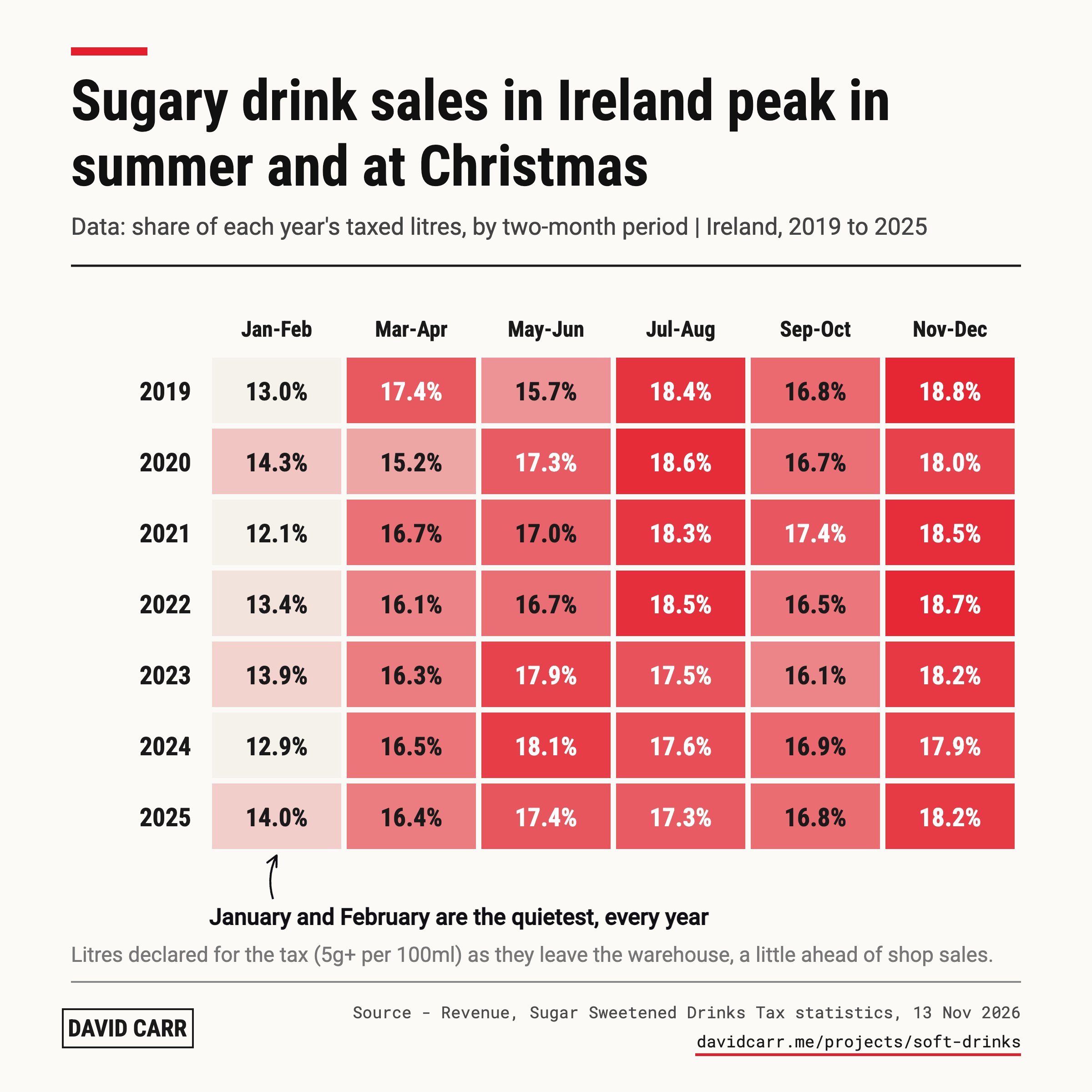
Sugary drink sales in Ireland peak in summer and at Christmas
- Nov-Dec: 18.3% of the year, on average
- Jul-Aug: 18.0%
- Jan-Feb: 13.4%, the lowest every year
November and December are the busiest two months in five of the seven years; summer wins the other two. January and February are the quietest in all seven. They are also two or three days shorter.
My sums from Revenue's sugar tax figures, which count litres of drinks with 5g or more of sugar per 100ml, by two-month period, 2019 to 2025. Drinks under 5g are not in this data.
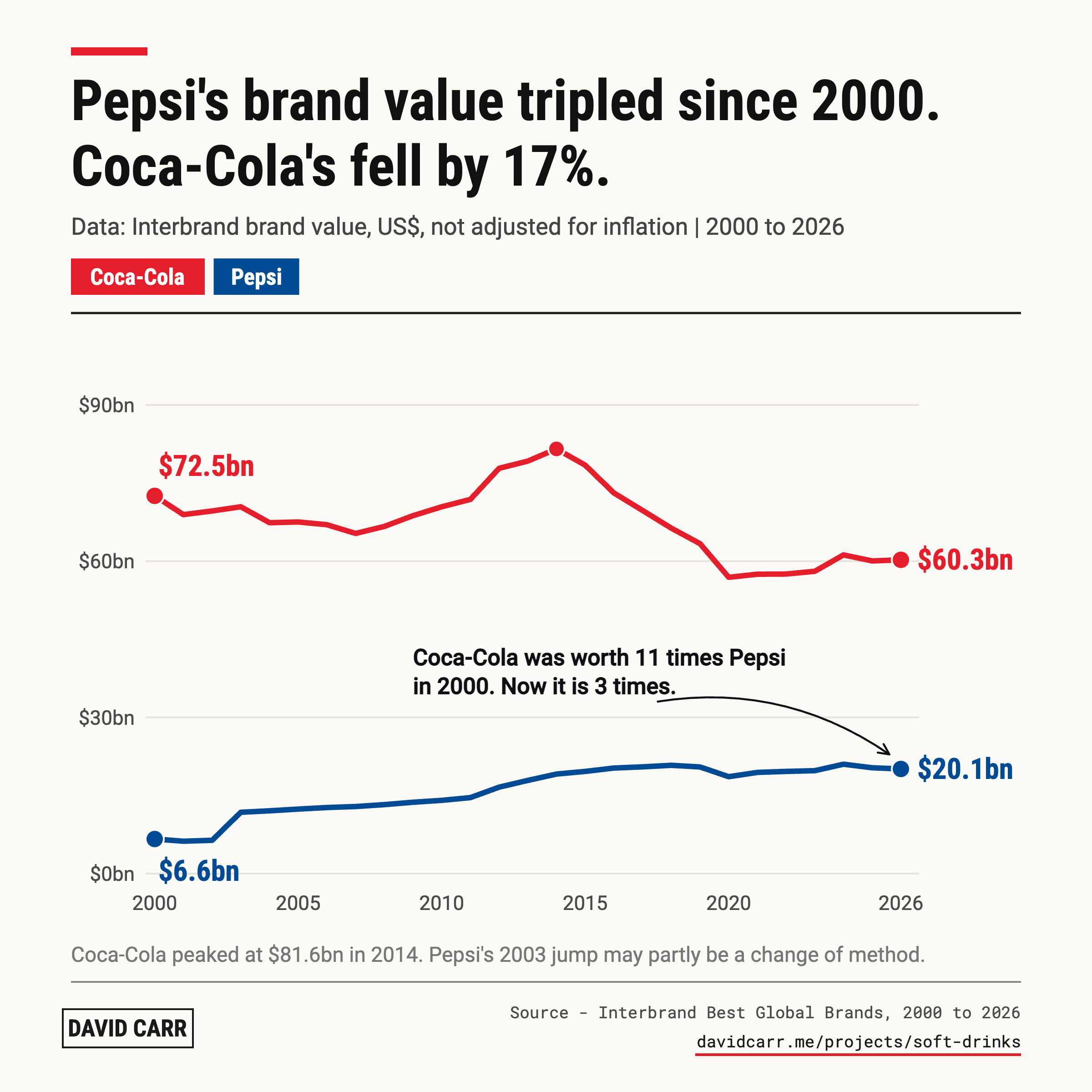
Pepsi's brand value tripled since 2000. Coca-Cola's fell by 17%.
- Coca-Cola: $72.5bn in 2000, $81.6bn at its 2014 peak, $60.3bn in 2026
- Pepsi: $6.6bn in 2000, $20.1bn in 2026
- Gap: 11 times in 2000, 3 times in 2026
Coca-Cola was the world's most valuable brand every year from 2000 to 2012. It is 8th in 2026. Pepsi's value grew but its rank slipped from 35th to 42nd, as tech brands rose past both.
Interbrand Best Global Brands, every year since 2000. These are Interbrand's estimates, in US dollars, not adjusted for inflation. More in Brand values.
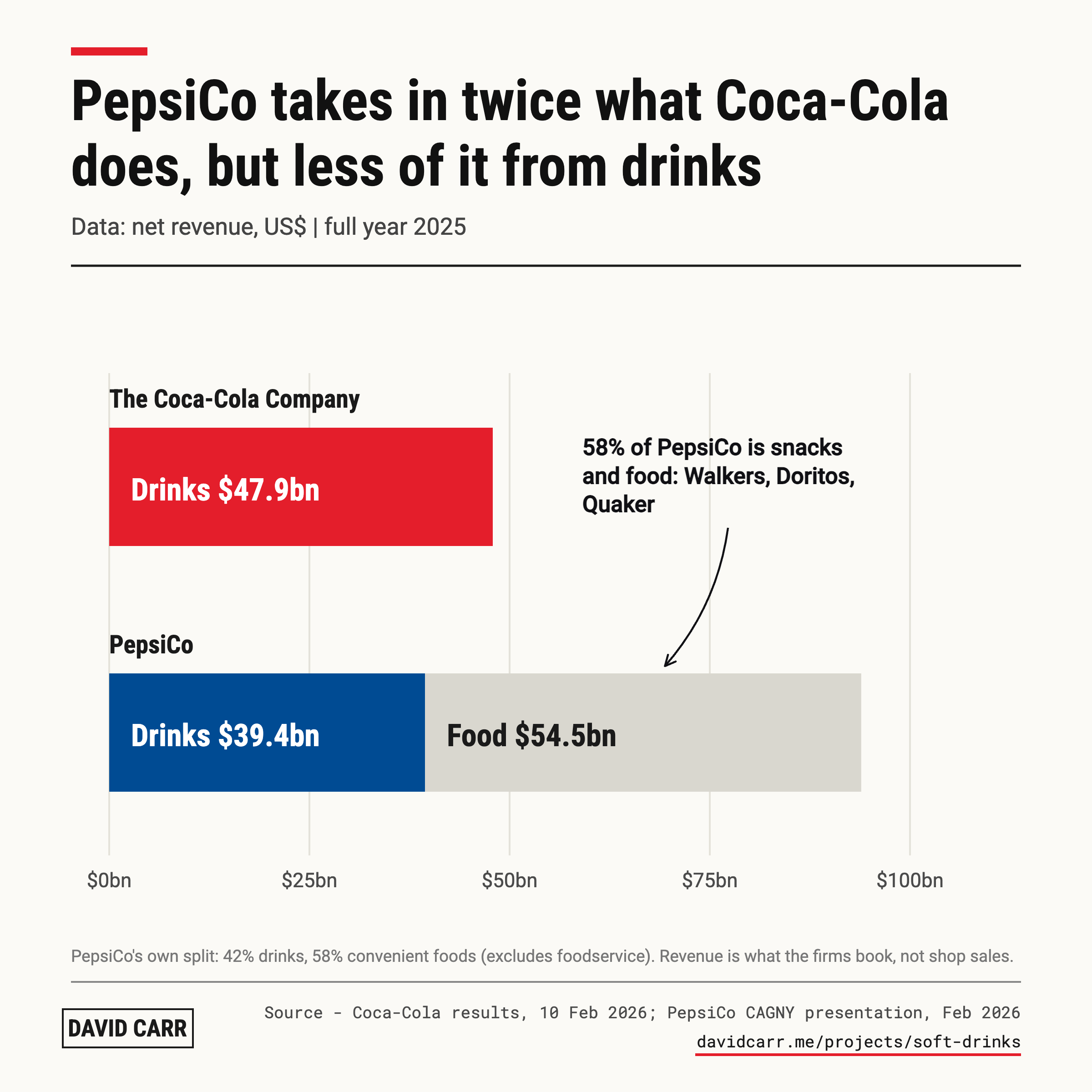
PepsiCo takes in twice what Coca-Cola does, but less of it from drinks
- The Coca-Cola Company: $47.9bn in 2025, almost all drinks
- PepsiCo: $93.9bn
- PepsiCo drinks: 42%, about $39.4bn
- PepsiCo food: 58%, about $54.5bn
PepsiCo owns Walkers, Doritos and Quaker as well as Pepsi, 7UP outside the US and Gatorade. Counting drinks only, Coca-Cola is the bigger of the two.
Coca-Cola full-year results, 10 Feb 2026; PepsiCo CAGNY presentation, Feb 2026, page 5. The drinks figure for PepsiCo is my sum from its own 42% split. Revenue is what each company books, so it depends on how much bottling it does itself.
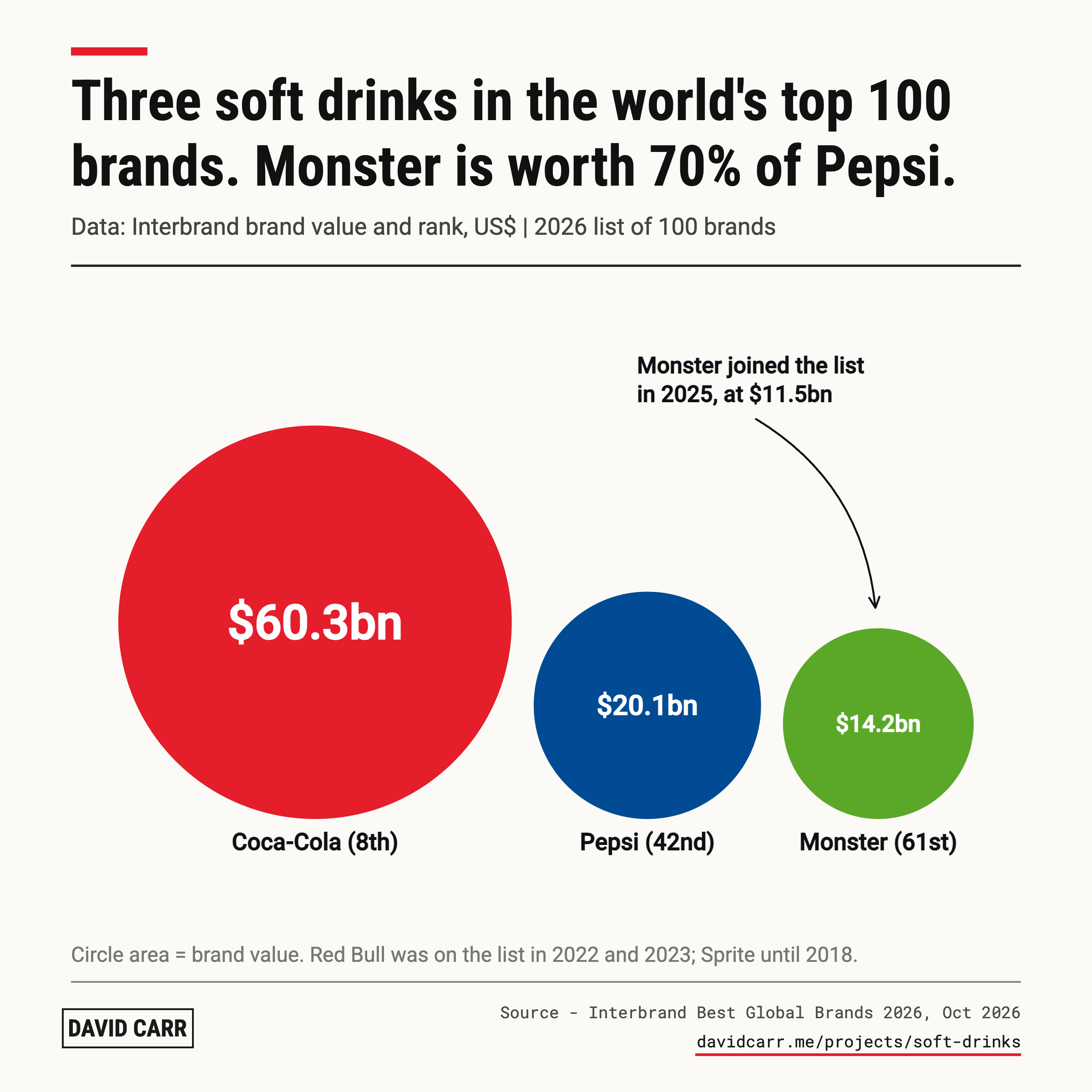
Three soft drinks in the world's top 100 brands. Monster is worth 70% of Pepsi.
- Coca-Cola: $60.3bn, 8th
- Pepsi: $20.1bn, 42nd
- Monster: $14.2bn, 61st, up from $11.5bn and 70th in 2025
Monster entered the list in 2025. Red Bull was on it in 2022 and 2023. Sprite dropped off after 2018.
Interbrand Best Global Brands 2026, October 2026. Kantar BrandZ, a rival ranking, puts Coca-Cola at $121bn, twice Interbrand's figure.
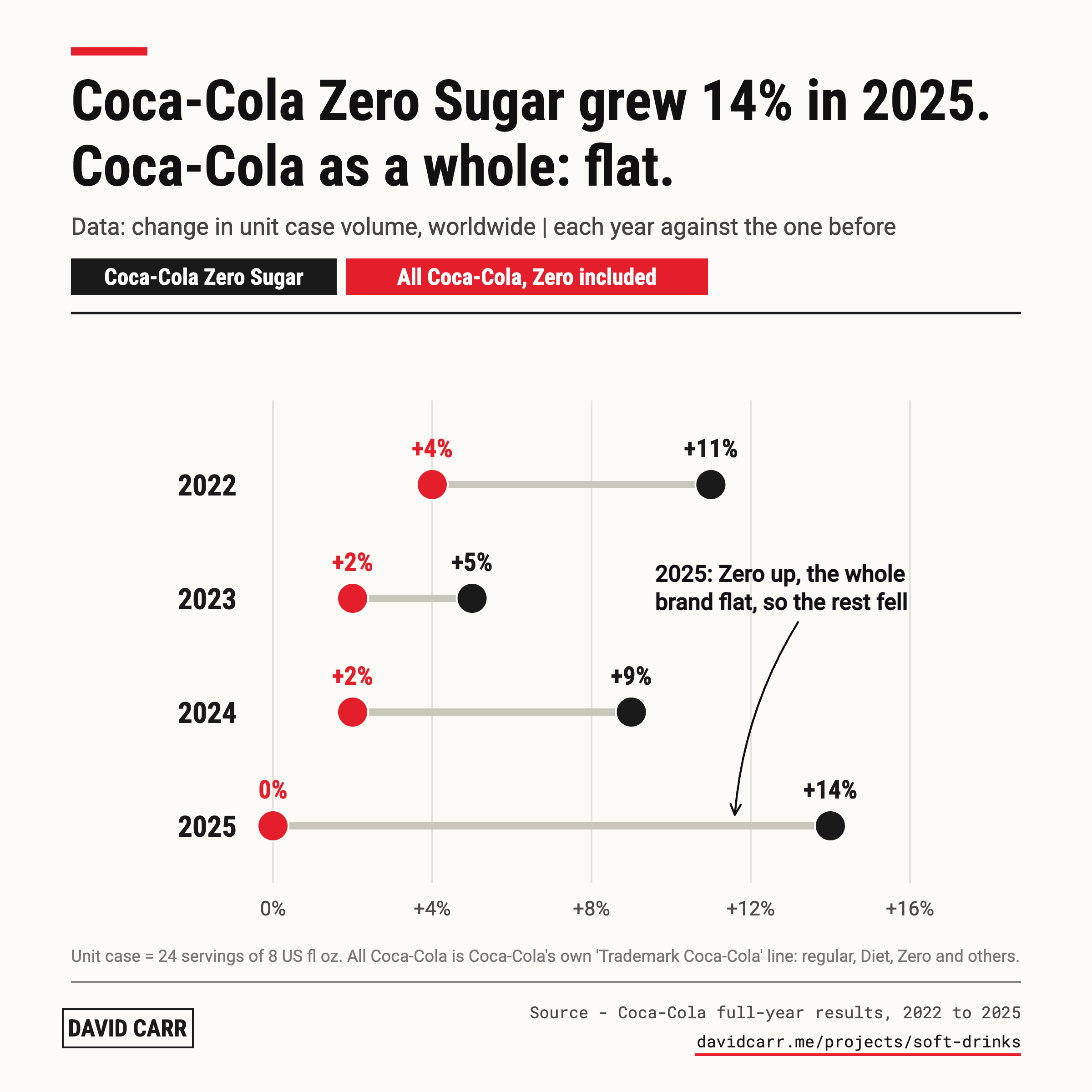
Coca-Cola Zero Sugar grew 14% in 2025. Coca-Cola as a whole: flat.
- 2022: Zero +11%, all Coca-Cola +4%
- 2023: Zero +5%, all +2%
- 2024: Zero +9%, all +2%
- 2025: Zero +14%, all flat
Zero Sugar sits inside the Coca-Cola total. So when Zero grows 14% and the total does not move, the other versions, mostly regular Coke, sold less. Over the four years, Zero grew by about 45%.
Unit case volume, worldwide, from Coca-Cola's results for 2022, 2023, 2024 and 2025. The 2021 release says only "double digits" for Zero, so it is left out. The four-year figure is my sum.
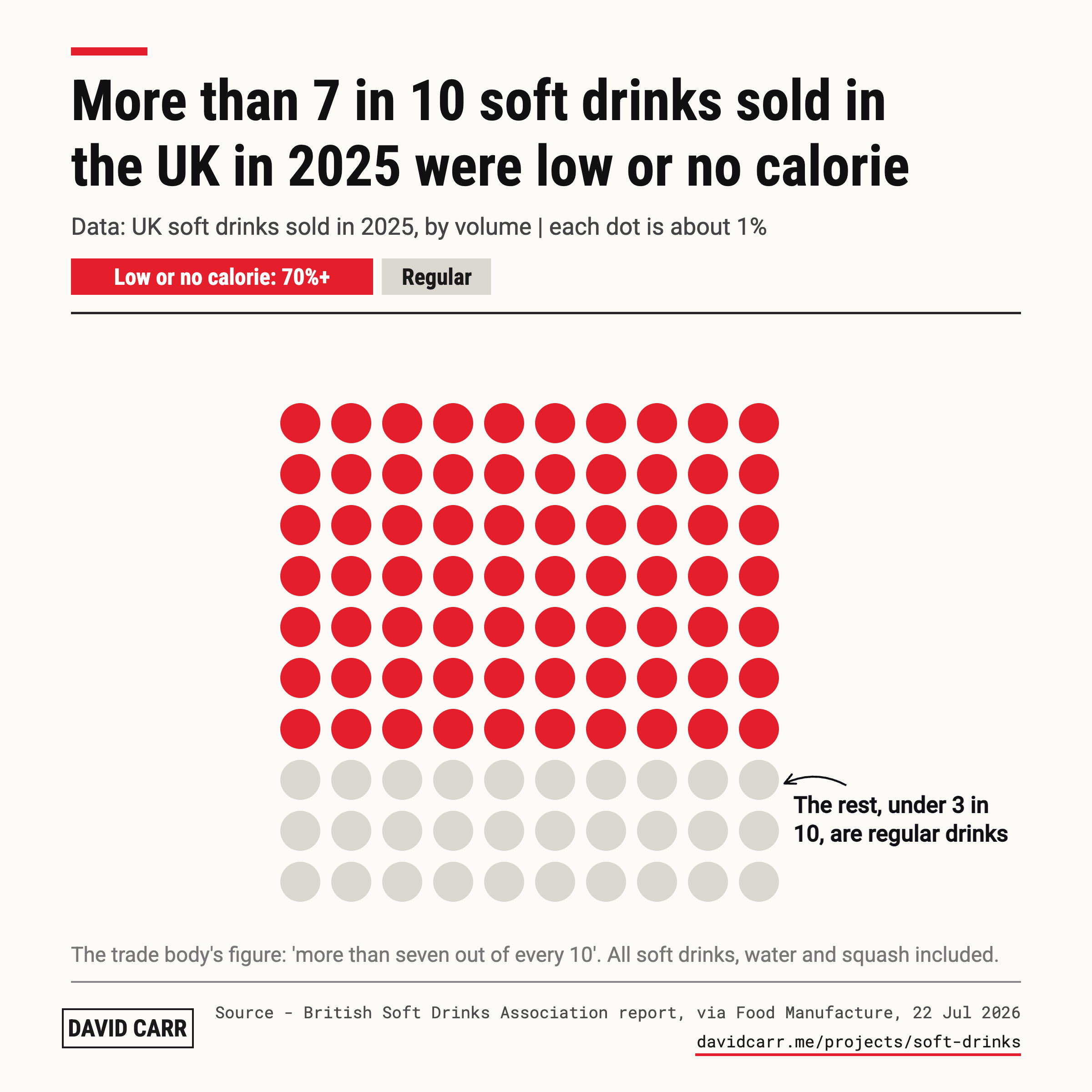
More than 7 in 10 soft drinks sold in the UK in 2025 were low or no calorie
- Low or no calorie: more than 70% of volume
- Soft drinks per person: 232 litres in 2025
- UK market: £26.3bn, volume up 2.2%
The count covers all soft drinks, including water, squash, juice and energy drinks. Water and diluted squash carry a lot of the low-calorie volume.
British Soft Drinks Association annual report, as reported by Food Manufacture, 22 Jul 2026. This is the trade body's own figure.
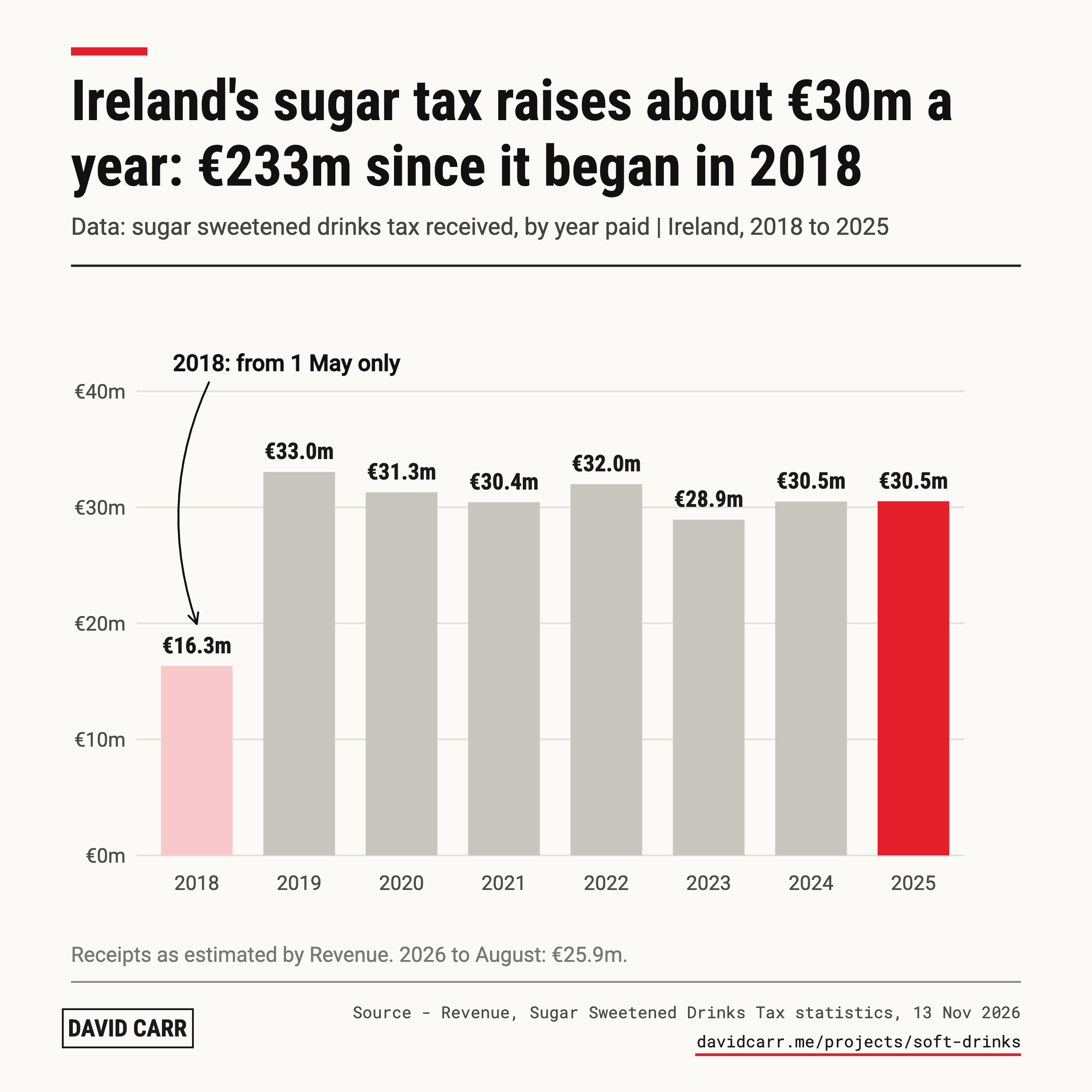
Ireland's sugar tax raises about €30m a year: €233m since it began in 2018
- 2018 (from 1 May): €16.3m
- 2019: €33.0m, the highest
- 2023: €28.9m, the lowest full year
- 2025: €30.5m, about €5.60 a person
The tax is 20c a litre for drinks with 5g to 8g of sugar per 100ml and 30c for 8g or more, VAT included. Drinks under 5g pay nothing. In the UK, the levy raised £327m in 2024-25 (HMRC).
Revenue sugar tax statistics, receipts by year paid, published 13 Nov 2026. The C&AG put net receipts at €172m for 2018 to 2023 (report, 2024). Per person uses the CSO's April 2025 population of 5,458,600 (CSO).
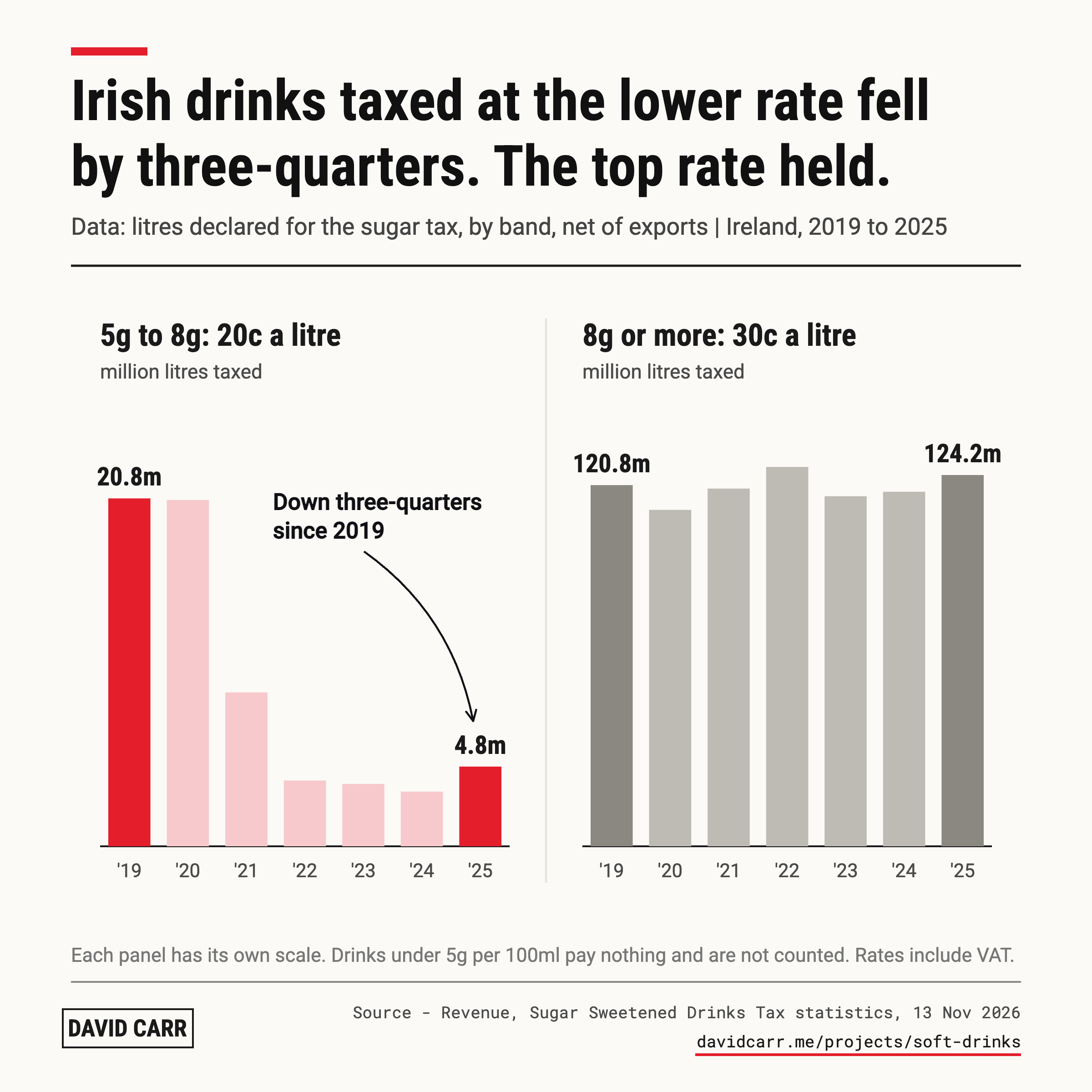
Irish drinks taxed at the lower rate fell by three-quarters. The top rate held.
- 5g to 8g: 20.8m litres in 2019, 4.8m in 2025
- 8g or more: 120.8m litres in 2019, 124.2m in 2025
- All taxed drinks in 2025: about 24 litres a person
Most of the drop came in 2021 and 2022, as more drinks moved below 5g. Many brands changed recipes before the tax started: Club Orange now has 4.5g of sugar per 100ml on its label (SuperValu). Drinks above 8g, which includes classic colas, kept selling at about the same volume.
My sums from Revenue's liability file: litres declared each two months, net of exports, added up by year. Drinks under 5g are not taxed, so they are not counted.
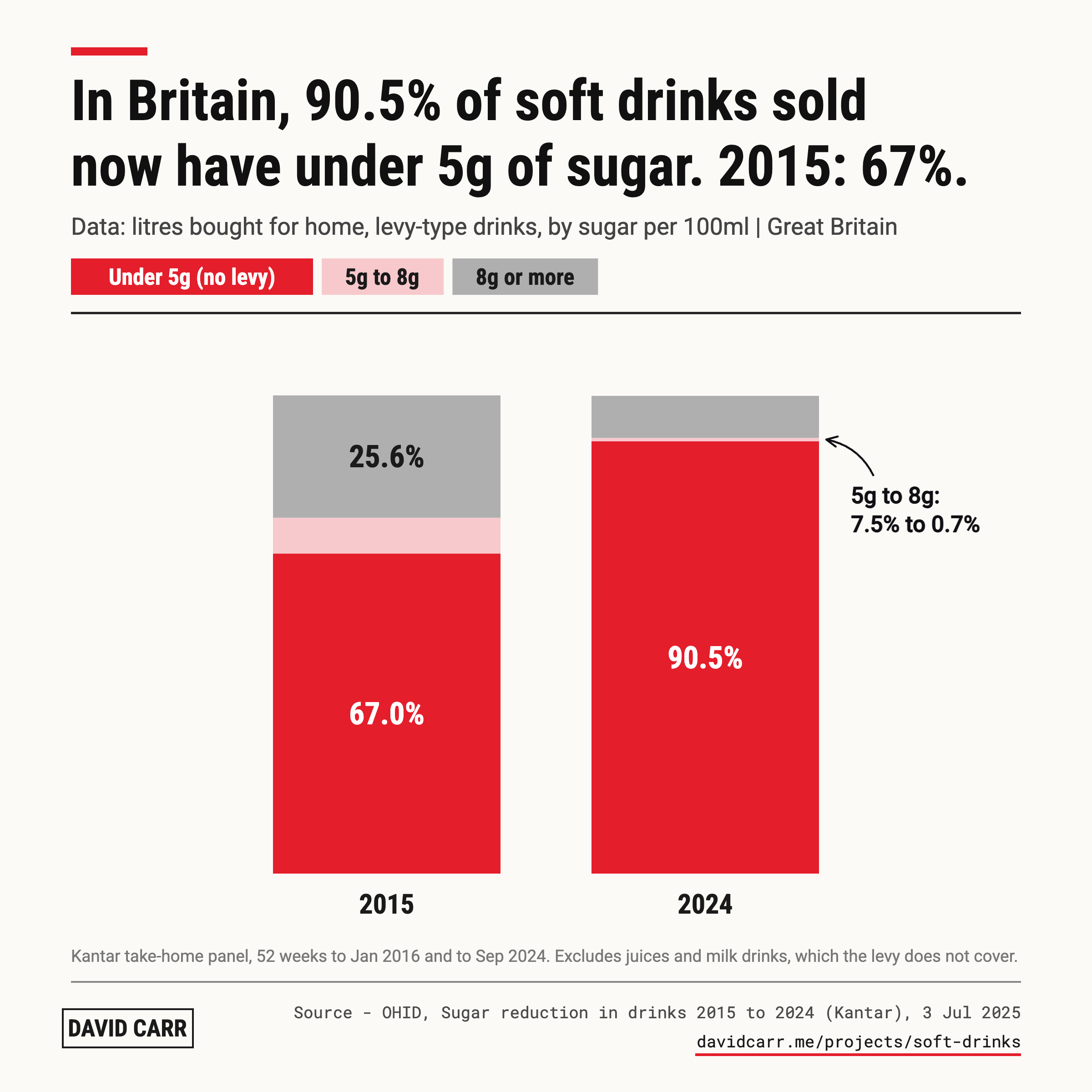
In Britain, 90.5% of soft drinks sold now have under 5g of sugar. 2015: 67%.
- Under 5g: 67.0% in 2015, 90.5% in 2024
- 5g to 8g: 7.5% to 0.7%
- 8g or more: 25.6% to 8.8%
The UK levy began in April 2018, two years after it was announced, and many drinks were changed in between. The rates are now 19.4p and 25.9p a litre, and the 5g line moves to 4.5g from January 2028 (gov.uk).
OHID, Sugar reduction in drinks: 2015 to 2024, 3 Jul 2025, from Kantar's take-home panel in Great Britain. Drinks the levy covers; juices and milk drinks are outside it.
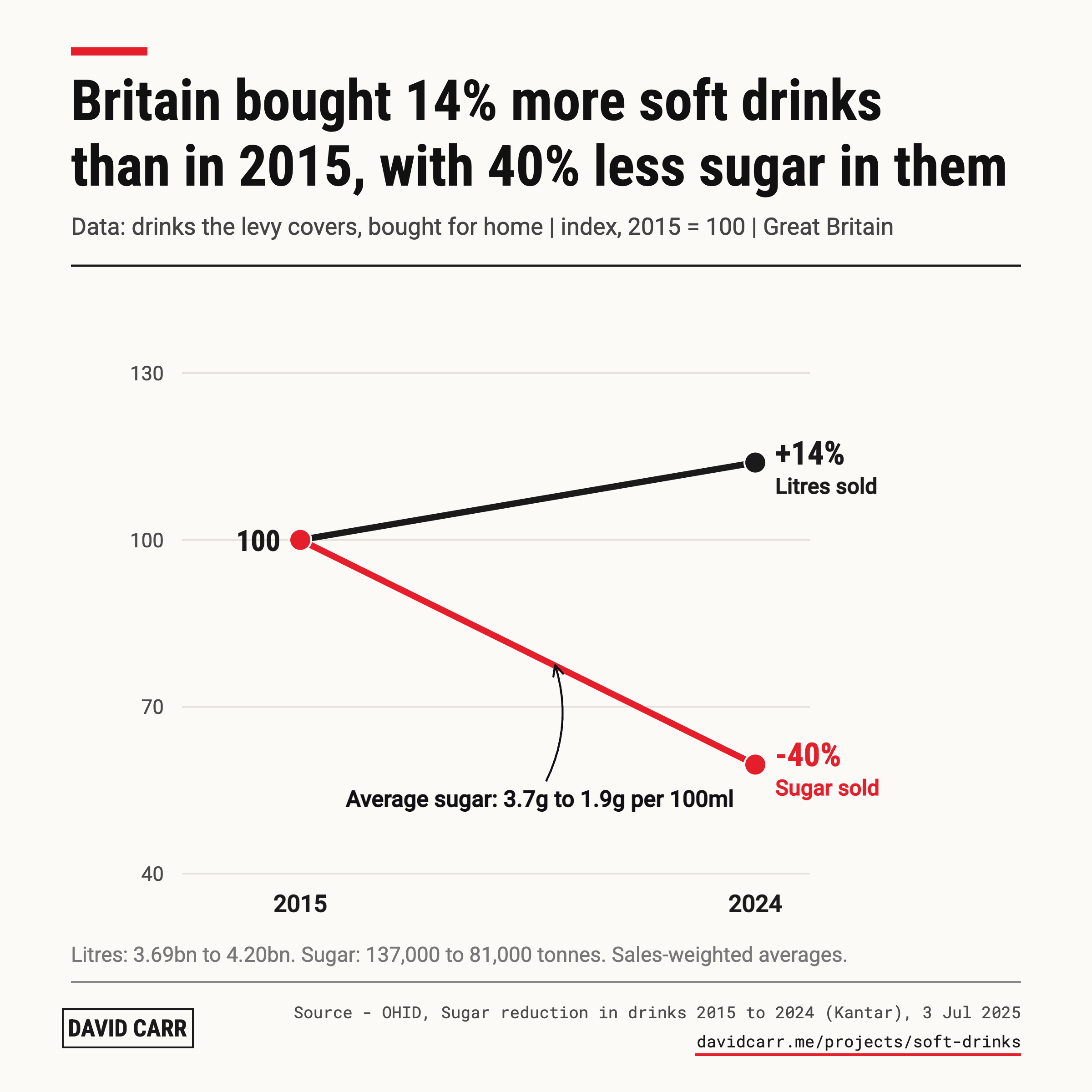
Britain bought 14% more soft drinks than in 2015, with 40% less sugar in them
- Litres: 3.69bn to 4.20bn, up 13.9%
- Sugar: 136,700 to 81,500 tonnes, down 40.4%
- Average sugar: 3.7g to 1.9g per 100ml
Sales of these drinks grew while the sugar in them fell, because most of the growth was in drinks under 5g.
Same source: OHID, Table 2a, 52 weeks to January 2016 against 52 weeks to September 2024. Bought for home only; cafés and restaurants are not counted.
Method, caveats and sources
The short answer. Soft drinks are five of Ireland's ten best-selling grocery brands, with Coca-Cola first for 22 years. Coca-Cola's brand is still worth three times Pepsi's, though the gap has closed since 2000. Coke Zero is where Coca-Cola's growth comes from. Since the sugar taxes, most drinks sold in Ireland and Britain have less than 5g of sugar per 100ml, while people buy as much or more.
Irish data. Revenue publishes litres and tax for drinks with 5g or more of sugar per 100ml, every two months since May 2018 (files, pulled 29 Nov 2026). It counts drinks when they leave the warehouse, not when they are sold, and it does not cover drinks below 5g. All shares and per-person figures are my sums.
British data. HMRC levy statistics (January 2026 tables) and OHID's analysis of Kantar's take-home panel (July 2025). Kantar is a panel of households, so it is an estimate.
Company and brand figures. Coca-Cola and PepsiCo results, as published by each company. Brand values are Interbrand's estimates, not sales. The Irish top ten is Checkout magazine's list with NIQ Ireland, as printed by ESM Magazine.
Not here. Market share by country, including the few places where Pepsi leads, and price per litre: no reliable free source was found, so they are left out. Taxes are shown as they are, with no view on whether they work.
Also: Irish supermarkets, Brand values and How Ireland shops for Christmas.