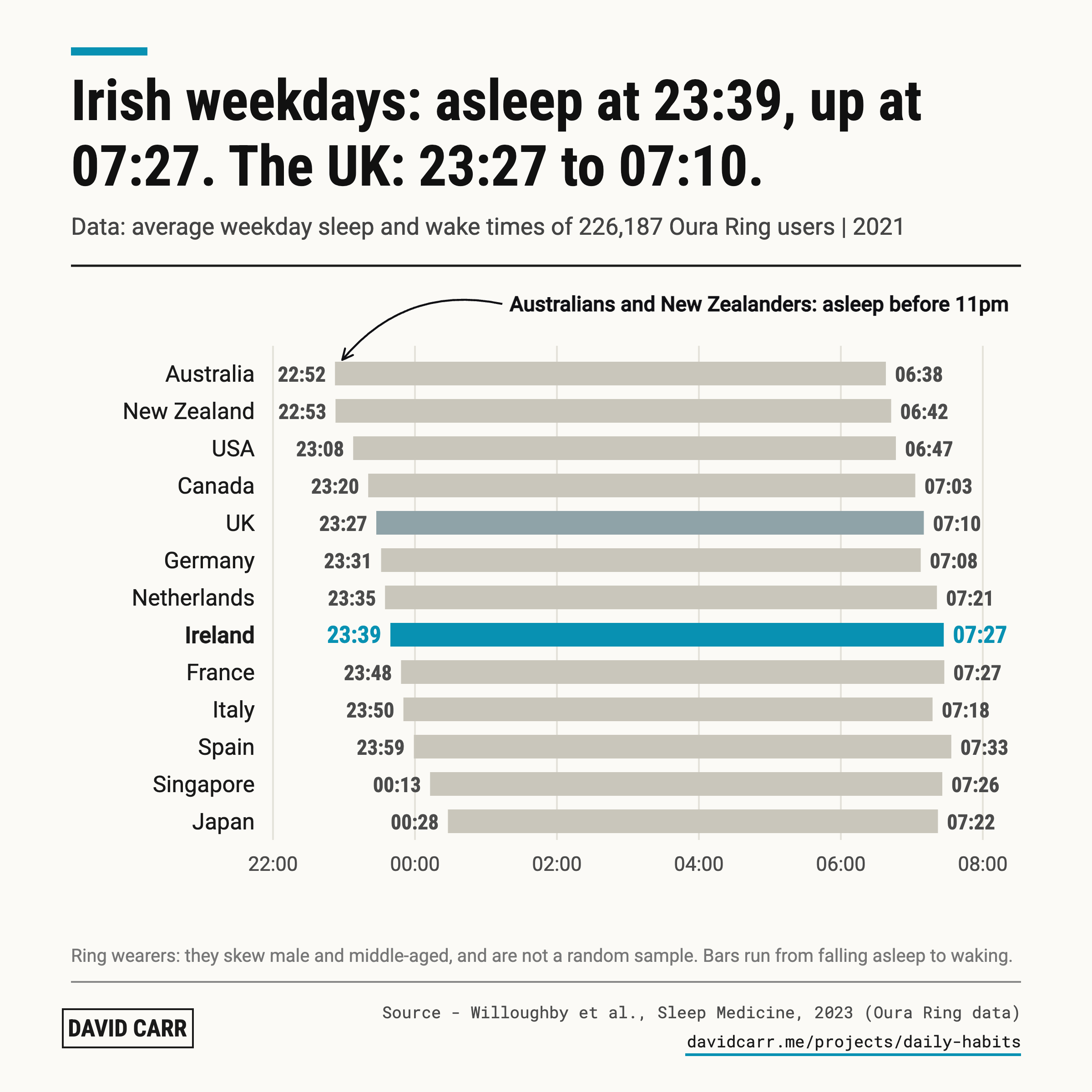
Irish weekdays: asleep at 23:39, up at 07:27. The UK: 23:27 to 07:10.
- Ireland: 23:39 to 07:27, 7 hours asleep
- UK: 23:27 to 07:10
- Australia: 22:52 to 06:38, the earliest
- Japan: 00:28 to 07:22, the latest to sleep
Ireland's weekday sleep of 7 hours was fourth-longest of 35 countries, just behind the Netherlands. Japan had the least: 6 hours 6 minutes. For how sleep fits into the rest of the Irish day, see Time use.
Willoughby, Alikhani, Karsikas, Chua and Chee, Sleep Medicine 110 (2023); country tables from the open preprint. 226,187 Oura Ring users, 54.8 million nights, 4 January 2021 to 2 January 2022. Ring owners skew male and middle-aged.
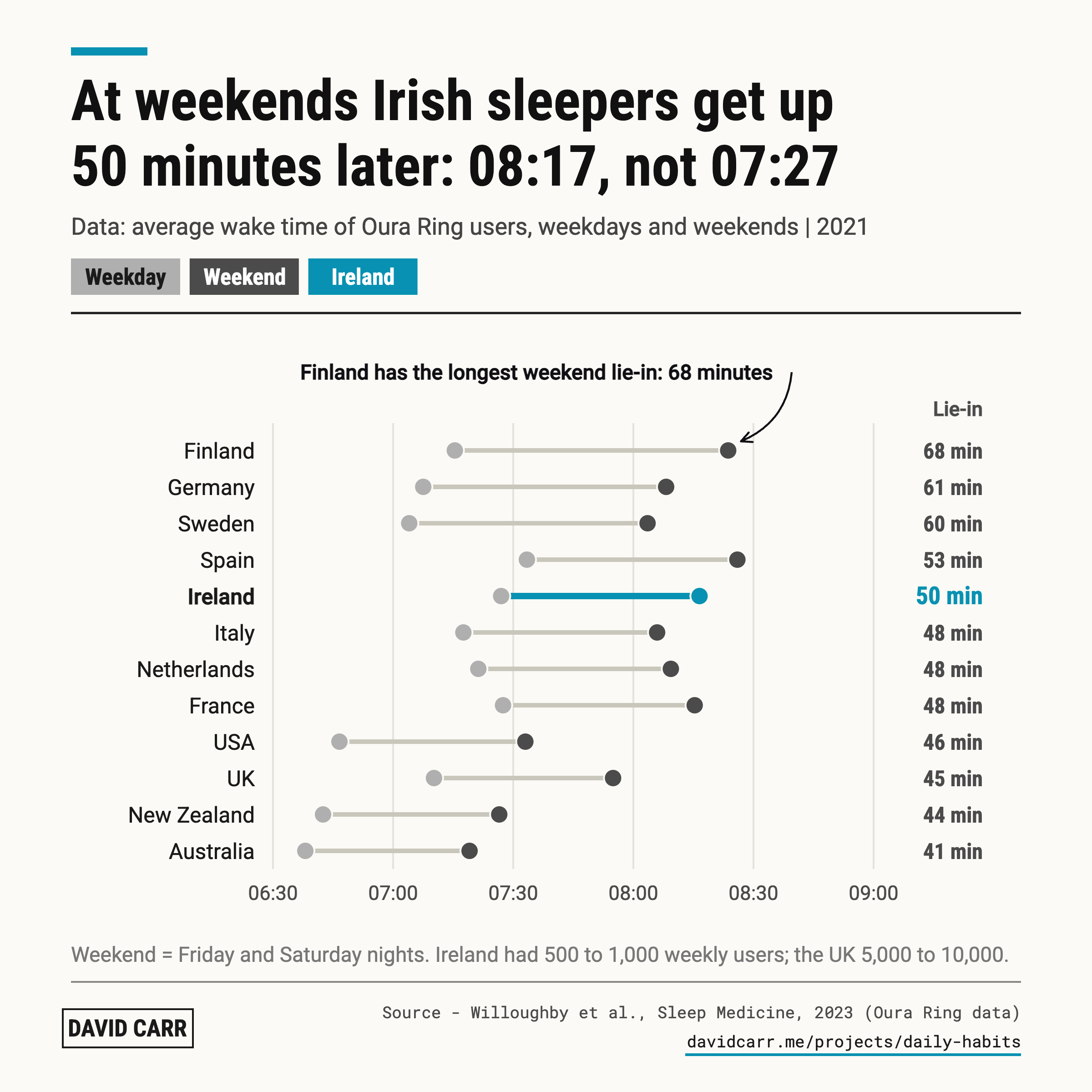
At weekends Irish sleepers get up 50 minutes later: 08:17, not 07:27
- Ireland: 07:27 on weekdays, 08:17 at weekends
- UK: 07:10 to 07:55, a 45-minute lie-in
- Finland: 68 minutes, the longest here
- Australia: 41 minutes, the shortest here
Irish sleepers also go to bed later at weekends: just after midnight, against 23:39 on weeknights. Australia and New Zealand have the shortest lie-ins here.
Same Oura study, 2021. Weekend means Friday and Saturday nights.
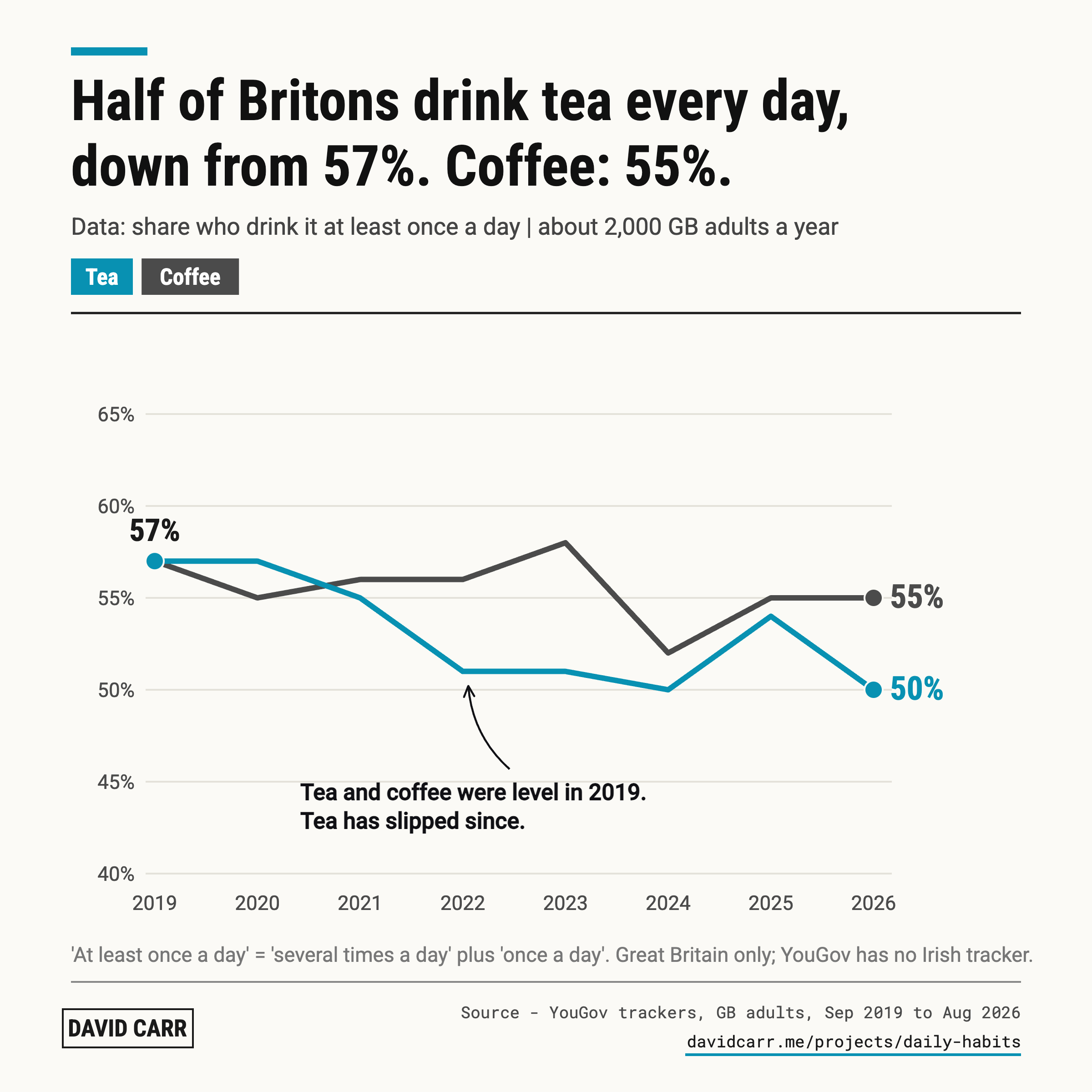
Half of Britons drink tea every day, down from 57%. Coffee: 55%.
- Tea at least once a day: 57% in 2019, 50% in 2026
- Coffee at least once a day: 57% in 2019, 55% in 2026
- Tea several times a day: 42% to 34%
Britain is still a tea country, just less so. One in four adults says they never drink tea, about the same share that never drinks coffee. YouGov has no matching Irish tracker, and the Irish cups-a-day figures I found come from tea and coffee brands, so they are left out.
YouGov trackers: tea and coffee, one wave a year, September 2019 to August 2026, about 2,000 GB adults each. A survey of what people say.
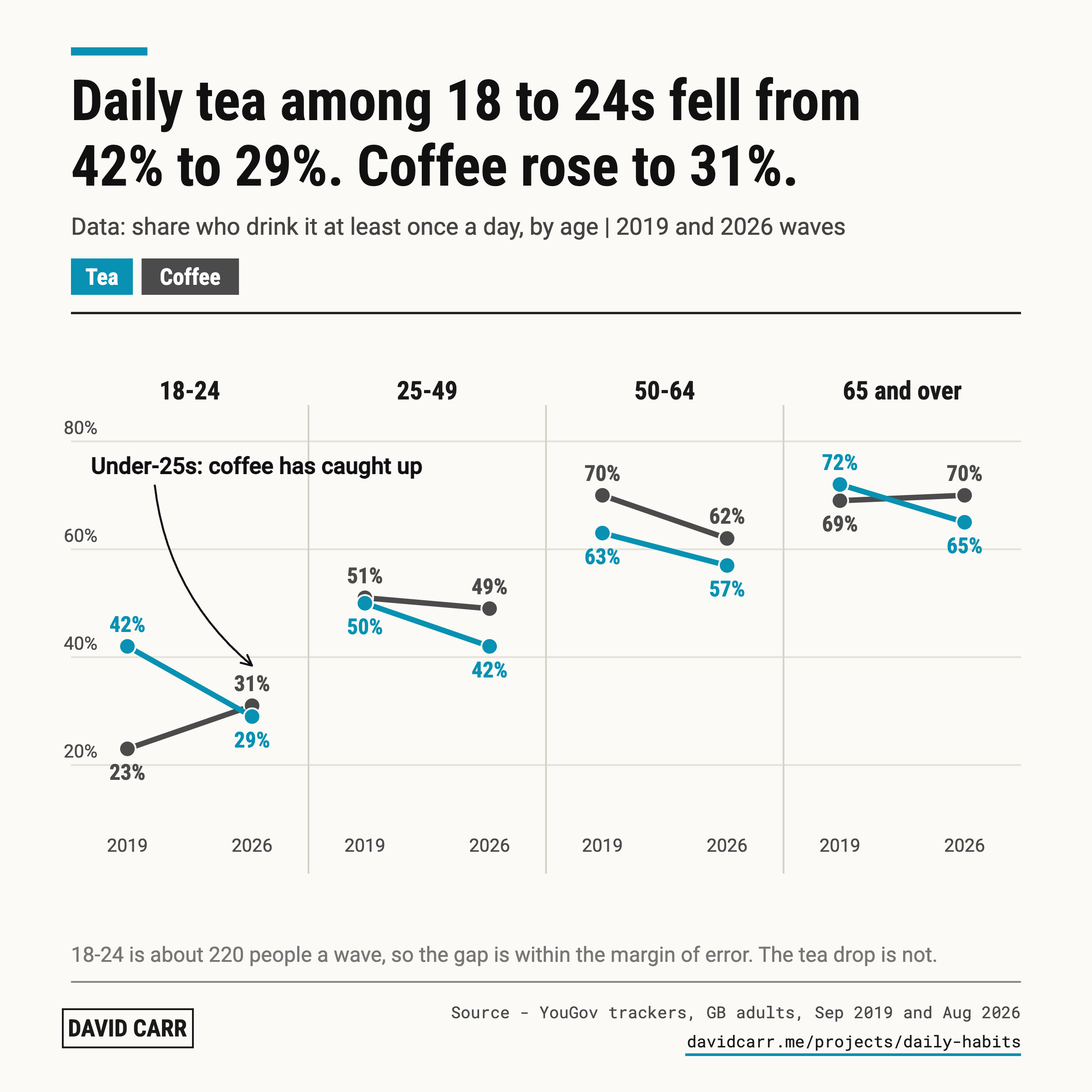
Daily tea among 18 to 24s fell from 42% to 29%. Coffee rose to 31%.
- 18 to 24: tea 42% to 29%, coffee 23% to 31%
- 25 to 49: tea 50% to 42%, coffee 51% to 49%
- 65 and over: tea 72% to 65%, coffee 69% to 70%
Tea fell in every age group. Coffee grew most among the youngest, who are now as likely to drink coffee daily as tea.
Same YouGov trackers, 2019 and 2026 waves. The 18 to 24 group is about 220 people a year, so treat its numbers as rough.
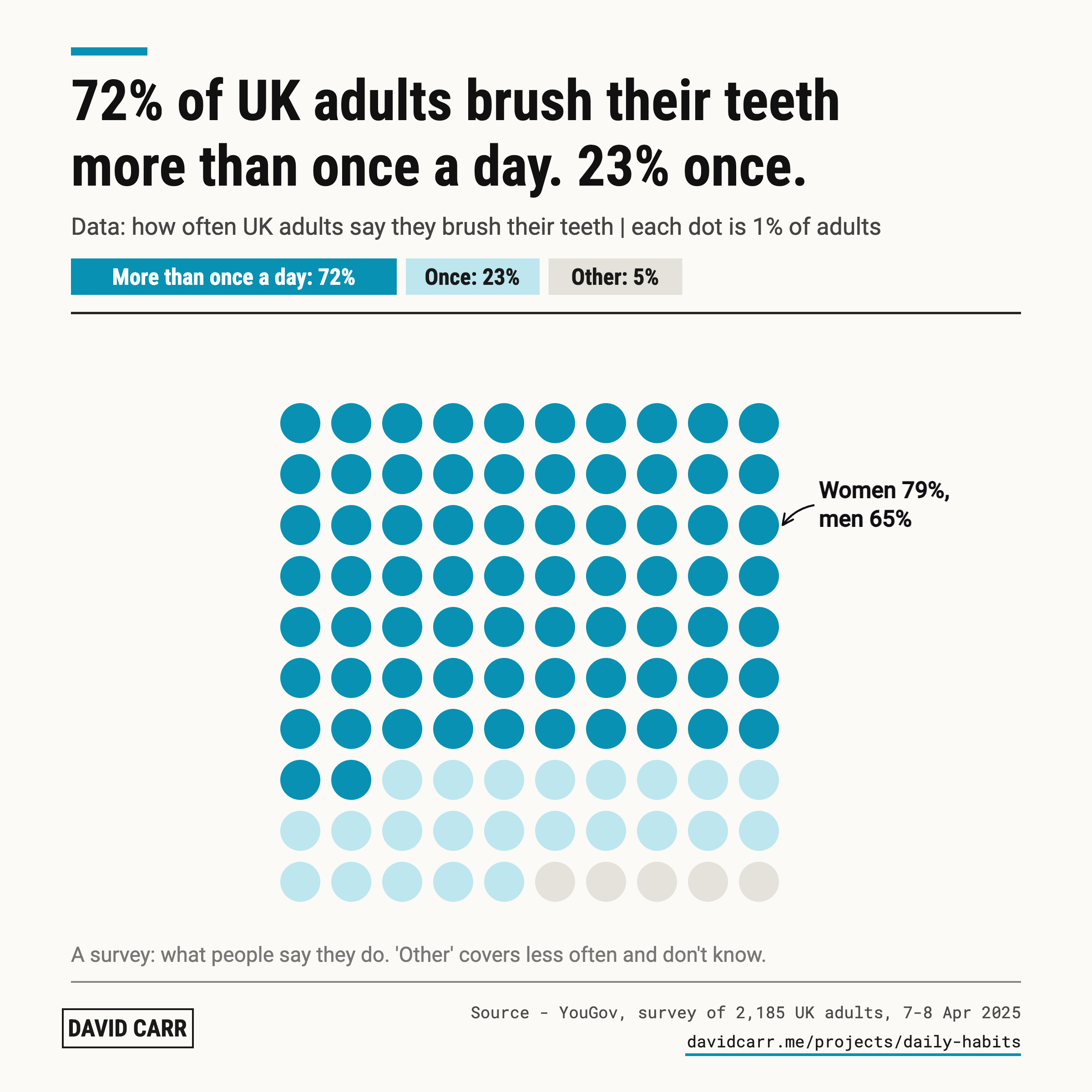
72% of UK adults brush their teeth more than once a day. 23% once.
- More than once a day: 72%
- Once a day: 23%
- Women: 79% more than once. Men: 65%
- Shower or bathe every day: 46%
The same survey found 39% change their sheets every week and 44% change their towels weekly.
Survey: YouGov, 2,185 UK adults, 7 to 8 April 2025, weighted. What people say they do.
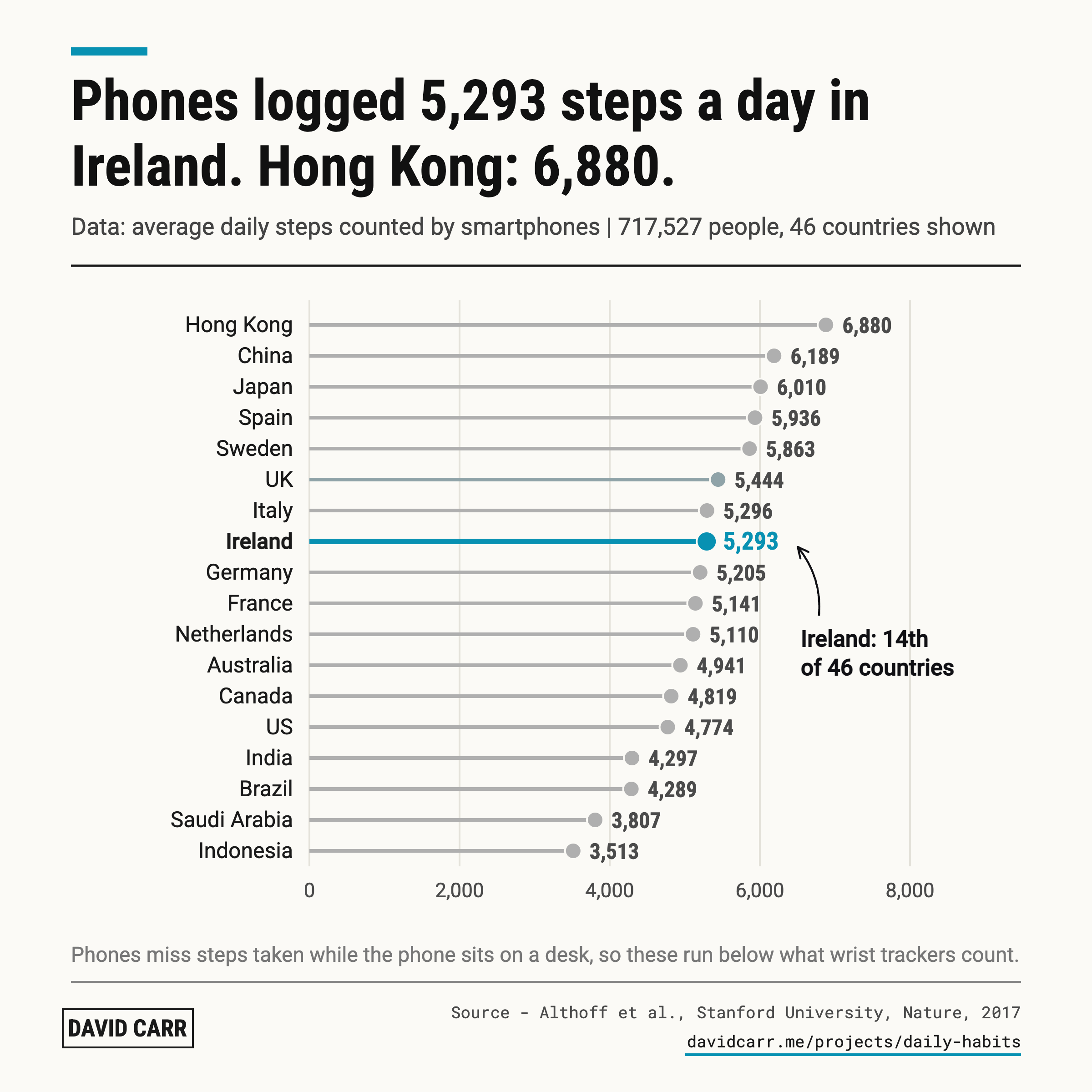
Phones logged 5,293 steps a day in Ireland. Hong Kong: 6,880.
- Hong Kong: 6,880, the most of 46 countries
- UK: 5,444 (12th)
- Ireland: 5,293 (14th)
- US: 4,774 (30th)
- Indonesia: 3,513, the fewest
Phones only count steps when they are carried, so these numbers are lower than wrist trackers report. Garmin's own users average far more: see Garmin. What this study is good for is comparing places on the same footing.
Althoff, Sosič, Hicks, King, Delp and Leskovec, Stanford University, Nature 547 (2017). 68 million days from 717,527 people using a step-counting phone app in 111 countries; the project page and data release list the 46 countries with 1,000+ users. Ireland: 2,758 users.
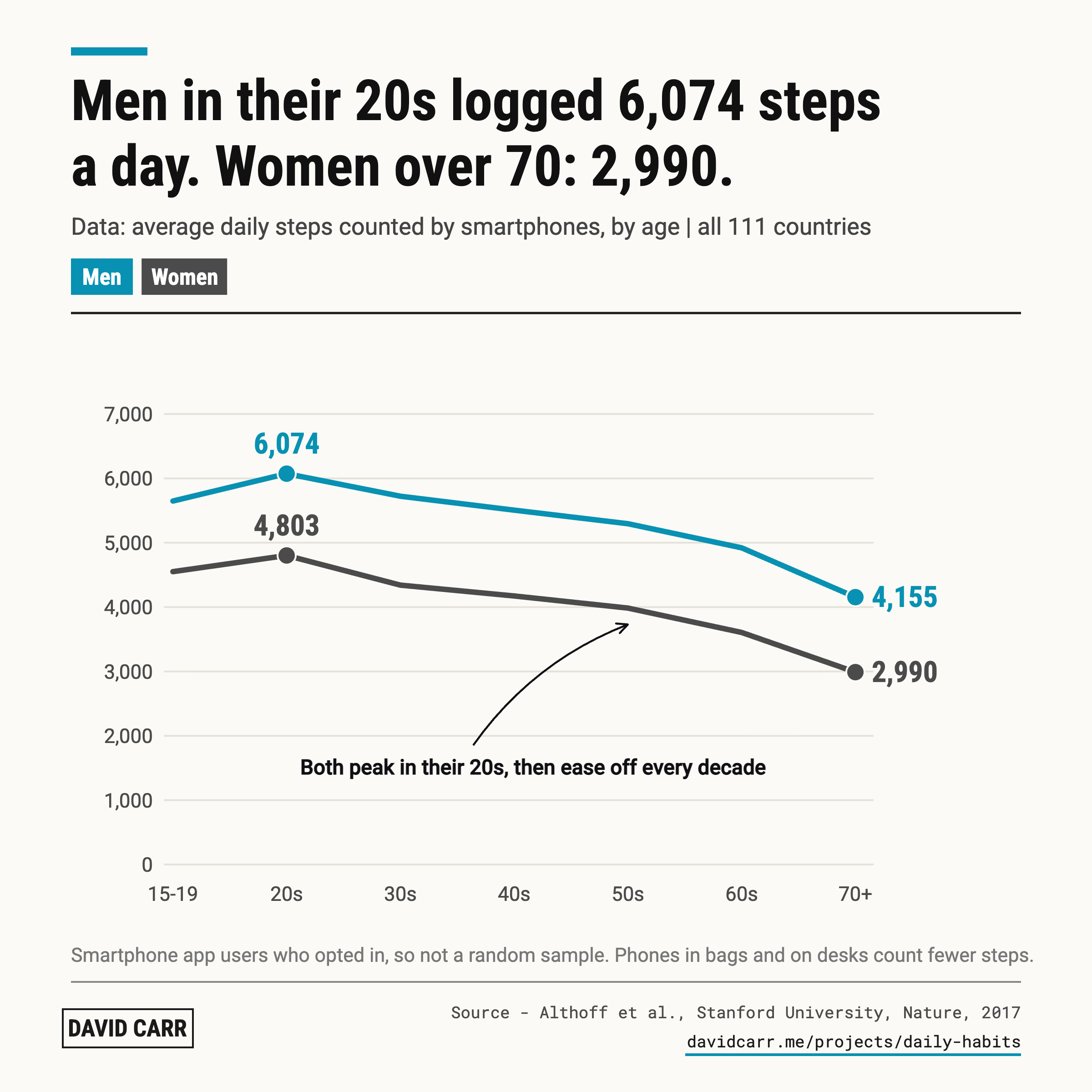
Men in their 20s logged 6,074 steps a day. Women over 70: 2,990.
- Men: 6,074 in their 20s, 4,155 at 70+
- Women: 4,803 in their 20s, 2,990 at 70+
- Both are highest in their 20s
Steps ease off with each decade after the 20s, for men and women alike.
Same Stanford data, all countries together. App users who chose to share data, so not a random sample.
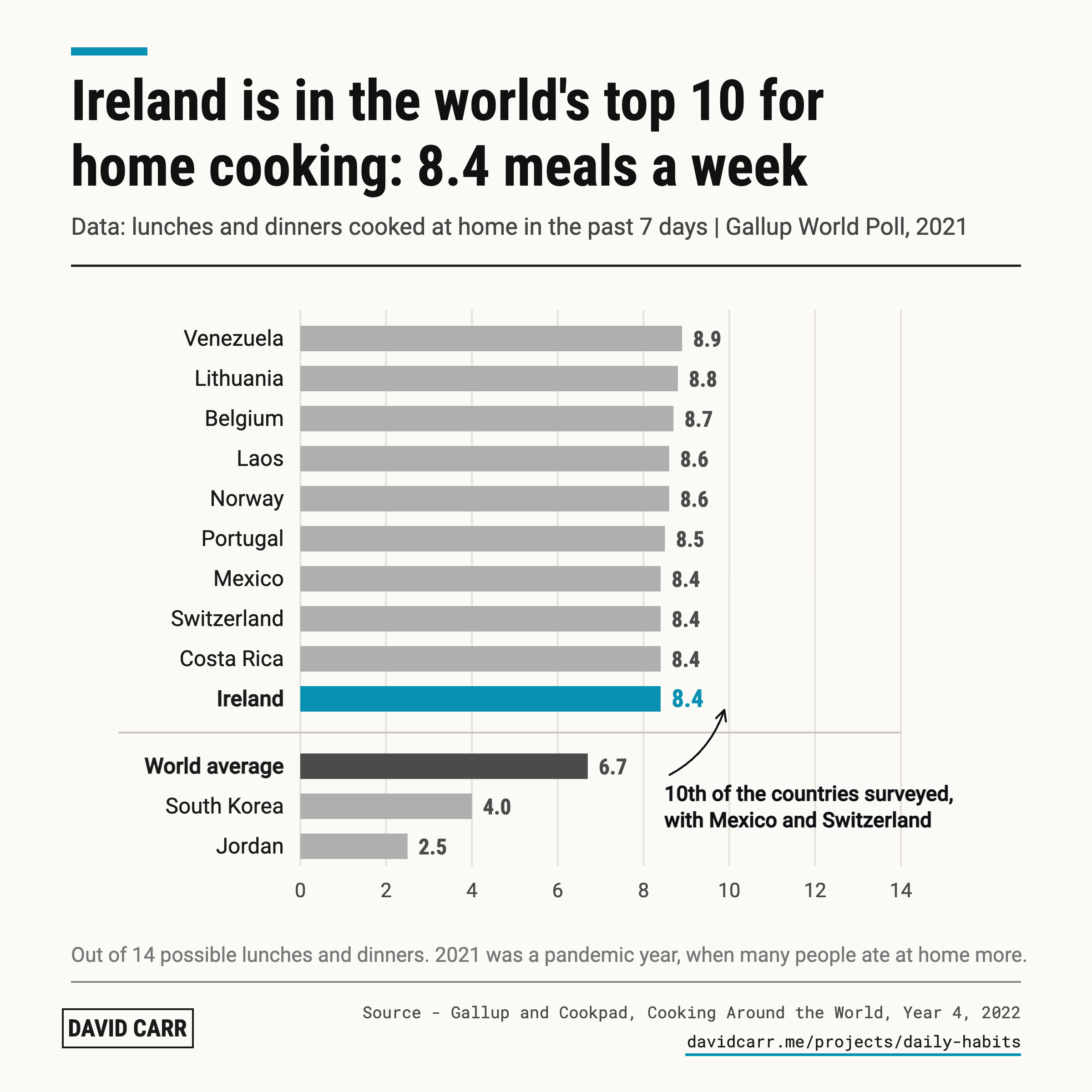
Ireland is in the world's top 10 for home cooking: 8.4 meals a week
- Venezuela: 8.9 lunches and dinners a week, the most
- Ireland: 8.4, joint with Mexico, Switzerland and Costa Rica
- World average: 6.7
- Jordan: 2.5, the fewest
The count is how many of the week's 14 lunches and dinners a person cooked at home themselves. In the next year's survey Ireland and the UK were among the ten countries where men and women cook most equally (Gallup, 2023).
Gallup and Cookpad, A Global Analysis of Cooking Around the World: Year 4 (2022), Figure 6. Asked in the Gallup World Poll in 2021, a pandemic year. More on the series at Gallup. The report does not print the UK figure.
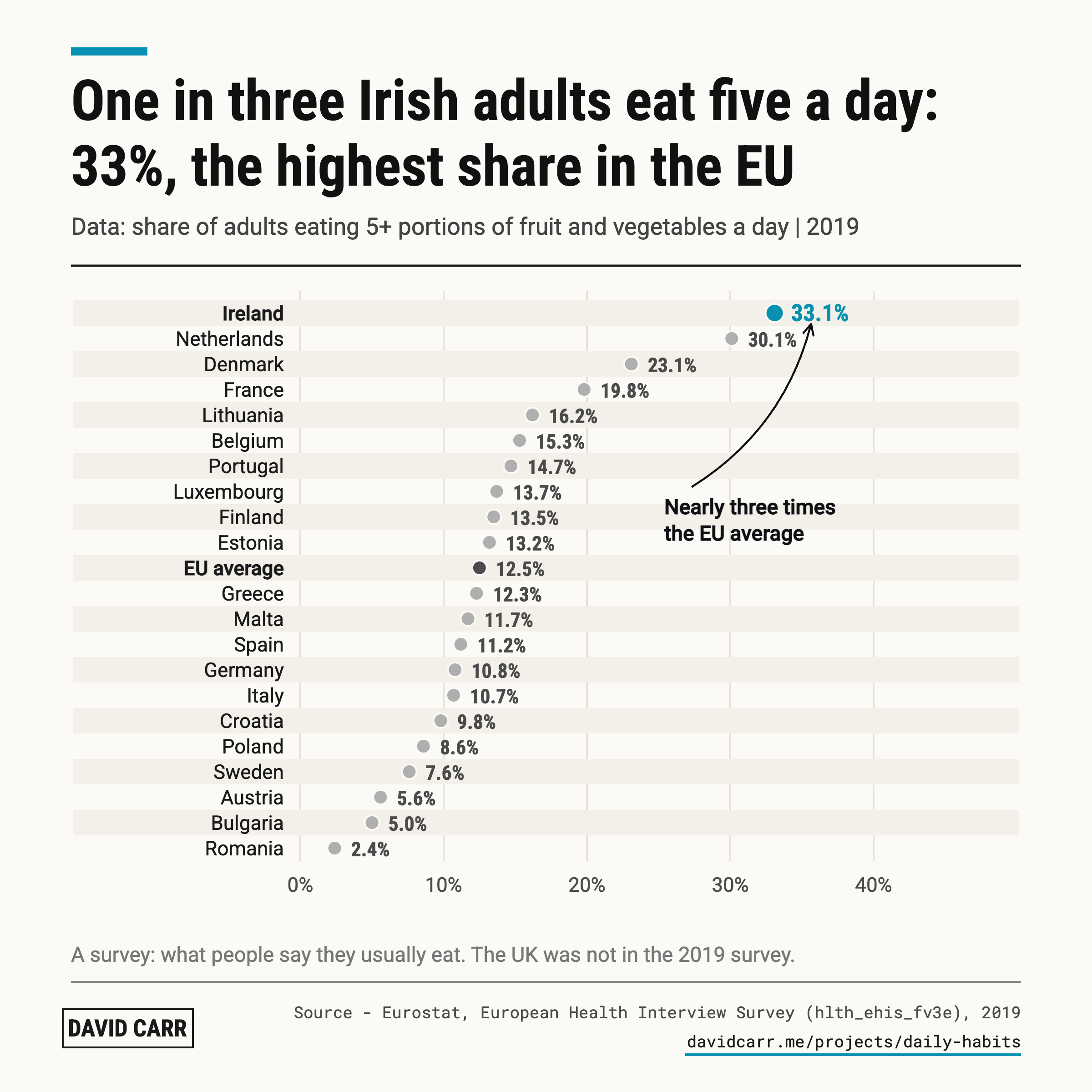
One in three Irish adults eat five a day: 33%, the highest share in the EU
- Ireland: 33.1%
- Netherlands: 30.1%
- Denmark: 23.1%
- EU average: 12.5%
- Romania: 2.4%
Ireland tops the EU on this measure by three points. Most Europeans eat between one and four portions a day.
Eurostat, European Health Interview Survey, hlth_ehis_fv3e, 2019, adults 18 and over. A survey of what people say they usually eat.
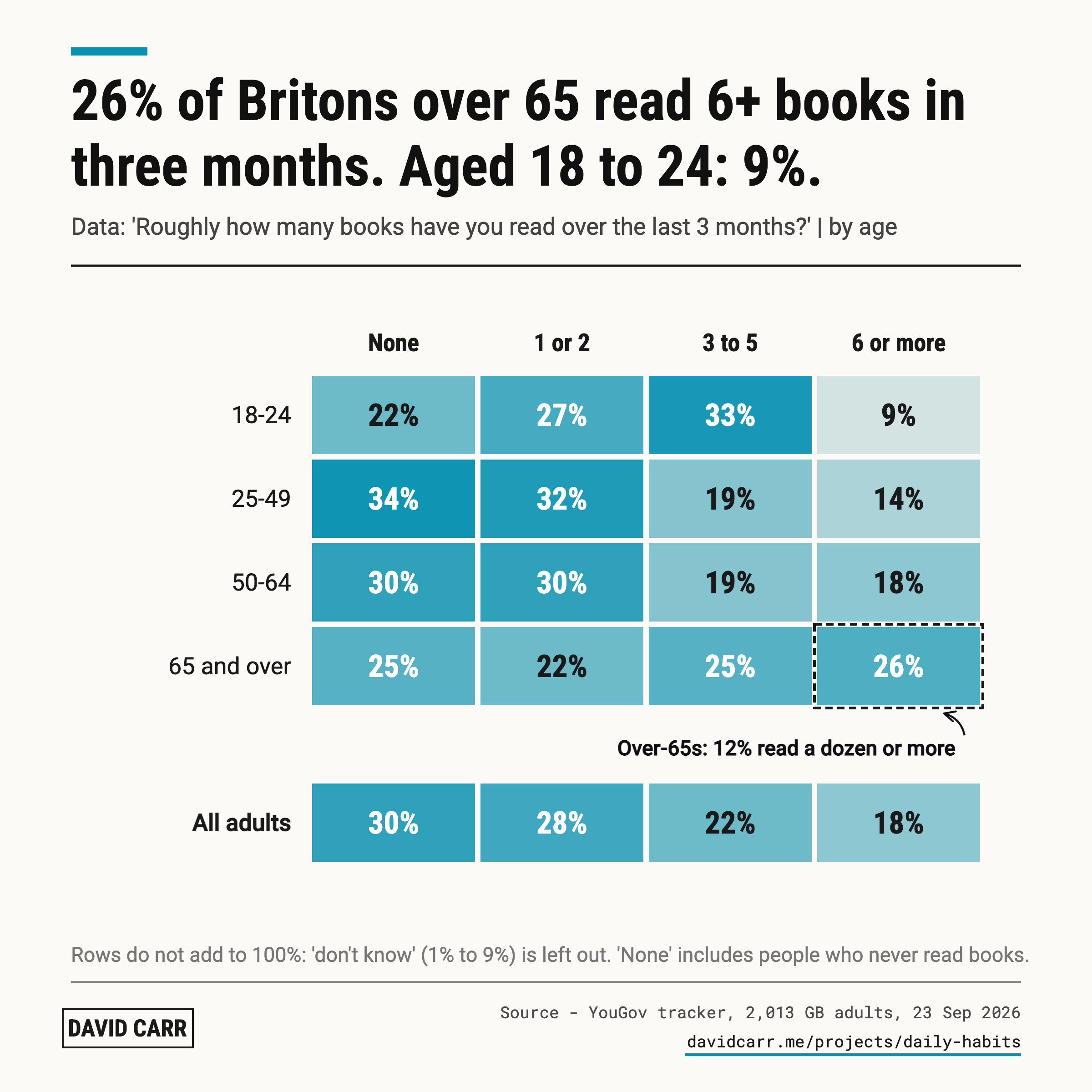
26% of Britons over 65 read 6+ books in three months. Aged 18 to 24: 9%.
- 65 and over: 26% read 6 or more, 12% read a dozen or more
- 18 to 24: 9% read 6 or more
- All adults: 30% read none in three months
Young adults were the least likely to have read nothing (22%), but most read one to five books. Women read more than men: 23% of women had read 6 or more, against 11% of men.
YouGov tracker, how many books Brits read, 2,013 GB adults, 23 September 2026.
Method, caveats and sources
The short answer. Irish adults in this data sleep a little later than the British, cook more at home than most of the world, eat more fruit and veg than anyone else in the EU and read more books than almost anyone in Europe. Phones counted about 5,300 steps a day in Ireland, mid-table. In Britain, daily tea drinking has slipped from 57% to 50% since 2019, while coffee has held.
Sleep. Oura Ring data from Willoughby et al., Sleep Medicine, 2023, using the country tables in the open preprint (CC BY 4.0). Ring wearers are a paying, mostly male, mostly middle-aged group, so read the times as "people who track their sleep", not the whole country.
Steps. Althoff et al., Nature, 2017, Stanford University, from a phone app's step counts. Data released by the authors on GitHub. The data is several years old, and phones undercount steps.
Surveys. YouGov GB trackers for tea, coffee and books (downloaded 29 November 2026), a YouGov UK poll from April 2025 for teeth, the Gallup World Poll (via Gallup and Cookpad) for cooking, and Eurostat's health survey (2019) and EU-SILC (2022) for fruit and veg and for reading. All are what people say they do.
Reading across Europe, with Ireland near the top, is on the Books and reading page.
Left out. Tea and coffee per person by country (the trade-based figures do not measure drinking, and the popular table is paywalled), breakfast skipping, showering by country, bed-making, glasses of water and the weekly shop day: I could not find a survey with a stated sample and date for Ireland or a fair comparison. For checking the phone on waking see Screen time; for the commute see Getting to work; for how the whole day is spent see Time use.