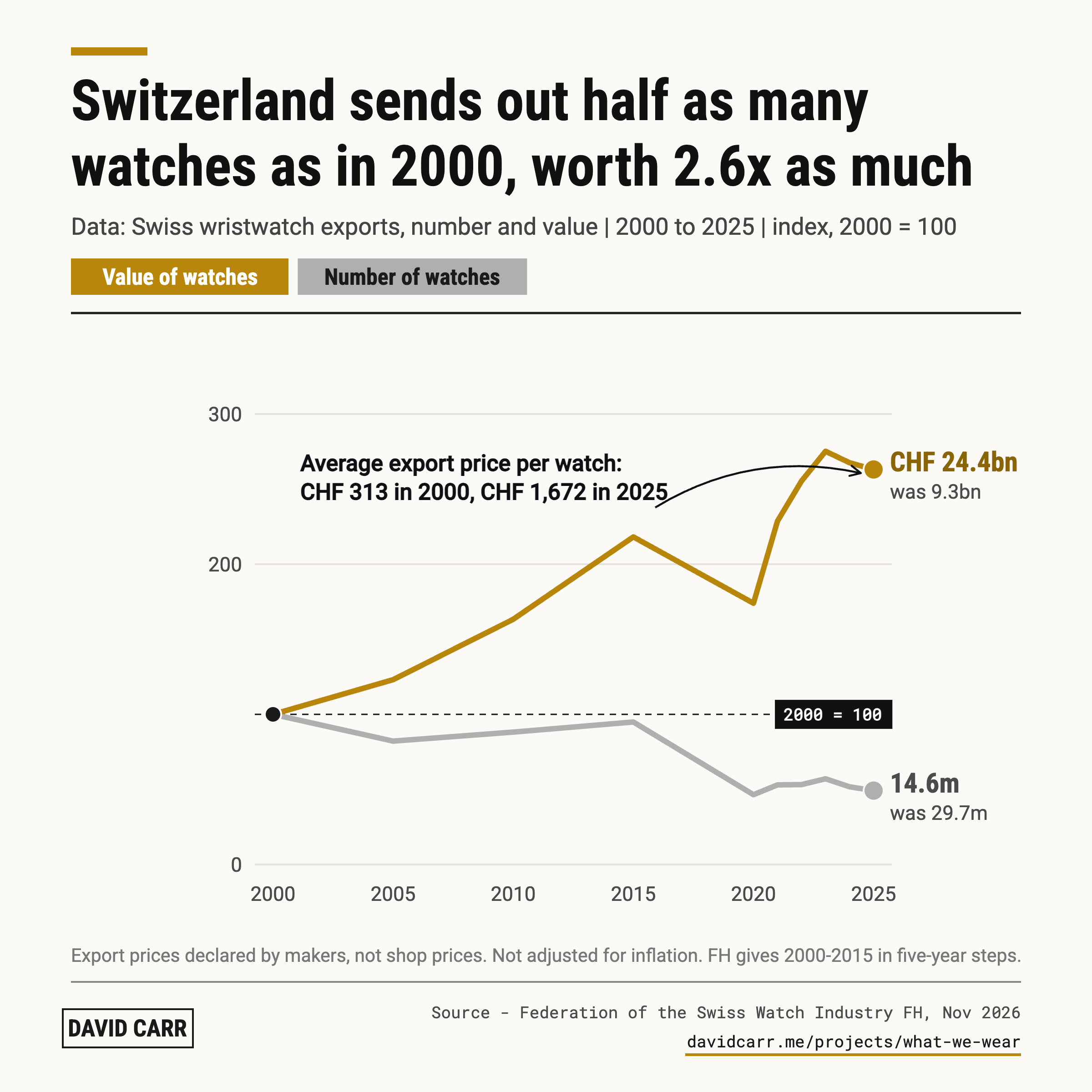
Switzerland sends out half as many watches as in 2000, worth 2.6x as much
- 2000: 29.7 million watches, CHF 9.3bn
- 2015: 28.1 million, CHF 20.2bn
- 2020: 13.8 million, CHF 16.1bn
- 2025: 14.6 million, CHF 24.4bn
The number of Swiss watches sent abroad halved between 2015 and 2020 and has not come back. Their value kept rising. The average export price of a Swiss watch went from CHF 313 in 2000 to CHF 1,672 in 2025.
From the Federation of the Swiss Watch Industry's historical series, November 2026. Export prices, not adjusted for inflation. 2026 is running 3.4% ahead of 2025 by value to October (FH).
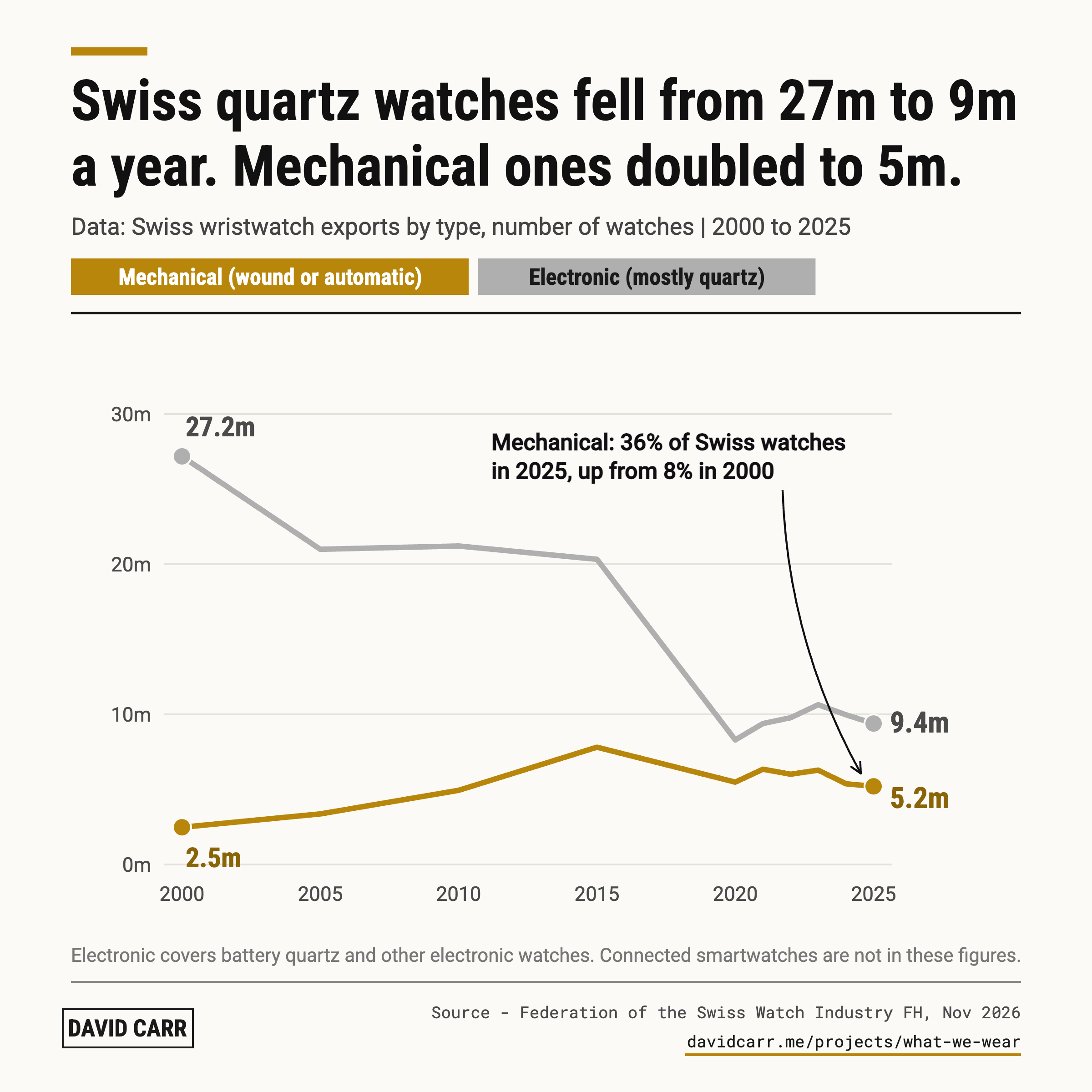
Swiss quartz watches fell from 27m to 9m a year. Mechanical ones doubled to 5m.
- Electronic (mostly quartz): 27.2m in 2000, 9.4m in 2025
- Mechanical: 2.5m in 2000, 7.8m in 2015, 5.2m in 2025
- Mechanical share of number: 8% in 2000, 36% in 2025
- Mechanical share of value in 2025: 86%
Mechanical watches, wound by hand or by the wearer's movement, are about a third of Swiss watches by number and most of the money.
FH electronic and mechanical watches. FH counts only traditional watches; connected smartwatches are not in its figures.
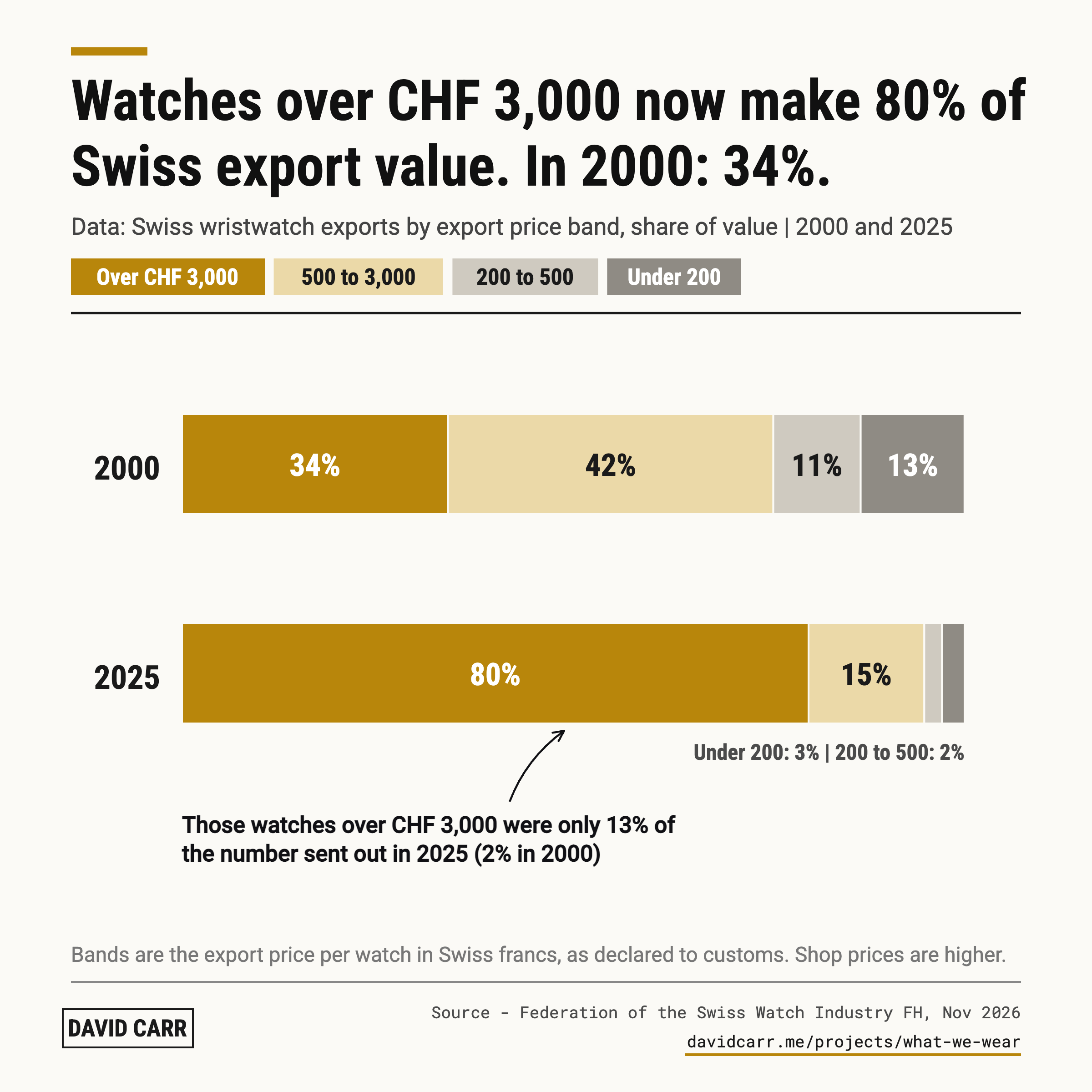
Watches over CHF 3,000 now make 80% of Swiss export value. In 2000: 34%.
- Over CHF 3,000: 34% of value in 2000, 80% in 2025
- 500 to 3,000: 42%, then 15%
- Under 500: 25%, then 5%
- Number over CHF 3,000: 488,000 in 2000, 1.87 million in 2025
The cheapest Swiss watches fell furthest. 22.8 million under CHF 200 were sent out in 2000, and 8.3 million in 2025. The most expensive band almost quadrupled in number.
FH watches by price point. The bands are the price per watch declared at export. A watch exported at CHF 3,000 usually sells for more in a shop.
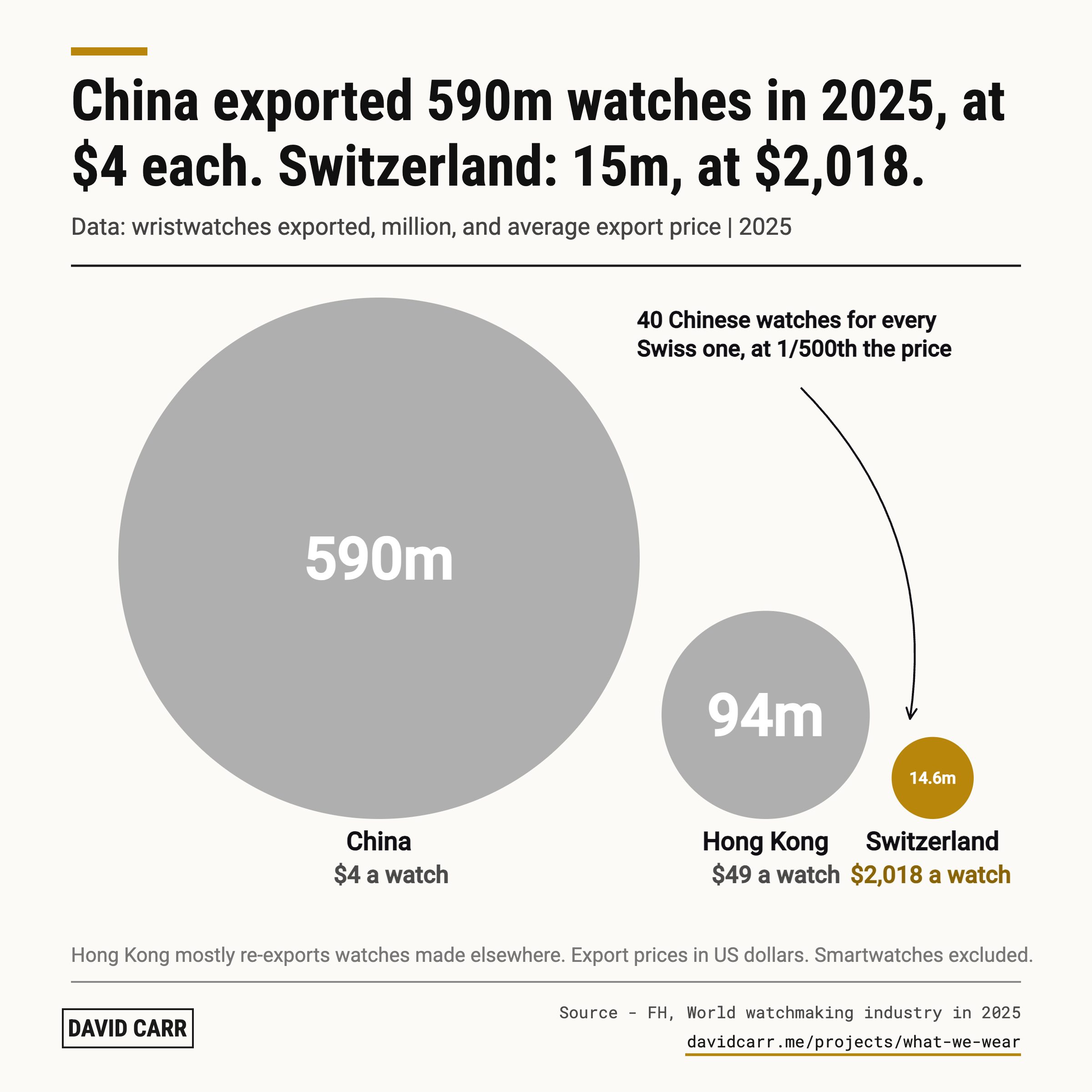
China exported 590m watches in 2025, at $4 each. Switzerland: 15m, at $2,018.
- China: 589.5 million, average $4
- Hong Kong: 94.0 million, average $49
- Switzerland: 14.6 million, average $2,018
- Germany: 12.1 million, $169; USA: 11.2 million, $151
For every Swiss watch exported, China exported about 40. By value it runs the other way: Switzerland shipped the equivalent of $30.8bn of watchmaking products, China $4.9bn.
FH, World watchmaking industry in 2025. Export prices in US dollars. Hong Kong mostly re-exports watches made elsewhere, so some watches are counted twice.
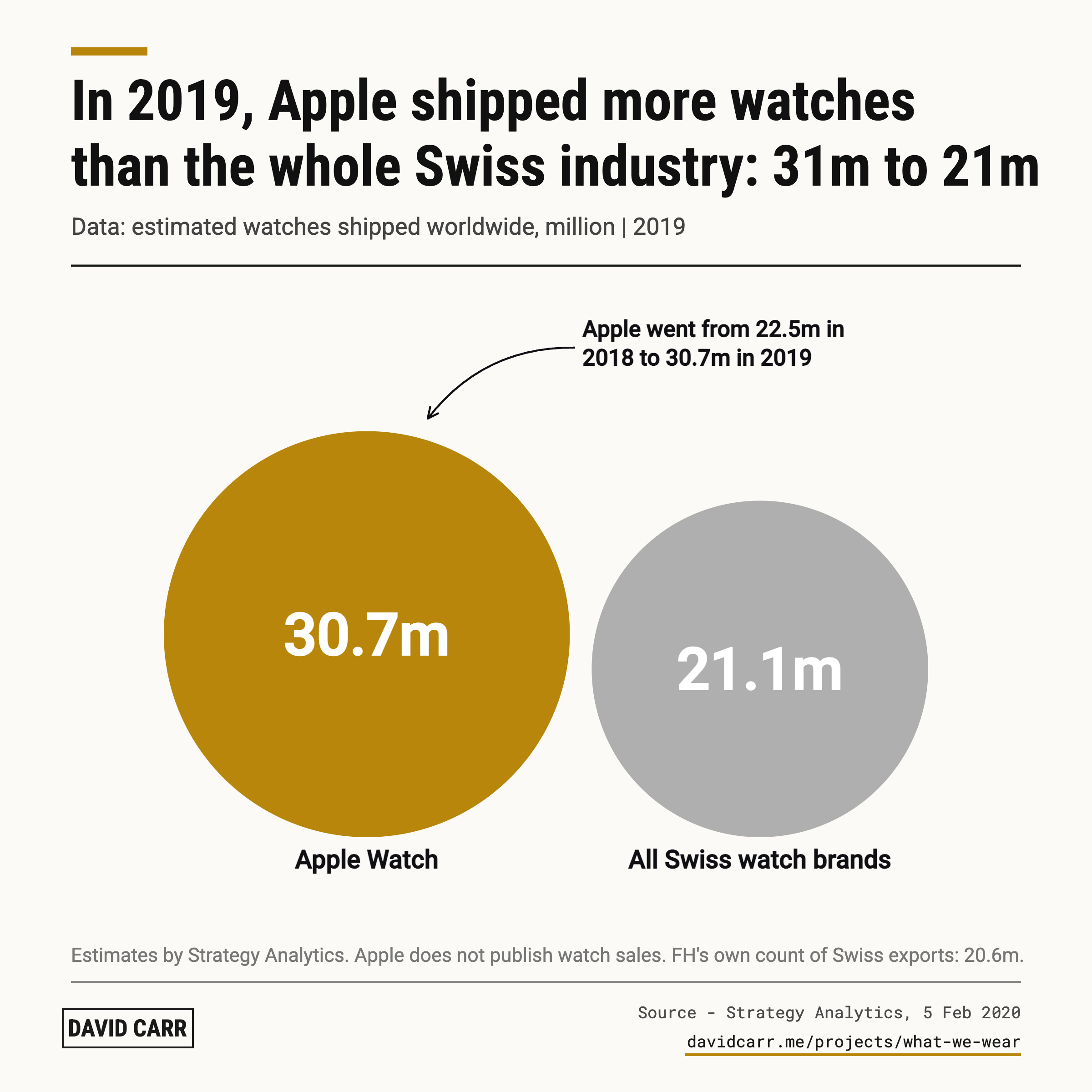
In 2019, Apple shipped more watches than the whole Swiss industry: 31m to 21m
- Apple Watch: 22.5m in 2018, 30.7m in 2019
- Swiss watch industry: 24.2m in 2018, 21.1m in 2019
- Apple's share of smartwatches shipped in 2025: 23%
Apple does not publish how many watches it sells, so these are estimates. Counterpoint puts Apple at nearly one in four smartwatches shipped in 2025, up from 22% in 2024 (9to5Mac).
Strategy Analytics, 5 February 2020. Its Swiss count includes sales inside Switzerland, so it is a little above FH's export figure.
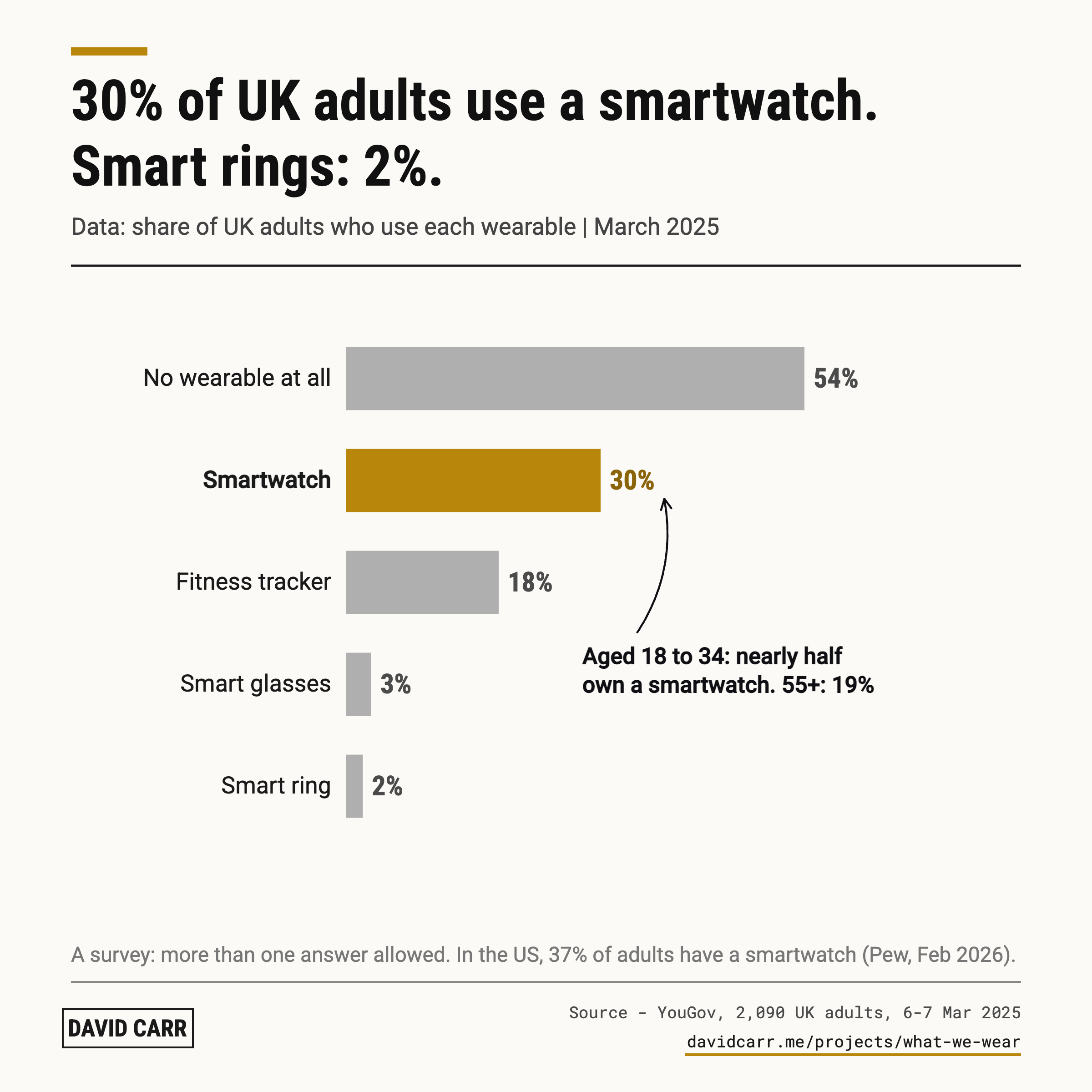
30% of UK adults use a smartwatch. Smart rings: 2%.
- Smartwatch: 30%
- Fitness tracker: 18%
- Smart glasses: 3%
- Smart ring: 2%
- None of these: 54%
Younger adults are far more likely to have one: 46% of 18 to 24-year-olds and 47% of 25 to 34-year-olds have one, against 19% of people 55 and over. In the US, 37% of adults have a smartwatch (Pew, February 2026).
YouGov, 2,090 UK adults, 6 to 7 March 2025. People could pick more than one device.
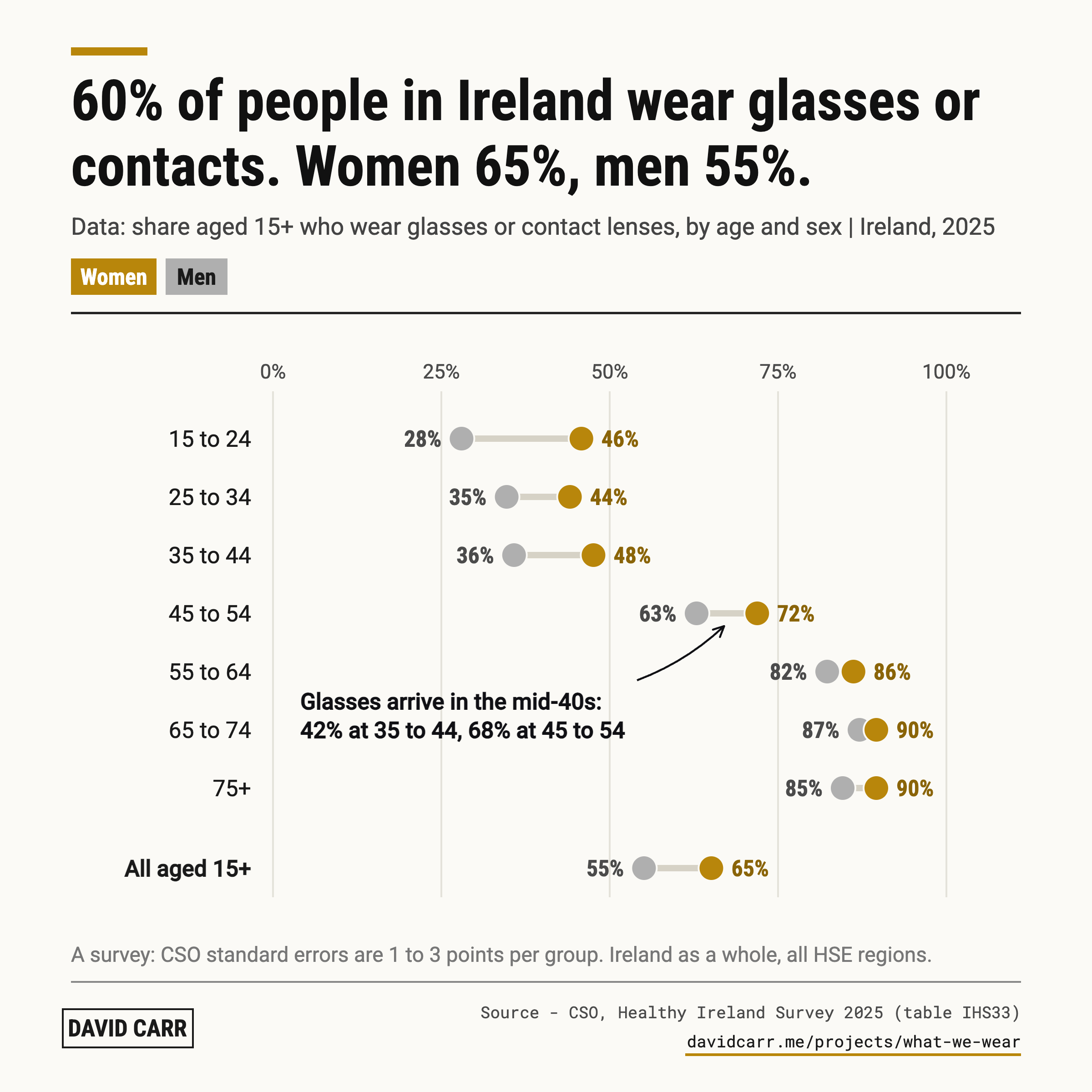
60% of people in Ireland wear glasses or contacts. Women 65%, men 55%.
- Aged 15 to 24: 37%
- 35 to 44: 42%
- 45 to 54: 68%
- 55 to 64: 84%
- 65 to 74: 88%
The big step comes in the mid-40s, when close-up sight usually starts to change. Women report wearing them more than men at every age, and the gap is widest among the young: 46% to 28% at 15 to 24.
CSO, Healthy Ireland Survey 2025, table IHS33. A survey of people aged 15 and over. Standard errors are 1 to 3 points per group.
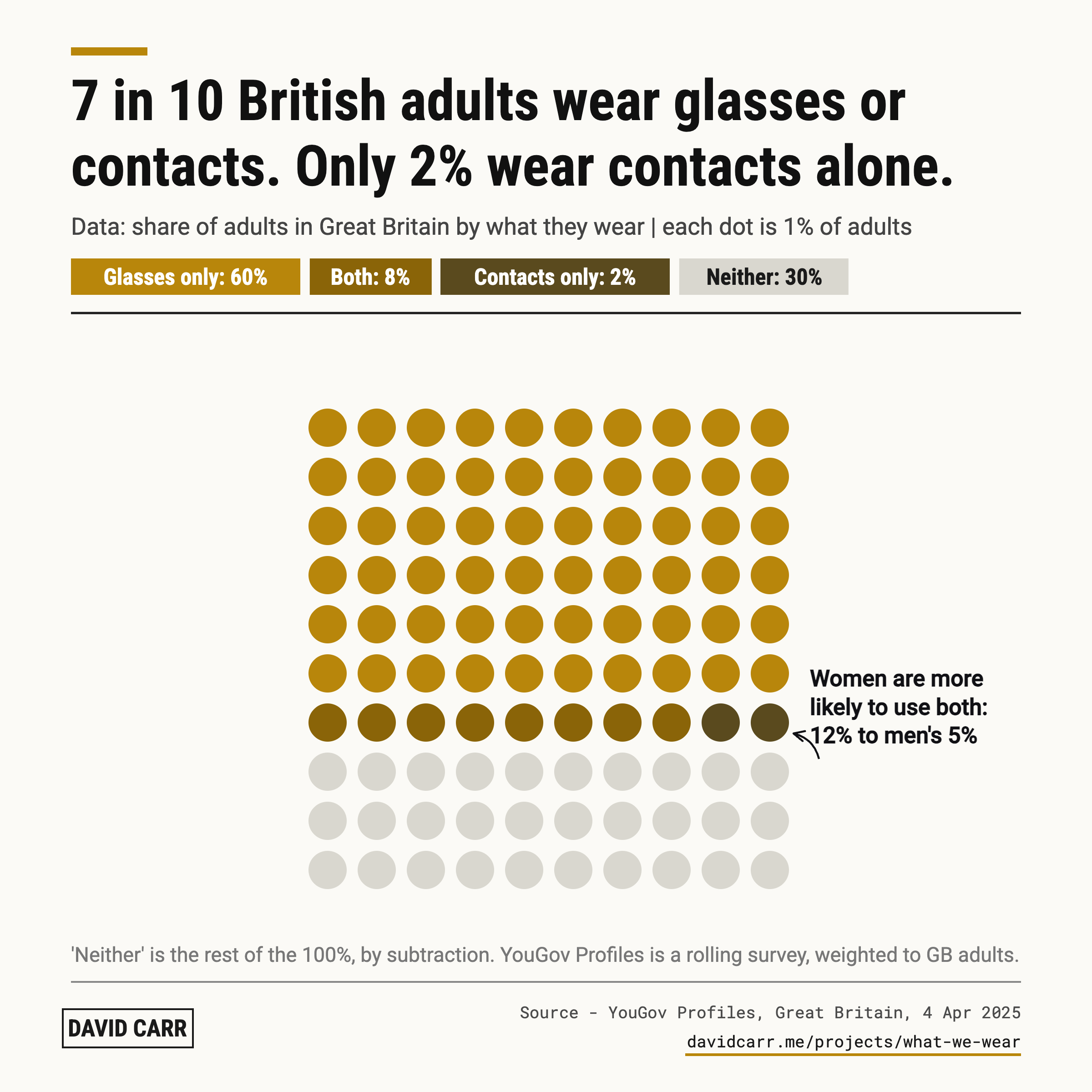
7 in 10 British adults wear glasses or contacts. Only 2% wear contacts alone.
- Glasses only: 60%
- Both: 8%
- Contacts only: 2%
- Neither: 30% (the rest)
Of people who wear only glasses, 53% said they did not know if they could get used to contact lenses, and 30% said glasses were easy and need little care.
YouGov Profiles, 4 April 2025. Great Britain. "Neither" is my subtraction.
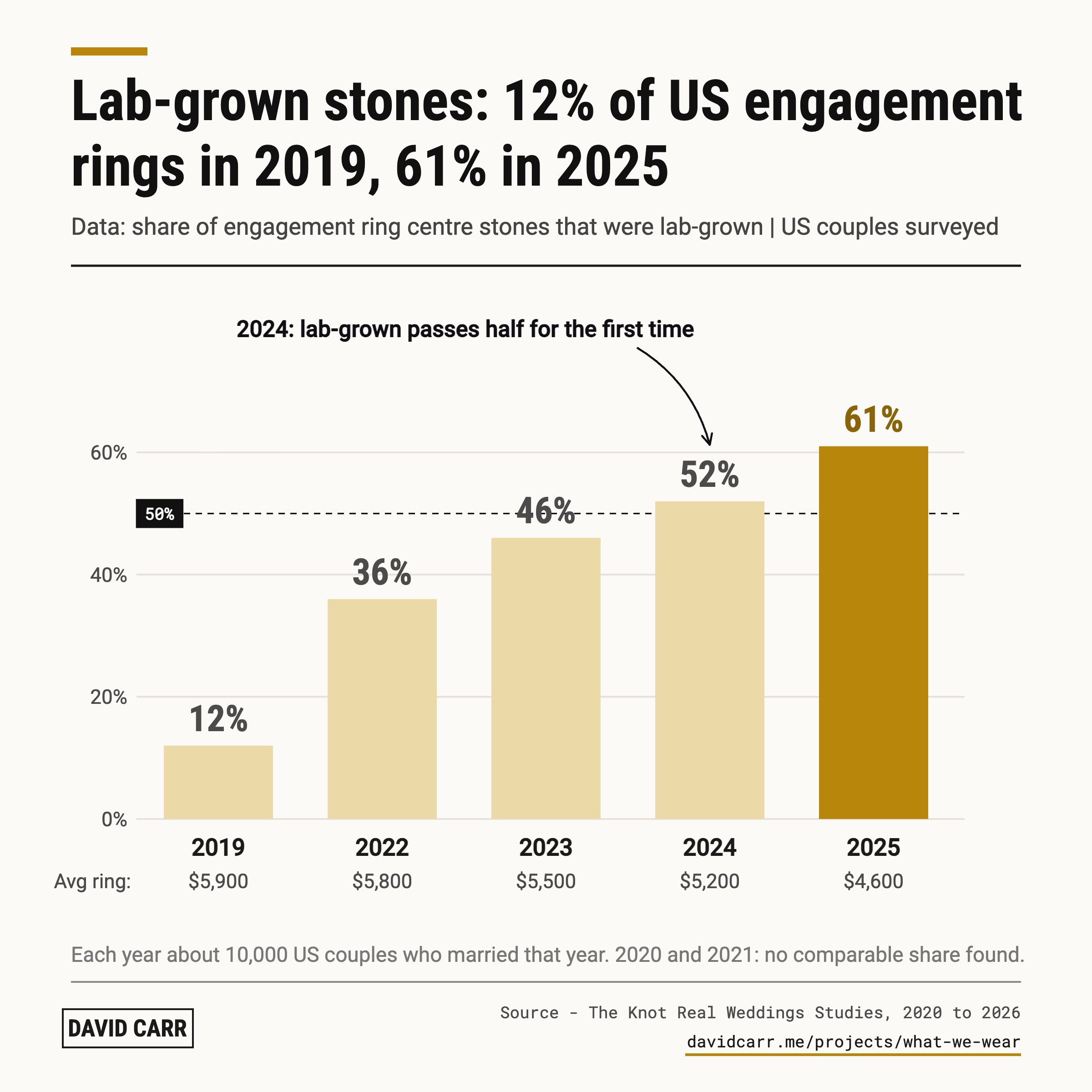
Lab-grown stones: 12% of US engagement rings in 2019, 61% in 2025
- 2019: 12% lab-grown, average ring $5,900
- 2022: 36%, $5,800
- 2023: 46%, $5,500
- 2024: 52%, $5,200
- 2025: 61%, $4,600
As lab-grown stones took over, the average spend fell and the stones got bigger. In 2025 a lab-grown ring averaged $4,300 for about 2 carats; a natural one $7,000 for 1.6 carats. In Ireland, couples in a January 2025 survey spent €3,095 on average on the engagement ring (weddingsonline, 641+ couples).
The Knot Real Weddings Studies, about 10,000 US couples a year, as reported by National Jeweler, Rapaport (2022), JCK (2023), CNBC (2024) and Rapaport (2025).
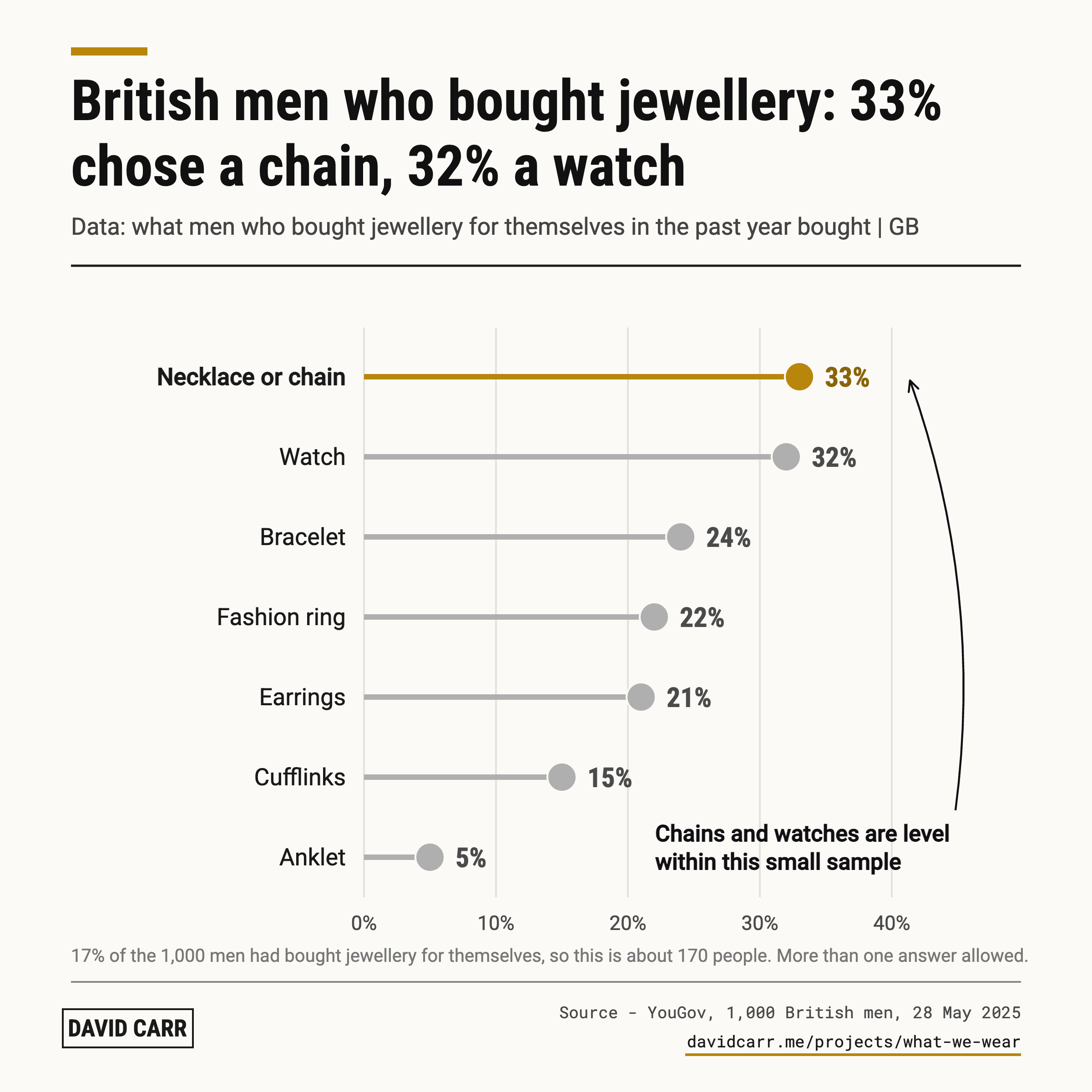
British men who bought jewellery: 33% chose a chain, 32% a watch
- Necklace or chain: 33%
- Watch: 32%
- Bracelet: 24%
- Fashion ring: 22%
- Earrings: 21%
17% of British men bought jewellery for themselves in the past year, and 24% of Gen Z men. Almost half (47%) bought mostly online. Jewellery overall is a big business: Pandora alone sold more than three pieces a second in 2025, on revenue of DKK 32.5bn (Pandora).
YouGov, 1,000 British men, 28 May 2025. The item shares are of the roughly 170 men who had bought, so they are rough.
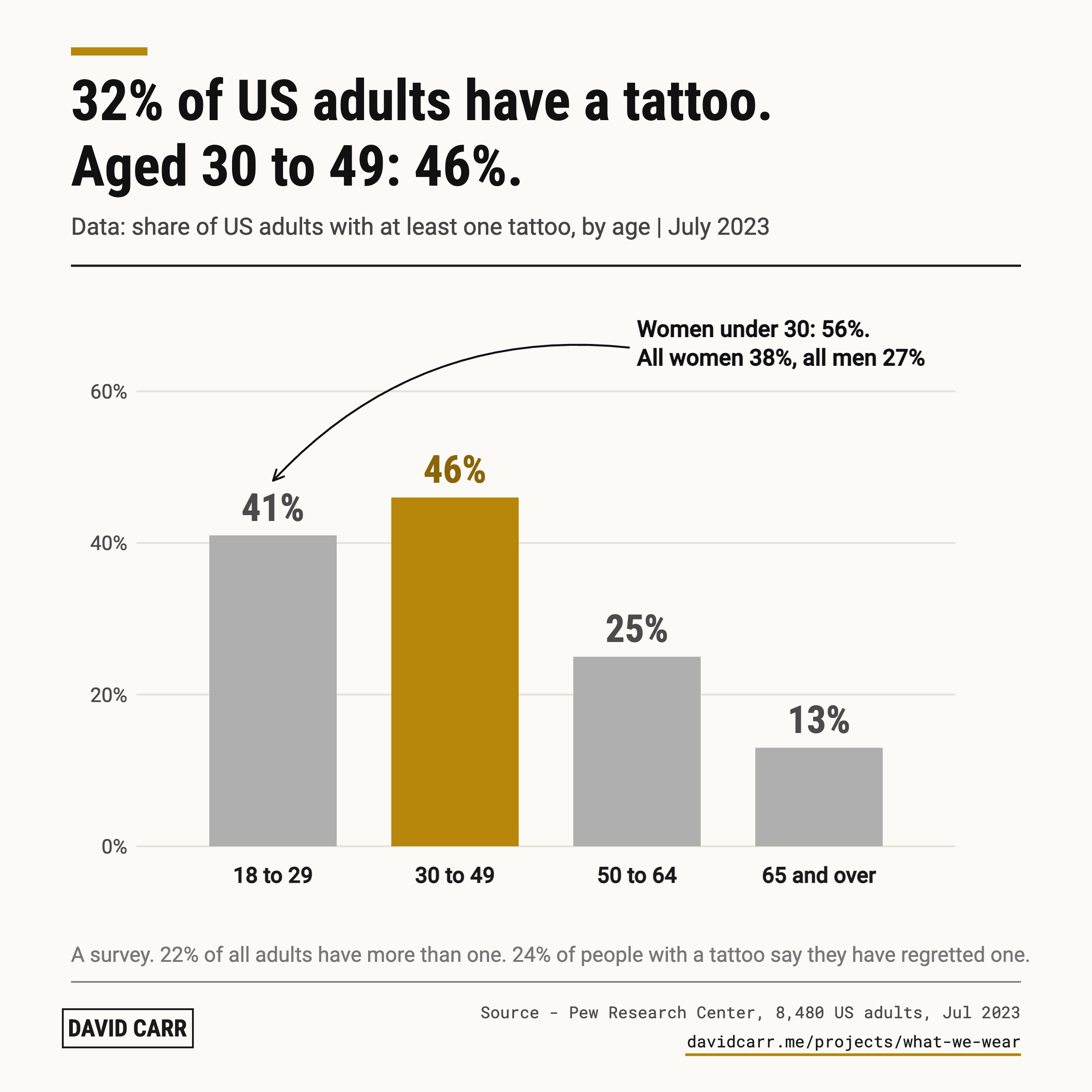
32% of US adults have a tattoo. Aged 30 to 49: 46%.
- 18 to 29: 41%
- 30 to 49: 46%
- 50 to 64: 25%
- 65 and over: 13%
- Women 38%, men 27%
The most permanent thing people wear. 22% of US adults have more than one. Among women under 30, 56% have a tattoo. About a quarter of people with one say they have regretted at least one.
Pew Research Center, 8,480 US adults, 10 to 16 July 2023.
Method, caveats and sources
The short answer. Switzerland sends out half as many watches as in 2000, but each is worth five times as much, and watches over CHF 3,000 are now 80% of the value. China makes the volume. Apple shipped more watches than the whole Swiss industry in 2019, and about three in ten UK adults now use a smartwatch. Six in ten people in Ireland wear glasses or contacts, rising steeply from the mid-40s. In the US, lab-grown stones are now in most engagement rings, and a third of adults have a tattoo.
Watch exports. Federation of the Swiss Watch Industry (FH) historical series, by type, by price and by market, downloaded 29 November 2026 from the FH statistics page. They come from Swiss customs data and use export prices, which are well below shop prices. FH publishes 2000 to 2015 in five-year steps, then every year. Values are not adjusted for inflation. World comparisons from FH's World watchmaking industry in 2025.
Surveys. Everything else is a survey of what people say: YouGov (UK and GB, 2025), Pew Research Center (US, 2023 and 2026), the CSO's Healthy Ireland Survey 2025 and The Knot's yearly study of US couples. Each chart names the survey, sample and date. Surveys from different countries ask different questions, so they are not set side by side.
Left out. I could not find recent, free survey data on how many people wear a traditional watch, how many married people wear a wedding ring, or ear piercings by age and sex. Those topics are left out rather than stretched. Smartwatch shipment counts by brand are mostly behind paywalls.
Also: Garmin, Luxury in numbers, Have clothes got cheaper?, Zara, H&M and Primark, Second-hand goes mainstream, From 'yes' to 'I do' and Screen time.